

SUBSCRIBE TO OUR FREE NEWSLETTER
Daily news & progressive opinion—funded by the people, not the corporations—delivered straight to your inbox.
5
#000000
#FFFFFF
To donate by check, phone, or other method, see our More Ways to Give page.
Daily news & progressive opinion—funded by the people, not the corporations—delivered straight to your inbox.
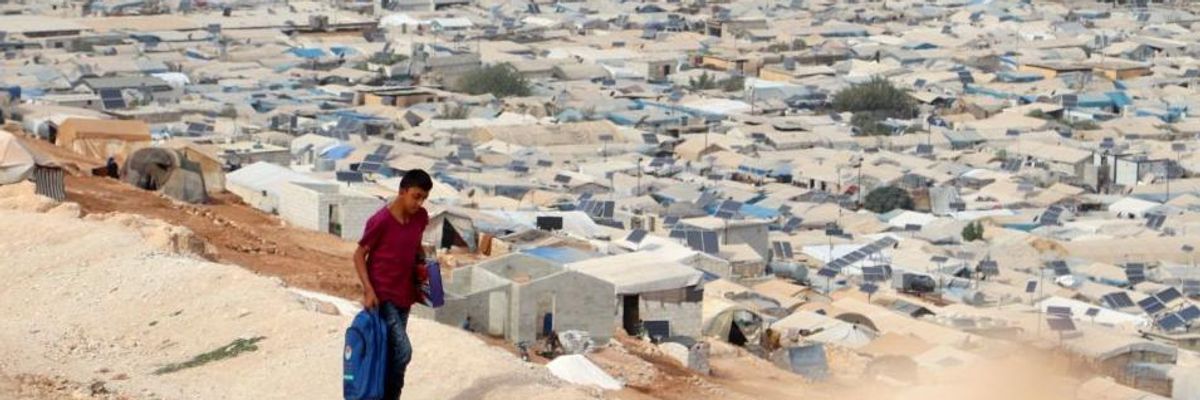
A camp for Syrian refugees near the village of Qah near the Turkish border in the northwestern Idlib province, on October 28, 2020, during the Covid-19 pandemic. Global health campaigners are fighting to ensure that the world's most vulnerable people get adeaquate access to future coronavirus vaccines. (Photo: Ahmad al-Atrash/AFP/Getty Images)
A handful of the world's wealthiest nations on Friday dug in their heels in their fight against waiving intellectual property rules for Covid-19 vaccines and treatments, putting them even more firmly at odds with global health campaigners struggling to ensure access for people in developing countries, conflict zones, and refugee camps.
The United States, European Union, United Kingdom, Canada, and Australia all opposed intellectual property waivers at a Friday meeting of the World Trade Organization (WTO) in Geneva. Such waivers would allow mass production of life-saving advances in a move campaigners say could shorten the peaking pandemic.
"This is a race against time and we cannot allow the pursuit of profit to triumph over human need."
--Heidi Chow, Global Justice Now
Seeking to avoid the type of tragedy the world witnessed a generation ago when hundreds of thousands of people in poor countries died from AIDS because they couldn't afford HIV medications, Kenya on Friday formally asked the WTO to suspend patents for certain Covid-19 treatments.
Last month, India and South Africa were the first countries to propose granting permission to WTO members to temporarily waive patents and other protections on all Covid-19-related vaccines and treatments until the end of the pandemic. Since then, China--which according to Reuters has five Covid-19 vaccine candidates in late-stage trials--has voiced support for the waivers. Dozens of mostly developing nations also back waivers, as do over 100 civil society groups in Europe who have signed an open letter sent to E.U. leaders on Thursday supporting the suspension policy.
Rich countries have come under fire for cornering the supply of future Covid-19 vaccines. In September, wealthy countries with just 13% of the world's population had already purchased rights to more than half of all promised vaccine doses, and last week Common Dreams reported that 82% of doses of Pfizer's forthcoming vaccine had been bought up by rich nations.
Compounding the injustice, say campaigners, is the unprecedented amount of taxpayer funding pharmaceutical companies have received to develop vaccines.
According to the France-based medical charity Medecins Sans Frontieres (MSF), although Pfizer/BioNTech, Moderna, and AstraZeneca/Oxford University have taken a combined $6.68 billion in public funding for their vaccine candidates, the corporations have retained control over key decisions including who gets the vaccines, when they get them, how much they get, and how much they pay.
Consumer advocates have warned that Big Pharma is having it both ways--by taking huge amounts of taxpayer funding to develop treatments that they will then sell back to the public at prodigious profit. Earlier this year, Moderna was accused of "taking taxpayers for a ride" after it announced that it plans to charge between $32 and $37 per dose for a Covid-19 vaccine developed entirely with U.S. government funding.
As the rollout of effective Covid-19 vaccines draws near, calls for a "people's vaccine" grow louder. Responding to news last week that a Pfizer vaccine candidate has been deemed over 90% effective and could soon be available, Heidi Chow, a pharmaceuticals campaigner at the advocacy group Global Justice Now, asserted that the company must "share this vaccine with the world, not hoard it for profit."
"That should mean putting it into the [World Health Organization's] global pool so that the technological know-how and patent rights are shared to enable multiple manufacturers to produce it as fast as possible," said Chow. "[But] since they won't, the [WTO] needs to act to suspend patents on all Covid-19 medicines, as South Africa and India have proposed."
"This is a race against time and we cannot allow the pursuit of profit to triumph over human need," Chow added.
That need is acute in war and conflict zones and camps for refugees and other displaced people. Public health advocates are hard at work lobbying rich countries to commit to reserving a portion of their Covid-19 vaccine stockpiles to form a "humanitarian buffer" to innoculate those who most need help.
In Syria, for example, "there are a lot of internally displaced people who might end up in areas not controlled by the government, or they might be considered to be anti-government or pro-revolution," MSF vaccine pharmacist Alain Alsalhani told the Guardian. "There are also ethnic minorities or others who might be neglected, so typically in India's Chhattisgarh state you have entire villages considered by the government to be pro-Maoist, and they don't have access to any healthcare at all."
Among rich nations, France is seen as a leader in backing the "humanitarian buffer." On Friday, French President Emmanuel Macron delivered a promising speech in which he said he hopes his country, as well as in other E.U. member states, would set aside a significant portion of their Covid-19 vaccine stock for medical workers and people "who need it most, in the most fragile countries."
However, France appears to be the exception to the rich country rule of profit before people. Yuanquiong Hu, senior legal and policy officer at MSF, told Reuters that "there is a hierarchical model, and poorer countries are being asked to take the leftovers."
Dear Common Dreams reader, It’s been nearly 30 years since I co-founded Common Dreams with my late wife, Lina Newhouser. We had the radical notion that journalism should serve the public good, not corporate profits. It was clear to us from the outset what it would take to build such a project. No paid advertisements. No corporate sponsors. No millionaire publisher telling us what to think or do. Many people said we wouldn't last a year, but we proved those doubters wrong. Together with a tremendous team of journalists and dedicated staff, we built an independent media outlet free from the constraints of profits and corporate control. Our mission has always been simple: To inform. To inspire. To ignite change for the common good. Building Common Dreams was not easy. Our survival was never guaranteed. When you take on the most powerful forces—Wall Street greed, fossil fuel industry destruction, Big Tech lobbyists, and uber-rich oligarchs who have spent billions upon billions rigging the economy and democracy in their favor—the only bulwark you have is supporters who believe in your work. But here’s the urgent message from me today. It's never been this bad out there. And it's never been this hard to keep us going. At the very moment Common Dreams is most needed, the threats we face are intensifying. We need your support now more than ever. We don't accept corporate advertising and never will. We don't have a paywall because we don't think people should be blocked from critical news based on their ability to pay. Everything we do is funded by the donations of readers like you. When everyone does the little they can afford, we are strong. But if that support retreats or dries up, so do we. Will you donate now to make sure Common Dreams not only survives but thrives? —Craig Brown, Co-founder |
A handful of the world's wealthiest nations on Friday dug in their heels in their fight against waiving intellectual property rules for Covid-19 vaccines and treatments, putting them even more firmly at odds with global health campaigners struggling to ensure access for people in developing countries, conflict zones, and refugee camps.
The United States, European Union, United Kingdom, Canada, and Australia all opposed intellectual property waivers at a Friday meeting of the World Trade Organization (WTO) in Geneva. Such waivers would allow mass production of life-saving advances in a move campaigners say could shorten the peaking pandemic.
"This is a race against time and we cannot allow the pursuit of profit to triumph over human need."
--Heidi Chow, Global Justice Now
Seeking to avoid the type of tragedy the world witnessed a generation ago when hundreds of thousands of people in poor countries died from AIDS because they couldn't afford HIV medications, Kenya on Friday formally asked the WTO to suspend patents for certain Covid-19 treatments.
Last month, India and South Africa were the first countries to propose granting permission to WTO members to temporarily waive patents and other protections on all Covid-19-related vaccines and treatments until the end of the pandemic. Since then, China--which according to Reuters has five Covid-19 vaccine candidates in late-stage trials--has voiced support for the waivers. Dozens of mostly developing nations also back waivers, as do over 100 civil society groups in Europe who have signed an open letter sent to E.U. leaders on Thursday supporting the suspension policy.
Rich countries have come under fire for cornering the supply of future Covid-19 vaccines. In September, wealthy countries with just 13% of the world's population had already purchased rights to more than half of all promised vaccine doses, and last week Common Dreams reported that 82% of doses of Pfizer's forthcoming vaccine had been bought up by rich nations.
Compounding the injustice, say campaigners, is the unprecedented amount of taxpayer funding pharmaceutical companies have received to develop vaccines.
According to the France-based medical charity Medecins Sans Frontieres (MSF), although Pfizer/BioNTech, Moderna, and AstraZeneca/Oxford University have taken a combined $6.68 billion in public funding for their vaccine candidates, the corporations have retained control over key decisions including who gets the vaccines, when they get them, how much they get, and how much they pay.
Consumer advocates have warned that Big Pharma is having it both ways--by taking huge amounts of taxpayer funding to develop treatments that they will then sell back to the public at prodigious profit. Earlier this year, Moderna was accused of "taking taxpayers for a ride" after it announced that it plans to charge between $32 and $37 per dose for a Covid-19 vaccine developed entirely with U.S. government funding.
As the rollout of effective Covid-19 vaccines draws near, calls for a "people's vaccine" grow louder. Responding to news last week that a Pfizer vaccine candidate has been deemed over 90% effective and could soon be available, Heidi Chow, a pharmaceuticals campaigner at the advocacy group Global Justice Now, asserted that the company must "share this vaccine with the world, not hoard it for profit."
"That should mean putting it into the [World Health Organization's] global pool so that the technological know-how and patent rights are shared to enable multiple manufacturers to produce it as fast as possible," said Chow. "[But] since they won't, the [WTO] needs to act to suspend patents on all Covid-19 medicines, as South Africa and India have proposed."
"This is a race against time and we cannot allow the pursuit of profit to triumph over human need," Chow added.
That need is acute in war and conflict zones and camps for refugees and other displaced people. Public health advocates are hard at work lobbying rich countries to commit to reserving a portion of their Covid-19 vaccine stockpiles to form a "humanitarian buffer" to innoculate those who most need help.
In Syria, for example, "there are a lot of internally displaced people who might end up in areas not controlled by the government, or they might be considered to be anti-government or pro-revolution," MSF vaccine pharmacist Alain Alsalhani told the Guardian. "There are also ethnic minorities or others who might be neglected, so typically in India's Chhattisgarh state you have entire villages considered by the government to be pro-Maoist, and they don't have access to any healthcare at all."
Among rich nations, France is seen as a leader in backing the "humanitarian buffer." On Friday, French President Emmanuel Macron delivered a promising speech in which he said he hopes his country, as well as in other E.U. member states, would set aside a significant portion of their Covid-19 vaccine stock for medical workers and people "who need it most, in the most fragile countries."
However, France appears to be the exception to the rich country rule of profit before people. Yuanquiong Hu, senior legal and policy officer at MSF, told Reuters that "there is a hierarchical model, and poorer countries are being asked to take the leftovers."
A handful of the world's wealthiest nations on Friday dug in their heels in their fight against waiving intellectual property rules for Covid-19 vaccines and treatments, putting them even more firmly at odds with global health campaigners struggling to ensure access for people in developing countries, conflict zones, and refugee camps.
The United States, European Union, United Kingdom, Canada, and Australia all opposed intellectual property waivers at a Friday meeting of the World Trade Organization (WTO) in Geneva. Such waivers would allow mass production of life-saving advances in a move campaigners say could shorten the peaking pandemic.
"This is a race against time and we cannot allow the pursuit of profit to triumph over human need."
--Heidi Chow, Global Justice Now
Seeking to avoid the type of tragedy the world witnessed a generation ago when hundreds of thousands of people in poor countries died from AIDS because they couldn't afford HIV medications, Kenya on Friday formally asked the WTO to suspend patents for certain Covid-19 treatments.
Last month, India and South Africa were the first countries to propose granting permission to WTO members to temporarily waive patents and other protections on all Covid-19-related vaccines and treatments until the end of the pandemic. Since then, China--which according to Reuters has five Covid-19 vaccine candidates in late-stage trials--has voiced support for the waivers. Dozens of mostly developing nations also back waivers, as do over 100 civil society groups in Europe who have signed an open letter sent to E.U. leaders on Thursday supporting the suspension policy.
Rich countries have come under fire for cornering the supply of future Covid-19 vaccines. In September, wealthy countries with just 13% of the world's population had already purchased rights to more than half of all promised vaccine doses, and last week Common Dreams reported that 82% of doses of Pfizer's forthcoming vaccine had been bought up by rich nations.
Compounding the injustice, say campaigners, is the unprecedented amount of taxpayer funding pharmaceutical companies have received to develop vaccines.
According to the France-based medical charity Medecins Sans Frontieres (MSF), although Pfizer/BioNTech, Moderna, and AstraZeneca/Oxford University have taken a combined $6.68 billion in public funding for their vaccine candidates, the corporations have retained control over key decisions including who gets the vaccines, when they get them, how much they get, and how much they pay.
Consumer advocates have warned that Big Pharma is having it both ways--by taking huge amounts of taxpayer funding to develop treatments that they will then sell back to the public at prodigious profit. Earlier this year, Moderna was accused of "taking taxpayers for a ride" after it announced that it plans to charge between $32 and $37 per dose for a Covid-19 vaccine developed entirely with U.S. government funding.
As the rollout of effective Covid-19 vaccines draws near, calls for a "people's vaccine" grow louder. Responding to news last week that a Pfizer vaccine candidate has been deemed over 90% effective and could soon be available, Heidi Chow, a pharmaceuticals campaigner at the advocacy group Global Justice Now, asserted that the company must "share this vaccine with the world, not hoard it for profit."
"That should mean putting it into the [World Health Organization's] global pool so that the technological know-how and patent rights are shared to enable multiple manufacturers to produce it as fast as possible," said Chow. "[But] since they won't, the [WTO] needs to act to suspend patents on all Covid-19 medicines, as South Africa and India have proposed."
"This is a race against time and we cannot allow the pursuit of profit to triumph over human need," Chow added.
That need is acute in war and conflict zones and camps for refugees and other displaced people. Public health advocates are hard at work lobbying rich countries to commit to reserving a portion of their Covid-19 vaccine stockpiles to form a "humanitarian buffer" to innoculate those who most need help.
In Syria, for example, "there are a lot of internally displaced people who might end up in areas not controlled by the government, or they might be considered to be anti-government or pro-revolution," MSF vaccine pharmacist Alain Alsalhani told the Guardian. "There are also ethnic minorities or others who might be neglected, so typically in India's Chhattisgarh state you have entire villages considered by the government to be pro-Maoist, and they don't have access to any healthcare at all."
Among rich nations, France is seen as a leader in backing the "humanitarian buffer." On Friday, French President Emmanuel Macron delivered a promising speech in which he said he hopes his country, as well as in other E.U. member states, would set aside a significant portion of their Covid-19 vaccine stock for medical workers and people "who need it most, in the most fragile countries."
However, France appears to be the exception to the rich country rule of profit before people. Yuanquiong Hu, senior legal and policy officer at MSF, told Reuters that "there is a hierarchical model, and poorer countries are being asked to take the leftovers."

