

SUBSCRIBE TO OUR FREE NEWSLETTER
Daily news & progressive opinion—funded by the people, not the corporations—delivered straight to your inbox.
5
#000000
#FFFFFF
To donate by check, phone, or other method, see our More Ways to Give page.
Daily news & progressive opinion—funded by the people, not the corporations—delivered straight to your inbox.
Mandy Wimmer,
Communications Associate, 202-822-8200 x110,
mwimmer@vpc.org
U.S. court records from southwestern states clearly show that illegal gun traffickers involved in smuggling firearms to Mexico seek semiautomatic assault weapons, armor-piercing handguns, and 50 caliber anti-armor sniper rifles from U.S. gun shops according to a new report released today by the Violence Policy Center (VPC). For its investigation, the VPC obtained records filed in 21 federal firearms smuggling prosecutions in Arizona, California, Nevada, and Texas between February 2006 and February 2009. For a copy of the VPC investigation, "Indicted: Types of Firearms and Methods of Gun Trafficking from the United States to Mexico as Revealed in U.S. Court Documents," please see https://www.vpc.org/studies/indicted.pdf.
"The documents we examined make absolutely clear that Mexican gun traffickers are seeking out military-style weapons easily obtained on the U.S. civilian gun market," said VPC Legislative Director Kristen Rand, the study's author. "Many of these guns are imported assault rifles and armor-piercing handguns, underscoring the urgent need for the Obama administration to use its executive powers to strictly enforce existing restrictions on the import of such non-sporting weapons and then begin working with Congress to enact an effective federal assault weapons ban."
In addition to detailed analysis of the more than 500 firearms listed in the smuggling cases reviewed, the report contains excerpts from records that detail the methods by which traffickers exploit weak federal laws in the U.S. to buy guns for Mexican criminals. Among other findings in the report:
o Traffickers seek out semiautomatic assault weapons (42 percent of guns named), armor-piercing handguns (18 percent), and 50 caliber anti-armor sniper rifles (two percent).
o More than 90 percent of the 226 rifles named could be identified as semiautomatic assault rifles, primarily AK-47 and AR-15 variants.
o More than one-third of the guns obtained by traffickers were made by foreign manufacturers.
o At least 70,000 rounds of ammunition were directly involved in the cases.
Rand stated that the federal court records thoroughly refute National Rifle Association Executive Vice President Wayne LaPierre's recent false claim that the Mexican cartels do not "trifle with paperwork at U.S. gun stores."
"The NRA has received a free ride with its undocumented assertions," Rand said. "Now, for the first time, the American people can see detailed information on the types of military-style firearms illegal traffickers are buying in the United States and shipping to Mexican criminals. This is merely a snapshot of the kind of detailed information about tens of thousands of smuggled guns that the federal Bureau of Alcohol, Tobacco, Firearms, and Explosives has in its files but no longer releases to the public or our elected representatives on Capitol Hill."
The Violence Policy Center (VPC) works to stop gun death and injury through research, education, advocacy, and collaboration. Founded in 1988 by Executive Director Josh Sugarmann, a native of Newtown, Connecticut, the VPC informs the public about the impact of gun violence on their daily lives, exposes the profit-driven marketing and lobbying activities of the firearms industry and gun lobby, offers unique technical expertise to policymakers, organizations, and advocates on the federal, state, and local levels, and works for policy changes that save lives. The VPC has a long and proven record of policy successes on the federal, state, and local levels, leading the National Rifle Association to acknowledge us as "the most effective ... anti-gun rabble-rouser in Washington."
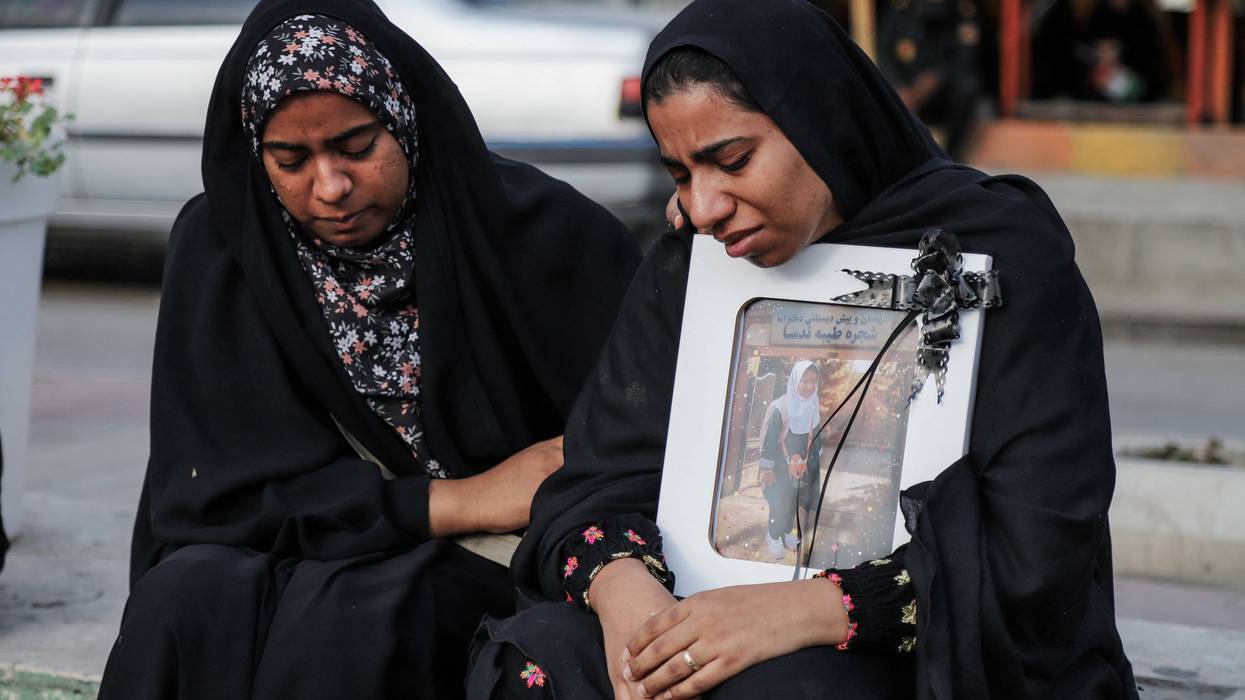
With more than 1,700 civilians, including hundreds of children, reportedly killed during US-Israeli bombarding of Iran, one advocacy group said that "more pressure and oversight on these war crimes is urgently needed."
While claiming that the subject of civilian casualties is his “passion” before US lawmakers during a US Senate hearing on Thursday, the head of US Central Command was asked directly if he and his team had investigated a litany of reports about civilians being killed or maimed by US bombs in Iran. His answer? No.
Commander Adm. Brad Cooper appeared before the Senate Armed Services Committee for a hearing on US Central Command (CENTCOM) and US Africa Command (AFRICOM) concerning the Trump administration's request for $1.5 trillion in military spending authorization for 2027.
During the questioning, Cooper refuted reports that US-Israeli airstrikes have hit 22 schools in Iran and raised eyebrows for his answers regarding cuts to Pentagon programs meant to mitigate harm to noncombatants.
Sen. Kirsten Gillibrand (D-NY)—who last month led the introduction of a defeated war powers resolution aimed at stopping President Donald Trump's "reckless" attack on Iran—pressed Cooper about US conduct in the war. She cited New York Times reporting that 22 schools and 17 healthcare facilities have been destroyed or damaged since Trump and Israeli Prime Minister Benjamin Netanyahu launched the illegal war of choice on February 28.
"We have regulations. We have the law of war. We have human rights obligations. We have our own targeting requirements to avoid civilian harm and death," Gillibrand said. "Have you been implementing all the laws that are required under current law to minimize civilian death?"
.@SenGillibrand presses CENTCOM Commander Cooper on the bombing of schools and hospitals in Iran.
Cooper’s response is woefully insufficient, denying that more than one such bombing took place, despite widespread documentation of bombings destroying protected civilian sites. pic.twitter.com/8gy6Zx6eg2
— NIAC (@NIACouncil) May 14, 2026
"We follow all the procedures and have gone above and beyond to, in my case, personally warn the Iranian people of several instances during conflict where they were being potentially used as human targets," the admiral said.
Asked by Gillibrand "how did we then bomb 22 schools," Cooper countered that "there is no indication that we have that has been corroborated."
The Iranian Red Crescent Society claimed last month that at least 60 students and 10 staff members were killed in US-Israeli attacks on 32 universities and 857 schools.
Pressed by the senator on "how many schools" the US has bombed, Cooper retorted that "there is one active civilian casualty investigation from the 13,629 munitions" used to attack Iran.
The admiral was presumably referring to the February 28 cruise missile strike on the Shajareh Tayyebeh girls’ elementary school in Minab, which killed 156 students and staff and wounded 95 others. Trump and senior administration officials initially denied responsibility for the massacre, but physical evidence, journalistic investigations, and a preliminary Pentagon probe indicate US culpability.
A skeptical Gillibrand repeated her question about 22 schools "and multiple hospitals" being bombed.
"There's no way that we can corroborate that," Cooper replied. "No indication of that whatsoever."
The senator asked for clarification: "There's no way you can corroborate, or no indication of it? Which one?"
Cooper answered, "No indication."
"Well, the indication is what's publicly available," Gillibrand fired back. "There is indication. Have you investigated those claims?"
The admiral replied, "We have not."
Gillibrand continued: "Why have you not? If this is a passion of yours, if you believe that the civilian casualties are not consistent with the law of war and not consistent with human rights obligations... why have you not investigated those allegations when they're publicly being made on the cover of The New York Times?"
The senator then asked how Cooper has "managed the 90% cut to the personnel who are supposed to avoid civilian targets," a reference to Defense Secretary Pete Hegseth's gutting of the Biden-era Civilian Harm Mitigation and Response Action Plan (CHMR-AP), which laid out a series of policy steps aimed at preventing and responding to the death and injury of noncombatants.
The plan, which was implemented after US forces killed an estimated 432,000 civilians since late 2001 during the so-called War on Terror, was skeptically welcomed for its commitment to reducing harm to noncombatants. However, Hegseth said at the outset of the Iran War that US forces would not be bound by “stupid rules of engagement" and would instead prioritize “lethality."
The Pentagon eliminated the entire civilian harm office at Joint Special Operations Command, removed related specialists from target development teams, and slashed CENTCOM's civilian harm mitigation team from 10 people to just one full-time staffer.
Cooper told Gillibrand that he would be "happy to provide any report" on the matter.
Iranian officials and human rights groups say more than 1,700 Iranian civilians have been killed by US and Israeli attacks since February 28. US and Israeli use of artificial intelligence systems to select bombing targets exponentially faster than any person has also raised concerns regarding a lack of meaningful human oversight. One former IDF officer said AI enabled a “mass assassination factory” in Gaza, where more than 250,000 Palestinians have been killed or wounded by Israeli attacks since the Hamas-led attack of October 7, 2023.
The National Iranian American Council (NIAC) said after the exchange with Gillibrand that "Cooper’s response is woefully insufficient, denying that more than one such bombing took place, despite widespread documentation of bombings destroying protected civilian sites."
"More than 1,700 civilians, including hundreds of children, were killed in the bombardment of Iran," NIAC added. "Dozens of schools and hospitals were damaged and destroyed by the dropping of massive bombs in urban areas. More pressure and oversight on these war crimes is urgently needed."
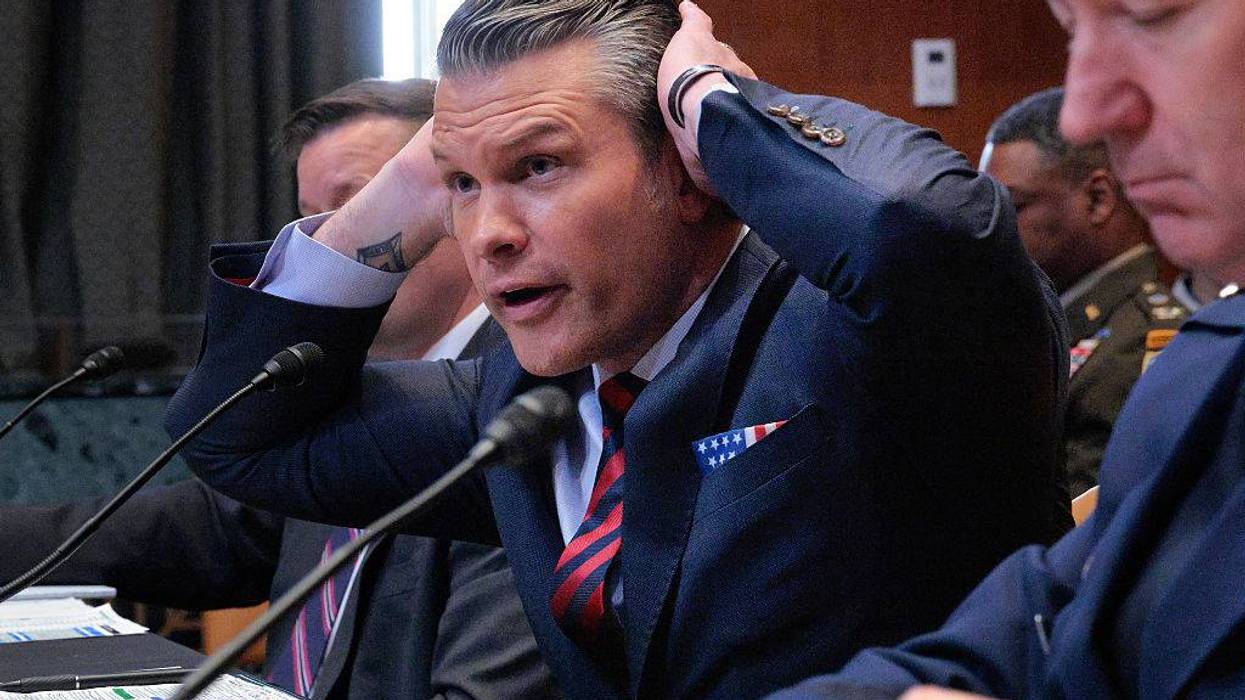
"What we're seeing is the public experience how more spending does not actually keep them safe," said a researcher at Brown University's Costs of War Project.
US Defense Secretary Pete Hegseth on Thursday released yet another ad pitching President Donald Trump's proposed $1.5 trillion Pentagon budget, as new polling showed major skepticism over the idea.
In his latest pitch for the record-breaking defense budget, the former Fox News host insists that "America is not in decline," even though the US has been unable to compel Iran to reopen the Strait of Hormuz despite having spent nearly $1 trillion on defense in 2025.
"We remain the strongest military power on Earth," Hegseth continued. "But that power requires renewal. And with global threats that are constantly evolving, it's time to make a $1.5 trillion investment."
The $1.5 trillion investment is a GENERATIONAL DOWN PAYMENT on America’s national defense.
This investment guarantees the United States maintains overwhelming strength and unmatched deterrence against any adversary for generations to come. pic.twitter.com/2zOSlZkzNr
— Secretary of War Pete Hegseth (@SecWar) May 14, 2026
A $1.5 trillion military budget would be over 50% more than the 2025 US defense budget and more than four times the money spent on defense by China, the world’s second-biggest defense spender.
Among other things, Hegseth said that the budget would invest $18 billion into Trump's proposed "Golden Dome" missile defense shield, which the Congressional Budget Office on Tuesday estimated would cost $1.2 trillion to create, deploy, and operate over the first 20 years of its existence.
Hegseth also said that the Pentagon would be increasing its investment in artificial intelligence by "800%," although it's not at the moment clear how well AI helps militaries effectively fight wars.
The defense secretary concluded his video by insisting that "we are expanding our strength, we are restoring our deterrence, and we are putting America first."
USA Today reported on Thursday that a new poll conducted by ReThink Media and the Costs of War Project at Brown University finds that nearly 60% of Americans think the proposed Trump Pentagon budget is too large, including 40% who say $1.5 trillion is "much too high" to spend on defense.
Breaking the figures down by party, 87% of Democrats said the defense budget was too high, along with 54% of independents, and even 30% of Republicans.
Jennifer Greenburg, a researcher with Brown's Costs of War Project, told USA Today that Americans were broadly skeptical that plunging more taxpayer money into the Pentagon is really necessary given that the US already doles out more for defense than the next four biggest spenders—China, Russia, Germany, and India—combined.
"In real time, I think what we're seeing," said Greenberg, "is the public experience how more spending does not actually keep them safe."
In a column published by The New York Times on Wednesday, longtime national security reporter Noah Shachtman argued that Hegseth's $1.5 trillion proposal was "less like a budget and more like a trip to an endless casino buffet" in which the Pentagon spends money in "gut-busting proportions."
Shachtman also noted that the proposed $1.5 trillion defense budget comes at a time when the Trump administration has wrecked traditional oversight mechanisms, thus making waste and fraud far more likely at a Pentagon that's never passed an audit.
"One of their early actions was to fire and replace the Pentagon’s inspector general, whose office looks into claims of fraud and abuse in military contracting," Shachtman explained. "The independent office that tests whether our weapons actually work has been gutted."
Ben Freeman, director of the Democratizing Foreign Policy program at the Quincy Institute for Responsible Statecraft, argued in an analysis published on Tuesday that Hegseth's budget pitch at congressional hearings this week was particularly baffling because there is really no imperative behind it on par with the Cold War or the post-9/11 defense buildup.
"Despite presenting no strategic necessity for the largest year-over-year Pentagon spending increase since World War II," Freeman wrote, "Hegseth repeatedly claimed the $1.5 trillion Pentagon budget was a sound financial decision, arguing in the Senate hearing that 'at every level we have made it a fiscally responsible budget.' Yet, the fact is that the entirety of this proposed increase in Pentagon spending would be deficit financed, effectively going on Uncle Sam’s credit card."
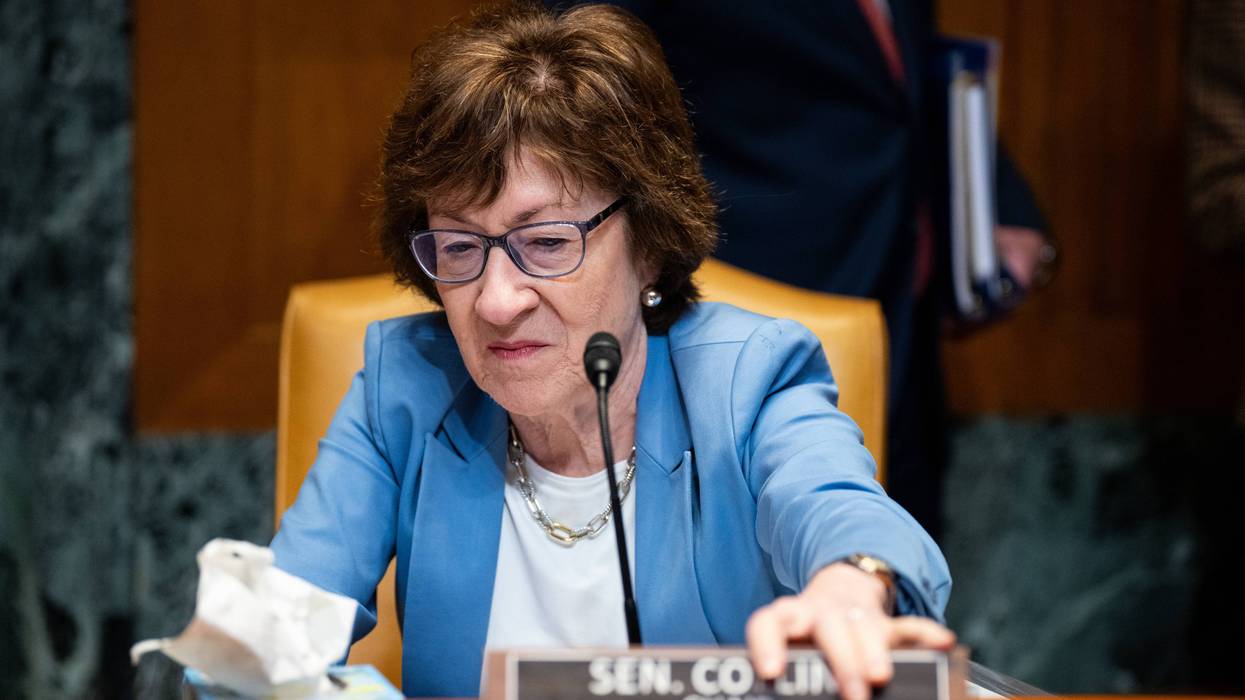
"Susan Collins cares far more about protecting bank executives’ millions than protecting the rest of us from BS overdraft fees," said Platner's campaign manager.
Graham Platner's campaign is accusing Sen. Susan Collins of siding with banking interests after she joined Senate Republicans in blocking a Democratic measure to protect consumers from unexpected overdraft fees.
On Wednesday, the GOP voted largely along party lines against a set of Democratic resolutions aiming to restore Consumer Financial Protection Bureau (CFPB) policies killed by the Trump administration.
In what its acting director, Russell Vought, has described as an effort to effectively dismantle the bureau, which has been credited with delivering more than $21 billion in consumer relief since its creation, he has rescinded 67 policies that protected Americans from junk fees, medical debt, lending discrimination, and other financial abuses.
One resolution voted down Wednesday would have restored a scrapped CFPB guidance against debt collectors hounding consumers over false or inflated medical debts. Another would have reaffirmed that the bureau can scrutinize financial companies for predatory credit practices aimed at military families.
These Democratic resolutions were not expected to pass in a Republican-controlled Senate, but were instead meant to force Republicans to put themselves on the record as standing against consumer interests.
As President Donald Trump takes a beating from voters on the economy, the votes will serve as ammunition as Democrats run with the message that the GOP has "abandoned consumers and is making life more expensive for them," as the CFPB's architect, Sen. Elizabeth Warren (D-Mass), said on Wednesday.
Platner is already deploying that ammunition in one of November's marquee races, hammering Collins (R-Maine) for voting with the GOP against restoring a guidance enacted by the Biden administration that required banks to obtain customers' consent before charging overdraft fees for ATM and one-time debit card transactions.
"Last night, Susan Collins voted once again to make it easier for big banks to hit Maine families with predatory overdraft fees," his campaign said in an email on Thursday. "Her vote to block even a debate on restoring basic consumer protections was just the latest reminder of where Collins' real loyalties lie."
"There is no legitimate policy rationale for voting against basic consumer protections on overdraft fees,” said Platner's campaign manager, Ben Chin. “But Susan Collins cares far more about protecting bank executives’ millions than protecting the rest of us from BS overdraft fees. This vote is yet another example of this deeply unfortunate reality.”
According to data from OpenSecrets, Collins has received nearly $1.8 million this cycle in contributions from the financial sector, including more than $570,000 from private equity and investment firms, which the Platner campaign said were "among the most predatory actors in the American economy."
She's also received more than $44,000 from commercial banks and holding companies that have a particular interest in her stance on overdraft fees.
The Pine Tree Results PAC, which has thrown about $12.7 million behind Collins, likewise got nearly a third of its funding from figures in the financial sector, particularly in private equity and hedge funds with a broader interest in neutering the CFPB.