SUBSCRIBE TO OUR FREE NEWSLETTER
Daily news & progressive opinion—funded by the people, not the corporations—delivered straight to your inbox.
5
#000000
#FFFFFF
To donate by check, phone, or other method, see our More Ways to Give page.
Daily news & progressive opinion—funded by the people, not the corporations—delivered straight to your inbox.
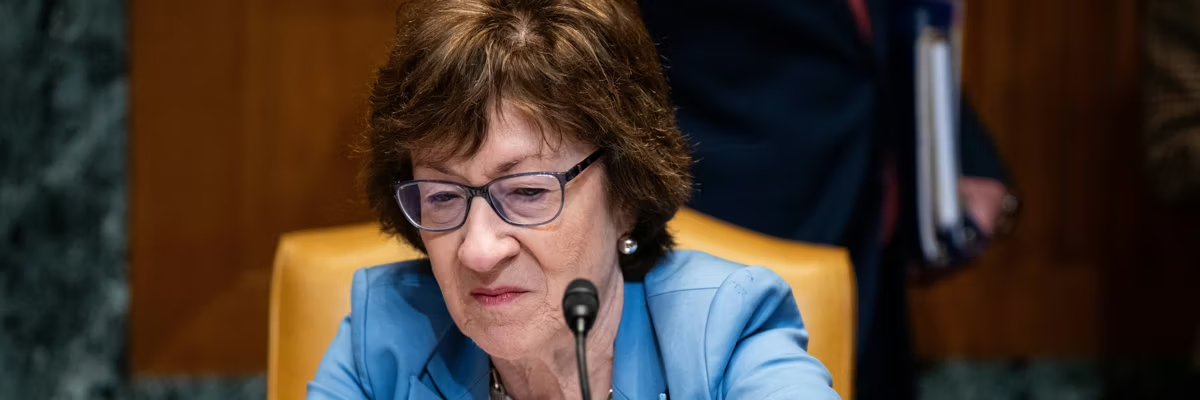
Sen. Susan Collin (R-Maine) attends a Senate Appropriations Subcommittee on Transportation, Housing and Urban Development, and Related Agencies hearing on May 14, 2026.
"Susan Collins cares far more about protecting bank executives’ millions than protecting the rest of us from BS overdraft fees," said Platner's campaign manager.
Graham Platner's campaign is accusing Sen. Susan Collins of siding with banking interests after she joined Senate Republicans in blocking a Democratic measure to protect consumers from unexpected overdraft fees.
On Wednesday, the GOP voted largely along party lines against a set of Democratic resolutions aiming to restore Consumer Financial Protection Bureau (CFPB) policies killed by the Trump administration.
In what its acting director, Russell Vought, has described as an effort to effectively dismantle the bureau, which has been credited with delivering more than $21 billion in consumer relief since its creation, he has rescinded 67 policies that protected Americans from junk fees, medical debt, lending discrimination, and other financial abuses.
One resolution voted down Wednesday would have restored a scrapped CFPB guidance against debt collectors hounding consumers over false or inflated medical debts. Another would have reaffirmed that the bureau can scrutinize financial companies for predatory credit practices aimed at military families.
These Democratic resolutions were not expected to pass in a Republican-controlled Senate, but were instead meant to force Republicans to put themselves on the record as standing against consumer interests.
As President Donald Trump takes a beating from voters on the economy, the votes will serve as ammunition as Democrats run with the message that the GOP has "abandoned consumers and is making life more expensive for them," as the CFPB's architect, Sen. Elizabeth Warren (D-Mass), said on Wednesday.
Platner is already deploying that ammunition in one of November's marquee races, hammering Collins (R-Maine) for voting with the GOP against restoring a guidance enacted by the Biden administration that required banks to obtain customers' consent before charging overdraft fees for ATM and one-time debit card transactions.
"Last night, Susan Collins voted once again to make it easier for big banks to hit Maine families with predatory overdraft fees," his campaign said in an email on Thursday. "Her vote to block even a debate on restoring basic consumer protections was just the latest reminder of where Collins' real loyalties lie."
"There is no legitimate policy rationale for voting against basic consumer protections on overdraft fees,” said Platner's campaign manager, Ben Chin. “But Susan Collins cares far more about protecting bank executives’ millions than protecting the rest of us from BS overdraft fees. This vote is yet another example of this deeply unfortunate reality.”
According to data from OpenSecrets, Collins has received nearly $1.8 million this cycle in contributions from the financial sector, including more than $570,000 from private equity and investment firms, which the Platner campaign said were "among the most predatory actors in the American economy."
She's also received more than $44,000 from commercial banks and holding companies that have a particular interest in her stance on overdraft fees.
The Pine Tree Results PAC, which has thrown about $12.7 million behind Collins, likewise got nearly a third of its funding from figures in the financial sector, particularly in private equity and hedge funds with a broader interest in neutering the CFPB.
Dear Common Dreams reader, It’s been nearly 30 years since I co-founded Common Dreams with my late wife, Lina Newhouser. We had the radical notion that journalism should serve the public good, not corporate profits. It was clear to us from the outset what it would take to build such a project. No paid advertisements. No corporate sponsors. No millionaire publisher telling us what to think or do. Many people said we wouldn't last a year, but we proved those doubters wrong. Together with a tremendous team of journalists and dedicated staff, we built an independent media outlet free from the constraints of profits and corporate control. Our mission has always been simple: To inform. To inspire. To ignite change for the common good. Building Common Dreams was not easy. Our survival was never guaranteed. When you take on the most powerful forces—Wall Street greed, fossil fuel industry destruction, Big Tech lobbyists, and uber-rich oligarchs who have spent billions upon billions rigging the economy and democracy in their favor—the only bulwark you have is supporters who believe in your work. But here’s the urgent message from me today. It's never been this bad out there. And it's never been this hard to keep us going. At the very moment Common Dreams is most needed, the threats we face are intensifying. We need your support now more than ever. We don't accept corporate advertising and never will. We don't have a paywall because we don't think people should be blocked from critical news based on their ability to pay. Everything we do is funded by the donations of readers like you. When everyone does the little they can afford, we are strong. But if that support retreats or dries up, so do we. Will you donate now to make sure Common Dreams not only survives but thrives? —Craig Brown, Co-founder |
Graham Platner's campaign is accusing Sen. Susan Collins of siding with banking interests after she joined Senate Republicans in blocking a Democratic measure to protect consumers from unexpected overdraft fees.
On Wednesday, the GOP voted largely along party lines against a set of Democratic resolutions aiming to restore Consumer Financial Protection Bureau (CFPB) policies killed by the Trump administration.
In what its acting director, Russell Vought, has described as an effort to effectively dismantle the bureau, which has been credited with delivering more than $21 billion in consumer relief since its creation, he has rescinded 67 policies that protected Americans from junk fees, medical debt, lending discrimination, and other financial abuses.
One resolution voted down Wednesday would have restored a scrapped CFPB guidance against debt collectors hounding consumers over false or inflated medical debts. Another would have reaffirmed that the bureau can scrutinize financial companies for predatory credit practices aimed at military families.
These Democratic resolutions were not expected to pass in a Republican-controlled Senate, but were instead meant to force Republicans to put themselves on the record as standing against consumer interests.
As President Donald Trump takes a beating from voters on the economy, the votes will serve as ammunition as Democrats run with the message that the GOP has "abandoned consumers and is making life more expensive for them," as the CFPB's architect, Sen. Elizabeth Warren (D-Mass), said on Wednesday.
Platner is already deploying that ammunition in one of November's marquee races, hammering Collins (R-Maine) for voting with the GOP against restoring a guidance enacted by the Biden administration that required banks to obtain customers' consent before charging overdraft fees for ATM and one-time debit card transactions.
"Last night, Susan Collins voted once again to make it easier for big banks to hit Maine families with predatory overdraft fees," his campaign said in an email on Thursday. "Her vote to block even a debate on restoring basic consumer protections was just the latest reminder of where Collins' real loyalties lie."
"There is no legitimate policy rationale for voting against basic consumer protections on overdraft fees,” said Platner's campaign manager, Ben Chin. “But Susan Collins cares far more about protecting bank executives’ millions than protecting the rest of us from BS overdraft fees. This vote is yet another example of this deeply unfortunate reality.”
According to data from OpenSecrets, Collins has received nearly $1.8 million this cycle in contributions from the financial sector, including more than $570,000 from private equity and investment firms, which the Platner campaign said were "among the most predatory actors in the American economy."
She's also received more than $44,000 from commercial banks and holding companies that have a particular interest in her stance on overdraft fees.
The Pine Tree Results PAC, which has thrown about $12.7 million behind Collins, likewise got nearly a third of its funding from figures in the financial sector, particularly in private equity and hedge funds with a broader interest in neutering the CFPB.
Graham Platner's campaign is accusing Sen. Susan Collins of siding with banking interests after she joined Senate Republicans in blocking a Democratic measure to protect consumers from unexpected overdraft fees.
On Wednesday, the GOP voted largely along party lines against a set of Democratic resolutions aiming to restore Consumer Financial Protection Bureau (CFPB) policies killed by the Trump administration.
In what its acting director, Russell Vought, has described as an effort to effectively dismantle the bureau, which has been credited with delivering more than $21 billion in consumer relief since its creation, he has rescinded 67 policies that protected Americans from junk fees, medical debt, lending discrimination, and other financial abuses.
One resolution voted down Wednesday would have restored a scrapped CFPB guidance against debt collectors hounding consumers over false or inflated medical debts. Another would have reaffirmed that the bureau can scrutinize financial companies for predatory credit practices aimed at military families.
These Democratic resolutions were not expected to pass in a Republican-controlled Senate, but were instead meant to force Republicans to put themselves on the record as standing against consumer interests.
As President Donald Trump takes a beating from voters on the economy, the votes will serve as ammunition as Democrats run with the message that the GOP has "abandoned consumers and is making life more expensive for them," as the CFPB's architect, Sen. Elizabeth Warren (D-Mass), said on Wednesday.
Platner is already deploying that ammunition in one of November's marquee races, hammering Collins (R-Maine) for voting with the GOP against restoring a guidance enacted by the Biden administration that required banks to obtain customers' consent before charging overdraft fees for ATM and one-time debit card transactions.
"Last night, Susan Collins voted once again to make it easier for big banks to hit Maine families with predatory overdraft fees," his campaign said in an email on Thursday. "Her vote to block even a debate on restoring basic consumer protections was just the latest reminder of where Collins' real loyalties lie."
"There is no legitimate policy rationale for voting against basic consumer protections on overdraft fees,” said Platner's campaign manager, Ben Chin. “But Susan Collins cares far more about protecting bank executives’ millions than protecting the rest of us from BS overdraft fees. This vote is yet another example of this deeply unfortunate reality.”
According to data from OpenSecrets, Collins has received nearly $1.8 million this cycle in contributions from the financial sector, including more than $570,000 from private equity and investment firms, which the Platner campaign said were "among the most predatory actors in the American economy."
She's also received more than $44,000 from commercial banks and holding companies that have a particular interest in her stance on overdraft fees.
The Pine Tree Results PAC, which has thrown about $12.7 million behind Collins, likewise got nearly a third of its funding from figures in the financial sector, particularly in private equity and hedge funds with a broader interest in neutering the CFPB.