SUBSCRIBE TO OUR FREE NEWSLETTER
Daily news & progressive opinion—funded by the people, not the corporations—delivered straight to your inbox.
5
#000000
#FFFFFF
To donate by check, phone, or other method, see our More Ways to Give page.
Daily news & progressive opinion—funded by the people, not the corporations—delivered straight to your inbox.
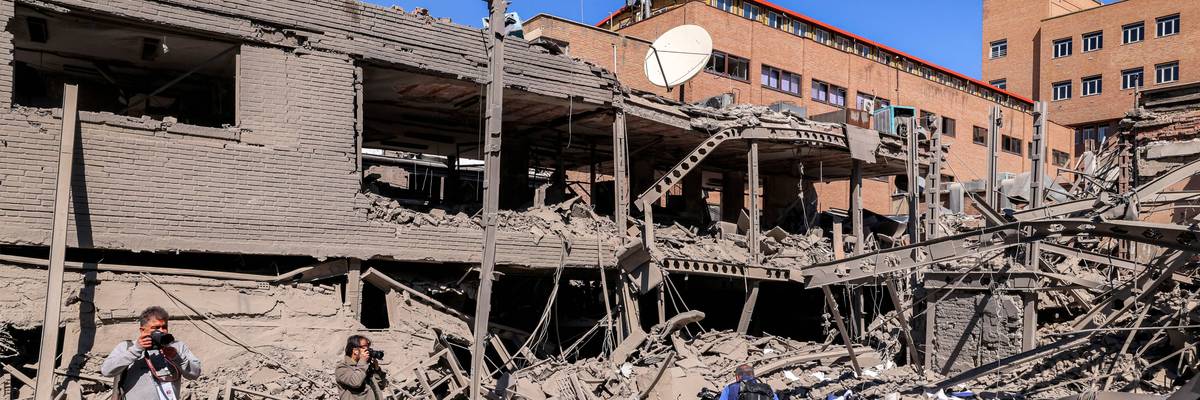
Journalists film at a damaged area following strikes on Sharif University of Technology in Tehran on April 7, 2026.
"The enemy does not want us to succeed or have development and progress, but all our universities are united now by these attacks," said the president of Tehran's prestigious Sharif University of Technology.
At least 60 students and 10 professors have been killed in US-Israeli attacks on universities, according to an Iranian government official, while other university officials report even higher death tolls.
Standing outside the bombed-out ruins of Iran's Aerospace Research Institute, which was targeted twice earlier this month, Minister of Science, Research, and Technology, Hossein Simaei, said on Wednesday that attacks on the facility and other universities were “scientific crimes."
“This was a center where researchers worked on civilian sectors, including biology, agriculture, and surveying,” Simaei said. “Unfortunately, it has fallen victim to the enemy’s brutal attacks.”
The institute was one of at least 32 universities and 857 schools that have been attacked by US and Israeli forces since the US and Israel launched the war at the end of February, according to a report by the Iranian Red Crescent on April 10.
Bijan Ranjbar, the president of the Islamic Azad University system—one of the largest in the world—has confirmed that at least 110 students at his institution have been killed and 21 university branches have been damaged.
On April 6, the Sharif University of Technology in Tehran, which has been described as the "MIT of Iran," was also bombed, severely damaging its High-Performance Computing Center, which serves more than 3,000 artificial intelligence and computer science researchers.
The Pasteur Institute, one of the oldest research and health institutes in Iran, was also hit earlier this month, rendering it "unable to continue delivering health services," according to the World Health Organization.
"The enemy does not want us to succeed or have development and progress, but all our universities are united now by these attacks," said Sharif University president Masoud Tajrishi.
Israel has justified attacking these institutions on the grounds that they are closely linked to the Iranian military, similar to its claim that universities in Gaza are used by Hamas.
But following promises by US President Donald Trump and Defense Secretary Pete Hegseth to bomb Iran "back to the Stone Ages," attacks on civilian infrastructure have gone far beyond those with any discernible military purpose.
The WHO reported on April 8 that since the beginning of the war, at least 23 healthcare institutions were attacked by US and Israeli forces. Attacks have also been reported on several oil and energy facilities.
Though the US and Israel often frame these attacks as inseparable from their objective of weakening Iran militarily, Eskandar Sadeghi-Boroujerdi, an assistant professor of the international relations of the Middle East at the University of St. Andrews, argues that they function as attacks on the whole of Iranian society.
"Whatever role the state played in constructing refineries, pharmaceutical plants, and research institutions, it is Iranian workers, engineers, scientists, and patients who depend on them, who built their careers inside them, and who will suffer most from their destruction," he wrote in Jacobin earlier this week. "Bombing a country’s industrial and scientific base is an act of violence against its people, regardless of what one thinks of its government."
He said: “The systematic killing of scientists and engineers, the destruction of centrifuges and computer networks, the bombing of research universities and pharmaceutical facilities: All of it reflects a coherent strategic objective, which is to erase the embodied knowledge, the accumulated expertise, and the institutional memory that make Iranian technological development possible.”
Dear Common Dreams reader, It’s been nearly 30 years since I co-founded Common Dreams with my late wife, Lina Newhouser. We had the radical notion that journalism should serve the public good, not corporate profits. It was clear to us from the outset what it would take to build such a project. No paid advertisements. No corporate sponsors. No millionaire publisher telling us what to think or do. Many people said we wouldn't last a year, but we proved those doubters wrong. Together with a tremendous team of journalists and dedicated staff, we built an independent media outlet free from the constraints of profits and corporate control. Our mission has always been simple: To inform. To inspire. To ignite change for the common good. Building Common Dreams was not easy. Our survival was never guaranteed. When you take on the most powerful forces—Wall Street greed, fossil fuel industry destruction, Big Tech lobbyists, and uber-rich oligarchs who have spent billions upon billions rigging the economy and democracy in their favor—the only bulwark you have is supporters who believe in your work. But here’s the urgent message from me today. It's never been this bad out there. And it's never been this hard to keep us going. At the very moment Common Dreams is most needed, the threats we face are intensifying. We need your support now more than ever. We don't accept corporate advertising and never will. We don't have a paywall because we don't think people should be blocked from critical news based on their ability to pay. Everything we do is funded by the donations of readers like you. When everyone does the little they can afford, we are strong. But if that support retreats or dries up, so do we. Will you donate now to make sure Common Dreams not only survives but thrives? —Craig Brown, Co-founder |
At least 60 students and 10 professors have been killed in US-Israeli attacks on universities, according to an Iranian government official, while other university officials report even higher death tolls.
Standing outside the bombed-out ruins of Iran's Aerospace Research Institute, which was targeted twice earlier this month, Minister of Science, Research, and Technology, Hossein Simaei, said on Wednesday that attacks on the facility and other universities were “scientific crimes."
“This was a center where researchers worked on civilian sectors, including biology, agriculture, and surveying,” Simaei said. “Unfortunately, it has fallen victim to the enemy’s brutal attacks.”
The institute was one of at least 32 universities and 857 schools that have been attacked by US and Israeli forces since the US and Israel launched the war at the end of February, according to a report by the Iranian Red Crescent on April 10.
Bijan Ranjbar, the president of the Islamic Azad University system—one of the largest in the world—has confirmed that at least 110 students at his institution have been killed and 21 university branches have been damaged.
On April 6, the Sharif University of Technology in Tehran, which has been described as the "MIT of Iran," was also bombed, severely damaging its High-Performance Computing Center, which serves more than 3,000 artificial intelligence and computer science researchers.
The Pasteur Institute, one of the oldest research and health institutes in Iran, was also hit earlier this month, rendering it "unable to continue delivering health services," according to the World Health Organization.
"The enemy does not want us to succeed or have development and progress, but all our universities are united now by these attacks," said Sharif University president Masoud Tajrishi.
Israel has justified attacking these institutions on the grounds that they are closely linked to the Iranian military, similar to its claim that universities in Gaza are used by Hamas.
But following promises by US President Donald Trump and Defense Secretary Pete Hegseth to bomb Iran "back to the Stone Ages," attacks on civilian infrastructure have gone far beyond those with any discernible military purpose.
The WHO reported on April 8 that since the beginning of the war, at least 23 healthcare institutions were attacked by US and Israeli forces. Attacks have also been reported on several oil and energy facilities.
Though the US and Israel often frame these attacks as inseparable from their objective of weakening Iran militarily, Eskandar Sadeghi-Boroujerdi, an assistant professor of the international relations of the Middle East at the University of St. Andrews, argues that they function as attacks on the whole of Iranian society.
"Whatever role the state played in constructing refineries, pharmaceutical plants, and research institutions, it is Iranian workers, engineers, scientists, and patients who depend on them, who built their careers inside them, and who will suffer most from their destruction," he wrote in Jacobin earlier this week. "Bombing a country’s industrial and scientific base is an act of violence against its people, regardless of what one thinks of its government."
He said: “The systematic killing of scientists and engineers, the destruction of centrifuges and computer networks, the bombing of research universities and pharmaceutical facilities: All of it reflects a coherent strategic objective, which is to erase the embodied knowledge, the accumulated expertise, and the institutional memory that make Iranian technological development possible.”
At least 60 students and 10 professors have been killed in US-Israeli attacks on universities, according to an Iranian government official, while other university officials report even higher death tolls.
Standing outside the bombed-out ruins of Iran's Aerospace Research Institute, which was targeted twice earlier this month, Minister of Science, Research, and Technology, Hossein Simaei, said on Wednesday that attacks on the facility and other universities were “scientific crimes."
“This was a center where researchers worked on civilian sectors, including biology, agriculture, and surveying,” Simaei said. “Unfortunately, it has fallen victim to the enemy’s brutal attacks.”
The institute was one of at least 32 universities and 857 schools that have been attacked by US and Israeli forces since the US and Israel launched the war at the end of February, according to a report by the Iranian Red Crescent on April 10.
Bijan Ranjbar, the president of the Islamic Azad University system—one of the largest in the world—has confirmed that at least 110 students at his institution have been killed and 21 university branches have been damaged.
On April 6, the Sharif University of Technology in Tehran, which has been described as the "MIT of Iran," was also bombed, severely damaging its High-Performance Computing Center, which serves more than 3,000 artificial intelligence and computer science researchers.
The Pasteur Institute, one of the oldest research and health institutes in Iran, was also hit earlier this month, rendering it "unable to continue delivering health services," according to the World Health Organization.
"The enemy does not want us to succeed or have development and progress, but all our universities are united now by these attacks," said Sharif University president Masoud Tajrishi.
Israel has justified attacking these institutions on the grounds that they are closely linked to the Iranian military, similar to its claim that universities in Gaza are used by Hamas.
But following promises by US President Donald Trump and Defense Secretary Pete Hegseth to bomb Iran "back to the Stone Ages," attacks on civilian infrastructure have gone far beyond those with any discernible military purpose.
The WHO reported on April 8 that since the beginning of the war, at least 23 healthcare institutions were attacked by US and Israeli forces. Attacks have also been reported on several oil and energy facilities.
Though the US and Israel often frame these attacks as inseparable from their objective of weakening Iran militarily, Eskandar Sadeghi-Boroujerdi, an assistant professor of the international relations of the Middle East at the University of St. Andrews, argues that they function as attacks on the whole of Iranian society.
"Whatever role the state played in constructing refineries, pharmaceutical plants, and research institutions, it is Iranian workers, engineers, scientists, and patients who depend on them, who built their careers inside them, and who will suffer most from their destruction," he wrote in Jacobin earlier this week. "Bombing a country’s industrial and scientific base is an act of violence against its people, regardless of what one thinks of its government."
He said: “The systematic killing of scientists and engineers, the destruction of centrifuges and computer networks, the bombing of research universities and pharmaceutical facilities: All of it reflects a coherent strategic objective, which is to erase the embodied knowledge, the accumulated expertise, and the institutional memory that make Iranian technological development possible.”