
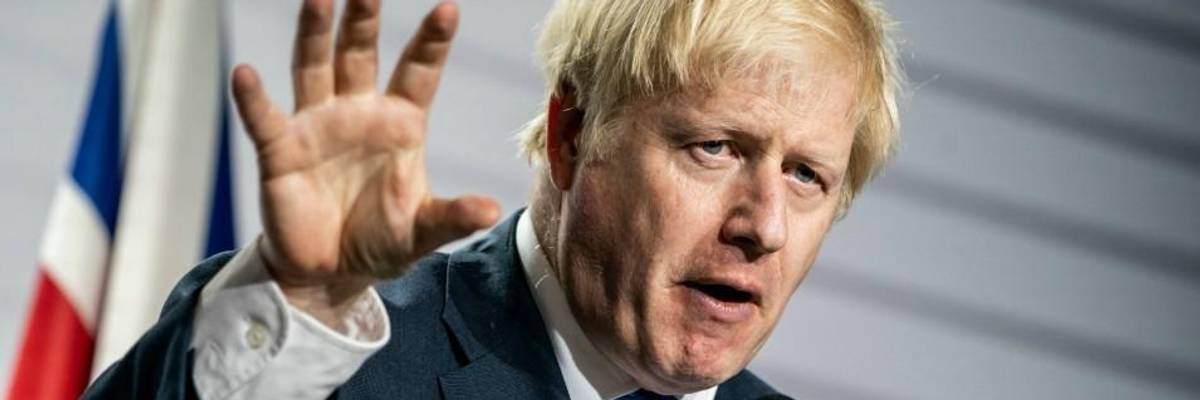
U.K. Prime Minister Boris Johnson will smear lipstick all over this pig of a deal and declare it a triumph. (Photo: Michael Kappeler/Picture Alliance via Getty Images)
The European Union: Free at Last
The goal of 'ever closer union', anathema to English exceptionalists, is back on the agenda.
Blaming the victims is never a good look. As Britain finally leaves the European Union, 1,651 days after the Brexit referendum of 2016, we should try to remember that 48% of the turkeys didn't vote for Christmas.
Brexit was not exactly a national act of self-harm; it was really an attack by the nostalgic and nationalist old on the young. 60% of British over-65s voted to leave the E.U., but 61% of the under-35s voted to remain. Having had four years to think it over, most British now think it was a mistake--by a 48-39 majority, according to a YouGov poll in October.
Too late. Boris Johnson is prime minister and he dares not anger the English ultra-nationalists on the right of his own Conservative party. After months of the amateur dramatics that accompany any Johnson decision, on Christmas Day the United Kingdom concluded a pathetically thin 'free trade' deal that reflects the real balance of power between the E.U. and the U.K.
It looks pretty good for manufactured goods and commodities, which make up 20% of Britain's GDP: no tariffs, no quotas. But the E.U. sells far more stuff to the U.K. than the other way around: it has a $45 billion trade surplus in goods. Of course it made a deal on that.
By contrast there is no trade deal at all in services, which account for 80% of the U.K. economy and used to produce a $112 billion surplus for the U.K. The U.K. is entirely vulnerable to whatever restrictions the E.U. may choose to apply to its banks, insurance companies and providers of other professional services.
Johnson will smear lipstick all over this pig of a deal and declare it a triumph. Those who want to believe it will do so, and the only early evidence of the huge defeat that it really is will be some delays at the ports as customs officers learn their new jobs. The real bill will come in later and almost invisibly, in lost trade, investment and opportunities.
The last official British government estimate was that 15 years from now the British economy will be between 5% and 7% smaller than it would have been as an E.U. member (but still a bit bigger than it is now).
That's not the raw material for a counter-revolution--and besides, any projection about the economic situation in 2035 is really pure guesstimate. One Covid more or less could make just as much difference as Brexit.
All one can say is that the British economy will not "prosper mightily" outside the E.U., as Johnson promised, but it won't collapse either. And then, in due course, the younger, pro-E.U. Brits will become the majority thanks to the magic of generational turnover. But until then, if Britain comes knocking at the E.U.'s door asking to be allowed back in, Brussels should say 'no'.
What really happens on December 31 is that the European Union is finally freed to develop in the way that its other major members clearly want. The goal of 'ever closer union', anathema to English exceptionalists, is back on the agenda.
There is ambivalence in every member country about the idea of creating a semi-federal European super-state, but in a world where democracy and the rule of law are under siege most people can see the need to strengthen the European Union. Last July the E.U.'s leaders took a huge step in that direction: for the first time they agreed to borrow collectively on the financial markets.
France and Germany were all for it, and Italy and Spain needed the money to finance a trillion-euro aid program to help them through the coronavirus crisis. Those four countries now contain more than half the E.U.'s population, and they outvoted the 'frugal four' (the Netherlands, Austria, Sweden and Denmark) that opposed taking on debt to support 'feckless' Mediterranean members.
If Britain had still been a member, it would have vetoed the measure because it infringed on the U.K.'s sacred 'sovereignty'. French President Charles de Gaulle, who vetoed British membership applications twice in the 1960s, was right: England does not have a 'European vocation', and it should not be allowed in.
The financial precedent that was set in July opens the door to a future E.U. that acts much more like a state. Even a common defense budget is now within reach--not something vital in military terms, but a European army would be a hugely important symbol of unity.
The United States may be back soon, but the world could certainly use a second powerful advocate for democracy and the rule of law. Brexit may be giving us just that by freeing the E.U. to move on, and we should be grateful.
We are at a crossroads
This country and this world are at a monumental crossroads. In a few short weeks, US voters will have an opportunity to beat back the forces of fascism and confront the billionaires who are rigging the economy, our media system, and our democracy, making it increasingly impossible for ordinary people to get by. We’re not just talking about the election. We’re talking about what must be done once these fascist elements are vanquished from power. We need a bolder set of solutions than what either major party has so far been willing to offer and a working-class movement ready to fight like hell for it. Trump didn't emerge from nowhere. The conditions that fueled MAGA authoritarianism were created by decades of radical neoliberal economic policies and a corrupt political system dominated by corporate interests. They slashed taxes on the super-rich, promising that the benefits would trickle down. They said giveaways to the corporate titans would make life more affordable for the rest of us. It was all bullshit. And when a bitter, betrayed populace searches for someone to blame, right-wing demagogues have little trouble finding scapegoats. People know when they're being lied to, but you won't hear any of this from the corporate media. Only independent journalism—powered and funded by people who believe in building a better world—can deliver truly trustworthy daily news. Our Fall Campaign is underway, and we need your help. To power our newsroom through the rest of the year, we need to raise $125,000 by midnight on October 31. So if you share our vision, please contribute whatever you can to sustain our work. |
Blaming the victims is never a good look. As Britain finally leaves the European Union, 1,651 days after the Brexit referendum of 2016, we should try to remember that 48% of the turkeys didn't vote for Christmas.
Brexit was not exactly a national act of self-harm; it was really an attack by the nostalgic and nationalist old on the young. 60% of British over-65s voted to leave the E.U., but 61% of the under-35s voted to remain. Having had four years to think it over, most British now think it was a mistake--by a 48-39 majority, according to a YouGov poll in October.
Too late. Boris Johnson is prime minister and he dares not anger the English ultra-nationalists on the right of his own Conservative party. After months of the amateur dramatics that accompany any Johnson decision, on Christmas Day the United Kingdom concluded a pathetically thin 'free trade' deal that reflects the real balance of power between the E.U. and the U.K.
It looks pretty good for manufactured goods and commodities, which make up 20% of Britain's GDP: no tariffs, no quotas. But the E.U. sells far more stuff to the U.K. than the other way around: it has a $45 billion trade surplus in goods. Of course it made a deal on that.
By contrast there is no trade deal at all in services, which account for 80% of the U.K. economy and used to produce a $112 billion surplus for the U.K. The U.K. is entirely vulnerable to whatever restrictions the E.U. may choose to apply to its banks, insurance companies and providers of other professional services.
Johnson will smear lipstick all over this pig of a deal and declare it a triumph. Those who want to believe it will do so, and the only early evidence of the huge defeat that it really is will be some delays at the ports as customs officers learn their new jobs. The real bill will come in later and almost invisibly, in lost trade, investment and opportunities.
The last official British government estimate was that 15 years from now the British economy will be between 5% and 7% smaller than it would have been as an E.U. member (but still a bit bigger than it is now).
That's not the raw material for a counter-revolution--and besides, any projection about the economic situation in 2035 is really pure guesstimate. One Covid more or less could make just as much difference as Brexit.
All one can say is that the British economy will not "prosper mightily" outside the E.U., as Johnson promised, but it won't collapse either. And then, in due course, the younger, pro-E.U. Brits will become the majority thanks to the magic of generational turnover. But until then, if Britain comes knocking at the E.U.'s door asking to be allowed back in, Brussels should say 'no'.
What really happens on December 31 is that the European Union is finally freed to develop in the way that its other major members clearly want. The goal of 'ever closer union', anathema to English exceptionalists, is back on the agenda.
There is ambivalence in every member country about the idea of creating a semi-federal European super-state, but in a world where democracy and the rule of law are under siege most people can see the need to strengthen the European Union. Last July the E.U.'s leaders took a huge step in that direction: for the first time they agreed to borrow collectively on the financial markets.
France and Germany were all for it, and Italy and Spain needed the money to finance a trillion-euro aid program to help them through the coronavirus crisis. Those four countries now contain more than half the E.U.'s population, and they outvoted the 'frugal four' (the Netherlands, Austria, Sweden and Denmark) that opposed taking on debt to support 'feckless' Mediterranean members.
If Britain had still been a member, it would have vetoed the measure because it infringed on the U.K.'s sacred 'sovereignty'. French President Charles de Gaulle, who vetoed British membership applications twice in the 1960s, was right: England does not have a 'European vocation', and it should not be allowed in.
The financial precedent that was set in July opens the door to a future E.U. that acts much more like a state. Even a common defense budget is now within reach--not something vital in military terms, but a European army would be a hugely important symbol of unity.
The United States may be back soon, but the world could certainly use a second powerful advocate for democracy and the rule of law. Brexit may be giving us just that by freeing the E.U. to move on, and we should be grateful.