SUBSCRIBE TO OUR FREE NEWSLETTER
Daily news & progressive opinion—funded by the people, not the corporations—delivered straight to your inbox.
5
#000000
#FFFFFF
To donate by check, phone, or other method, see our More Ways to Give page.


Daily news & progressive opinion—funded by the people, not the corporations—delivered straight to your inbox.

I was so concerned about the pending war that I flew to Washington DC from my home in San Francisco. It was the first congressional hearing I had ever witnessed. My heart was pounding as my colleague Diane Wilson and I pulled out banners that read "UN inspectors, not US war", and proceeded to ask Rumsfeld our own questions: how many innocent Iraqis would die, how many US soldiers, how many of our tax dollars would be poured into this war of choice, and how much money would Halliburton make from the war. We were hauled out of the room by the Capitol police.
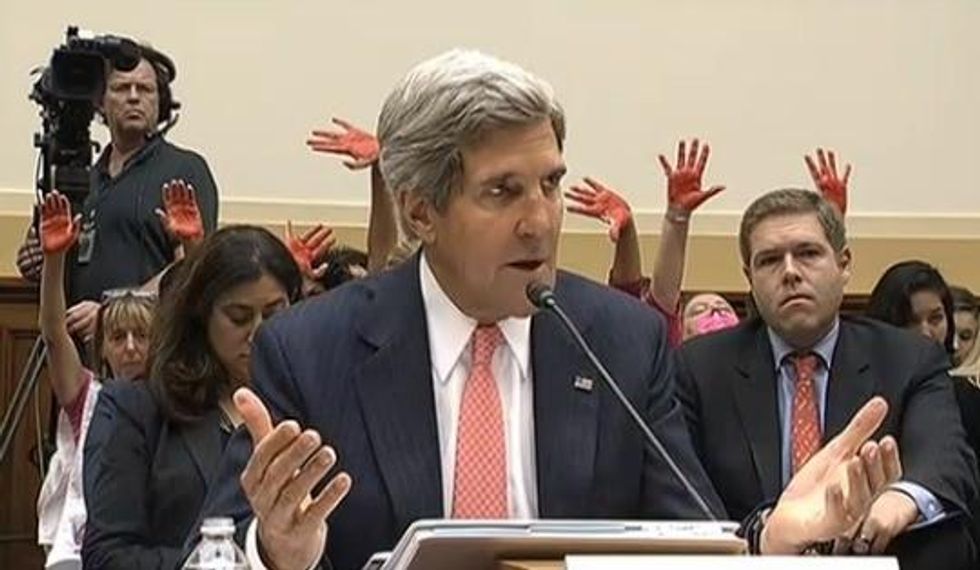
Fast forward to September 3, 2013, and I found myself in a hearing with Secretary of State John Kerry telling members of the Senate Foreign Relations Committee why it was necessary to invade a country that never attacked us: Syria. By now I'm a pro, having attended countless hearings over the last decade. My CODEPINK colleagues and I came prepared. We took out signs that read "Syria Needs a Ceasefire, Not War" and "No US Attack on Syria", and we rubbed red paint on our hands to signify that the blood of Syrians would be on the administration's hands if it went ahead with the attack.
With an intense feeling of deja vu, I got up to speak right after Secretary Kerry gave his opening remarks. Kerry had said he was proposing limited strikes, not a war. It sounded to me just like the false "cakewalk" argument from the Iraq war sales pitch. I responded that lobbing cruise missiles into another country's sovereign territory was indeed a war, and that the consequences could be devastating. I also insisted that the American people - and the entire global community - did not support US military intervention. I was hauled out by Capitol Police, arrested and charged with "disorderly conduct", a charge I have received many times over the last 11 years.
Kerry responded to my intervention by evoking his youth. "You know, the first time I testified before this committee when I was 27 years old, I had feelings very similar to that protester," he said, referring to when he spoke out against the Vietnam War in 1971 as a member of Vietnam Veterans Against the War. "And I would just say that is exactly why it is so important that we are all here having this debate, talking about these things before the country, and that the Congress itself will act representing the American people."We are telling our elected officials that if they are truly concerned about the violence that has killed more than 100,000 Syrians, they should pressure the administration to invest its considerable influence and energies in brokering a ceasefire and seeking a political settlement.
But what does it mean to represent the American people? In the case of Iraq, the US public had been whipped up by the government and the media to believe that Saddam Hussein played a key role in the 9/11 attacks. That's why a clear majority - 60 percent - supported the Iraq invasion. This time, the public is what some call "war-weary" - but I would call "war-wise". This time, 60 percent of Americans have not bought the government and media hype and are instead opposed to this intervention.
In the congressional vote for the Iraq war, almost all the Republicans lined up to support the war, along with 40 percent of the Democrats. But now that the war is not pushed by a rough-and-tumble Texas Republican but by a more refined, sweet-talking, Nobel Peace Prize-winning Democrat, it's unclear how the votes will shake out. Many of the traditional anti-war Democrats have become pro-war, and we in CODEPINK find ourselves applauding the stand of Tea Party favourites like Kentucky Senator Rand Paul or small-government Republicans like Michigan Congressman Justin Amash. Amash has been outspoken in his criticism of military action, holding town halls across his district to discuss the issue. He tweeted that 95 percent of those he met with opposed US military action in Syria.
There is little time left to stop this new, mad rush to war. Just as the British people put pressure on their members of parliament and insisted they steer clear of this American folly, so, too, the American people are mobilising. We are making our opposition known in town hall meetings throughout the country, and in a flood of calls, petitions, emails and visits to our elected officials. At both the Senate and House hearings, officials mentioned that their constituents were overwhelmingly opposed to intervention.
We are insisting that there are much better ways than cruise missiles to tell the Syrian people that we care. We are calling for increased US support for the more than two million refugees who are overwhelming the neighbouring countries of Lebanon, Jordan and Turkey. With the UN's financial needs only 40 percent fulfilled, the billions of dollars that our government would spend on war would be far better spent addressing the mounting refugee crisis.
We are also telling our elected officials that if they are truly concerned about the violence that has killed more than 100,000 Syrians, they should pressure the administration to invest its considerable influence and energies in brokering a ceasefire and seeking a political settlement. This is obviously no easy task. Neither Syrian President Bashar al-Assad nor the divided rebel forces (including the growing al-Qaeda elements) are eager to sit down for talks, as both sides think they can win through force. Yet in the end, this civil war will end with a political settlement, and the sooner it happens, the more lives saved.
The clock is ticking, with President Obama and Secretary Kerry frantically selling a war that the American people don't want to buy. If Congress goes ahead and approves military action, they - unlike their British counterparts - will fail to represent the people who elected them.

Dear Common Dreams reader, It’s been nearly 30 years since I co-founded Common Dreams with my late wife, Lina Newhouser. We had the radical notion that journalism should serve the public good, not corporate profits. It was clear to us from the outset what it would take to build such a project. No paid advertisements. No corporate sponsors. No millionaire publisher telling us what to think or do. Many people said we wouldn't last a year, but we proved those doubters wrong. Together with a tremendous team of journalists and dedicated staff, we built an independent media outlet free from the constraints of profits and corporate control. Our mission has always been simple: To inform. To inspire. To ignite change for the common good. Building Common Dreams was not easy. Our survival was never guaranteed. When you take on the most powerful forces—Wall Street greed, fossil fuel industry destruction, Big Tech lobbyists, and uber-rich oligarchs who have spent billions upon billions rigging the economy and democracy in their favor—the only bulwark you have is supporters who believe in your work. But here’s the urgent message from me today. It's never been this bad out there. And it's never been this hard to keep us going. At the very moment Common Dreams is most needed, the threats we face are intensifying. We need your support now more than ever. We don't accept corporate advertising and never will. We don't have a paywall because we don't think people should be blocked from critical news based on their ability to pay. Everything we do is funded by the donations of readers like you. When everyone does the little they can afford, we are strong. But if that support retreats or dries up, so do we. Will you donate now to make sure Common Dreams not only survives but thrives? —Craig Brown, Co-founder |

I was so concerned about the pending war that I flew to Washington DC from my home in San Francisco. It was the first congressional hearing I had ever witnessed. My heart was pounding as my colleague Diane Wilson and I pulled out banners that read "UN inspectors, not US war", and proceeded to ask Rumsfeld our own questions: how many innocent Iraqis would die, how many US soldiers, how many of our tax dollars would be poured into this war of choice, and how much money would Halliburton make from the war. We were hauled out of the room by the Capitol police.
Fast forward to September 3, 2013, and I found myself in a hearing with Secretary of State John Kerry telling members of the Senate Foreign Relations Committee why it was necessary to invade a country that never attacked us: Syria. By now I'm a pro, having attended countless hearings over the last decade. My CODEPINK colleagues and I came prepared. We took out signs that read "Syria Needs a Ceasefire, Not War" and "No US Attack on Syria", and we rubbed red paint on our hands to signify that the blood of Syrians would be on the administration's hands if it went ahead with the attack.
With an intense feeling of deja vu, I got up to speak right after Secretary Kerry gave his opening remarks. Kerry had said he was proposing limited strikes, not a war. It sounded to me just like the false "cakewalk" argument from the Iraq war sales pitch. I responded that lobbing cruise missiles into another country's sovereign territory was indeed a war, and that the consequences could be devastating. I also insisted that the American people - and the entire global community - did not support US military intervention. I was hauled out by Capitol Police, arrested and charged with "disorderly conduct", a charge I have received many times over the last 11 years.
Kerry responded to my intervention by evoking his youth. "You know, the first time I testified before this committee when I was 27 years old, I had feelings very similar to that protester," he said, referring to when he spoke out against the Vietnam War in 1971 as a member of Vietnam Veterans Against the War. "And I would just say that is exactly why it is so important that we are all here having this debate, talking about these things before the country, and that the Congress itself will act representing the American people."We are telling our elected officials that if they are truly concerned about the violence that has killed more than 100,000 Syrians, they should pressure the administration to invest its considerable influence and energies in brokering a ceasefire and seeking a political settlement.
But what does it mean to represent the American people? In the case of Iraq, the US public had been whipped up by the government and the media to believe that Saddam Hussein played a key role in the 9/11 attacks. That's why a clear majority - 60 percent - supported the Iraq invasion. This time, the public is what some call "war-weary" - but I would call "war-wise". This time, 60 percent of Americans have not bought the government and media hype and are instead opposed to this intervention.
In the congressional vote for the Iraq war, almost all the Republicans lined up to support the war, along with 40 percent of the Democrats. But now that the war is not pushed by a rough-and-tumble Texas Republican but by a more refined, sweet-talking, Nobel Peace Prize-winning Democrat, it's unclear how the votes will shake out. Many of the traditional anti-war Democrats have become pro-war, and we in CODEPINK find ourselves applauding the stand of Tea Party favourites like Kentucky Senator Rand Paul or small-government Republicans like Michigan Congressman Justin Amash. Amash has been outspoken in his criticism of military action, holding town halls across his district to discuss the issue. He tweeted that 95 percent of those he met with opposed US military action in Syria.
There is little time left to stop this new, mad rush to war. Just as the British people put pressure on their members of parliament and insisted they steer clear of this American folly, so, too, the American people are mobilising. We are making our opposition known in town hall meetings throughout the country, and in a flood of calls, petitions, emails and visits to our elected officials. At both the Senate and House hearings, officials mentioned that their constituents were overwhelmingly opposed to intervention.
We are insisting that there are much better ways than cruise missiles to tell the Syrian people that we care. We are calling for increased US support for the more than two million refugees who are overwhelming the neighbouring countries of Lebanon, Jordan and Turkey. With the UN's financial needs only 40 percent fulfilled, the billions of dollars that our government would spend on war would be far better spent addressing the mounting refugee crisis.
We are also telling our elected officials that if they are truly concerned about the violence that has killed more than 100,000 Syrians, they should pressure the administration to invest its considerable influence and energies in brokering a ceasefire and seeking a political settlement. This is obviously no easy task. Neither Syrian President Bashar al-Assad nor the divided rebel forces (including the growing al-Qaeda elements) are eager to sit down for talks, as both sides think they can win through force. Yet in the end, this civil war will end with a political settlement, and the sooner it happens, the more lives saved.
The clock is ticking, with President Obama and Secretary Kerry frantically selling a war that the American people don't want to buy. If Congress goes ahead and approves military action, they - unlike their British counterparts - will fail to represent the people who elected them.

I was so concerned about the pending war that I flew to Washington DC from my home in San Francisco. It was the first congressional hearing I had ever witnessed. My heart was pounding as my colleague Diane Wilson and I pulled out banners that read "UN inspectors, not US war", and proceeded to ask Rumsfeld our own questions: how many innocent Iraqis would die, how many US soldiers, how many of our tax dollars would be poured into this war of choice, and how much money would Halliburton make from the war. We were hauled out of the room by the Capitol police.
Fast forward to September 3, 2013, and I found myself in a hearing with Secretary of State John Kerry telling members of the Senate Foreign Relations Committee why it was necessary to invade a country that never attacked us: Syria. By now I'm a pro, having attended countless hearings over the last decade. My CODEPINK colleagues and I came prepared. We took out signs that read "Syria Needs a Ceasefire, Not War" and "No US Attack on Syria", and we rubbed red paint on our hands to signify that the blood of Syrians would be on the administration's hands if it went ahead with the attack.
With an intense feeling of deja vu, I got up to speak right after Secretary Kerry gave his opening remarks. Kerry had said he was proposing limited strikes, not a war. It sounded to me just like the false "cakewalk" argument from the Iraq war sales pitch. I responded that lobbing cruise missiles into another country's sovereign territory was indeed a war, and that the consequences could be devastating. I also insisted that the American people - and the entire global community - did not support US military intervention. I was hauled out by Capitol Police, arrested and charged with "disorderly conduct", a charge I have received many times over the last 11 years.
Kerry responded to my intervention by evoking his youth. "You know, the first time I testified before this committee when I was 27 years old, I had feelings very similar to that protester," he said, referring to when he spoke out against the Vietnam War in 1971 as a member of Vietnam Veterans Against the War. "And I would just say that is exactly why it is so important that we are all here having this debate, talking about these things before the country, and that the Congress itself will act representing the American people."We are telling our elected officials that if they are truly concerned about the violence that has killed more than 100,000 Syrians, they should pressure the administration to invest its considerable influence and energies in brokering a ceasefire and seeking a political settlement.
But what does it mean to represent the American people? In the case of Iraq, the US public had been whipped up by the government and the media to believe that Saddam Hussein played a key role in the 9/11 attacks. That's why a clear majority - 60 percent - supported the Iraq invasion. This time, the public is what some call "war-weary" - but I would call "war-wise". This time, 60 percent of Americans have not bought the government and media hype and are instead opposed to this intervention.
In the congressional vote for the Iraq war, almost all the Republicans lined up to support the war, along with 40 percent of the Democrats. But now that the war is not pushed by a rough-and-tumble Texas Republican but by a more refined, sweet-talking, Nobel Peace Prize-winning Democrat, it's unclear how the votes will shake out. Many of the traditional anti-war Democrats have become pro-war, and we in CODEPINK find ourselves applauding the stand of Tea Party favourites like Kentucky Senator Rand Paul or small-government Republicans like Michigan Congressman Justin Amash. Amash has been outspoken in his criticism of military action, holding town halls across his district to discuss the issue. He tweeted that 95 percent of those he met with opposed US military action in Syria.
There is little time left to stop this new, mad rush to war. Just as the British people put pressure on their members of parliament and insisted they steer clear of this American folly, so, too, the American people are mobilising. We are making our opposition known in town hall meetings throughout the country, and in a flood of calls, petitions, emails and visits to our elected officials. At both the Senate and House hearings, officials mentioned that their constituents were overwhelmingly opposed to intervention.
We are insisting that there are much better ways than cruise missiles to tell the Syrian people that we care. We are calling for increased US support for the more than two million refugees who are overwhelming the neighbouring countries of Lebanon, Jordan and Turkey. With the UN's financial needs only 40 percent fulfilled, the billions of dollars that our government would spend on war would be far better spent addressing the mounting refugee crisis.
We are also telling our elected officials that if they are truly concerned about the violence that has killed more than 100,000 Syrians, they should pressure the administration to invest its considerable influence and energies in brokering a ceasefire and seeking a political settlement. This is obviously no easy task. Neither Syrian President Bashar al-Assad nor the divided rebel forces (including the growing al-Qaeda elements) are eager to sit down for talks, as both sides think they can win through force. Yet in the end, this civil war will end with a political settlement, and the sooner it happens, the more lives saved.
The clock is ticking, with President Obama and Secretary Kerry frantically selling a war that the American people don't want to buy. If Congress goes ahead and approves military action, they - unlike their British counterparts - will fail to represent the people who elected them.