
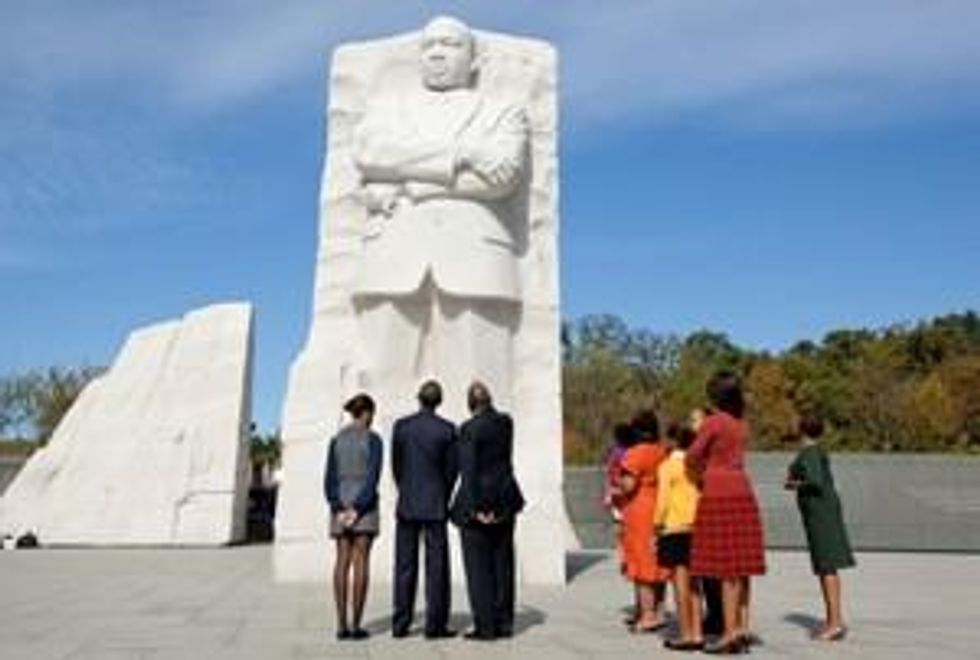
The national memorial to Martin Luther King Jr. was dedicated last Sunday. President Barack Obama said of Dr. King, "If he were alive today, I believe he would remind us that the unemployed worker can rightly challenge the excesses of Wall Street without demonizing all who work there." The dedication occurred amidst the increasingly popular and increasingly global Occupy Wall Street movement. What Obama left unsaid is that King, were he alive, would most likely be protesting Obama administration policies.
Not far from the dedication ceremony, Cornel West, preacher, professor, writer and activist, was being arrested on the steps of the U.S. Supreme Court. He said, before being hauled off to jail: "We want to bear witness today that we know the relation between corporate greed and what goes on too often in the Supreme Court decisions. ... We will not allow this day of Martin Luther King Jr.'s memorial to go without somebody going to jail, because Martin King would be here right with us, willing to throw down out of deep love."
West was arrested with 18 others, declaring "solidarity with the Occupy movement all around the world, because we love poor people, we love working people, and we want Martin Luther King Jr. to smile from the grave that we haven't forgot his movement."
Over the same weekend as the dedication, the U.S. military/CIA's drone campaign, under Commander in Chief Obama, launched what the independent, nonprofit Bureau of Investigative Journalism, based in London, called the 300th drone strike, the 248th since Obama took office. According to the BIJ, of the at least 2,318 people killed by drone strikes, between 386 and 775 were civilians, including 175 children. Imagine how Obama's fellow Nobel Peace Prize laureate, Dr. King, would respond to those grim statistics.
Back in 1963, King published a collection of sermons titled "Strength to Love." His preface began, "In these turbulent days of uncertainty the evils of war and of economic and racial injustice threaten the very survival of the human race." Three of the 15 sermons were written in Georgia jails, including "Shattered Dreams." In that one, he wrote, "To cooperate passively with an unjust system makes the oppressed as evil as the oppressor." King revisited the idea of shattered dreams four years later, eight months before his assassination, in his speech called "Where Do We Go From Here," saying: "Our dreams will sometimes be shattered and our ethereal hopes blasted. ... Let us realize the arc of the moral universe is long but it bends toward justice."
Earlier in that year, 1967, a year to the day before he was killed, King gave his oft-overlooked "Beyond Vietnam" speech at Riverside Church in New York City. King preached, "I knew that I could never again raise my voice against the violence of the oppressed in the ghettos without having first spoken clearly to the greatest purveyor of violence in the world today, my own government."
With those words, with that speech, King set the tone for his final, fateful year. Despite death threats, and his close advisers urging him not to go to Memphis, King went to march in solidarity with that city's sanitation workers. On April 4, 1968, he was shot and killed on the balcony of the Lorraine Motel.
Deeply impacted at the time by the assassination, we can follow two young men along King's arc of moral justice all the way to Occupy Wall Street. One was John Carlos, a U.S. Olympic track star. Carlos won the bronze medal in the 200 meter race at the 1968 Summer Olympics in Mexico City. Carlos and his teammate Tommie Smith, who won the gold, raised their black-gloved fists in the power salute on the medal stand, instantly gaining global fame. They both stood without shoes, protesting black children in poverty in the United States. Last week, John Carlos spoke at Occupy Wall Street, and he told me after, "I'm just so happy to see so many people who are standing up to say: 'We're not asking for change. We demand change.' "
The other person is the Rev. Jesse Jackson. He was with King when he was assassinated. Late Monday night, the New York Police Department seemed to be making a move on Occupy Wall Street's first-aid tent. Jackson was there. Just days past his 70th birthday, Jackson joined arms with the young protesters, defying the police. The police backed off. And the arc of moral justice bent a bit more toward justice.
Denis Moynihan contributed research to this column.
The national memorial to Martin Luther King Jr. was dedicated last Sunday. President Barack Obama said of Dr. King, "If he were alive today, I believe he would remind us that the unemployed worker can rightly challenge the excesses of Wall Street without demonizing all who work there." The dedication occurred amidst the increasingly popular and increasingly global Occupy Wall Street movement. What Obama left unsaid is that King, were he alive, would most likely be protesting Obama administration policies.
Not far from the dedication ceremony, Cornel West, preacher, professor, writer and activist, was being arrested on the steps of the U.S. Supreme Court. He said, before being hauled off to jail: "We want to bear witness today that we know the relation between corporate greed and what goes on too often in the Supreme Court decisions. ... We will not allow this day of Martin Luther King Jr.'s memorial to go without somebody going to jail, because Martin King would be here right with us, willing to throw down out of deep love."
West was arrested with 18 others, declaring "solidarity with the Occupy movement all around the world, because we love poor people, we love working people, and we want Martin Luther King Jr. to smile from the grave that we haven't forgot his movement."
Over the same weekend as the dedication, the U.S. military/CIA's drone campaign, under Commander in Chief Obama, launched what the independent, nonprofit Bureau of Investigative Journalism, based in London, called the 300th drone strike, the 248th since Obama took office. According to the BIJ, of the at least 2,318 people killed by drone strikes, between 386 and 775 were civilians, including 175 children. Imagine how Obama's fellow Nobel Peace Prize laureate, Dr. King, would respond to those grim statistics.
Back in 1963, King published a collection of sermons titled "Strength to Love." His preface began, "In these turbulent days of uncertainty the evils of war and of economic and racial injustice threaten the very survival of the human race." Three of the 15 sermons were written in Georgia jails, including "Shattered Dreams." In that one, he wrote, "To cooperate passively with an unjust system makes the oppressed as evil as the oppressor." King revisited the idea of shattered dreams four years later, eight months before his assassination, in his speech called "Where Do We Go From Here," saying: "Our dreams will sometimes be shattered and our ethereal hopes blasted. ... Let us realize the arc of the moral universe is long but it bends toward justice."
Earlier in that year, 1967, a year to the day before he was killed, King gave his oft-overlooked "Beyond Vietnam" speech at Riverside Church in New York City. King preached, "I knew that I could never again raise my voice against the violence of the oppressed in the ghettos without having first spoken clearly to the greatest purveyor of violence in the world today, my own government."
With those words, with that speech, King set the tone for his final, fateful year. Despite death threats, and his close advisers urging him not to go to Memphis, King went to march in solidarity with that city's sanitation workers. On April 4, 1968, he was shot and killed on the balcony of the Lorraine Motel.
Deeply impacted at the time by the assassination, we can follow two young men along King's arc of moral justice all the way to Occupy Wall Street. One was John Carlos, a U.S. Olympic track star. Carlos won the bronze medal in the 200 meter race at the 1968 Summer Olympics in Mexico City. Carlos and his teammate Tommie Smith, who won the gold, raised their black-gloved fists in the power salute on the medal stand, instantly gaining global fame. They both stood without shoes, protesting black children in poverty in the United States. Last week, John Carlos spoke at Occupy Wall Street, and he told me after, "I'm just so happy to see so many people who are standing up to say: 'We're not asking for change. We demand change.' "
The other person is the Rev. Jesse Jackson. He was with King when he was assassinated. Late Monday night, the New York Police Department seemed to be making a move on Occupy Wall Street's first-aid tent. Jackson was there. Just days past his 70th birthday, Jackson joined arms with the young protesters, defying the police. The police backed off. And the arc of moral justice bent a bit more toward justice.
Denis Moynihan contributed research to this column.
The national memorial to Martin Luther King Jr. was dedicated last Sunday. President Barack Obama said of Dr. King, "If he were alive today, I believe he would remind us that the unemployed worker can rightly challenge the excesses of Wall Street without demonizing all who work there." The dedication occurred amidst the increasingly popular and increasingly global Occupy Wall Street movement. What Obama left unsaid is that King, were he alive, would most likely be protesting Obama administration policies.
Not far from the dedication ceremony, Cornel West, preacher, professor, writer and activist, was being arrested on the steps of the U.S. Supreme Court. He said, before being hauled off to jail: "We want to bear witness today that we know the relation between corporate greed and what goes on too often in the Supreme Court decisions. ... We will not allow this day of Martin Luther King Jr.'s memorial to go without somebody going to jail, because Martin King would be here right with us, willing to throw down out of deep love."
West was arrested with 18 others, declaring "solidarity with the Occupy movement all around the world, because we love poor people, we love working people, and we want Martin Luther King Jr. to smile from the grave that we haven't forgot his movement."
Over the same weekend as the dedication, the U.S. military/CIA's drone campaign, under Commander in Chief Obama, launched what the independent, nonprofit Bureau of Investigative Journalism, based in London, called the 300th drone strike, the 248th since Obama took office. According to the BIJ, of the at least 2,318 people killed by drone strikes, between 386 and 775 were civilians, including 175 children. Imagine how Obama's fellow Nobel Peace Prize laureate, Dr. King, would respond to those grim statistics.
Back in 1963, King published a collection of sermons titled "Strength to Love." His preface began, "In these turbulent days of uncertainty the evils of war and of economic and racial injustice threaten the very survival of the human race." Three of the 15 sermons were written in Georgia jails, including "Shattered Dreams." In that one, he wrote, "To cooperate passively with an unjust system makes the oppressed as evil as the oppressor." King revisited the idea of shattered dreams four years later, eight months before his assassination, in his speech called "Where Do We Go From Here," saying: "Our dreams will sometimes be shattered and our ethereal hopes blasted. ... Let us realize the arc of the moral universe is long but it bends toward justice."
Earlier in that year, 1967, a year to the day before he was killed, King gave his oft-overlooked "Beyond Vietnam" speech at Riverside Church in New York City. King preached, "I knew that I could never again raise my voice against the violence of the oppressed in the ghettos without having first spoken clearly to the greatest purveyor of violence in the world today, my own government."
With those words, with that speech, King set the tone for his final, fateful year. Despite death threats, and his close advisers urging him not to go to Memphis, King went to march in solidarity with that city's sanitation workers. On April 4, 1968, he was shot and killed on the balcony of the Lorraine Motel.
Deeply impacted at the time by the assassination, we can follow two young men along King's arc of moral justice all the way to Occupy Wall Street. One was John Carlos, a U.S. Olympic track star. Carlos won the bronze medal in the 200 meter race at the 1968 Summer Olympics in Mexico City. Carlos and his teammate Tommie Smith, who won the gold, raised their black-gloved fists in the power salute on the medal stand, instantly gaining global fame. They both stood without shoes, protesting black children in poverty in the United States. Last week, John Carlos spoke at Occupy Wall Street, and he told me after, "I'm just so happy to see so many people who are standing up to say: 'We're not asking for change. We demand change.' "
The other person is the Rev. Jesse Jackson. He was with King when he was assassinated. Late Monday night, the New York Police Department seemed to be making a move on Occupy Wall Street's first-aid tent. Jackson was there. Just days past his 70th birthday, Jackson joined arms with the young protesters, defying the police. The police backed off. And the arc of moral justice bent a bit more toward justice.
Denis Moynihan contributed research to this column.