

SUBSCRIBE TO OUR FREE NEWSLETTER
Daily news & progressive opinion—funded by the people, not the corporations—delivered straight to your inbox.
5
#000000
#FFFFFF
To donate by check, phone, or other method, see our More Ways to Give page.
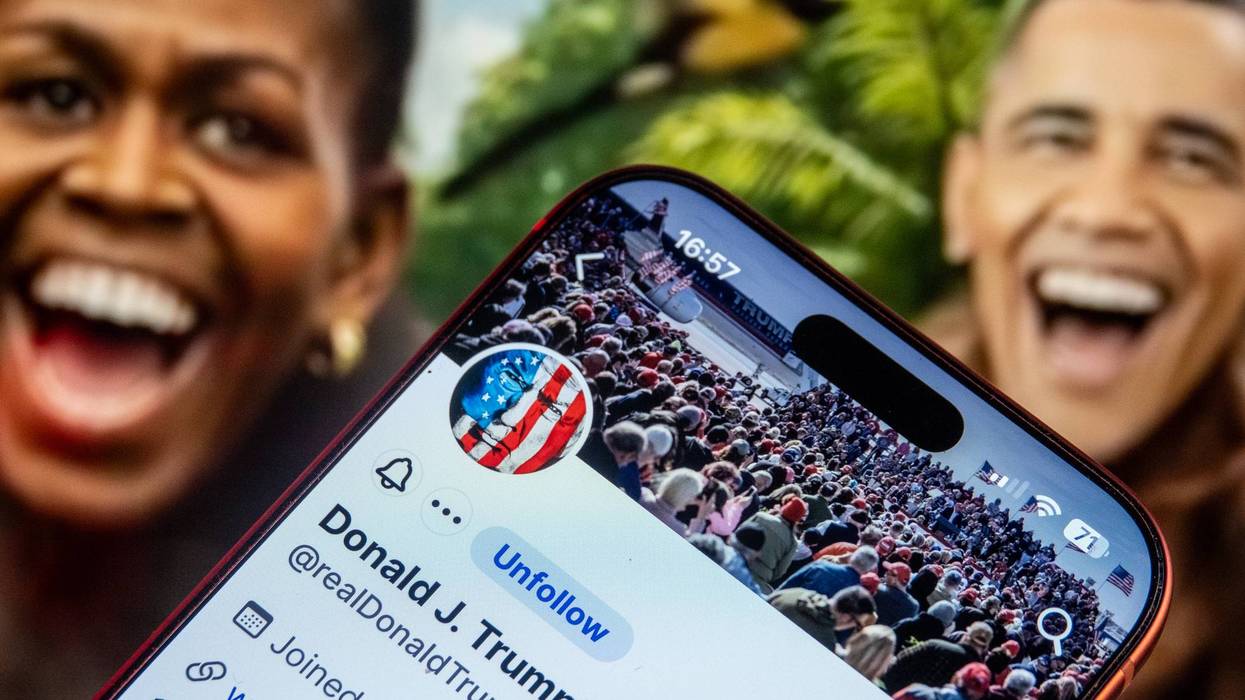
That a popular pro-Trump account on X created this video and it has lived on that platform without consequence is disgusting in and of itself. But Trump — as our president, speaking in our voice — made it infinitely worse last night by promoting it to millions around the world.
Promoting a video that depicts Barack and Michelle Obama as non-human primates isn’t a joke. It isn’t satire or an accident. It’s the oldest racist smear in the book, dressed up in a cheap meme and now blasted out by a man who once swore an oath to preserve, protect, and defend the Constitution of the United States.
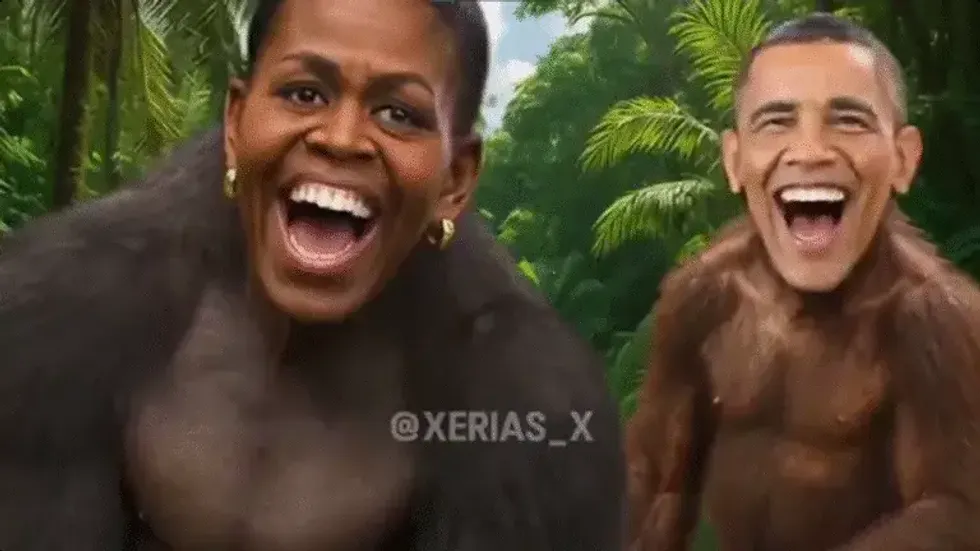 Normally I wouldn’t post such a disgusting, racist image that originated on Elon’s social media sewer, but it’s important for the historical record for Americans to see what the President of the United States reposted last night on his own site — as your and my representative — for the entire world to see. (Screengrab / Truth Social)
When the president of the United States does something like this, it doesn’t just insult two people. It tells a story about who, according to the most powerful man in the world, belongs in America and who doesn’t.
For centuries, racism in this country has relied on the lie that some people are less than human. That lie has been used to justify slavery, Jim Crow, lynchings, and mass incarceration.
It’s the lie that made it easier for people to look away while their neighbors were brutalized. It’s the lie that justifies ICE’s brutal, racist behavior. When Trump shares imagery that taps directly into that history, he’s not being edgy: he’s reopening wounds that never fully healed.
Pretending this doesn’t matter is how we normalize it and weaken our shared sense of humanity. And the end point of that is always disaster.
When the President of the United States signals that this kind of racism is acceptable, it gives permission to others. It tells the kid being harassed at school, the family being targeted by a hate group, and the voter being pushed out of the polling line that the cruelty they’re experiencing is justified. That it’s their own fault.
It tells the bullies and thugs of ICE as they do their “Kavanaugh Stops” — targeting people based on their race — that they’re on the right side of power.
This isn’t just about harm to minorities, although that harm is real and immediate. It’s about what happens to democracy itself when the presidency becomes a megaphone for dehumanization.
Democracy depends on the idea that we’re all political equals. Once you start suggesting that some Americans are animals, that idea collapses. It becomes easier to justify taking away voting rights, ignore court rulings, or shrug when violence follows hateful rhetoric.
I remember a time, during the era of Eisenhower and Kennedy, when the presidency stood as a kind of moral North Star. Even when presidents like Nixon and Clinton failed to live up to it, there was at least a shared understanding that the office itself mattered. That it should pull us together, not rip us apart.
Trump has spent years doing the opposite, from the 1970s when he was busted along with his father for refusing to rent to Black people to his recent use of words like “vermin” and “shitholes” to describe Hispanic and Black people and majority-Black countries. Last night’s post is another brutally clear example of Trump’s deep, lifelong racism.
What’s even more chilling is the silence from Republican leaders and elected officials. If you can’t bring yourself to condemn something this overtly racist, where exactly is your line?
Silence in moments like this isn’t neutrality: it’s complicity. It tells people of color in America, already dealing with the burden of centuries of institutional racism, that their pain is irrelevant and their dignity a plaything in the hands of white people.
I know some people will say we should ignore it, that reacting “just feeds the outrage machine.” Trump’s propaganda princess, Karoline Leavitt, tried to downplay it by telling reporters this morning:
“This is from an internet meme video depicting President Trump as the King of the Jungle and Democrats as characters from the Lion King. Please stop the fake outrage and report on something today that actually matters to the American public.”
But pretending this doesn’t matter is how we normalize it and weaken our shared sense of humanity. And the end point of that is always disaster.
As California Governor Gavin Newsome just posted:
“Disgusting behavior by the President. Every single Republican must denounce this. Now.”
“Denounce” is a bare minimum. This country can do better. We’ve done better before, often after terrible struggle and sacrifice.
But we won’t get there by minimizing moments like this or waving them off as “just another Trump post.” We get there by calling it what it is, by standing up for one another as equals in our humanity, and by insisting that the presidency must reflect our highest ideals, not our ugliest instincts.
If this doesn’t provoke the 13 white billionaires in Trump’s cabinet — who would all instantly fire anybody in any of their companies who posted such an image on their company’s servers — to start 25th Amendment proceedings or endorse impeachment, it’ll tell us everything about who they are, too.
America is stronger when we recognize each other as fully human. The moment we let that slip, we all lose something precious.

The outrage over the post was immediate, even as Trump's racism is well known and documented over many years.
"The most foundational racist idea is likening Black people to apes," said Howard University historian Ibram X. Kendi in a social media post. "Since humans evolved from an ape-like ancestor, racist ideas cast white people as the most evolved people and the furthest away on the evolutionary scale from apes. Racist ideas cast Black people as the least evolved people and the closest on the evolutionary scale to apes. Almost all racist ideas build on this foundational one expressed by Trump."
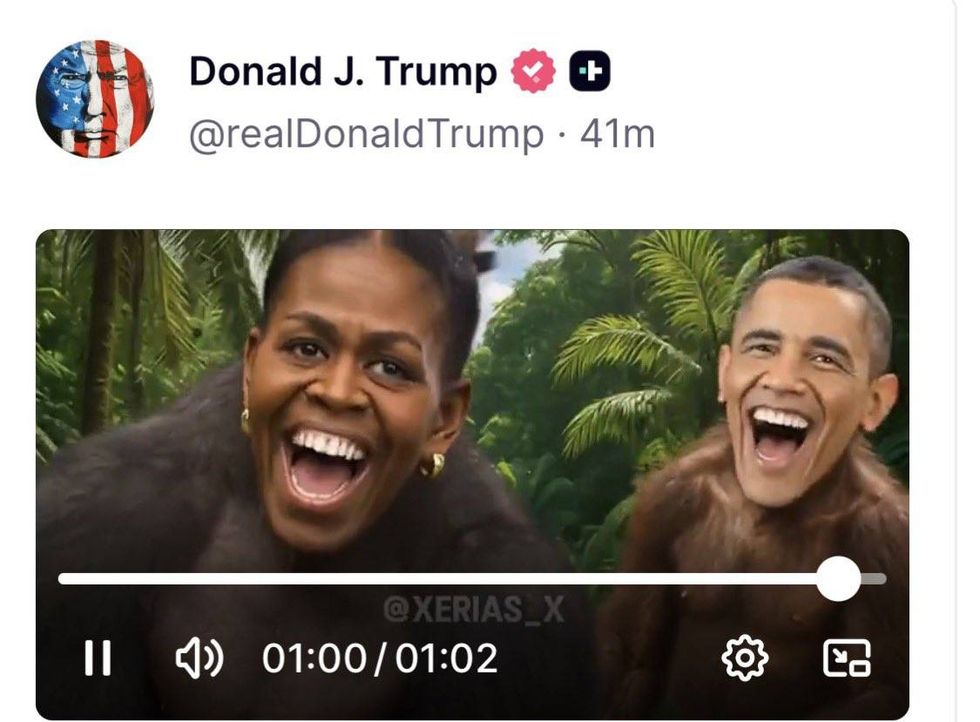
A screenshot of the video Trump shared:
Tom Jocelyn, senior fellow at the Reiss Center on Law and Security, predicted how Trump and his allies would defend his promotion of obvious racism.
"Let’s call out a game Trump and MAGA play," he wrote. "1. Trump posts, says or does something racist. 2. Some point out it’s racist. 3. Trump (with MAGA’s help) pretends to be the victim for being called a racist. MAGA stews in its imaginary grievances. 4. Rinse and repeat."
Mark Jacob, former metro editor at the Chicago Tribune, called out the New York Times for writing that it was "unclear if Mr. Trump was aware" that the racist depiction of the Obamas "had been included in the video before he shared it."
"What the hell is the New York Times doing?" he asked. "In its article on Trump posting a video that included a clip of the Obamas as apes, NYT tries to help him come up with an excuse."
Ben Rhodes, former deputy national security adviser under Obama, argued that Trump's post was yet another sign that he will be remembered as a deeply loathsome historical figure.
"Let it haunt Trump and his racist followers that future Americans will embrace the Obamas as beloved figures," he wrote, "while studying him as a stain on our history."
Even Trump allies such as Sens. Tim Scott (R-SC) and Roger Wicker (R-Miss.) demanded the president take down the racist video.
"Praying it was fake because it’s the most racist thing I’ve seen out of this White House," wrote Scott. "The President should remove it."
"This is totally unacceptable," wrote Wicker. "The president should take it down and apologize."





If you haven't met glyphosate (Roundup) yet, allow me to introduce you. Glyphosate is the most widely used pesticide in the US. Its use has skyrocketed during the last 20 years because of the popularity of genetically-modified crops that are tolerant of this weedkiller. Health concerns about glyphosate have also skyrocketed since 2015, when the World Health Organization evaluated its ability to cause cancer.
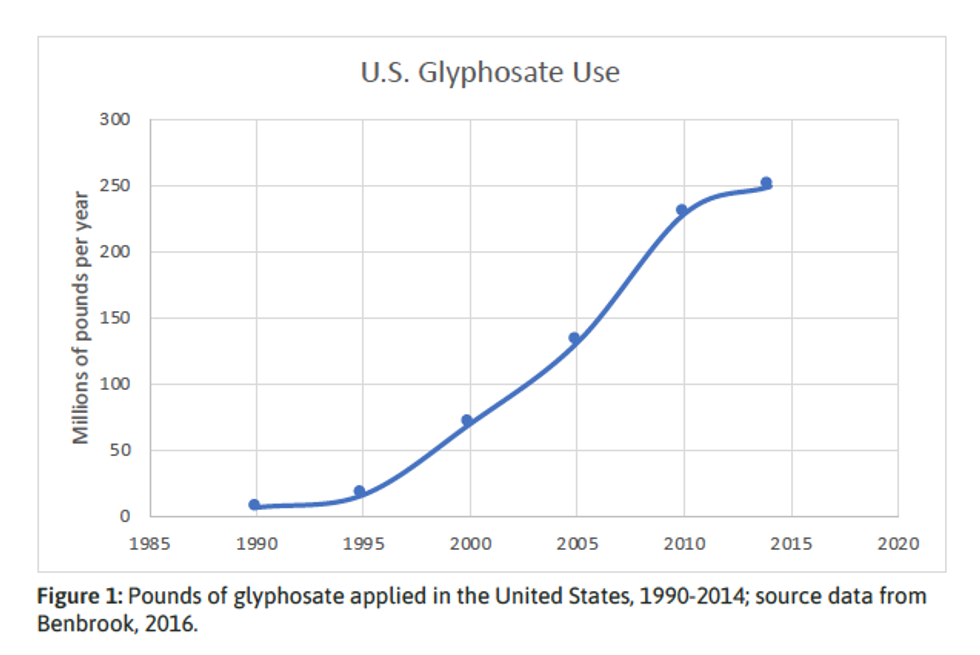
The above graph was created by the Center for Environmental Health using data from the study "Trends in glyphosate herbicide use in the United States and globally," by Charles M. Benbrook.
Glyphosate's evaluation as a probable carcinogen is scary and was recently validated by a jury that awarded a school groundskeeper a multimillion-dollar judgment against Monsanto/Bayer because he had developed cancer after years of Roundup use. The decision has paved the way for thousands of other cancer patients and families to seek justice and compensation in court.
Glyphosate is now in most of us: Recent biomonitoring studies have detected it in the urine samples of 70 to 93 percent of the US population.
Even scarier, recent research has demonstrated that glyphosate can disrupt our body's hormones, those vital molecules that manage growth, development, behavior, sex and more.
Exposing children, with their developing bodies, to a chemical that can cause cancer and hormone dysfunction is wrong. It's especially wrong for children simply eating breakfast at school, who often are from low-income families. This fact has spurred the nonprofit Center for Environmental Health (CEH), where I serve as the senior scientist, to measure glyphosate contamination in breakfast cereals and bars served at schools. Although our study was small, the results were striking.
We found significant contamination in 70 percent of the products we tested, including big name brands like Quaker, whose glyphosate contamination more than six times the safety threshold developed by the Environmental Working Group (EWG) and Cheerios, whose glyphosate contamination was more than five times the EWG safety threshold.

Our findings corroborate a growing list of recent studies demonstrating the presence of glyphosate in children's foods, including preliminary findings by CEH in August, as well as those by the EWG, Moms Across America, Food Democracy Now and the Food and Drug Administration.
Because our study was small, and there is not much government testing of glyphosate contamination in popular grocery items, there may be other contaminated products at your school or grocery store. We just don't know. We did recently find glyphosate contamination in King Arthur bread flour. King Arthur is the fourth largest seller of flour in the country, consumed by approximately 16.61 million Americans this year. King Arthur's bread flour is used for more than just baking bread, the company also claims "it strengthens whole-grain pastries, makes cookies crispier, and when combined with all-purpose flour, creates chewier pizza crusts and more tender muffins." If we found it in commonly sold wheat flour, where else might it be?
Fortunately, there is a straightforward way to reduce the amount of glyphosate that our students consume. Certified organic foods are grown without glyphosate and the ones that we have tested are uncontaminated. Thus, we are asking schools to buy these organic cereals and bars. Some organic food is more expensive than conventionally grown food, but even a partial switch reduces the amount of this pesticide that students are eating and increases the market for organics, setting up the economies of scale that will lower prices.
Further, switching to organic cereals in the short term and advocating for stronger chemical regulation in the long term is beneficial to all eaters, especially people who are exposed to the highest levels of pesticides because of their work, such as groundskeepers and farmworkers.
What can parents do? Here are three steps to help protect you and your family:
Buy organic cereals for your family whenever they are affordable and available for you.
Ask your children's schools to add organic cereals to their menus. For advice about effective ways to do this, contact us at food@ceh.org.
Tell the CEO of General Mills to get rid of glyphosate in Cheerios and other cereal products by switching to organic oats. Children aren't test subjects and parents deserve warning labels.
Monsanto (now Bayer) made hundreds of millions of dollars in 2017 from herbicide sales. We need to demand a change. Cancer-causing chemicals do not belong in children's meals, whether served at home, at school or a child care center.
This article was produced by Earth | Food | Life, a project of the Independent Media Institute, and originally published by Truthout.

