

SUBSCRIBE TO OUR FREE NEWSLETTER
Daily news & progressive opinion—funded by the people, not the corporations—delivered straight to your inbox.
5
#000000
#FFFFFF
To donate by check, phone, or other method, see our More Ways to Give page.
Daily news & progressive opinion—funded by the people, not the corporations—delivered straight to your inbox.
The "garrison state" Eisenhower warned of has arrived, with negative consequences for nearly everyone but giant weapons conglomerates and their competitors in the emerging military-tech sector.
When, in his 1961 farewell address, President Dwight D. Eisenhower warned of the dangers of the unwarranted influence wielded by a partnership between the military and a growing cohort of U.S. weapons contractors and came up with the ominous term “military-industrial complex,” he could never have imagined quite how large and powerful that complex would become. In fact, in recent years, one firm — Lockheed Martin — has normally gotten more Pentagon funding than the entire U.S. State Department. And mind you, that was before the Trump administration moved to sharply slash spending on diplomacy and jack up the Pentagon budget to an astonishing $1 trillion per year.
In a new study issued by the Quincy Institute for Responsible Statecraft and the Costs of War Project at Brown University, Stephen Semler and I lay out just how powerful those arms makers and their allies have become, as Pentagon budgets simply never stop rising. And consider this: in the five years from 2020 to 2024, 54% of the Pentagon’s $4.4 trillion in discretionary spending went to private firms and $791 billion went to just five companies: Lockheed Martin ($313 billion), RTX (formerly Raytheon, $145 billion), Boeing ($115 billion), General Dynamics ($116 billion), and Northrop Grumman ($81 billion). And mind you, that was before Donald Trump’s Big Beautiful Budget bill landed on planet Earth, drastically slashing spending on diplomacy and domestic programs to make room for major tax cuts and near-record Pentagon outlays.
In short, the “garrison state” Eisenhower warned of has arrived, with negative consequences for nearly everyone but the executives and shareholders of those giant weapons conglomerates and their competitors in the emerging military tech sector who are now hot on their trail. High-tech militarists like Peter Thiel of Palantir, Elon Musk of SpaceX, and Palmer Luckey of Anduril have promised a new, more affordable, more nimble, and supposedly more effective version of the military-industrial complex, as set out in Anduril’s “Rebooting the Arsenal of Democracy,” an ode to the supposed value of those emerging tech firms.
Curiously enough, that Anduril essay is actually a remarkably apt critique of the Big Five contractors and their allies in Congress and the Pentagon, pointing out their unswerving penchant for cost overruns, delays in scheduling, and pork-barrel politics to preserve weapons systems that all too often no longer serve any useful military purpose. That document goes on to say that, while the Lockheed Martins of the world served a useful function in the ancient days of the Cold War with the Soviet Union, today they are incapable of building the next-generation of weaponry. The reason: their archaic business model and their inability to master the software at the heart of a coming new generation of semi-autonomous, pilotless weapons driven by artificial intelligence (AI) and advanced computing. For their part, the new titans of tech boldly claim that they can provide exactly such a futuristic generation of weaponry far more effectively and at far less cost, and that their weapons systems will preserve or even extend American global military dominance into the distant future by outpacing China in the development of next-generation technologies.
War and a Possible Coming Techno-Autocracy
Could there indeed be a new, improved military-industrial complex just waiting in the wings, one aligned with this country’s actual defense needs that doesn’t gouge taxpayers in the process?
Don’t count on it, not at least if it’s premised on the development of “miracle weapons” that will cost so much less and do so much more than current systems. Such a notion, it seems, arises in every generation, only to routinely fall flat. From the “electronic battlefield” that was supposed to pinpoint and destroy Viet Cong forces in the jungles of Southeast Asia in the Vietnam War years to Ronald Reagan’s failed vision of an impenetrable “Star Wars” missile shield, to the failure of precision-guided munitions and networked warfare to bring victory in Iraq and Afghanistan during this country’s Global War on Terror, the notion that superior military technology is the key to winning America’s wars and expanding U.S. power and influence has been routinely marked by failure. And that’s been true even if the weapons work as advertised (which all too often they don’t).
And while you’re at it, don’t forget, for example, that, nearly 30 years later, the highly touted, high-tech F-35 combat aircraft — once hailed as a technological marvel-in-the-making that would usher in a revolution in both warfare and military procurement — still isn’t ready for prime time. Designed for multiple war-fighting tasks, including winning aerial dogfights, supporting troops on the ground, and bombing enemy targets, the F-35 has turned out to be able to do none of those things particularly well. And to add insult to injury, the plane is so complex that it spends almost as much time being maintained or repaired as being ready to do battle.
That history of technological hubris and strategic failure should be kept in mind when listening to the — so far unproven — claims of the leaders of this country’s military-tech sector about the value of their latest gadgets. For one thing, everything they propose to build — from swarms of drones to unpiloted aircraft, land vehicles, and ships — will rely on extremely complex software that is bound to fail somewhere along the way. And even if, by some miracle, their systems, including artificial intelligence, work as advertised, they may not only not prove decisive in the wars of the future but make wars of aggression that much more likely. After all, countries that master new technologies are tempted to go on the attack, putting fewer of their own people at immediate risk while doing devastating harm to targeted populations. The use of Palantir’s technology by the Israeli Defense Forces to increase the number of targets devastated in a given time frame in their campaign of mass slaughter in Gaza could foreshadow the new age of warfare if emerging military technologies aren’t brought under some system of control and accountability.
A further risk posed by AI-driven warfare is the possibility that the new weapons could choose their targets without human intervention. Current Pentagon policy promises to keep a human “in the loop” in the use of such systems, but military logic runs counter to such claims. As Anduril President and Chief Strategy Officer Christian Brose has written in his seminal book Kill Chain, the high-tech wars of the future will hinge on which side can identify and destroy its targets most quickly — an imperative that would ensure slow-moving humans were left out of the process.
In short, two possibilities arise if the U.S. military transitions to the “new improved” military-industrial complex espoused by the denizens of Silicon Valley: complex systems that don’t perform as advertised, or new capabilities that may make war both more likely and more deadly. And such dystopian outcomes will only be reinforced by the ideology of the new Silicon Valley militarists. They see themselves as both the “founders” of a new form of warfare and “the new patriots” poised to restore American greatness without the need for a democratic government in the war-making mix. Their ideal, in fact, would be to ensure that the government got out of the way and let them solve the myriad problems we face alone. Ayn Rand would be proud.
Such a techno-autocracy would be far more likely to serve the interests of a relatively small elite than aid the average American in any way. From Peter Thiel’s quest for a way to live forever to Elon Musk’s desire to enable the mass colonization of space, it’s not at all clear that, if such goals could even be achieved, they would be generally available. It’s more likely that such opportunities would be restricted to the species of superior beings that the techno-militarists see themselves as being.
The Ultimate Brawl Between the Big Five and the Emerging Tech Firms?
Still, the techno-militarists face serious obstacles in their quest to reach the top rungs of power and influence, not least among them, the continued clout of old-school weapons makers. After all, they still receive the vast bulk of Pentagon weapons spending, based in part on their millions of dollars in lobbying and campaign expenditures and their ability to spread jobs to almost every state and district in the country. These tools of influence give the Big Five far deeper roots in and influence over Congress than the new tech firms. These large, legacy companies also influence government policy through their funding of hawkish think tanks that help shape government policies designed to regulate their conduct, and so much more.
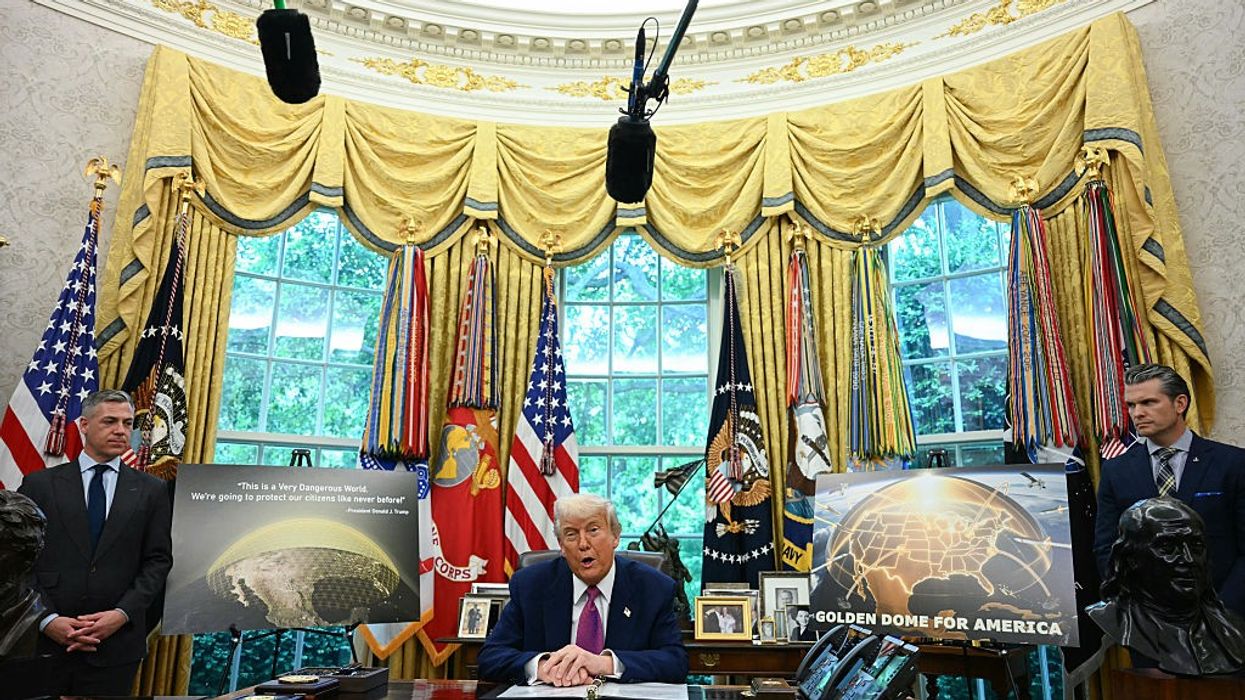
Of course, one way to prevent the ultimate brawl between the Big Five and the emerging tech firms would be to feed them both with ample funding — but that would require a Pentagon budget that would soar well beyond the present trillion-dollar mark. There are, of course, some projects that could benefit both factions, ranging from Donald Trump’s pet Golden Dome missile defense scheme, which could incorporate hardware from the Big Five with software from the emerging tech firms, to Boeing’s new F-47 combat aircraft program, which calls for unpiloted “wing men” likely to be produced by Anduril or another military tech firm. So, the question of confrontation versus cooperation between the new and old guard in the military sector has yet to be settled. If the rival firms end up turning their lobbying resources against each other and going for each other’s proverbial throats, it could weaken their grip on the rest of us and perhaps reveal useful information that might undermine the authority and credibility of both sides.
But count on one thing: neither sector has the best interests of the public in mind, so we need to prepare to fight back ourselves regardless of how their battle plays out.
Okay, then, what could we possibly do to head off the nightmare scenario of a world run by Peter Thiel, Elon Musk, and crew? First, we’ll need the kind of “alert and knowledgeable” citizenry that Dwight D. Eisenhower pointed to so long ago as the only antidote to an ever more militarized society. That would mean concerted efforts by both the public and the government (which would, of course, have to be run by someone unlike Donald J. Trump — already a project in itself!).
At the moment, the tech sector is indeed increasingly embedded in the Trump administration and he owes a number of them a distinct debt of gratitude for helping him over the top in the 2024 election. Despite his very public and bitter falling out with fellow narcissist Elon Musk, the influence of the tech sector within his administration remains all too strong, starting with Vice President J.D. Vance, who owes his career to the employment, mentoring, and financial support of Silicon Valley militarist Peter Thiel. And don’t forget that a substantial cohort of former employees of Palantir and Anduril have already been given key posts in this administration.
Creating a counterweight to those new-age militarists will require a full-scale societal effort, including educators, scientists, and technologists, the labor movement, non-tech business leaders, and activists of all stripes. Silicon Valley workers did, in fact, organize a number of protests against the militarization of their handiwork before being beaten back. Now, a new wave of such activism is all too desperately needed.
Just as many of the scientists who helped build the atomic bomb spent their post-Hiroshima and Nagasaki lives trying to rein in or abolish nuclear weapons, a cohort of scientists and engineers in the tech sector needs to play a leading role in beginning to craft guardrails to limit the military uses of the technologies they helped develop. Meanwhile, the student movement against the use of U.S. weapons in Gaza has begun to expand its horizons to target the militarization of universities writ large. In addition, environmentalists need to double down on criticisms of the immense energy requirements needed to power AI and crypto, while labor leaders need to reckon with the consequences of AI destroying jobs in the military and civilian sectors alike. And all of this has to happen in the context of a far greater technological literacy, including among congressional representatives and workers in government agencies charged with regulating the suppliers of new military technologies.
None of that is, of course, likely to happen except in the context of a resurgence of democracy and a committed effort to fulfill the unmet rhetorical promises that undergird the myth of the American dream. And speaking of contexts, here’s one that anybody preparing to protest the further militarization of this society should take into account: contrary to the belief of many key figures from the Pentagon to Wall Street to Main Street, the peak of American military and economic power has indeed passed, never to return. The only rational course is to craft policies that maintain American influence in the context of a world where power has been defused and cooperation is all too essential.
Such a view, of course, is the polar opposite of the bombastic, bullying approach of the Trump administration, which, if it persists, will only accelerate American decline. And in that context, the key question is whether the widespread harm inherent in the new budget bill — which will only continue to wildly enrich the Pentagon and big arms firms of both kinds, while hitting the rest of us across the political spectrum — could prompt a new surge of public engagement and a genuine debate about what kind of world we want to live in and how this country could play a constructive (rather than destructive) role in bringing it about.
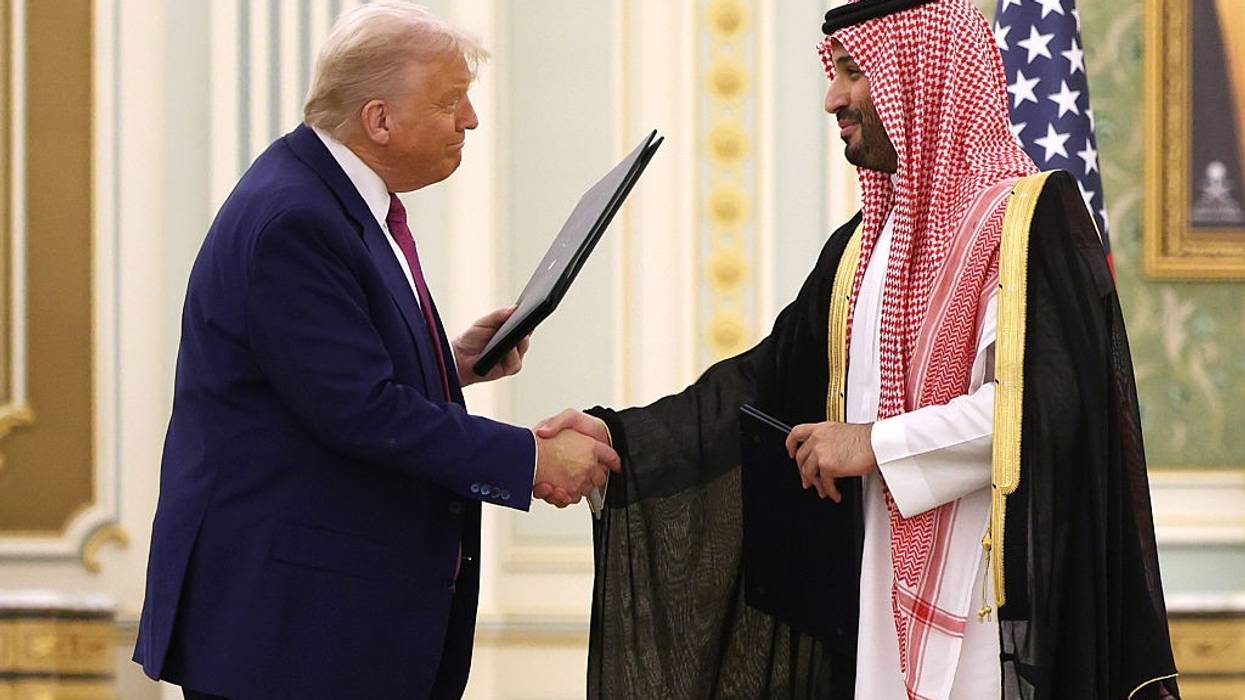
"I like him a lot," Trump said of Saudi Crown Prince Mohammed bin Salman, a prolific human rights violator. "I like him too much."
In what the White House described as "the largest defense sales agreement in history," U.S. President Donald Trump on Tuesday announced a deal for prolific human rights violator Saudi Arabia to purchase $142 billion worth of arms from a dozen different American companies.
The White House unveiled the sale as Trump visited Saudi leaders including Crown Prince Mohammed bin Salman in the kingdom's capital city of Riyadh on the first leg of a Mideast tour, with stops also scheduled in Qatar and the United Arab Emirates.
A fact sheet published by the executive office said the arms sale involves "air force advancement and space capabilities, air and missile defense, maritime and coastal security, border security and land forces modernization, and information and communication systems upgrades."
"Oh, what I do for the crown prince."
Reuters reported that military-industrial complex titans including Lockheed Martin, RTX—formerly Raytheon—Boeing, Northrop Grumman, and General Atomics are involved in the deal. The U.S. and Saudi Arabia reportedly discussed the potential sale of Lockheed Martin F-35 fighter jets to the kingdom, but it remains unclear if the Trump administration will allow the transfer of the highly advanced warplanes.
The agreement is part of a broader Saudi commitment to invest $600 billion in the United States, which the White House said will "strengthen our energy security, defense industry, technology leadership, and access to global infrastructure and critical minerals."
Trump and his relatives, including son-in-law Jared Kushner, enjoy close personal and financial relations with the Saudi royal family, which has poured billions of dollars into their business ventures.
During a signing ceremony, Trump—who apparently fell asleep during the proceedings—joked that the Saudis should invest $1 trillion.
Business leaders including Tesla and SpaceX CEO Elon Musk—who is also the de facto Department of Government Efficiency chief—OpenAI CEO Sam Altman, IBM CEO Arvind Krishna, CitiGroup CEO Jane Fraser, and the heads of investment firms including BlackRock, Franklin Templeton, and Blackstone Group also traveled to Saudi Arabia.
Critics including congressional progressives and anti-war groups have long opposed U.S. arms sales to Saudi Arabia, which stands accused of a litany of human rights violations including bombing and starving civilians in Yemen, massacring African migrants, and the 2018 murder of journalist and U.S. resident Jamal Khashoggi.
In 2019, during Trump's first term, Congress passed three bipartisan bills aimed at blocking an $8 billion arms sale to Saudi Arabia and its coalition partner in the U.S.-backed war on Yemen, the United Arab Emirates. Trump vetoed the legislation. His successor, former President Joe Biden, paused U.S. arms transfers to Saudi Arabia and the UAE but subsequently lifted the freeze despite pleas from human rights defenders.
The record arms sale comes amid Trump's effort to broker a diplomatic normalization deal between Saudi Arabia and Israel. The president is no longer demanding that the Saudis normalize relations with Israel as a precondition for a civilian nuclear cooperation deal, a move that reportedly alarmed Israel's far-right government.
Trump lavished praise on the Saudi monarchy in a rambling speech in Riyadh on Tuesday, hailing bin Salman as an "incredible man."
Trump gushes over MBS: "We have great partners in the world, but we have none stronger and nobody like the gentleman right before me. He's your greatest representative. And if I didn't like him, I'd get out of here so fast. He knows me well. I do. I like him a lot. I like him too much."
[image or embed]
— Aaron Rupar (@atrupar.com) May 13, 2025 at 9:01 AM
"We have great partners in the world, but we have none stronger, and nobody like the gentleman that's right before me, he's your greatest representative, your greatest representative," Trump said. "And if I didn't like him, I would get out of here so fast. You know that don't you? He knows me well."
"I do, I like him a lot. I like him too much, that's why we give so much, you know?" the president continued. "Too much. I like you too much!"
"Oh, what I do for the crown prince," he added.
Trump also announced that the U.S. would lift sanctions on Syria and restore relations with the country's new government, a move the peace group CodePink called "good news."
"The bad news is he's making new arms deals with Saudi Arabia, jeopardizing diplomacy with Iran, and continuing to ignore the U.S. and Israel's genocide in Gaza as they drop bombs on hospitals," the group added.

A new force — Silicon Valley startup culture — has entered the fray, and the military-industrial complex equation is suddenly changing dramatically.
Last April, in a move generating scant media attention, the Air Force announced that it had chosen two little-known drone manufacturers — Anduril Industries of Costa Mesa, California, and General Atomics of San Diego — to build prototype versions of its proposed Collaborative Combat Aircraft (CCA), a future unmanned plane intended to accompany piloted aircraft on high-risk combat missions. The lack of coverage was surprising, given that the Air Force expects to acquire at least 1,000 CCAs over the coming decade at around $30 million each, making this one of the Pentagon’s costliest new projects. But consider that the least of what the media failed to note. In winning the CCA contract, Anduril and General Atomics beat out three of the country’s largest and most powerful defense contractors — Boeing, Lockheed Martin, and Northrop Grumman — posing a severe threat to the continued dominance of the existing military-industrial complex, or MIC.
For decades, a handful of giant firms like those three have garnered the lion’s share of Pentagon arms contracts, producing the same planes, ships, and missiles year after year while generating huge profits for their owners. But an assortment of new firms, born in Silicon Valley or incorporating its disruptive ethos, have begun to challenge the older ones for access to lucrative Pentagon awards. In the process, something groundbreaking, though barely covered in the mainstream media, is underway: a new MIC is being born, one that potentially will have very different goals and profit-takers than the existing one. How the inevitable battles between the old and the new MICs play out can’t be foreseen, but count on one thing: they are sure to generate significant political turbulence in the years to come.
The very notion of a “military-industrial complex” linking giant defense contractors to powerful figures in Congress and the military was introduced on January 17, 1961, by President Dwight D. Eisenhower in his farewell address to Congress and the American people. In that Cold War moment, in response to powerful foreign threats, he noted that “we have been compelled to create a permanent armaments industry of vast proportions.” Nevertheless, he added, using the phrase for the first time, “we must guard against the acquisition of unwarranted influence, whether sought or unsought, by the military-industrial complex. The potential for the disastrous rise of misplaced power exists and will persist.”
Ever since, debate over the MIC’s accumulating power has roiled American politics. A number of politicians and prominent public figures have portrayed U.S. entry into a catastrophic series of foreign wars — in Vietnam, Cambodia, Laos, Iraq, Afghanistan, and elsewhere — as a consequence of that complex’s undue influence on policymaking. No such claims and complaints, however, have ever succeeded in loosening the MIC’s iron grip on Pentagon arms procurement. This year’s record defense budget of approximately $850 billion includes $143.2 billion for research and development and another $167.5 billion for the procurement of weaponry. That $311 billion, most of which will be funneled to those giant defense firms, exceeds the total amount spent on defense by every other country on Earth.
Over time, the competition for billion-dollar Pentagon contracts has led to a winnowing of the MIC ecosystem, resulting in the dominance of a few major industrial behemoths. In 2024, just five companies — Lockheed Martin (with $64.7 billion in defense revenues), RTX (formerly Raytheon, with $40.6 billion), Northrop Grumman ($35.2 billion), General Dynamics ($33.7 billion), and Boeing ($32.7 billion) — claimed the vast bulk of Pentagon contracts. (Anduril and General Atomics didn’t even appear on a list of the top 100 contract recipients.)
Typically, these companies are the lead, or “prime,” contractors for major weapons systems that the Pentagon keeps buying year after year. Lockheed Martin, for example, is the prime contractor for the Air Force’s top-priority F-35 stealth fighter (a plane that has often proved distinctly disappointing in operation); Northrop Grumman is building the B-21 stealth bomber; Boeing produces the F-15EX combat jet; and General Dynamics makes the Navy’s Los Angeles-class attack submarines. “Big-ticket” items like these are usually purchased in substantial numbers over many years, ensuring steady profits for their producers. When the initial buys of such systems seem to be nearing completion, their producers usually generate new or upgraded versions of the same weapons, while employing their powerful lobbying arms in Washington to convince Congress to fund the new designs.
Over the years, non-governmental organizations like the National Priorities Project and the Friends Committee on National Legislation have heroically tried to persuade lawmakers to resist the MIC’s lobbying efforts and reduce military spending, but without noticeable success. Now, however, a new force — Silicon Valley startup culture — has entered the fray, and the military-industrial complex equation is suddenly changing dramatically.
Along Came Anduril
Consider Anduril Industries, one of two under-the-radar companies that left three MIC heavyweights in the dust last April by winning the contract to build a prototype of the Collaborative Combat Aircraft. Anduril (named after the sword carried by Aragorn in J.R.R. Tolkien’s The Lord of the Rings) was founded in 2017 by Palmer Luckey, a virtual-reality headset designer, with the goal of incorporating artificial intelligence into novel weapons systems. He was supported in that effort by prominent Silicon Valley investors, including Peter Thiel of the Founders Fund and the head of another defense-oriented startup, Palantir (a name also derived from The Lord of the Rings).
From the start, Luckey and his associates sought to shoulder aside traditional defense contractors to make room for their high-tech startups. Those two companies and other new-fledged tech firms often found themselves frozen out of major Pentagon contracts that had long been written to favor the MIC giants with their bevies of lawyers and mastery of government paperwork. In 2016, Palantir even sued the U.S. Army for refusing to consider it for a large data-processing contract and later prevailed in court, opening the door for future Department of Defense awards.
In addition to its aggressive legal stance, Anduril has also gained notoriety thanks to the outspokenness of its founder, Palmer Luckey. Whereas other corporate leaders were usually restrained in their language when discussing Department of Defense operations, Luckey openly criticized the Pentagon’s inbred preference for working with traditional defense contractors at the expense of investments in the advanced technologies he believes are needed to overpower China and Russia in some future conflict.
Such technology, he insisted, was only available from the commercial tech industry. “The largest defense contractors are staffed with patriots who nevertheless do not have the software expertise or business model to build the technology we need,” Luckey and his top associates claimed in their 2022 Mission Document. “These companies work slowly, while the best [software] engineers relish working at speed. And the software engineering talent who can build faster than our adversaries resides in the commercial sector, not at large defense primes.”
To overcome obstacles to military modernization, Luckey argued, the government needed to loosen its contracting rules and make it easier for defense startups and software companies to do business with the Pentagon. “We need defense companies that are fast. That won’t happen simply by wishing it to be so: it will only happen if companies are incentivized to move” by far more permissive Pentagon policies.
Buttressed by such arguments, as well as the influence of key figures like Thiel, Anduril began to secure modest but strategic contracts from the military and the Department of Homeland Security. In 2019, it received a small Marine Corps contract to install AI-enabled perimeter surveillance systems at bases in Japan and the United States. A year later, it won a five-year, $25 million contract to build surveillance towers on the U.S.-Mexican border for Customs and Border Protection (CBP). In September 2020, it also received a $36 million CBP contract to build additional sentry towers along that border.
After that, bigger awards began to roll in. In February 2023, the Department of Defense started buying Anduril’s Altius-600 surveillance/attack drone for delivery to the Ukrainian military and, last September, the Army announced that it would purchase its Ghost-X drone for battlefield surveillance operations. Anduril is also now one of four companies selected by the Air Force to develop prototypes for its proposed Enterprise Test Vehicle, a medium-sized drone intended to launch salvos of smaller surveillance and attack drones.
Anduril’s success in winning ever-larger Pentagon contracts has attracted the interest of wealthy investors looking for opportunities to profit from the expected growth of defense-oriented startups. In July 2020, it received fresh investments of $200 million from Thiel’s Founders Fund and prominent Silicon Valley investor Andreessen Horowitz, raising the company’s valuation to nearly $2 billion. A year later, Anduril obtained another $450 million from those and other venture capital firms, bringing its estimated valuation to $4.5 billion (double what it had been in 2020). More finance capital has flowed into Anduril since then, spearheading a major drive by private investors to fuel the rise of defense startups — and profit from their growth as it materializes.
The Replicator Initiative
Along with its success in attracting big defense contracts and capital infusions, Anduril has succeeded in convincing many senior Pentagon officials of the need to reform the department’s contracting operations so as to make more room for defense startups and tech firms. On August 28, 2023, Deputy Secretary of Defense Kathleen Hicks, then the department’s second-highest official, announced the inauguration of the “Replicator” initiative, designed to speed the delivery of advanced weaponry to the armed forces.
“[Our] budgeting and bureaucratic processes are slow, cumbersome, and byzantine,” she acknowledged. To overcome such obstacles, she indicated, the Replicator initiative would cut through red tape and award contracts directly to startups for the rapid development and delivery of cutting-edge weaponry. “Our goal,” she declared, “is to seed, spark, and stoke the flames of innovation.”
As Hicks suggested, Replicator contracts would indeed be awarded in successive batches, or “tranches.” The first tranche, announced last May, included AeroVironment Switchblade 600 kamikaze drones (called that because they are supposed to crash into their intended targets, exploding on contact). Anduril was a triple winner in the second tranche, announced on November 13th. According to the Department of Defense, that batch included funding for the Army’s purchase of Ghost-X surveillance drones, the Marine Corps’ acquisition of Altius-600 kamikaze drones, and development of the Air Force’s Enterprise Test Vehicle, of which Anduril is one of four participating vendors.
Just as important, perhaps, was Hicks’ embrace of Palmer Luckey’s blueprint for reforming Pentagon purchasing. “The Replicator initiative is demonstrably reducing barriers to innovation, and delivering capabilities to warfighters at a rapid pace,” she affirmed in November. “We are creating opportunities for a broad range of traditional and nontraditional defense and technology companies… and we are building the capability to do that again and again.”
Enter the Trumpians
Kathleen Hicks stepped down as deputy secretary of defense on January 20th when Donald Trump reoccupied the White House, as did many of her top aides. Exactly how the incoming administration will address the issue of military procurement remains to be seen, but many in Trump’s inner circle, including Elon Musk and Vice President J.D. Vance, have strong ties to Silicon Valley and so are likely to favor Replicator-like policies.
Pete Hegseth, the former Fox News host who recently won confirmation as secretary of defense, has no background in weapons development and has said little about the topic. However, Trump’s choice as deputy secretary (and Hick’s replacement) is billionaire investor Stephen A. Feinberg who, as chief investment officer of Cerberus Capital Management, acquired the military startup Stratolaunch — suggesting that he might favor extending programs like Replicator.
In a sense, the Trump moment will fit past Washington patterns when it comes to the Pentagon in that the president and his Republican allies in Congress will undoubtedly push for a massive increase in military spending, despite the fact that the military budget is already at a staggering all-time high. Every arms producer is likely to profit from such a move, whether traditional prime contractors or Silicon Valley startups. If, however, defense spending is kept at current levels — in order to finance the tax cuts and other costly measures favored by Trump and the Republicans — fierce competition between the two versions of the military-industrial complex could easily arise again. That, in turn, might trigger divisions within Trump’s inner circle, pitting loyalists to the old MIC against adherents to the new one.
Most Republican lawmakers, who generally rely on contributions from the old MIC companies to finance their campaigns, are bound to support the major prime contractors in such a rivalry. But two of Trump’s key advisers, J.D. Vance and Elon Musk, could push him in the opposite direction. Vance, a former Silicon Valley functionary who reportedly became Trump’s running mate only after heavy lobbying by Peter Thiel and other tech billionaires, is likely to be encouraged by his former allies to steer more Pentagon contracts to Anduril, Palantir, and related companies. And that would hardly be surprising, since Vance’s private venture fund, Narya Capital (yes, another name derived from The Lord of the Rings!), has invested in Anduril and other military/space ventures.
Named by Trump to direct the as-yet-to-be-established Department of Government Efficiency, Elon Musk, like Anduril’s Palmer Luckey, fought the Department of Defense to obtain contracts for one of his companies, SpaceX, and has expressed deep contempt for the Pentagon’s traditional way of doing things. In particular, he has denigrated the costly, generally ill-performing Lockheed-made F-35 jet fighter at a time when AI-governed drones are becoming ever more capable. Despite that progress, as he wrote on X, the social media platform he now owns, “some idiots are still building manned fighter jets like the F-35.” In a subsequent post, he added that “manned fighter jets are obsolete in the age of drones anyway.”
His critique of the F-35 ruffled feathers at the Air Force and caused Lockheed’s stock to fall by more than 3%. “We are committed to delivering the world’s most advanced aircraft — the F-35 — and its unrivaled capabilities with the government and our industry partners,” Lockheed declared in response to Musk’s tweets. Over at the Pentagon, Air Force Secretary Frank Kendall had this to say: “I have a lot of respect for Elon Musk as an engineer. He’s not a warfighter, and he needs to learn a little bit more about the business, I think, before he makes such grand announcements as he did.” He then added, “I don’t see F-35 being replaced. We should continue to buy it, and we also should continue to upgrade it.”
President Trump has yet to indicate his stance on the F-35 or other high-priced items in the Pentagon’s budget lineup. He may (or may not) call for a slowdown in purchases of that plane and seek greater investment in other projects. Still, the divide exposed by Musk — between costly manned weapons made by traditional defense contractors and more affordable unmanned systems made by the likes of Anduril, General Atomics, and AeroVironment — is bound to widen in the years to come as the new version of the military-industrial complex only grows in wealth and power. How the old MIC will address such a threat to its primacy remains to be seen, but multibillion-dollar weapons companies are not likely to step aside without a fight. And that fight will likely divide the Trumpian universe.
"If Congress wants to wash itself of conflicts of interest it can start by passing a stock trading ban."
Dozens of U.S. lawmakers and their families bought or sold up to $113 million worth of shares in top Pentagon contractors this year, an analysis published on Wednesday revealed.
The Quincy Institute for Responsible Statecraft found that at least 37 members of Congress and their relatives traded between $24-113 million worth of stock in companies listed on Defense and Security Monitor's Top 100 Defense Contractors index.
As the Quincy Institute noted: "Eight of these members even simultaneously held positions on the Armed Services and Foreign Affairs Committees, the committees overseeing defense policy and foreign relations. Members of Congress that oversee the annual defense bill and are privy to intelligence briefings have an upper hand in predicting future stock prices."
The analysis found that one Democratic congressman accounted for the vast bulk of defense stock trading in 2024.
Rep. Josh Gottheimer of New Jersey traded at least $22 million and as much as $104 million worth of shares in companies on the index, including Microsoft, Northrop Grumman, and IBM. Gottheimer—who said his trades are handled by a third-party firm—sits on both the House Permanent Select Committee on Intelligence and the National Security subcommittee of the Committee on Financial Services.
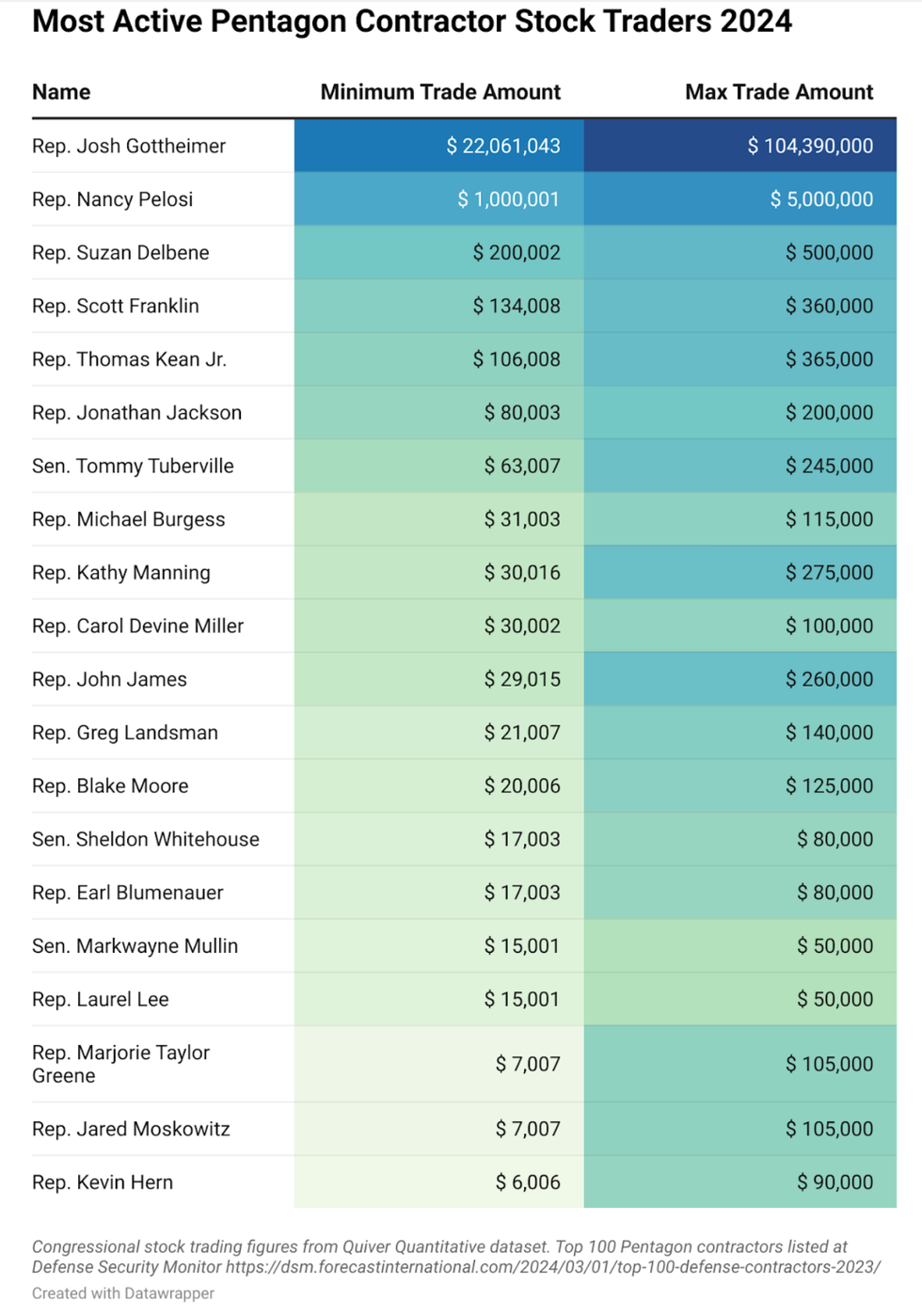 (Image: Quincy Institute for Responsible Statecraft/Datawrapper)
Next on the list in distant second place is former House Speaker Nancy Pelosi (D-Calif.), who has defended stock trading by lawmakers, and according to Quincy, "sold over $1 million worth of Microsoft stock in late July."
"The timing of Pelosi's Microsoft trades in the past have garnered attention, too; in March 2021, she bought Microsoft call options less than two weeks before the Army announced a $22 billion contract with the software company to supply augmented reality headsets," the analysis states.
"Pelosi had the most profitable 2024 of any lawmaker, netting an estimated $38.6 million from all stock trading activity, according to Quiver Quantitative," the report adds.
Pelosi was followed by Reps. Suzan DelBene (D-Wash.), Scott Franklin (R-Fla.), and Thomas Keane Jr. (R-N.J.).
The Quincy Institute asserted: "If Congress wants to wash itself of conflicts of interest it can start by passing a stock trading ban. The Ending Trading and Holdings in Congressional Stocks Act, or ETHICS Act, would prohibit members of Congress from trading individual stocks."
The ETHICS Act was approved by the Democrat-controlled Senate Committee on Homeland Security and Government Affairs in July. The full Senate—which will be GOP-controlled starting next month—has yet to vote on the bill.
Earlier this month, U.S. President Joe Bide n was applauded by progressive lawmakers for backing a ban on congressional stock trading and asserting that "nobody in the Congress should be able to make money in the stock market while they're in the Congress."
On Monday, Biden signed the $895 billion Servicemember Quality of Life Improvement and National Defense Authorization Act for Fiscal Year 2025. As Sen. Bernie Sanders (I-Vt.) has highlighted, "Of that nearly $1 trillion dollars... about half will go to a handful of hugely profitable defense contractors."
Congresswoman Rashida Tlaib (D-Mich.) decried both the enormity of the military budget, as well as the fact that some of her colleagues have profited from investments in the military-industrial complex.
Tlaib has introduced the Stop Politicians Profiting from War Act, which would ban members of Congress, their spouses, and their dependent children from trading defense stocks or having financial interests in companies that do business with the U.S. Department of Defense.
In 2012, Congress passed the Stop Trading on Congressional Knowledge (STOCK) Act, legislation that has been panned as
weak and ineffective.

One issue that has slipped beneath the radar in terms of news coverage is the recent decision by the Biden administration to resume the sale of offensive weapons to Saudi Arabia. For starters, the U.S. will be sending a shipment of bombs worth $750 million in the coming months.
These weapons were cut off by the Biden administration in 2021 because the Saudis were using them in Yemen in their war against the Houthis, killing thousands of civilians.
The resumption of the sale of offensive weapons is part of U.S. efforts to push the Saudis to normalize relations with Israel. In 2020, Bahrain, Morocco, Sudan and the United Arab Emirates (UAE) signed normalization agreements that are collectively known as the Abraham Accords. These deals were brokered primarily by the Trump administration. Some of the countries that signed on, such as the UAE, view the accord not only as a way to bolster trade, but as a military alliance against their historical rival, Iran.
For the Saudis, however, normalization has been pushed off the table by the Israeli assault on Gaza and public sympathy for the Palestinians. A December 2023 survey by the pro-Israel Washington Institute for Near East Policy found that a near unanimous 96 percent of Saudis say that Arab countries should break all contacts with Israel to protest against Israeli attacks in Gaza.
The Saudis say that Israel must first end the war in Gaza and, even more elusive, create a credible pathway to a Palestinian state. Saudi Arabia has told the United States it will not open diplomatic relations with Israel unless it agrees to accept an independent Palestinian state on the internationally-recognized pre-1967 borders, with East Jerusalem as its capital. Such a Palestinian state is precisely what Prime Minister Netanyahu and the Knesset are dead set against.
But U.S. officials still want to push for normalization, and the Biden administration has offered a series of incentives, including negotiating a defense pact and an agreement for civil nuclear cooperation.
The U.S. also wants to build closer Saudi ties to drive a wedge into the peace process between Saudi Arabia and Iran that was brokered by China last year, and to counter the inroads that China is making in the region. More immediately, the U.S. wants Saudi cooperation in repelling Iranian retaliatory attacks on Israel. In mid-April, when Iran retaliated against the April 1 Israeli airstrike that killed a top Revolutionary Guard commander in Syria, the Saudis, along with Jordan and the United Arab Emirates, cooperated with the U.S. and Israel in repelling some 300 missiles and drones that Iran fired on Israel. The Israelis are now bracing for another Iranian response to the killing in Tehran of Hamas political leader Ismael Haniya.
But the arms sales violate the Biden administration’s earlier promises of a new approach to Saudi Arabia that would focus on human rights. In 2020 Biden vowed to treat Crown Prince Mohammed bin Salman, the kingdom’s de facto ruler, as a “pariah,” mainly because of the 2018 assassination of journalist Jamal Khashoggi. Despite recent cosmetic openings like musical concerts and some real reforms like giving women the right to drive and the abolition of the religious police, Saudi Arabia remains one of the most repressive countries in the world. While U.S. officials regularly criticize elections in neighboring Iran, there are no elections in Saudi Arabia. It continues to be one of the last remaining absolute monarchies in the world.
You don’t have to look at the damning reports from groups like Amnesty International and Human Right Watch to see the extent of Saudi repression. Just look at the U.S. State Department’s 2023 human rights report. It talks about extrajudicial killings; enforced disappearance; torture; life-threatening prison conditions; arbitrary arrest and detention; lack of an independent judiciary; punishment of family members for alleged offenses by a relative; violence against journalists and press censorship; serious restrictions on internet freedom, religious freedom and freedom of movement, including the right to leave the country; bans on independent trade unions; violence against gay and transgender persons; and the excessive use of the death penalty.
Remember: this stinging critique is coming from the US government–a major ally of the Saudis.
Sending more weapons to the Saudis will only strengthen this repressive regime and increase regional conflicts. But, of course, it will also increase the profits of weapons companies, such as Lockheed Martin and Northrop Grumman. That, in turn, increases the campaign coffers of our politicians.
So the U.S. government is authorizing the sale of offensive weapons to Saudi Arabia, while it continues to tout itself as the defender of the “free world.” Go figure.

Considering the rising tide of nuclear escalation globally, is it really the right time for this country to invest a fortune of taxpayer dollars in a new generation of devastating “use them or lose them” weapons?
The Pentagon is in the midst of a massive $2 trillion multiyear plan to build a new generation of nuclear-armed missiles, bombers, and submarines. A large chunk of that funding will go to major nuclear weapons contractors like Bechtel, General Dynamics, Honeywell, Lockheed Martin, and Northrop Grumman. And they will do everything in their power to keep that money flowing.
This January, a review of the Sentinel intercontinental ballistic missile (ICBM) program under the Nunn-McCurdy Act — a congressional provision designed to rein in cost overruns of Pentagon weapons programs — found that the missile, the crown jewel of the nuclear overhaul plan involving 450 missile-holding silos spread across five states, is already 81% over its original budget. It is now estimated that it will cost a total of nearly $141 billion to develop and purchase, a figure only likely to rise in the future.
That Pentagon review had the option of canceling the Sentinel program because of such a staggering cost increase. Instead, it doubled down on the program, asserting that it would be an essential element of any future nuclear deterrent and must continue, even if the funding for other defense programs has to be cut to make way for it. In justifying the decision, Deputy Defense Secretary William LaPlante stated: “We are fully aware of the costs, but we are also aware of the risks of not modernizing our nuclear forces and not addressing the very real threats we confront.”
Cost is indeed one significant issue, but the biggest risk to the rest of us comes from continuing to build and deploy ICBMs, rather than delaying or shelving the Sentinel program. As former Secretary of Defense William Perry has noted, ICBMs are “some of the most dangerous weapons in the world” because they “could trigger an accidental nuclear war.” As he explained, a president warned (accurately or not) of an enemy nuclear attack would have only minutes to decide whether to launch such ICBMs and conceivably devastate the planet.
Cost is indeed one significant issue, but the biggest risk to the rest of us comes from continuing to build and deploy ICBMs, rather than delaying or shelving the Sentinel program.
Possessing such potentially world-ending systems only increases the possibility of an unintended nuclear conflict prompted by a false alarm. And as Norman Solomon and the late Daniel Ellsberg once wrote, “If reducing the dangers of nuclear war is a goal, the top priority should be to remove the triad’s ground-based leg — not modernize it.”
This is no small matter. It is believed that a large-scale nuclear exchange could result in more than five billion of us humans dying, once the possibility of a “nuclear winter” and the potential destruction of agriculture across much of the planet is taken into account, according to an analysis by International Physicians for the Prevention of Nuclear War.
In short, the need to reduce nuclear risks by eliminating such ICBMs could not be more urgent. The Bulletin of Atomic Scientists’ “Doomsday Clock” — an estimate of how close the world may be at any moment to a nuclear conflict — is now set at 90 seconds to midnight, the closest it’s been since that tracker was first created in 1947. And just this June, Russian President Vladimir Putin signed a mutual defense agreement with North Korean leader Kim Jong-un, a potential first step toward a drive by Moscow to help Pyongyang expand its nuclear arsenal further. And of the nine countries now possessing nuclear weapons, it’s hardly the only one other than the U.S. in an expansionist phase.
Considering the rising tide of nuclear escalation globally, is it really the right time for this country to invest a fortune of taxpayer dollars in a new generation of devastating “use them or lose them” weapons? The American public has long said no, according to a 2020 poll by the University of Maryland’s Program for Public Consultation, which showed that 61% of us actually support phasing out ICBM systems like the Sentinel.
The Pentagon’s misguided plan to keep such ICBMs in the U.S arsenal for decades to come is only reinforced by the political power of members of Congress and the companies that benefit financially from the current buildup.
Who Decides? The Role of the ICBM Lobby
A prime example of the power of the nuclear weapons lobby is the Senate ICBM Coalition. That group is composed of senators from four states — Montana, North Dakota, Utah, and Wyoming — that either house major ICBM bases or host significant work on the Sentinel. Perhaps you won’t be surprised to learn that the members of that coalition have received more than $3 million in donations from firms involved in the production of the Sentinel over the past four election cycles. Nor were they alone. ICBM contractors made contributions to 92 of the 100 senators and 413 of the 435 house members in 2024. Some received hundreds of thousands of dollars.
The nuclear lobby paid special attention to members of the armed services committees in the House and Senate. For example, Mike Turner, a House Republican from Ohio, has been a relentless advocate of “modernizing” the nuclear arsenal. In a June 2024 talk at the Center for Strategic and International Studies, which itself has received well over a million dollars in funding from nuclear weapons producers, he called for systematically upgrading the nuclear arsenal for decades to come, while chiding any of his congressional colleagues not taking such an aggressive stance on the subject.
Although Turner vigorously touts the need for a costly nuclear buildup, he fails to mention that, with $305,000 in donations, he’s been the fourth-highest recipient of funding from the ICBM lobby over the four elections between 2018 and 2024. Little wonder that he pushes for new nuclear weapons and staunchly opposes extending the New START arms reduction treaty.
In another example of contractor influence, veteran Texas representative Kay Granger secured the largest total of contributions from the ICBM lobby of any House member. With $675,000 in missile contractor contributions in hand, Granger went to bat for the lobby, lending a feminist veneer to nuclear “modernization” by giving a speech on her experience as a woman in politics at Northrop Grumman’s Women’s conference. And we’re sure you won’t be surprised that Granger has anything but a strong track record when it comes to keeping the Pentagon and arms makers accountable for waste, fraud, and abuse in weapons programs. Her X account is, in fact, littered with posts heaping praise on Lockheed Martin and its overpriced, underperforming F-35 combat aircraft.
Other recipients of ICBM contractor funding, like Alabama Congressman Mike Rogers, have lamented the might of the “far-left disarmament community,” and the undue influence of “anti-nuclear zealots” on our politics. Missing from the statements his office puts together and the speeches his staffers write for him, however, is any mention of the $471,000 in funding he’s received so far from ICBM producers. You won’t be surprised, we’re sure, to discover that Rogers has pledged to seek a provision in the forthcoming National Defense Authorization Act to support the Pentagon’s plan to continue the Sentinel program.
Lobbying Dollars and the Revolving Door
The flood of campaign contributions from ICBM contractors is reinforced by their staggering investments in lobbying. In any given year, the arms industry as a whole employs between 800 and 1,000 lobbyists, well more than one for every member of Congress. Most of those lobbyists hired by ICBM contractors come through the “revolving door” from careers in the Pentagon, Congress, or the Executive Branch. That means they come with the necessary tools for success in Washington: an understanding of the appropriations cycle and close relations with decision-makers on the Hill.
During the last four election cycles, ICBM contractors spent upwards of $226 million on 275 extremely well-paid lobbyists. For example, Bud Cramer, a former Democratic congressman from Alabama who once sat on the defense subcommittee of the House Appropriations Committee, netted $640,000 in fees from Northrop Grumman over a span of six years. He was also a cofounder of the Blue Dog Democrats, an influential conservative faction within the Democratic Party. Perhaps you won’t be surprised to learn that Cramer’s former chief of staff, Jefferies Murray, also lobbies for Northrop Grumman.
While some lobbyists work for one contractor, others have shared allegiances. For example, during his tenure as a lobbyist, former Senate Appropriations Committee Chair Trent Lott received more than $600,000 for his efforts for Raytheon, Textron Inc., and United Technologies (before United Technologies and Raytheon merged to form RX Technologies). Former Virginia Congressman Jim Moran similarly received $640,000 from Northrop Grumman and General Dynamics.
Playing the Jobs Card
The argument of last resort for the Sentinel and similar questionable weapons programs is that they create well-paying jobs in key states and districts. Northrop Grumman has played the jobs card effectively with respect to the Sentinel, claiming it will create 10,000 jobs in its development phase alone, including about 2,250 in the state of Utah, where the hub for the program is located.
As a start, however, those 10,000 jobs will help a miniscule fraction of the 167-million-member American workforce. Moreover, Northrop Grumman claims facilities tied to the program will be set up in 32 states. If 2,250 of those jobs end up in Utah, that leaves 7,750 more jobs spread across 31 states — an average of about 250 jobs per state, essentially a rounding error compared to total employment in most localities.
Nor has Northrop Grumman provided any documentation for the number of jobs the Sentinel program will allegedly create. Journalist Taylor Barnes of ReThink Media was rebuffed in her efforts to get a copy of the agreement between Northrop Grumman and the state of Utah that reportedly indicates how many Sentinel-related jobs the company needs to create to get the full subsidy offered to put its primary facility in Utah.
Choosing to fund those ICBMs instead is, in fact, a job killer, not a job creator.
A statement by a Utah official justifying that lack of transparency suggested Northrop Grumman was operating in “a competitive defense industry” and that revealing details of the agreement might somehow harm the company. But any modest financial harm Northrop Grumman might suffer, were those details revealed, pales in comparison with the immense risks and costs of the Sentinel program itself.
There are two major flaws in the jobs argument with respect to the future production of nuclear weapons. First, military spending should be based on security considerations, not pork-barrel politics. Second, as Heidi Peltier of the Costs of War Project has effectively demonstrated, virtually any other expenditure of funds currently devoted to Pentagon programs would create between 9% and 250% more jobs than weapons spending does. If Congress were instead to put such funds into addressing climate change, dealing with future disease epidemics, poverty, or homelessness — all serious threats to public safety — the American economy would gain hundreds of thousands of jobs. Choosing to fund those ICBMs instead is, in fact, a job killer, not a job creator.
Unwarranted Influence in the Nuclear Age
Advocates for eliminating ICBMs from the American arsenal make a strong case. (If only they were better heard!) For example, former Representative John Tierney of the Center for Arms Control and Nonproliferation offered this blunt indictment of ICBMs:
“Not only are intercontinental ballistic missiles redundant, but they are prone to a high risk of accidental use…They do not make us any safer. Their only value is to the defense contractors who line their fat pockets with large cost overruns at the expense of our taxpayers. It has got to stop.”
The late Daniel Ellsberg made a similar point in a February 2018 interview with the Bulletin of the Atomic Scientists:
“You would not have these arsenals, in the U.S. or elsewhere, if it were not the case that it was highly profitable to the military-industrial complex, to the aerospace industry, to the electronics industry, and to the weapons design labs to keep modernizing these weapons, improving accuracy, improving launch time, all that. The military-industrial complex that Eisenhower talked about is a very powerful influence. We’ve talked about unwarranted influence. We’ve had that for more than half a century.”
Given how the politics of Pentagon spending normally work, that nuclear weapons policy is being so heavily influenced by individuals and organizations profiting from an ongoing arms race should be anything but surprising. Still, in the case of such weaponry, the stakes are so high that critical decisions shouldn’t be determined by parochial politics. The influence of such special interest groups and corporate weapons-makers over life-and-death issues should be considered both a moral outrage and perhaps the ultimate security risk.
Isn’t it finally time for the executive branch and Congress to start assessing the need for ICBMs on their merits, rather than on contractor lobbying, weapons company funding, and the sort of strategic thinking that was already outmoded by the end of the 1950s? For that to happen, our representatives would need to hear from their constituents loud and clear.

"Congress must put an end to this form of corporate welfare," the senator said, arguing that one new way to do that involves reviving an old policy.
U.S. Sen. Bernie Sanders has a novel way to stop military-industrial complex profiteers from "bilking the American people"—and it's actually over 80 years old.
In an article published Tuesday in The Atlantic, Sanders (I-Vt.) called for a revived Truman Committee—a World War II-era bipartisan congressional panel "designed to rein in defense contractors, closely oversee military contracts, and take back excessive payments."
"America's national priorities are badly misplaced," the senator asserted. "Our country spends, with almost no debate, nearly $1 trillion a year on the military while at the same time ignoring massive problems at home. We apparently have unlimited amounts of money for nuclear weapons, fighter planes, bombs, and tanks. But somehow we can't summon the resources to provide healthcare for all, childcare, affordable housing, and other basic needs."
"The United States remains the world's dominant military power," the senator continued. "Alone, we account for roughly 40% of global military spending; the U.S. spends more on its military than the next 10 countries combined, most of whom are allies. Last year, we spent more than three times what China spent on its military."
Sanders noted that nearly half of the approximately $900 billion the U.S. will allocate for military spending this year "will go to a handful of huge defense contractors enjoying immense profits," with many weapons companies profiting handsomely off sales to Ukraine, which is struggling to repel a two-year Russian invasion.
In what Sanders called a "particularly egregious example" of war profiteering, RTX Corporation—formerly Raytheon—has increased the price of its Stinger shoulder-launched surface-to-air missiles by 600% to $400,000 since the early 1990s.
The senator continued:
It's not just RTX. The stocks of American arms manufacturers have surged: Northrop Grumman's share price increased 40% by the end of 2022, and Lockheed Martin's by 37%. In 2022, the federal government awarded Lockheed Martin more than $45 billion in unclassified contracts. The company returned about one-quarter of that amount to shareholders through dividends and stock buybacks, and paid its CEO $25 million.
"There's a name for all this: war profiteering. There's a solution too," Sanders stressed. "Congress should resurrect the Truman Committee."
"These companies' greed is not just fleecing the American taxpayer; it's killing Ukrainians," he contended. "A contractor padding its profit margins means that fewer weapons reach Ukrainians on the frontlines. Corporate greed is helping [Russian President] Vladimir Putin."
Sanders highlighted the U.S. Department of Defense's six consecutive failed audits, including the most recent one last December, in which the Pentagon was unable to fully account for nearly two-thirds of its $3.8 trillion in assets.
"It should therefore come as no surprise that defense contractors routinely overcharge the Pentagon—and the American taxpayer—by nearly 40-50%," he wrote. "One company, TransDigm, overcharged by 4,451%."
"But despite billions in fines for fraud or misconduct, the contracts never seem to dry up," Sanders said. "That may be down to America's system of legalized bribery: A share of the profits from these lucrative contracts will flow back to politicians who gladly accept millions in campaign contributions to make sure the defense budget is always flush."
"According to the watchdog group OpenSecrets, defense contractors spent nearly $140 million lobbying the federal government last year," he noted. "Millions of dollars more go directly to members of Congress in campaign contributions from companies, individuals, and political action committees linked to the defense industry."
"Congress must put an end to this form of corporate welfare," Sanders argued. "The best way to do that is to reinstate the Truman Committee on war profiteering so that we can end corporate greed in the defense industry. A windfall profits tax could help achieve this end as well."

"As the Biden administration attempts to deny the death toll of Israel's campaign of mass murder in Gaza and sell genocide as a stimulus for the U.S. economy, these are the death merchants profiting from the war machine."
With more than 7,300 Palestinians killed so far in Israel's three-week bombardment of Gaza, a series of reports this week have exposed how U.S. weapon-makers and billionaire donors are enabling what legal scholars say could amount to genocide.
After Israel declared war in response to Hamas killing over 1,400 Israelis and taking around 200 hostages, the stocks of major American and European war profiteers soared. A Thursday report from Eyes on the Ties—the news site of LittleSis and Public Accountability Initiative—targets five U.S. firms with a record of providing weaponry to Israel.
The outlet stressed that while announcing a supplemental funding request that includes $14.3 billion for Israel, U.S. President Joe Biden last week "invoked 'patriotic American workers' who are 'building the arsenal of democracy and serving the cause of freedom,' but it's the defense company CEOs who rake in tens of millions a year, and Wall Street shareholders, who are the real beneficiaries of warmongering."
The five targeted industry giants collectively recorded $196.5 billion in military-related revenue last year, Eyes on the Ties reported. They are Boeing ($30.8 billion), General Dynamics ($30.4 billion), Lockheed Martin ($63.3 billion), Northrop Grumman ($32.4 billion), and RTX, formerly Raytheon ($39.6 billion).
"The top shareholders in these five defense companies largely consist of big asset managers, or big banks with asset management wings, that include BlackRock, Vanguard, State Street, Fidelity, Capital Group, Wellington, JPMorgan Chase, Morgan Stanley, Newport Trust Company, Longview Asset Management, Massachusetts Financial Services Company, Geode Capital, and Bank of America," the news outlet noted.
Eyes on the Ties also highlighted how chief executives are handsomely compensated—and the CEOs' ties to Big Pharma, the fossil fuel industry, Wall Street, and foreign policy think tanks such as the Council on Foreign Relations and Center for Strategic and International Studies.
According to the report:
Other reporting this week has taken aim at those CEOs for their suggestions that Israel's assault on Gaza is good for business.
During Lockheed Martin's latest earnings call, Taiclet correctly predicted Biden's request last week, saying that "there continues to be the option... for supplemental requests related to support Ukraine, Israel, and potentially Taiwan."
In addition to the request for Israel—which already gets nearly $4 billion in annual U.S. military aid—Biden asked for $4 billion to counter Chinese influence in the Indo-Pacific region and $61.4 billion more for
Ukraine, which is battling a Russian invasion.
"We are all witnessing significant geopolitical tensions across the globe, including the ongoing war in Ukraine and the horrific attacks in Israel," Warden said during Northrop Grumman's Thursday earnings call, according to VICE. "As we saw last week, the [Biden] administration continues to make supplemental requests for urgent needs, including those in Ukraine and Israel, to include investments in weapons systems and defense industrial base readiness."
As The Lever reported:
"The Israel situation obviously is a terrible one, frankly, and one that's just evolving as we speak," said Jason Aiken, chief financial officer and executive vice president at General Dynamics, on Wednesday. "But I think if you look at the incremental demand potential coming out of that, the biggest one to highlight and that really sticks out is probably on the artillery side."
He continued: "Obviously that's been a big pressure point up to now with Ukraine, one that we've been doing everything we can to support our Army customer. We've gone from 14,000 rounds per month to 20,000 very quickly. We're working ahead of schedule to accelerate that production capacity up to 85,000, even as high as 100,000 rounds per month, and I think the Israel situation is only going to put upward pressure on that demand."
Last week, roughly 100 activists gathered outside of General Dynamics' weapons plant in Pittsfield, Massachusetts, to protest the Israeli war, holding signs with slogans like, "Genocide: Brought To You By General Dynamics."
Both The Lever and VICE also pointed out that during RTX's Tuesday call, Hayes started by "acknowledging the tragic situation playing out in Israel" before turning to "an update on our end markets."
If Congress approves Biden's request for Israel, VICE explained, "some of the money would be used to restock Israel's Iron Dome rocket defense system, which RTX manufactured." Hayes said: "I think really across the entire Raytheon portfolio, you're going to see a benefit of this restocking. On top of what we think is going to be an increase in [U.S. Department of Defense] top line."
It's not just defense executives enabling Israel's mass slaughter of civilians in Gaza. As Eyes on the Ties reported, "Lobbying groups including the American Israel Public Affairs Committee (AIPAC) and Democratic Majority for Israel have been active in Washington, calling on lawmakers to send money and weapons to Israel."
The report names some billionaire donors to the lobbying groups, including New England Patriots and the Kraft Group CEO Robert Kraft, private equity investor Marc Rowan, venture capitalist Gary Lauder, hedge fund managers Daniel Loeb and Paul Singer, and Home Depot co-founder Bernard Marcus, who is also the founding president of the Israel Democracy Institute.
U.S. Rep. Summer Lee (D-Pa.) said Wednesday that Americans "know that funneling billions more dollars into arms dealers' pockets won't keep our children safe from weapons of war at home or across the world. It won't keep our loved ones safe from toxins in our air and drinking water. They know that lining the pockets of weapons manufacturers won't help families struggling to afford housing, medicine, or grocery costs. They know defense contractors won't safeguard Medicare and Social Security or shield our communities against the climate crisis."
Unlike the CEOs of firms like Lockheed Martin and RTX, "moms who can't afford childcare, young folks who can't pay off their debt, veterans who can't keep up with housing costs, and children who go to school hungry don't have million-dollar lobbying budgets," added Lee, one of the few members of Congress pushing for a cease-fire in Gaza. "So it's up to us to stand up for their needs."

"As countries need to replenish their weapons, we do think defense companies will do very well," said one expert.
"War is good for business."
That's what one defense executive said at a London arms conference last month, and what the stock market reflected on Monday, as Israel blockaded and bombarded the Gaza Strip—bombing the occupied Palestinian territory's main university, residential buildings, a refugee camp, and a major hospital—in response to Hamas' weekend attack that killed hundreds of Israelis.
The United States, which already gives Israel $3.8 billion in annual military assistance, is now preparing to send additional weaponry and other support. Meanwhile, the stocks of U.S. and European firms that make money off of war soared on Monday.
U.S. companies including Lockheed Martin, Northrop Grumman, and RTX—previously known as Raytheon—were all affected, as were top British, French, Germany, and Italian firms, according to The Wall Street Journal.
Fox Business reported that "shares of General Dynamics, which makes submarines and combat vehicles, rose the most since March 2020 when it gained over 9%."
"Lockheed Martin's stock jump Monday was the biggest for the U.S.' largest defense contractor on a non-earnings day since March 2020, narrowly topping the gains it notched immediately after Russia launched its full-scale invasion of Ukraine," Forbes noted. "Northrop Grumman shares also had their best day since 2020."
Barron's pointed out that "separately, Lockheed's board on Friday approved the expansion of Lockheed's stock repurchase program by $6 billion, and the company raised its quarterly dividend to $3.15 a share from $3."
Commenting on the bloodshed in Israel and Gaza over the past few days, Sameer Samana, senior global market strategist at Wells Fargo Investment Institute, told MarketWatch that "clearly it's a huge human tragedy."
"It seems like we're entering a different phase globally with respect to geopolitics," he added, with conflicts appearing more likely compared with recent decades. "As countries need to replenish their weapons, we do think defense companies will do very well."
Less than two months after Russia's invasion last year, William Hartung, a senior research fellow at the Quincy Institute for Responsible Statecraft, highlighted how such conflicts benefit the arms industry, writing for TomDispatch that "the war in Ukraine will indeed be a bonanza for the likes of Raytheon and Lockheed Martin."
"First of all, there will be the contracts to resupply weapons like Raytheon's Stinger anti-aircraft missile and the Raytheon/Lockheed Martin-produced Javelin anti-tank missile that Washington has already provided to Ukraine by the thousands," he explained. "The bigger stream of profits, however, will come from assured post-conflict increases in national security spending here and in Europe justified, at least in part, by the Russian invasion and the disaster that's followed."
Last December, in Forbes, Hartung warned against using the Russia-Ukraine war to permanently expand the weapons industry:
Plans that have been floated so far include building new weapons factories, dramatically boosting production of ammunition, anti-tank weapons, and other systems, and easing oversight of weapons procurement. These changes will come at a cost that over time will run into tens of billions of dollars above current spending plans, and possibly more—much more.
This drive to rapidly expand the size and reach of the military-industrial complex is both unnecessary and unwise. The rush to do so while reducing existing safeguards against waste and poor performance risks promoting price gouging and substandard production even as it ties up funds that could be used more effectively on other urgent priorities.
Oil prices also climbed on Monday in response to the violence in the Middle East.
The Associated Press explained that "the area under conflict is not home to major oil production, but fears that the fighting could spill into the politics around the crude market sent a barrel of U.S. oil up 4.1% to $86.16. Brent crude, the international standard, rose 3.9% to $87.91 per barrel."

"These tax breaks are nothing but corporate handouts," the lawmakers said in a letter to the CEOs of four military-industrial complex giants.
A pair of Democratic U.S. lawmakers on Wednesday sent a letter to the CEOs of four of the largest corporations in the military-industrial complex asking how their firms would benefit from Republicans' proposed expansion of a Trump-era tax cut under which the companies stand to save billions of dollars.
In their letter to heads of Raytheon, General Dynamics, Lockheed Martin, and Northrop Grumman, Sen. Elizabeth Warren (D-Mass.) and Rep. Chris Deluzio (D-Penn.) took aim at Republican efforts to extend provisions of the nearly $2 trillion Tax Cuts and Jobs Act (TCJA), signed into law by then-President Donald Trump in 2017.
One of those provisions, the so-called research and experimentation (R&E) deduction, would give the weapon-makers billions of dollars in retroactive tax breaks.
"A revival of the R&E tax break would add to the billions in savings your companies have already received from the 2017 Trump tax cuts."
" House Republicans, thanks to aggressive lobbying by Northrop Grumman, are trying to extend these tax giveaways while continuing to demand massive cuts to critical government programs relied on by millions of Americans," the letter states.
"A revival of the R&E tax break would add to the billions in savings your companies have already received from the 2017 Trump tax cuts, but it is far from clear if that is the best use of taxpayer dollars," the lawmakers continued. "As Congress continues to debate corporate tax reform and government funding levels—including proposals for further corporate tax giveaways, large increases [in] military spending, and cuts to other critical government programs—we should understand how your company and other massive corporations will be rewarded."
The lawmakers noted that Raytheon, Lockheed Martin, and Northrop Grumman have acknowledged they would save between $500 million and $2 billion for 2022 alone if the R&E deduction is retroactively extended.
"These tax breaks are nothing but corporate handouts," the letter asserts. "Meanwhile, Republicans plan on paying for their bill by gutting the clean energy credits passed through the Inflation Reduction Act. These energy credits will help grow the U.S. economy up to $200 billion and create up to 1.3 million jobs nationally by 2030, mainly by incentivizing investments in research and domestic manufacturing."
On Wednesday, Warren—who last month partnered with Sen. Mike Braun (R-Ind.) and Rep. Mike Garamendi (D-Calif.) to reintroduce legislation to crack down on price gouging by military contractors—led a Senate Armed Services Committee hearing on what she called "the need to root out waste" and profiteering.
The Biden administration is asking Congress to authorize $886 billion in military spending in the 2024 National Defense Authorization Act, which was passed by the GOP-controlled House of Representatives earlier this month. The bill is currently before the Senate.
Speaking on the Senate floor Wednesday, Sen. Bernie Sanders (I-Vt.)—who earlier said he would vote against the measure—"in the richest country on Earth, we do not need to force false choices. We can fund critical domestic priorities while maintaining a strong military, caring for our veterans, and getting Ukraine what it needs."
"But it will require the wealthy and corporations to pay their fair share in taxes, and it will require members of Congress to care less about the profits of Lockheed Martin, Boeing, or Raytheon, and more about the needs of working people," Sanders added. "Now is the time to rethink what we value as a society and to fundamentally transform our national priorities."