SUBSCRIBE TO OUR FREE NEWSLETTER
Daily news & progressive opinion—funded by the people, not the corporations—delivered straight to your inbox.
5
#000000
#FFFFFF
To donate by check, phone, or other method, see our More Ways to Give page.
Daily news & progressive opinion—funded by the people, not the corporations—delivered straight to your inbox.
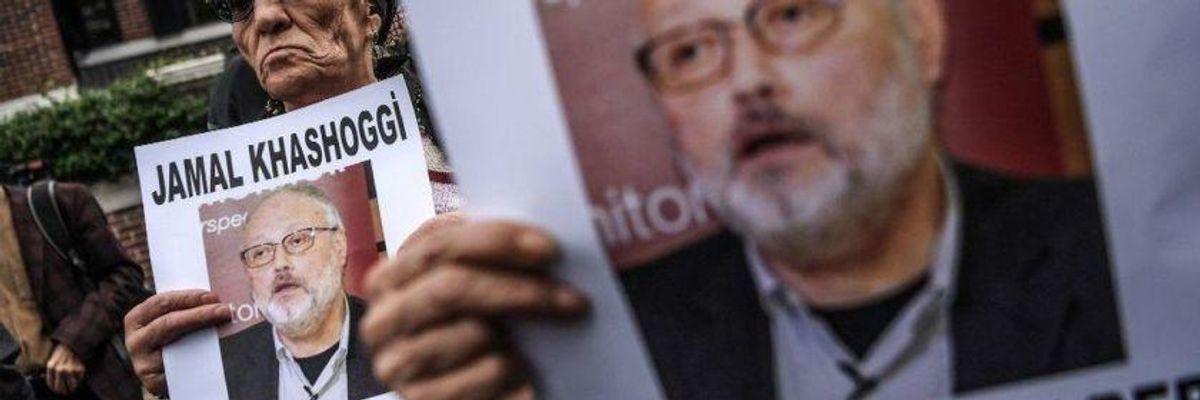
Protesters rally outside the Saudi Arabia Consulate in Istanbul, Turkey, where journalist Jamal Khashoggi was killed October 2, 2018.
"Without meaningful accountability," said one advocate, "returning to business as usual after Khashoggi's murder will imperil free expression beyond Saudi Arabia."
Human rights advocates on Monday condemned the continued failure of international officials to hold accountable the people responsible for journalist Jamal Khashoggi's murder—including those at the top of Saudi Arabia's government—as his former colleagues and loved ones marked the fifth anniversary of the brutal killing.
Amnesty International secretary general Agnes Callamard was serving as the United Nations special rapporteur on extrajudicial, summary, or arbitrary executions at the time of Khashoggi's murder at the Saudi consulate in Istanbul on October 2, 2018, and authored a report in 2019 that stated his death was "a pre-meditated extrajudicial killing for which the state of Saudi Arabia is responsible."
On Monday, Callamard said that with European and U.S. officials having reopened diplomatic relations with Saudi Arabia, "the path to justice for his killing remains fully blocked."'
"Khashoggi's enforced disappearance, torture, and extrajudicial execution are crimes under international law, which must be urgently investigated and may be prosecuted by any state through universal jurisdiction," said Callamard. "It is appalling that instead of pushing for justice for his murder, the international community continues to roll out the red carpet for Saudi Arabia's leaders at any opportunity, placing diplomatic and economic interests before human rights."
Two years after the U.N.'s analysis of Khashoggi's killing, the U.S. released an intelligence report showing that Saudi Crown Prince Mohammed bin Salman personally approved the murder, in which 15 high-level agents flew to Istanbul to carry out the "capture or kill" operation.
The release of the report signaled to many at the time that the Biden administration was prepared to hold the Saudi government to account for killing Khashoggi, who wrote critically about the repressive regime as a Washington Post columnist.
But as Democracy for the Arab World Now (DAWN), a nonprofit founded by Khashoggi, noted Monday, while some U.S. lawmakers have "maintained their commitment to accountability," the U.S. has since expanded arm sales and offered a security guarantee to the Saudis in exchange for normalized relations with Israel. British and French leaders have also reopened friendly relations with bin Salman, appearing to accept the crown prince's claim that unspecified individuals have been "prosecuted" for the killing.
"We need to connect the dots and understand that failing to hold Saudi Arabia accountable for the extraterritorial murder of Khashoggi encourages other governments to believe that they too can get away with it, which is exactly what India's reported murder of a Canadian citizen this year demonstrates," said Sarah Leah Whitson, executive director of DAWN. "If democratic governments fail to protect journalists and activists living in their own countries from foreign attacks, our own press and societies will be the victims, and our own democracies will lose."
The group expressed gratitude for efforts by civil society groups and local governments to honor Khashoggi's memory and his family's fight for justice, including the unveiling of Jamal Khashoggi Square across from the Saudi Consulate in Los Angeles on Monday evening. Whitson and DAWN advocacy director Raed Jarrar were scheduled to deliver remarks.
"Five years after this heinous crime, we persist in demanding justice and accountability from the Saudi government and are moved by the global efforts to commemorate Khashoggi's life and legacy," said Whitson. "If the Saudi government spent a fraction of the billions it is spending to sanitize its disastrous human rights record on real reforms and accountability, everyone—from Saudi citizens to people around the world—would be better off."
Lamenting that there is "still no justice" for the journalist, Amnesty reiterated its call "for an international, independent, and impartial investigation into Khashoggi's killing," with those responsible brought to justice in fair trials.
The group was among those noting that while the murder has been largely brushed aside by authorities around the world, the Saudi government is continuing its "relentless crackdown on freedom of speech with complete impunity," including a death sentence for a retired teacher in July over social media posts in which he criticized the human rights record and corruption of the kingdom.
"Five years after Jamal Khashoggi's brutal murder, there has been no justice and no meaningful accountability, with dire consequences for writers worldwide," said Justin Shilad, Middle East and North Africa research and advocacy lead for free expression advocacy group PEN America. "Under Crown Prince Mohammed bin Salman, Saudis are being sentenced to death or decades in prison for social media posts. Beyond the kingdom's borders, the lack of justice in Khashoggi's case has laid the groundwork for transnational repression becoming institutionalized worldwide."
"Without meaningful accountability," said Shilad, "returning to business as usual after Khashoggi's murder will imperil free expression beyond Saudi Arabia."
Dear Common Dreams reader, It’s been nearly 30 years since I co-founded Common Dreams with my late wife, Lina Newhouser. We had the radical notion that journalism should serve the public good, not corporate profits. It was clear to us from the outset what it would take to build such a project. No paid advertisements. No corporate sponsors. No millionaire publisher telling us what to think or do. Many people said we wouldn't last a year, but we proved those doubters wrong. Together with a tremendous team of journalists and dedicated staff, we built an independent media outlet free from the constraints of profits and corporate control. Our mission has always been simple: To inform. To inspire. To ignite change for the common good. Building Common Dreams was not easy. Our survival was never guaranteed. When you take on the most powerful forces—Wall Street greed, fossil fuel industry destruction, Big Tech lobbyists, and uber-rich oligarchs who have spent billions upon billions rigging the economy and democracy in their favor—the only bulwark you have is supporters who believe in your work. But here’s the urgent message from me today. It's never been this bad out there. And it's never been this hard to keep us going. At the very moment Common Dreams is most needed, the threats we face are intensifying. We need your support now more than ever. We don't accept corporate advertising and never will. We don't have a paywall because we don't think people should be blocked from critical news based on their ability to pay. Everything we do is funded by the donations of readers like you. When everyone does the little they can afford, we are strong. But if that support retreats or dries up, so do we. Will you donate now to make sure Common Dreams not only survives but thrives? —Craig Brown, Co-founder |
Human rights advocates on Monday condemned the continued failure of international officials to hold accountable the people responsible for journalist Jamal Khashoggi's murder—including those at the top of Saudi Arabia's government—as his former colleagues and loved ones marked the fifth anniversary of the brutal killing.
Amnesty International secretary general Agnes Callamard was serving as the United Nations special rapporteur on extrajudicial, summary, or arbitrary executions at the time of Khashoggi's murder at the Saudi consulate in Istanbul on October 2, 2018, and authored a report in 2019 that stated his death was "a pre-meditated extrajudicial killing for which the state of Saudi Arabia is responsible."
On Monday, Callamard said that with European and U.S. officials having reopened diplomatic relations with Saudi Arabia, "the path to justice for his killing remains fully blocked."'
"Khashoggi's enforced disappearance, torture, and extrajudicial execution are crimes under international law, which must be urgently investigated and may be prosecuted by any state through universal jurisdiction," said Callamard. "It is appalling that instead of pushing for justice for his murder, the international community continues to roll out the red carpet for Saudi Arabia's leaders at any opportunity, placing diplomatic and economic interests before human rights."
Two years after the U.N.'s analysis of Khashoggi's killing, the U.S. released an intelligence report showing that Saudi Crown Prince Mohammed bin Salman personally approved the murder, in which 15 high-level agents flew to Istanbul to carry out the "capture or kill" operation.
The release of the report signaled to many at the time that the Biden administration was prepared to hold the Saudi government to account for killing Khashoggi, who wrote critically about the repressive regime as a Washington Post columnist.
But as Democracy for the Arab World Now (DAWN), a nonprofit founded by Khashoggi, noted Monday, while some U.S. lawmakers have "maintained their commitment to accountability," the U.S. has since expanded arm sales and offered a security guarantee to the Saudis in exchange for normalized relations with Israel. British and French leaders have also reopened friendly relations with bin Salman, appearing to accept the crown prince's claim that unspecified individuals have been "prosecuted" for the killing.
"We need to connect the dots and understand that failing to hold Saudi Arabia accountable for the extraterritorial murder of Khashoggi encourages other governments to believe that they too can get away with it, which is exactly what India's reported murder of a Canadian citizen this year demonstrates," said Sarah Leah Whitson, executive director of DAWN. "If democratic governments fail to protect journalists and activists living in their own countries from foreign attacks, our own press and societies will be the victims, and our own democracies will lose."
The group expressed gratitude for efforts by civil society groups and local governments to honor Khashoggi's memory and his family's fight for justice, including the unveiling of Jamal Khashoggi Square across from the Saudi Consulate in Los Angeles on Monday evening. Whitson and DAWN advocacy director Raed Jarrar were scheduled to deliver remarks.
"Five years after this heinous crime, we persist in demanding justice and accountability from the Saudi government and are moved by the global efforts to commemorate Khashoggi's life and legacy," said Whitson. "If the Saudi government spent a fraction of the billions it is spending to sanitize its disastrous human rights record on real reforms and accountability, everyone—from Saudi citizens to people around the world—would be better off."
Lamenting that there is "still no justice" for the journalist, Amnesty reiterated its call "for an international, independent, and impartial investigation into Khashoggi's killing," with those responsible brought to justice in fair trials.
The group was among those noting that while the murder has been largely brushed aside by authorities around the world, the Saudi government is continuing its "relentless crackdown on freedom of speech with complete impunity," including a death sentence for a retired teacher in July over social media posts in which he criticized the human rights record and corruption of the kingdom.
"Five years after Jamal Khashoggi's brutal murder, there has been no justice and no meaningful accountability, with dire consequences for writers worldwide," said Justin Shilad, Middle East and North Africa research and advocacy lead for free expression advocacy group PEN America. "Under Crown Prince Mohammed bin Salman, Saudis are being sentenced to death or decades in prison for social media posts. Beyond the kingdom's borders, the lack of justice in Khashoggi's case has laid the groundwork for transnational repression becoming institutionalized worldwide."
"Without meaningful accountability," said Shilad, "returning to business as usual after Khashoggi's murder will imperil free expression beyond Saudi Arabia."
Human rights advocates on Monday condemned the continued failure of international officials to hold accountable the people responsible for journalist Jamal Khashoggi's murder—including those at the top of Saudi Arabia's government—as his former colleagues and loved ones marked the fifth anniversary of the brutal killing.
Amnesty International secretary general Agnes Callamard was serving as the United Nations special rapporteur on extrajudicial, summary, or arbitrary executions at the time of Khashoggi's murder at the Saudi consulate in Istanbul on October 2, 2018, and authored a report in 2019 that stated his death was "a pre-meditated extrajudicial killing for which the state of Saudi Arabia is responsible."
On Monday, Callamard said that with European and U.S. officials having reopened diplomatic relations with Saudi Arabia, "the path to justice for his killing remains fully blocked."'
"Khashoggi's enforced disappearance, torture, and extrajudicial execution are crimes under international law, which must be urgently investigated and may be prosecuted by any state through universal jurisdiction," said Callamard. "It is appalling that instead of pushing for justice for his murder, the international community continues to roll out the red carpet for Saudi Arabia's leaders at any opportunity, placing diplomatic and economic interests before human rights."
Two years after the U.N.'s analysis of Khashoggi's killing, the U.S. released an intelligence report showing that Saudi Crown Prince Mohammed bin Salman personally approved the murder, in which 15 high-level agents flew to Istanbul to carry out the "capture or kill" operation.
The release of the report signaled to many at the time that the Biden administration was prepared to hold the Saudi government to account for killing Khashoggi, who wrote critically about the repressive regime as a Washington Post columnist.
But as Democracy for the Arab World Now (DAWN), a nonprofit founded by Khashoggi, noted Monday, while some U.S. lawmakers have "maintained their commitment to accountability," the U.S. has since expanded arm sales and offered a security guarantee to the Saudis in exchange for normalized relations with Israel. British and French leaders have also reopened friendly relations with bin Salman, appearing to accept the crown prince's claim that unspecified individuals have been "prosecuted" for the killing.
"We need to connect the dots and understand that failing to hold Saudi Arabia accountable for the extraterritorial murder of Khashoggi encourages other governments to believe that they too can get away with it, which is exactly what India's reported murder of a Canadian citizen this year demonstrates," said Sarah Leah Whitson, executive director of DAWN. "If democratic governments fail to protect journalists and activists living in their own countries from foreign attacks, our own press and societies will be the victims, and our own democracies will lose."
The group expressed gratitude for efforts by civil society groups and local governments to honor Khashoggi's memory and his family's fight for justice, including the unveiling of Jamal Khashoggi Square across from the Saudi Consulate in Los Angeles on Monday evening. Whitson and DAWN advocacy director Raed Jarrar were scheduled to deliver remarks.
"Five years after this heinous crime, we persist in demanding justice and accountability from the Saudi government and are moved by the global efforts to commemorate Khashoggi's life and legacy," said Whitson. "If the Saudi government spent a fraction of the billions it is spending to sanitize its disastrous human rights record on real reforms and accountability, everyone—from Saudi citizens to people around the world—would be better off."
Lamenting that there is "still no justice" for the journalist, Amnesty reiterated its call "for an international, independent, and impartial investigation into Khashoggi's killing," with those responsible brought to justice in fair trials.
The group was among those noting that while the murder has been largely brushed aside by authorities around the world, the Saudi government is continuing its "relentless crackdown on freedom of speech with complete impunity," including a death sentence for a retired teacher in July over social media posts in which he criticized the human rights record and corruption of the kingdom.
"Five years after Jamal Khashoggi's brutal murder, there has been no justice and no meaningful accountability, with dire consequences for writers worldwide," said Justin Shilad, Middle East and North Africa research and advocacy lead for free expression advocacy group PEN America. "Under Crown Prince Mohammed bin Salman, Saudis are being sentenced to death or decades in prison for social media posts. Beyond the kingdom's borders, the lack of justice in Khashoggi's case has laid the groundwork for transnational repression becoming institutionalized worldwide."
"Without meaningful accountability," said Shilad, "returning to business as usual after Khashoggi's murder will imperil free expression beyond Saudi Arabia."