SUBSCRIBE TO OUR FREE NEWSLETTER
Daily news & progressive opinion—funded by the people, not the corporations—delivered straight to your inbox.
5
#000000
#FFFFFF
To donate by check, phone, or other method, see our More Ways to Give page.

Daily news & progressive opinion—funded by the people, not the corporations—delivered straight to your inbox.
"President Joe Biden must reject all pending LNG export permits and stop the expansion of fossil fuels."
As the U.S. senior adviser to the president for international climate policy addressed the United Nations summit in Azerbaijan on Monday, green groups urged the outgoing Democratic administration to do whatever it can to tackle the global crisis before Republicans seize control of the White House and likely both chambers of Congress.
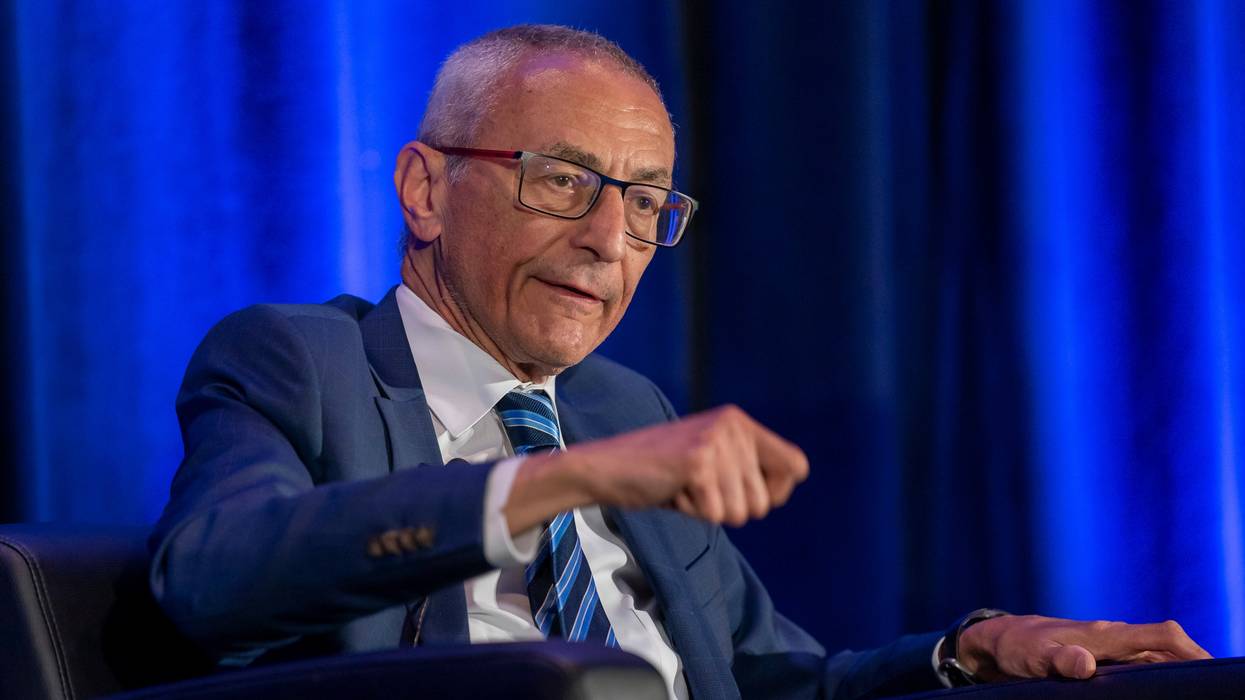
"I want to address tonight a topic that is on everyone's mind—the U.S. election," John Podesta, President Joe Biden's adviser, told the crowd in Baku on the first day of the United Nations Climate Change Conference (COP29), less than a week after President-elect Donald Trump defeated Vice President Kamala Harris.
Although votes are still being counted, Republicans have secured a majority in the U.S. Senate and are on track to retain control of the House of Representatives—paving the way for Trump's plans to roll back the Biden-Harris administration's progress on the climate emergency and "drill, baby, drill," which would lead to a surge in planet-heating pollution.
"Podesta's speech must be followed by swift action to limit U.S. fossil fuel expansion and achieve a strong COP29 outcome."
"For those of us dedicated to climate action, last week's outcome in the United States is obviously bitterly disappointing," Podesta acknowledged, "particularly because of the unprecedented resources and ambition President Biden and Vice President Harris brought to the climate fight."
Noting that Biden pledged to halve emissions this decade, rejoined the Paris agreement, signed the Inflation Reduction Act (IRA) and the Bipartisan Infrastructure Law, and promised $11 billion in international climate funds, Podesta warned that "the next administration will try to take a U-turn and reverse much of this progress."
"As President Biden said in the Rose Garden last week, setbacks are unavoidable, but giving up is unforgivable. This is not the end of our fight for a cleaner, safer planet. Facts are still facts. Science is still science," he continued. "This fight is bigger than one election, one political cycle, in one country. This fight is bigger still."
"We can and will make real progress on the backs of our climate-committed states and cities, our innovators, our companies, and our citizens, especially young people, who understand more than most that climate change poses an existential threat that we cannot afford to ignore," he added. "Failure or apathy is simply not an option."
Responding to the envoy's remarks in a Monday statement, Collin Rees, United States program manager at Oil Change International, said that "if John Podesta and President Joe Biden are committed to doing everything possible to continue climate progress despite Donald Trump's reelection, this moment demands a bold agenda that goes beyond locking in clean energy gains and takes real action toward a just transition off fossil fuels."
"There is no shortage of critical work to be done before Biden leaves office," Rees argued. "Here at COP29, the United States must support a new, transformative global finance goal in which rich countries pay their fair share in high-quality, grant-based finance and work to submit a Paris-aligned nationally determined contribution committing to do its fair share of climate action and phase out fossil fuels."
In the United States, Rees argued, Biden must "finalize studies on the dangerous impacts" of new liquefied natural gas exports, "reject deadly projects like the Dakota Access oil pipeline and pending LNG facilities in the Gulf South," and urge Congress to block the latest attempt by outgoing Sen. Joe Manchin (I-W.Va.) "to destroy bedrock environmental protections."
Looking toward next week's Organization for Economic Cooperation and Development (OECD) meeting, Rees said that "Biden's administration must support a global agreement to end export credit finance for oil and gas projects, a process which could end tens of billions of dollars in international finance for fossil fuels every year. This agreement would limit the global climate damages Trump and his fossil fuel cronies are able to perpetrate."
"Podesta's speech must be followed by swift action to limit U.S. fossil fuel expansion and achieve a strong COP29 outcome," he stressed. Leaders at other climate organizations—who have often argued that Biden hasn't gone far enough to tackle the fossil fuel-driven crisis—issued similar demands on Monday.
Emphasizing that "climate diplomacy on a boiling planet doesn't stop for a climate denier," Ben Goloff, senior campaigner at the Center for Biological Diversity's Climate Law Institute, called on Biden officials to "use the next two months to set up a bulwark of protections and secure their climate legacy."
"Beyond urgently getting IRA money out the door, John Podesta must commit the U.S.'s fair share of global climate finance and announce an ambitious NDC climate target," Goloff said, referring to nationally determined contributions for the Paris agreement.
Biden, he added, "has to make good on last year's agreement to transition away from fossil fuels by rejecting pending mega-polluting project," and "should also act quickly to fill all federal judicial vacancies as a wall of defense to Trump's rampage of legal attacks."
Jamie Minden, acting executive director of the youth-led movement Zero Hour, also declared that "before Trump takes office, President Joe Biden must reject all pending LNG export permits and stop the expansion of fossil fuels."
"Our climate is on the brink of collapse, and it is sheer madness that politicians continue to expand and subsidize deadly fossil fuels," Minden said. "Young people are fighting for our planet because we are facing the worst consequences of the unrelenting greed of these selfish politicians."
Exempt from transparency requirements within U.N. climate agreements, the military sector is, in fact, the leading institutional driver of the climate crisis.
Correction: An earlier version of this article said that the first two months of the Israeli war on Gaza released the carbon output of 26 countries. The actual figure is more than 20 countries, and the article has been updated to reflect this.
As we write, New York City is an unsettling 70°F in November. Meanwhile, a cohort of war profiteers, their pockets lined by the very industries destroying our climate, are flying to COP, the annual United Nations climate summit hosted by a petrostate, no less. They’re gathering to “discuss climate solutions”—but one of the world’s biggest contributors to the climate crisis will be entirely overlooked: the U.S. military-industrial complex.
The world’s largest institutional emitter, the U.S. military, sits beyond the reach of the metrics meant to hold countries accountable for climate pollution. Exempt from transparency requirements at the COP or within U.N. climate agreements, the military sector is, in fact, the leading institutional driver of the climate crisis. It burns through fossil fuels on a scale that surpasses entire nations while waging wars that destroy lives, communities, and the land itself. It’s a deliberate omission, one meant to hide the environmental and social costs of militarism from view.
Leading the U.S. delegation to COP is John Podesta—a career defender of militarism, a lobbyist who has worked to fortify the very military establishment poisoning our air, water, and land. Now, he arrives in the conference halls of COP wrapped in a cloak of environmentalism. Yet, as long as he skirts around the elephant in the room, no amount of recycled paper or energy-efficient lighting at COP will address the core driver of the climate crisis. If Podesta ignores the environmental impact of U.S. militarism, he’ll be dooming us.
Each weapon shipped, each tank deployed, is an environmental crime in the making, one funded by American tax dollars.
For those of us directly feeling the crisis, there’s no question that the U.S. Empire’s military machine is central to our climate emergency. Appalachians living through floods and those of us in New York watching temperatures soar out of season are witnesses to the toll. And yet we watch as our leaders, claiming to care about climate, push forward with policies and budgets that only deepen our climate emergency.
In the past year alone, the war on Gaza has been a horrifying example of militarism’s environmental toll. Entire communities were leveled under the firepower of U.S.-funded bombs. In just two months, emissions from these military activities equaled the yearly carbon output of more than 20 countries. This violence bleeds beyond borders. U.S. police forces train with the Israeli military, and they’ll soon bring their war tactics to Atlanta’s Cop City, where a training center is planned on sacred Indigenous land. Militarism is woven into every facet of our society—taking lives, razing homes, and desecrating land—all while stoking climate disaster.
This crisis can’t be solved by those who are its architects. It can’t be fixed by Podesta’s well-crafted speeches or the administration’s empty pledges. The Biden administration just passed one of the largest military budgets in history, pumping more dollars—and more carbon emissions—into the climate catastrophe. Each weapon shipped, each tank deployed, is an environmental crime in the making, one funded by American tax dollars. We can’t ignore this fact as COP progresses and climate talks fall short yet again.
It’s easy to despair in the face of such unaccountable power. But in times of crisis, clarity can become a weapon. We must expose the truth that militarism is antithetical to climate justice. True climate solutions don’t come from polite panel discussions led by those who wield the tools of destruction. They come from radical honesty and demands for accountability. They come from a commitment to ending the empire choking our planet and communities. And they come from a shared goal of mutual liberation that doesn’t ignore the plight of the many to serve the few.
The cost of militarism is clear, and its environmental toll demands our fiercest opposition. This COP, let’s not let the elephant in the room fade into the background. It’s time for those responsible for our climate crisis—the war machines, the lobbyists, and the industries that back them—to be held accountable. For our survival and for each other, we must demand climate justice that tells the truth.
The U.S. orders China to contribute more to countering climate change, all while treating China’s growing dominance over the “green economy” as a security threat.
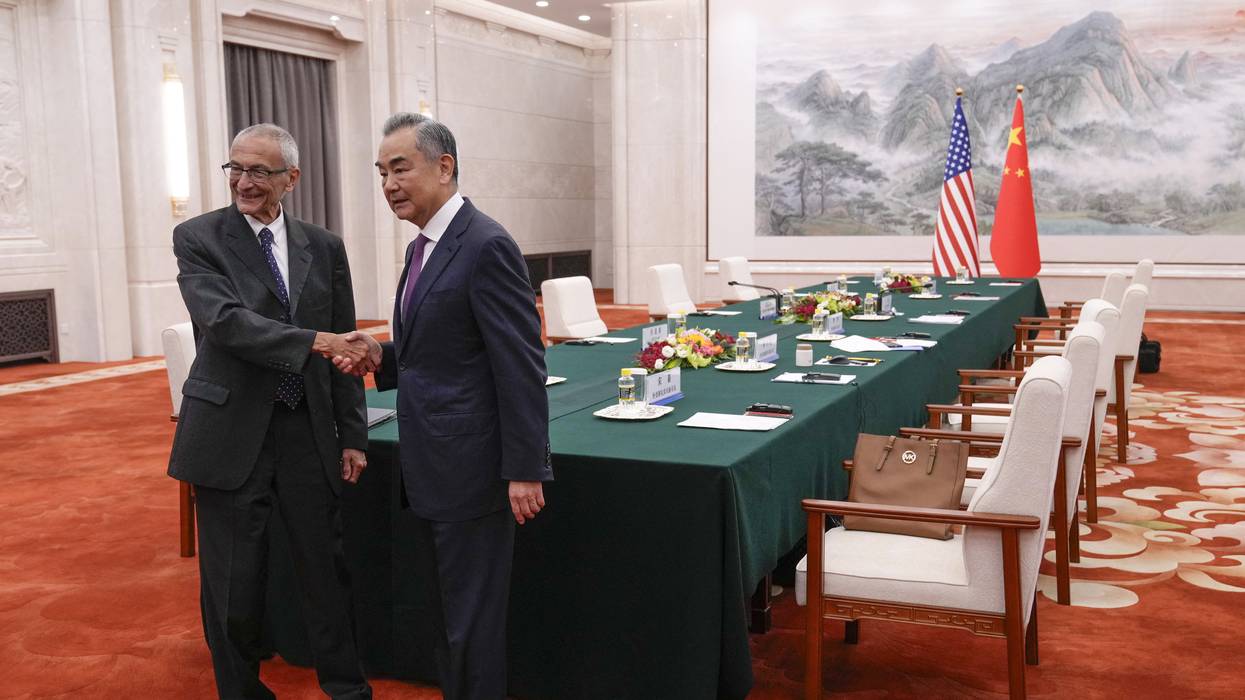
Earlier this month, U.S. climate envoy John Podesta met with Chinese Foreign Minister Wang Yi in Beijing to discuss climate financing for the upcoming years. The U.S. has long criticized China’s approach to confronting the climate threat, and continuously pushes Chinese leaders to do more.
At the same time, U.S. leaders label China’s investment into green energy technology as “exploitative” and attempt to sabotage its efforts with high tariffs, driving up the cost of Chinese imports, and making it more challenging to make the transition to green energy.
“They get less attention but they’re fully half of what’s causing global warming,” Podesta commented.
Former U.S. President Donald Trump officially cut off climate talks with China in 2017 after withdrawing from the Paris agreement. This past year, current President Joe Biden has made increasing efforts to engage with China on the topic before the end of his term.
The message is clear: China needs to contribute to the climate effort, but only in ways the U.S. deems acceptable.
This month’s climate talks were underscored by Beijing’s doubt over the upcoming election and the knowledge that any agreements would be undermined by another Trump win. Foreign Ministe Yi has also voiced concerns over U.S. “pan-securitism and protectionism”—kind words for describing U.S. actions that are accelerating a new cold war with China, including steps for conflict escalation by 2027.
Still, in the face of Washington’s increasingly threatening posture, Yi emphasized the importance of U.S.-China climate cooperation, saying the talks are “a positive signal to the outside world that as two major powers, China and the U.S., not only need to cooperate but can indeed work together.”
Discussions under the Biden administration began with former climate envoy John Kerry, who stepped down earlier this year. Kerry was one of the chief negotiators of the Paris climate agreement and had built strong rapport with top Chinese officials over the years. New climate envoy Podesta got his start in climate policy under the Obama administration, but is well known for serving as the White House chief of staff under President Bill Clinton, and for his consummate insider status in wealthy liberal circles. He co-founded the Podesta Group with his brother, which operated as one of the most powerful lobbying firms before it was shut down following its association with the Robert Mueller investigations. He’s also the founder of the progressive think tank Center for American Progress, which was created with the support of other liberal elites.
As the newest climate envoy, Podesta joins a long line of wealthy U.S. political leaders more inclined to imperialist finger-wagging fueled by Western superiority and fears that China’s rise threatens U.S. global hegemony. So while the U.S. pushes China to do more, it also strategically undermines its efforts.
Let’s break it down.
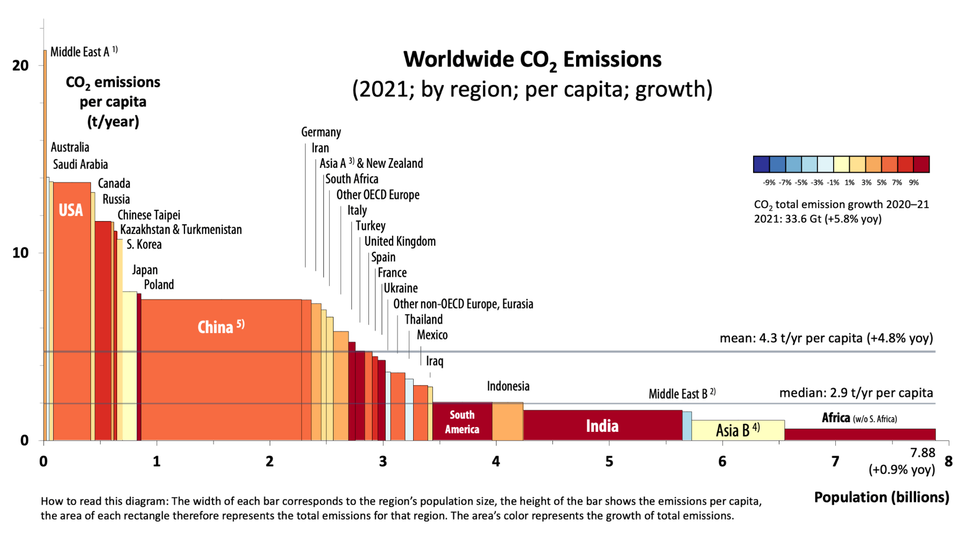
First, it’s important to note that China’s population makes up approximately 18% of the world, and its carbon dioxide emissions per capita fall short of many other countries, including the U.S., Canada, Australia, South Korea, and the UAE.
Additionally, China is a relatively new industrial power, and the total amount of CO2 it emitted over the last three centuries is incomparable to the 400 billion metric tons produced by the United States since 1750. It was only in recent years that China saw a sharp growth in emissions.
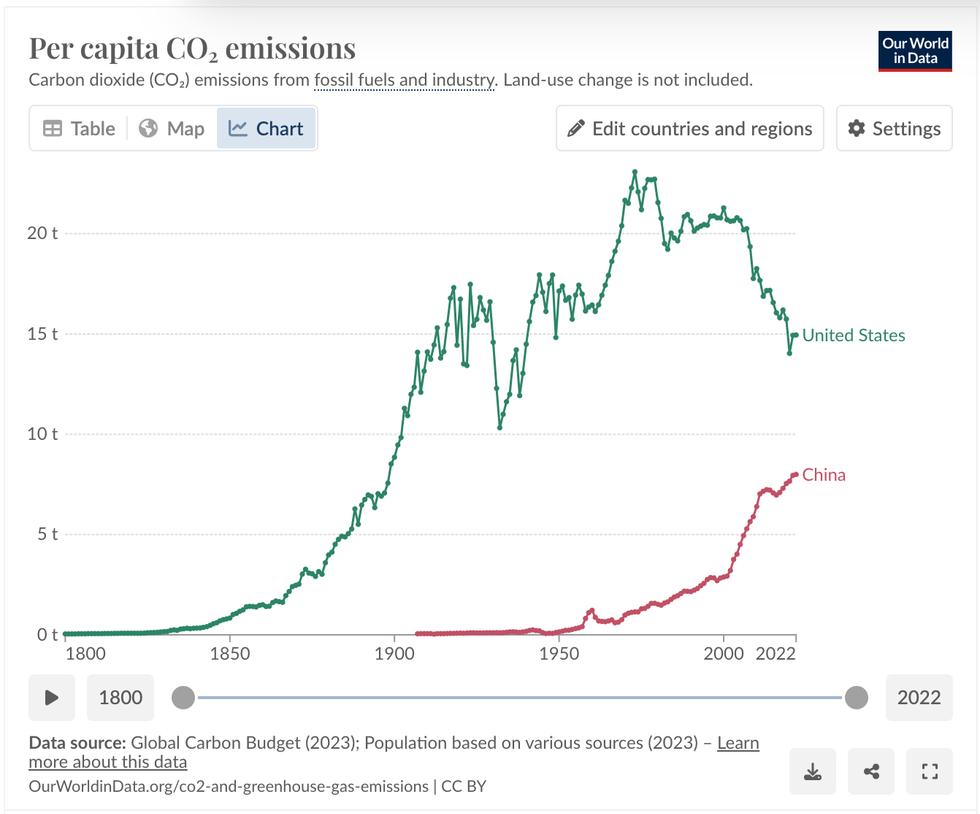
China’s early 20th century was marked by a political and social struggle of internal instability after the fall of the Qing Dynasty in 1911. After the establishment of the PROC in 1949, the challenge became improving the lives of its citizens. The Chinese government has been working to increase living standards across the country, and it is, in fact, the only country to rise from low to high on the United Nations Development Index since the program was created. Over 840 million people were taken out of extreme poverty, leading to a sharp rise in life expectancy, literacy rates, and quality of life.
In the early 2000s, as China became increasingly aware of the negative impacts of its fossil fuel use, leaders sought solutions that would create opportunities for future populations and not negate any of the progress made in the last century. Thus began China’s turn to manufacturing renewable technology in industries from solar to wind, green hydrogen, and geothermal energy. Today, China has approximately 80% of the world’s capacity for solar manufacturing. The mass production of renewable tech enabled lower sales costs, paving the way for nations in the Global South to afford making the move to green energy. In fact, China’s production of wind and solar tech enabled other nations to reduce CO2 emissions by over 800 million tons in 2023 alone.
In 2020, President Xi Jinping announced the plan for China to become carbon neutral by 2060, with a carbon peak no later than 2030. The declaration spurred new green projects and policies aimed at accomplishing the goal. The National Energy Administration (NEA), which regulates China’s energy, launched the Whole County PV program, which aims to install solar panels in half of China’s rural administration (a quarter of the population). China’s desert regions were deemed ideal locations for massive wind and solar farms, which will connect to towns and cities through high-speed transmission lines. In 2022, China installed as much solar capacity as all other nations combined, then doubled that number the following year–which was over twice as much as the United States.
It’s true that China still has a long way to go when it comes to switching away from fossil fuels, but it’s currently on track to reach its goals–and the Chinese government has a plan, which includes the construction of a unified power grid to better manage supply and demand.
Ultimately, the U.S. and China have different strategies of approaching the climate issue, and the U.S. isn’t happy with China’s methods. In fact, U.S. criticism over China’s green energy strategy lies partially in its condemnation of China’s monopoly over green energy tech, and the effects affordable prices could have on other U.S. business sectors, such as car manufacturing. Just last week, the U.S. locked in steep tariffs of 100% on incoming electric vehicles (EVs) from China, 50% on chips, and 25% on batteries. Chinese company BYD is the biggest EV manufacturer, with costs as low as $10,000 per car. Though not currently operating in U.S. markets, BYD electric cars with imposed tariffs would still be the cheapest option for U.S. consumers.
It seems likelier that U.S. politicians will protect the auto industry, which poured $85.5 million into lobbying efforts in 2023, a record high, rather than allow affordable, environmentally friendly electric cars from China to take over the market. Unfortunately, many politicians continue to call climate change a hoax and refer to EVs, like Trump did, as “green new scams.”
Chief economist of the International Monetary Fund, Pierre-Olivier Gourinchas, commented on the matter, warning that the high tariffs will “make it harder to coordinate policies that address global challenges, such as the climate transition.” Similarly, David Victor, professor of innovation and public policy at the University of California, San Diego, wrote that these policy moves are “bad for the environment” and will only “slow down the transition.”
The U.S. and China need to work together as two of the most powerful countries to pave the way to net global carbon neutrality.
The U.S. also continues to push China to contribute more money to fund countries in the Global South under the Copenhagen Accord drafted at the 2009 United Nations Climate Change Conference (COP15), in which multiple countries pledged to contribute to a $100 billion goal annually by 2020. However, while Podesta and Yi were talking about climate finance, other Chinese leaders were hosting the 2024 Summit of the Forum on China-Africa Cooperation with leaders from over 50 states across Africa. The summit concluded with China announcing an additional $50 billion in funding over the next three years, with a heavy focus on green energy transitioning. Additionally, President Xi announced plans to launch 30 new clean energy projects, as well as plans for EV manufacturing.
China’s rapid economic growth and growing global influence has enabled it to be an alternative source of investment for developing nations across the world. Western powers have been quick to criticize China’s global initiatives, brushing them off as self-interested and negatively impactful—though only when it’s outside the bounds of Western institutions like the International Monetary Fund. This is hypocritical, over-simplified, and misleading.
According to a McKinsey Global Institute report, delays in the global green energy shift will produce catastrophic results. As of right now, only 10% of the necessary low-emission technology needed to reach carbon neutrality by 2050 has been deployed. It’s crunch time, and slowing the transition due to political or economic interests is unacceptable.
Essentially, the U.S. orders China to contribute more to countering climate change, all while treating China’s growing dominance over the “green economy” as a security threat, and labeling China’s efforts to invest in green energy projects in the Global South as “geopolitical expansionism.” The message is clear: China needs to contribute to the climate effort, but only in ways the U.S. deems acceptable.
This strategy is ultimately counterproductive—it will only hinder the global effort to convert to renewable energy and delay climate goals, setting the stage for future potential environmental disasters. Instead, the U.S. and China need to work together as two of the most powerful countries to pave the way to net global carbon neutrality. This means removing tariffs on green energy tech, and providing avenues for all countries to make the transition. At the same time, the U.S. needs to make internal change, and defund the world’s highest polluting institution—the U.S. military.
High-level government participation in an oil and gas industry conference shows official disdain for the public interest; it’s time to make fossil fuels politically toxic.
From March 18 to 22, 2024, the oil and gas industry held its major annual conference, CERAWeek, in Houston, Texas.
The conference speakers included the usual rogues’ gallery of fossil fuel CEOs from the U.S. and worldwide, including the heads of Exxon Mobil, Chevron, Shell, Occidental, ConocoPhillips, Saudi Aramco, and Total. These corporations have covered up their responsibility for climate change, poisoned communities, and violated human rights in collusion with repressive governments, from the U.S. to Ecuador to Uganda and beyond.
But the egregious social, environmental, and human rights record of Big Oil did not deter high-level officials from the federal government and some state governments, from both major political parties, from attending and speaking at this event, giving it a stamp of official approval and legitimacy it didn’t deserve.
Our public officials need to get the message that the fossil fuel industry is politically toxic as well as literally toxic—and that they will pay a price for associating with the industry, taking its money, and serving its agenda.
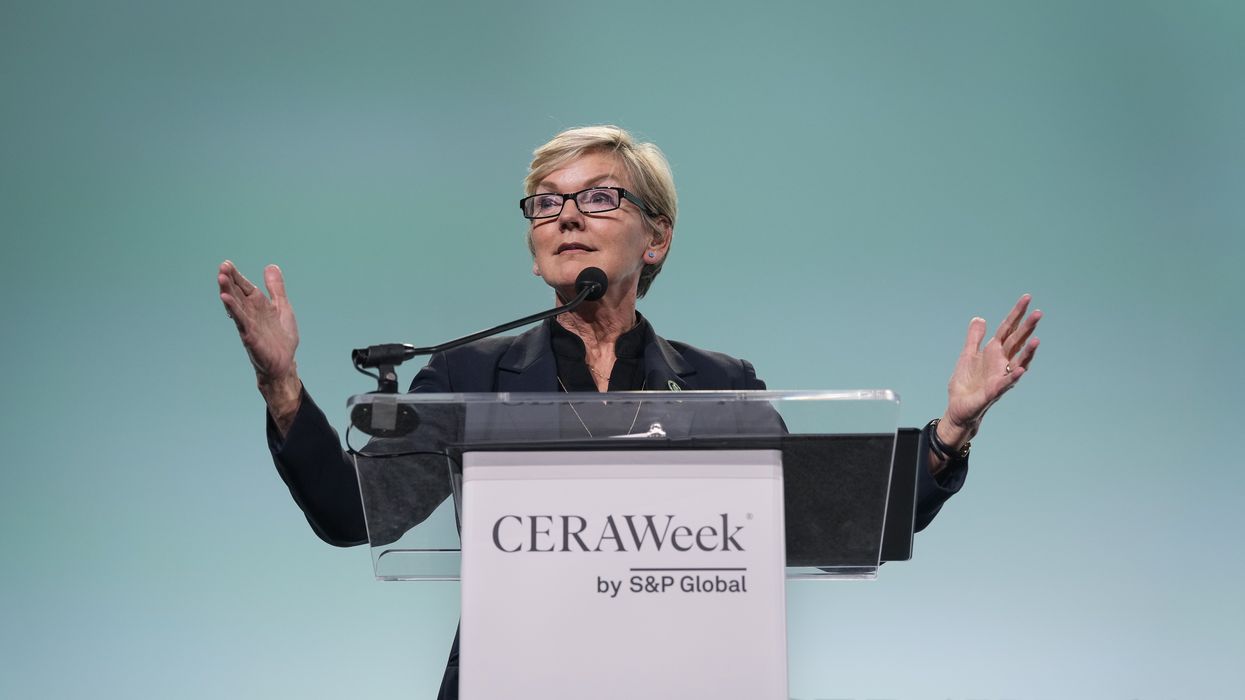
CERAWeek 2024 speakers from the federal executive branch included U.S. Secretary of Energy Jennifer Granholm, who heads the lead energy policy agency of the U.S. government; John Podesta, senior adviser to the president for international climate policy, who will be the public face of the U.S. in international climate negotiations; and John Kerry, who held Podesta’s position until recently.
Speakers also included Sen. Joe Manchin (D-W.Va.), who chairs the Senate Energy and Natural Resources Committee, and Sen. Dan Sullivan (R-Alaska). At least one governor, Mike Dunleavy of Alaska, was a speaker as well, as were other senior officials with the White House and the Department of Energy.
It’s bad enough that they went, but the content of some of their speeches was even worse. Senators Manchin and Sullivan criticized the modest recent step by the Biden administration to pause new export licenses for liquefied natural gas (LNG) in order to complete a new set of criteria for determining public interest.
Meanwhile, Secretary Granholm appeared to undermine her own agency’s review of the public interest test for LNG exports, by characterizing the review as a routine study (instead of an extraordinary study necessitated by the climate crisis), and saying the pause would be “in the rearview mirror” within a year. If the study has any integrity, an outcome that would end the pause and resume exports (implied by Granholm’s phrasing) should be far from assured.
On the contrary, a study aligned with the global scientific consensus, shared by the Intergovernmental Panel on Climate Change (IPCC), the International Energy Agency, the United Nations Environment Program, and others, would conclude that there should be no more expansion of fossil fuel infrastructure, period, and that the pause should be permanent. Granholm’s statements raise serious questions about whether the Department of Energy can be trusted to do this study.
If the U.S. were really concerned about the long-term energy security of lower income countries who import U.S. LNG, such as Bangladesh, Colombia, and Jamaica, we would be paying our fair share for climate mitigation and a just transition from fossil fuels in these countries instead of selling them our poisons.
The only real beneficiaries of LNG exports are the oil and gas industry. LNG exports are the main driver of growth in U.S. natural gas production, since domestic demand is growing only very slowly. According to government data, U.S. gas production grew about 96% between 2008 (the approximate start year of the shale gas, or “fracking,” boom) and 2023. Over the same period, U.S. gas exports grew by a whopping 690% while consumption grew by less than 40%. Clearly, the gas industry is looking at exports as their growth engine.
While industry makes its profits, communities are left to face serious climate change impacts, such as the recent Texas wildfires. Communities in the vicinity of the gas production supply chain, from fracking to pipelines to export terminals—disproportionately Indigenous, Black, brown, or low-income white communities—pay the price for industry’s profits with serious air and water pollution, as well as fire and explosion risks.
Another group harmed by LNG exports are U.S. utility consumers writ large, who face higher gas bills and become more vulnerable to price volatility as a consequence of increased exports.
What of the destination countries for U.S. LNG exports? Many of the leading importers of U.S. LNG, such as the Netherlands, U.K., France, Japan, and Germany, are affluent countries who can very well afford to transition their electric generation, home heating, and other sectors to renewables and electrification.
If the U.S. were really concerned about the long-term energy security of lower income countries who import U.S. LNG, such as Bangladesh, Colombia, and Jamaica, we would be paying our fair share for climate mitigation and a just transition from fossil fuels in these countries instead of selling them our poisons. Concern for “global energy security,” often cited as a justification for LNG exports, is a smokescreen for facilitating fossil fuel profits.
Since LNG exports benefit no one but an irresponsible, polluting industry, why are public officials so eager to cozy up to them?
For some, the answer is obvious. Sen. Manchin (who isn’t running for reelection) received more campaign money from the fossil fuel industry in the previous election cycle than any other candidate for federal office, and owns a coal company himself. Sen. Sullivan has also received sizable campaign contributions from the oil and gas industry.
In other words, they have been bribed and have obvious conflicts of interest that motivate them to side with polluters over people.
In her comments at CERAWeek, Granholm said that “the world will need secure supplies of both traditional and new energy for the foreseeable future,” underscoring the administration’s outdated thinking on energy policy.
With executive branch officials such as Secretary Granholm and John Podesta, the motive is a little less obvious, but can be discerned regardless. Their participation in CERAWeek is certainly consistent with the Biden administration’s record, which is likely being driven by a number of powerful appointees with industry ties in key positions.
Under Biden, the Department of the Interior has issued more oil and gas drilling permits on public lands than under former President Donald Trump, including a deeply unpopular “carbon bomb” oil drilling project in Alaska. The Department of Energy has issued export licenses to a number of controversial LNG terminals in Alaska and on the Gulf Coast.
These backwards actions are being driven by flawed thinking. In her comments at CERAWeek, Granholm said that “the world will need secure supplies of both traditional and new energy for the foreseeable future,” underscoring the administration’s outdated thinking on energy policy. This is merely a restatement of the Obama administration’s infamous “all of the above” energy policy, and is in direct conflict with the global scientific consensus that we need a rapid phaseout of fossil fuels.
Our public officials need to get the message that the fossil fuel industry is politically toxic as well as literally toxic—and that they will pay a price for associating with the industry, taking its money, and serving its agenda.
To do that successfully, our movements need to deepen popular understanding of the malfeasance of this industry, escalate our messaging against it, and make it clear to public officials that we are monitoring their ties with the industry closely. Cutting the ties between fossil fuels and the government will be immensely helpful in shifting U.S. government policy on climate and energy in a positive direction.
"Podesta needs to take the baton from Kerry and lead the U.S. on a furious sprint to end oil and gas expansion while we still have time to prevent the worst climate catastrophes," said one campaigner.
Senior White House adviser John Podesta has been tapped to replace outgoing U.S. climate envoy John Kerry, The Washington Post reported Wednesday.
According to the Post, Podesta—who is currently in charge of implementing the climate provisions of the Inflation Reduction Act—will have the title of "senior adviser to the president for international climate policy" and will work out of the White House instead of the State Department, where Kerry was based.
"We need to keep meeting the gravity of this moment, and there is no one better than John Podesta to make sure we do," White House chief of staff Jeff Zients said in a statement. "John has—and will continue to be—at the helm of driving the implementation of the most significant climate law in history."
NBC News reported that Kerry—a former secretary of state and the 2004 Democratic nominee for president—will shift to supporting President Joe Biden's reelection campaign.
In a statement, Center for Biological Diversity’s Energy Justice program director Jean Su underscored the imperative of building on the limited yet important climate progress achieved by the Biden administration.
"The recent pause on gas exports has positioned Podesta to lead the fossil fuel phaseout and the clean energy expansion we desperately need," Su said. "In his final act as climate envoy, John Kerry agreed to a global transition away from fossil fuels and urged a far more ambitious scale and timeline."
"Podesta needs to take the baton from Kerry and lead the U.S. on a furious sprint to end oil and gas expansion while we still have time to prevent the worst climate catastrophes," she added.
The phrase "Fake News" has exploded in usage since the election, but the term is similar to other malleable political labels such as "terrorism" and "hate speech": because it lacks any clear definition, it is essentially useless except as an instrument of propaganda and censorship. The most important fact to realize about this new term: those who most loudly denounce Fake News are typically those most aggressively disseminating it.
One of the most egregious examples was the recent Washington Post article hyping a new anonymous group and its disgusting blacklist of supposedly pro-Russia news outlets - a shameful article mindlessly spread by countless journalists who love to decry Fake News, despite the Post article itself being centrally based on Fake News. (The Post this week finally added a lame editor's note acknowledging these critiques, which absurdly claimed that it did not mean to "vouch for the validity" of the blacklist even though the article's key claims were based on doing exactly that).
Now we have an even more compelling example. Back in October, when WikiLeaks was releasing emails from the John Podesta archive, Clinton campaign officials and their media spokespeople adopted a strategy of outright lying to the public, claiming - with no basis whatsoever - that the emails were doctored or fabricated and thus should be ignored. That lie - and that is what it was: a claim made with knowledge of its falsity or reckless disregard for its truth - was most aggressively amplified by MSNBC personalities such as Joy Ann Reid and Malcolm Nance, The Atlantic's David Frum, and Newsweek's Kurt Eichenwald.
That the emails in the Wikileaks archive were doctored or faked - and thus should be disregarded - was classic Fake News, spread not by Macedonian teenagers or Kremlin operatives but by established news outlets such as MSNBC, the Atlantic and Newsweek. And, by design, this Fake News spread like wildfire all over the internet, hungrily clicked and shared by tens of thousands of people eager to believe it was true. As a result of this deliberate disinformation campaign, anyone reporting on the contents of the emails was instantly met with claims that the documents in the archive had been proven fake.
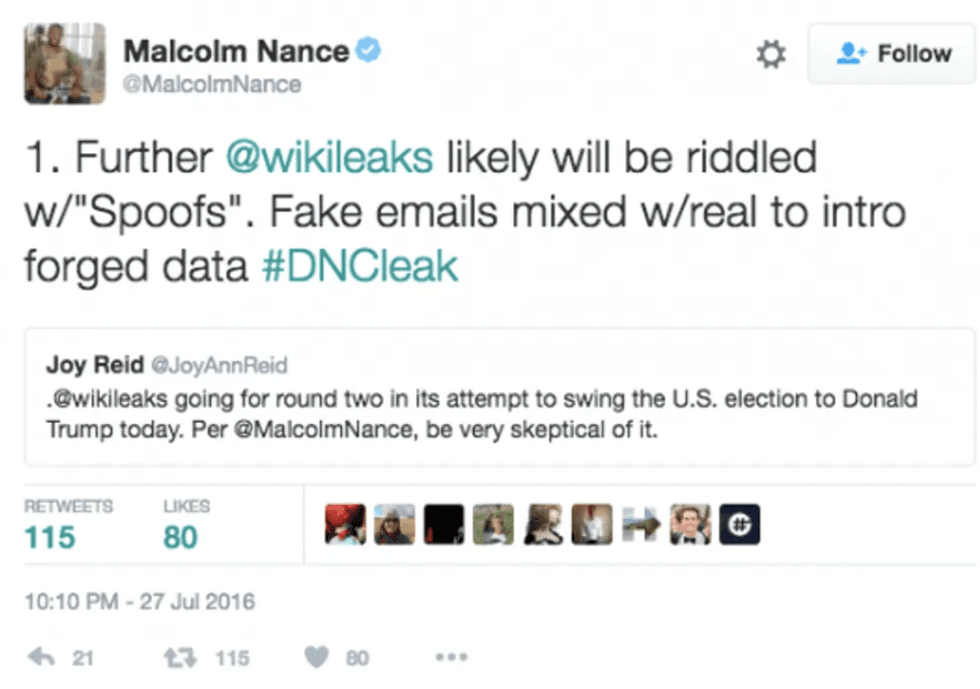
The most damaging such claim came from MSNBC's intelligence analyst Malcolm Nance. As I documented on October 11, he tweeted what he - for some bizarre reason - labeled an "Official Warning." It decreed: "#PodestaEmails are already proving to be riddled with obvious forgeries & #blackpropaganda not even professionally done." That tweet was re-tweeted by more than 4,000 people. It was vested with added credibility by Clinton-supporting journalists like Reid and Frum ("expert to take seriously").
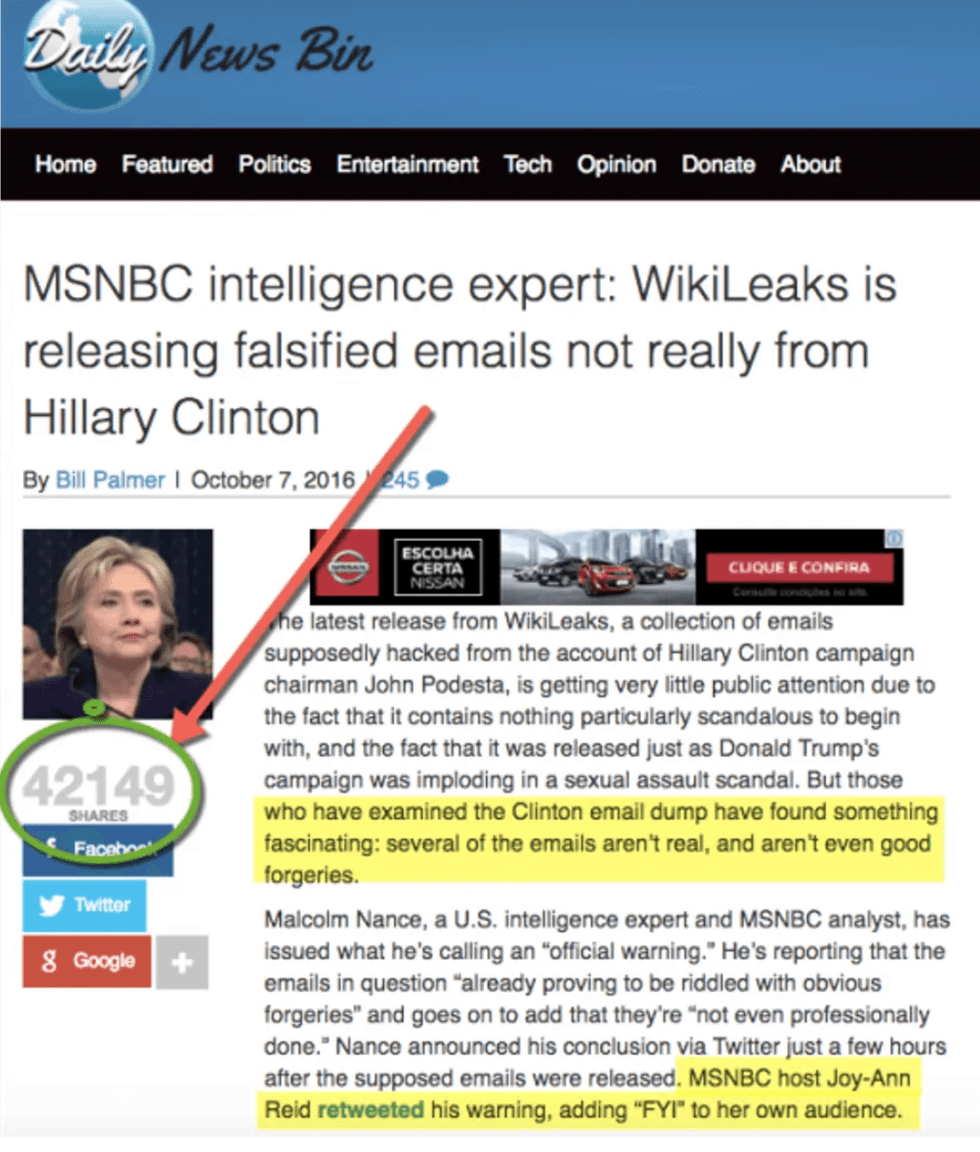
All of that, in turn, led to an article in something called "The Daily News Bin" with the headline: "MSNBC intelligence expert: WikiLeaks is releasing falsified emails not really from Hillary Clinton." This classic fake news product - citing Nance and Reid among others - was shared more than 40,000 times on Facebook alone.
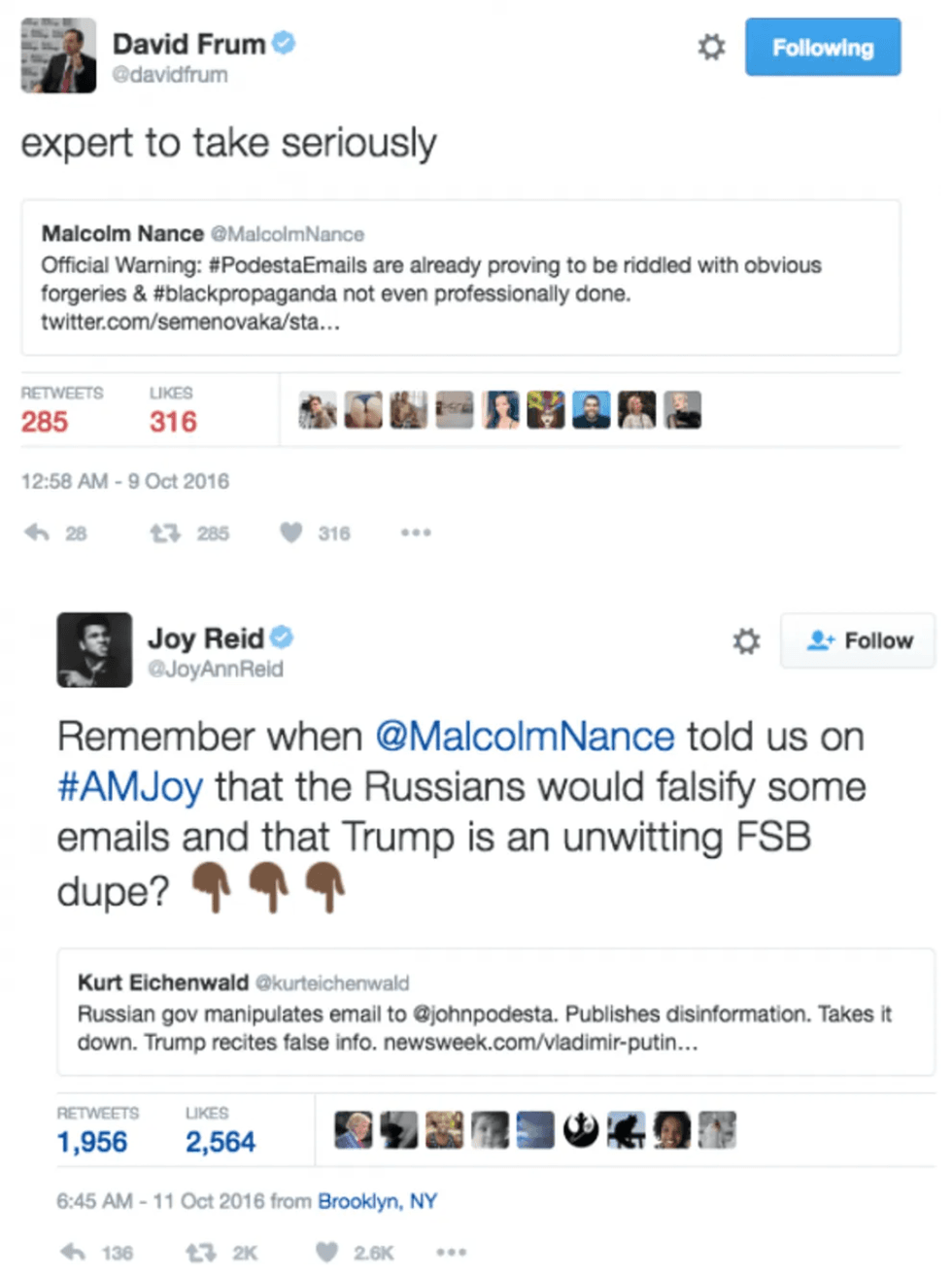
From the start, it was obvious that it was this accusation from Clinton supporters - not the WikiLeaks documents - that was a complete fraud, perpetrated on the public as deliberate disinformation. With regard to the claim about the Podesta emails, now we know exactly who created it in the first instance: a hard-core Clinton fanatic.
When Nance - MSNBC's "intelligence analyst" - issued his "Official Warning," he linked to a tweet that warned: "Please be skeptical of alleged #PodestaEmails. Trumpists are dirtying docs." That tweet, in turn, linked to a tweet from an anonymous account calling itself "The Omnivore," which had posted an obviously fake transcript purporting to be a Hillary Clinton speech to Goldman Sachs. Even though that fake document was never published by WikiLeaks, that was the entire basis for the MSNBC-inspired claim that some of the WikiLeaks documents were doctored.
Read the full article, with possible updates, at The Intercept.
In its 10th years of existence, WikiLeaks has been at the center of controversy. Ever since its global debut with the 2010 Apache helicopter gun-sight video depicting the killing of civilians in Baghdad, the whistleblowing site has consistently exposed the naked power of empire for the world to see. As a result, the organization has been subject to relentless retaliation. With banking blockades, a secret grand jury and constant character assassination of its founder Julian Assange, who remains arbitrarily detained in the Ecuadorian embassy, the U.S. government's efforts to divert public attention from evidence of its own crimes have quickly escalated into a war on the First Amendment.
WikiLeaks' publications influenced the outcome of a Kenyan election and played a role in instigating the Icelandic revolution. Now, by means of email leaks, they began informing U.S. voters of the real working of Corporate America's tradition of lesser-evil politics.
After the DNC email leaks that led to the resignation of top DNC officials, WikiLeaks has intensified its activity. Since October 7, they began publishing emails from the private account of Hillary Clinton's campaign chair John Podesta. The archive contained transcripts of Clinton's paid Goldman Sachs speeches that show her two faces and total disconnect from the middle class. It also revealed her private remarks dismissing climate activists. As usual, the leaks have been condemned by the status quo and Clinton loyalists. This time, a narrative that 'Vladimir Putin was meddling in the election' was used to discredit their publication, with the mainstream media creating an echo chamber of McCarthy-era style hysteria.
Over the years, as WikiLeaks grew, incorporating their evolving strategies, criticism against the organization has also changed. Back in the day, WikiLeaks was slandered with Pentagon official's rhetoric of "blood on their hands", and was depicted as reckless hackers putting innocents in danger. Proclaimed liberal media institutions such as The New York Times abandoned WikiLeaks, with then executive editor Bill Keller differentiating it from his kind of journalism.
Now, while the beam of transparency is focused on U.S. rigged contest for power, WikiLeaks is once again in the eye of media storms. Some criticize what they perceive as a politically driven information dump and question whether WikiLeaks has gone too far. This new sensation around WikiLeaks is now opening up a debate for all to examine the role of journalism and at the same time gives us an opportunity to understand how the organization's efforts to open governments is changing the media landscape.
Role of Journalists
Criticism toward WikiLeaks latest publication also emerged from those who share similar values. The NSA whistleblower Edward Snowden, who once described WikiLeaks as fearless journalism that they "run towards the risks everyone else runs away from", weighed in after release of the DNC emails this summer:
Now, renowned author and journalist Naomi Klein joined in this critique. In a recent interview with Glenn Greenwald of The Intercept (funded by eBay founder Pierre Omidyar), Klein expressed her view that the publication of the Podesta emails is not in the same category as the Pentagon papers and previous publications by WikiLeaks, such as chapters on the TPP trade agreements. Despite her acknowledging valuable and newsworthy stories in this material, she noted how indiscriminate publication of someone's personal exchanges bring grave threat to privacy.
The crux of the criticism revolves around different views on redaction, which has been debated in past years between Assange and Greenwald, who has been an advocate for WikiLeaks. In May 2014, what came to be widely portrayed as a Twitter storm emerged.
Upon The Intercept's publication that revealed the NSA interception of phone calls in the Bahamas, WikiLeaks began a series of tweets criticizing their decision to redact the name of a fifth country that was revealed by the Snowden files that was a target of NSA spying. Assange condemned The Intercept for censoring, noting how it is not the place for any media organizations to "deny the rights of an entire people to know they are being mass recorded." WikiLeaks then announced that in 72 hours they would reveal the name of the fifth country that had been a prime target of NSA mass surveillance and as promised, they identified the fifth country as Afghanistan and provided the reason behind their publication.
The difference in their approach to publishing now came up again and brought out a particular perspective about the role of journalists. In his recent article titled "On WikiLeaks, Journalism, and Privacy", Greenwald explored obligations of journalists for reporting controversial materials such as Podesta's emails that are widely speculated to be hacked (in which WikiLeaks noted they have many sources and have not stated the methods they used to obtain each part). He explained how he thinks it should be reported.
In this, Greenwald countered the often held objections that "Journalists should not act as arbiters of privacy or gatekeepers of information." He emphasized how all journalism is based on this determination of what should or should not be published and stated that "core purpose of the First Amendment's free press guarantee was to add an additional safeguard against excess government secrecy by ensuring that others beyond government officials made decisions about what the public knows."
Klein's thoughtful criticism also appeals to this principle of journalism. In expressing her concern about privacy, she questioned "the subjectivity of who gets defined as sufficiently powerful to lose their privacy..." Implied in this concern is a need for a designated authority who could and should determine what information is to be withheld. The idea here is that certain 'professionals' should decide what is to be released in the 'public interest' and for her this is certainly the responsibility of journalists.
Scientific Journalism as New Checks and Balance
This traditional role of journalism as a safeguard against the authoritarian state has been under attack for decades. The assault against WikiLeaks and Obama's war on whistleblowers has shown the dire state of press freedom, even in the West. With consolidation of media and infiltration of commercial and corporate interests, an oligarchic class has captured journalists, bringing them to defend the interests of those in power. As a result, free speech is often co-opted, becoming something that requires permission.
Once a position of authority is inserted, this often becomes a point of control used to violate the privacy and restrict information in favor of the rich and powerful. No matter how good the intentions of journalists are, the act of curating can become a slippery slope, where they engage in self-censorship with their own ingrained bias and act unconsciously as gatekeepers-- apologists and stenographers for their patrons.
The question now emerges as to what would hold journalists accountable and how can the everyday citizen protect themselves from those who claim to act on their behalf. Unlike many other media organizations, WikiLeaks is fully independent, with its operation being funded by its readers. By engaging in scientific journalism, they lift the gates that guard the structure of power, while at the same time bringing a new form of checks and balance.
Assange explained this scientific journalism:
"Everything we do is like science. It is independently checkable because the information which has informed our conclusions is there, just like scientific papers which are based on experimental data and must make that experimental data available to other scientists and to the public if they want their papers to be published."
Gavin MacFadyen, a mentor and staunch defender of WikiLeaks who recently passed away, noted how the good witness is a crucial element in investigative journalism and described this as "someone who bears a truthful account of something they witnessed," and "can describe it with the same accuracy, hopefully, as they saw it."
As described in their submission page, WikiLeaks accepts anonymous source material of "political or historical importance that are censored or otherwise suppressed." They verify the authenticity of these documents and they always release the full source material related to any story, whether it is published by them or someone else. In this, full source documents that are confirmed in their authenticity give opportunity for the public to become a good witness that can provide a true account of events, and this collective witnessing can engage people in what the Czech novelist Milan Kundera once said, "the struggle of memory against forgetting."
By connecting ordinary people directly to the documents, they replace the source of legitimacy that used to be journalists' supposed 'objectivity' into the public's understanding of the authentic documents. When the information that can lead to a conclusion is made available to the public, people can follow the process themselves and examine the validity of the disclosures and analysis so they can draw their own independent conclusions.
This allows the public to critically examine the legitimacy of those who claim to represent them and this brings accountability not only to those in positions of power but also to the media itself. It also makes the system of representation an option. Whether it is WikiLeaks or any other media organization, people can choose for themselves who they want to grant the authority to represent their interests.
The Invention of Anonymous Drop Box
At the core of WikiLeaks scientific journalism is a breakthrough of technological innovation. The invention of the anonymous drop box and mechanism of verifying documents without relying on a third party creatively solves the problem of corporate and state sponsored media. This foundation goes beyond just technology and into the philosophy of the Cypherpunks, a group who advocates the use of privacy-enhancing technologies for social and political change.
In Cypherpunk's Manifesto, Eric Hughes, one of the founders of the movement, expressed his distrust of illegitimate authority:
"We cannot expect governments, corporations, or other large, faceless organizations to grant us privacy out of their beneficence. It is to their advantage to speak of us, and we should expect that they will speak ... We must come together and create systems which allow anonymous transactions to take place."
Residents of the early Internet saw the enclosure of civil liberties and unaccounted power in the rise of the corporate state. Regulation and laws that are supposed to protect civil rights and maintain the function of democracy have shown to now be extremely ineffective. When law enforcement through the system of representation fails to protect the public, they sought for solutions in cryptography. In his speech titled "Computers, Freedom, and Privacy", John Gilmore, the founder of the Electronic Frontier Foundation and one of the individuals on the Cypherpunk mailing list spoke how, "I want a guarantee - with physics and mathematics, not with laws - that we can give ourselves real privacy of personal communications."
In 1991, as a response to the need for privacy, long before Snowden alerted the public about the looming dystopian vision of mass surveillance on the Internet, Philip R. Zimmermann invented and released PGP (Pretty Good Privacy) software that makes anonymous online communication possible.
Laws that are in favor of free speech have been increasingly weakened. The Freedom of Information Act (FOIA) was constantly undermined (as proven in the case of Reuters not being able to obtain the footage of 2007 U.S. airstrikes in Iraq that were later released as Collateral Murder video by WikiLeaks). The Whistleblower Protection Act was also gutted. Now, a free press needs to be guaranteed not by laws but by strong math. WikiLeaks created an anonymous drop box that cryptographically ensured anyone to communicate and transfer information securely and made it possible for whistleblowers to exercise unhindered free speech.
With this new technical capability combined with the ethics of Cypherpunks, WikiLeaks built a robust platform of publishing. By making servers run through various countries that have strong source protection laws and by bouncing encrypted information through dozens of computers, they decentralized their infrastructure, making them resilient to censorship and legal attacks.
Preserving History
With scientific journalism, WikiLeaks challenges the traditional role of journalists, shifting it from a gatekeeper to a liberator of information - to facilitate the public to bear witness to what whistleblowers saw and bring concealed information back into the historical record.
Contrary to U.S. high officials denouncement of this new journalistic organization, WikiLeaks, founded on the values of the American Revolution liberated the First Amendment from the castle of this empire state. By doing so, it appears to fulfill the promise in the Declaration of Independence that 'all men are created equal, with abolition of any single power that claims authority over history. But this time, it is at a global scale.
Assange once articulated this passionate conviction, reminding us how:
"History does not belong to institutions that is engaging in the world like National Security Agencies and the State Department. History does not belong to journalists. History does not belong to a media organization. History belongs to human civilization that understands in order to better itself."
Then he added that history also doesn't belong even to whistleblowers either, although they play a vital role. This commitment to preservation of history is shown in their approach to redaction. In addressing the issues of redaction at re:publica14, WikiLeaks editor Sarah Harrison (who facilitated the safe passage of Snowden out of Hong Kong) spoke about how the concept of redaction came to imply responsible journalism. She then pointed out that the process of redaction is often used to hide the deeds of those in power, where large companies' names are redacted and not for the reasons stated. Harrison explained how through their past publication experience, WikiLeaks learned that the best approach is to start with the premise that the public deserves everything and thus everything should be given to them.
She stated how the concept that information itself causes harm is illogical. She did clarify how names of individuals that cause imminent threats and loss of someone's life need to be redacted for a short period of time. Nevertheless, the organization believes that the public should have access to full source documents in order to see information in context as each part can change meaning in relationship.
As a critical part of preserving history, WikiLeaks believes that information needs to not only be accessible, but also usable. They teach the public how they can read and access documents, such as the Public Library of US Diplomacy or PlusD that contained Cablegate. By actively engaging the public to inform themselves, this publisher of last resort makes sure that no nation, president, political party or corporation -including journalists, can control the past, present or future of our civilization.
Insurgent Publisher of the Internet
In this new digital age, the role of media organizations is quickly changing. The Internet on one hand has become a terrain of surveillance and control. But, it also has fostered democratization of knowledge and free flow of information. Former Secretary of State John Kerry once said, "This little thing called the Internet ... makes it much harder to govern." Now, each person around the world can set up a blog or website and connect with social media and technically become their own media.
WikiLeaks is the iconic insurgent publisher of this new digital age. It ushers in a new journalism that is borderless, censorship resistant and participatory. In this, conventional lines between journalism and citizens dissolve and ordinary people are empowered to participate in history as authors of their own lives, as they themselves become watchdogs for force of power that omits, erases and alters history, in order to fight against collective amnesia.
With its Twitter account that has now close to 4 million followers, WikiLeaks actively interacts with its readers around the world. They now have created two new Twitter accounts, @WLTaskForce and @CommunityWL for the supporters to spread releases from WikiLeaks, verify facts and correct misinformation. Instead of top-down distribution of information, it encourages grassroots organizing and seeks for an awakening of civic power.
Despite massive attacks and threats coming from the Washington halls of power and its European allies, the organization remains relevant than ever. From creating sparks for uprisings in the Arab World to disrupting the scripted corporate sponsored charade of the current U.S. presidential election, WikiLeaks stays strong.
In its 10 years of activity, WikiLeaks publications have caused no harm. With a perfect record of authentication of documents, they are at the forefront of pushing the boundaries of free speech. WikiLeaks will continue to be in the spotlight, challenging our preconceived notions of journalism, law and governance, and inviting all to envision the future of democracy. Has WikiLeaks gone too far? Perhaps the real question that should be asked is how far can the rest of media organizations go to keep up with this world's first truly global 4th estate.
A discussion between The Intercept's Glenn Greenwald and author and activist Naomi Klein tackled thorny privacy issues surrounding WikiLeaks' indiscriminate release of John Podesta's hacked emails in a 30-minute discussion published by The Intercept late Wednesday.
The Intercept has covered the release of thousands of emails from Hillary Clinton's campaign manager in depth, from exploring Clinton's speeches to Wall Street to examining the Clinton campaign's inner workings, and Greenwald had previously described the decision to cover the emails as "an easy call."
"I'm concerned about the subjectivity of who gets defined as sufficiently powerful to lose their privacy."
-- Naomi Klein
But Klein wondered whether The Intercept might be betraying some of its core principals--most prominently, its privacy advocacy--by not taking note of the moral issues raised by such indiscriminate email dumps.
"Personal emails--and there's all kinds of personal stuff in these emails--this sort of indiscriminate dump is precisely what Snowden was trying to protect us from," Klein said. "That's why I wanted to talk with you about it, because I think we need to continuously reassert that principle."

"Certainly Podesta is a very powerful person, and he will be more powerful after Hillary Clinton is elected, if she's elected, and it looks like she will be," Klein added.
"But I'm concerned about the subjectivity of who gets defined as sufficiently powerful to lose their privacy because I am absolutely sure there are plenty of people in the world who believe that you and I are sufficiently powerful to lose our privacy," Klein said, "and I come to this as a journalist and author who has used leaked and declassified documents to do my work."
"But I'm also part of the climate justice movement, and this is a movement that has come under incredible amounts of surveillance by oil industry-funded front groups of various kinds. There are people in the movement now who are being tracked as if they were political candidates, everywhere they go," Klein continued, referring to right-wing groups' harassment of prominent climate activists.
Greenwald noted that WikiLeaks has radically changed its stance on privacy since its start, moving from curating leaked material to simply releasing all of it to the public.
"So there's debate, even among people who believe in radical transparency, over the proper way to handle information like this," Greenwald said. "I think WikiLeaks more or less at this point stands alone in believing that these kinds of dumps are ethically--never mind journalistically--just ethically, as a human being, justifiable."
Listen to the whole discussion here:
The Ecuadorian government has confirmed that it "temporarily" cut off internet access for WikiLeaks founder Julian Assange, who has been living in the country's embassy in London since 2012, over fears that recent leaks were improperly influencing the 2016 presidential election.
In an official statement released Tuesday, Ecuador stated that it "respects the principle of non-intervention in the internal affairs of other states. It does not interfere in external electoral processes, nor does it favor any particular candidate."
"Accordingly," the statement continued, "Ecuador has exercised its sovereign right to temporarily restrict access to some of its private communications network within its Embassy in the United Kingdom. This temporary restriction does not prevent the WikiLeaks organization from carrying out its journalistic activities."
WikiLeaks first reported on Monday that Assange's internet connection had been "intentionally severed by a state party."
While the government's statement insisted that "Ecuador's foreign policy responds to sovereign decisions alone and does not yield to pressure from other states," WikiLeaks claimed otherwise on Twitter on Tuesday:
The State Department denied the allegation, with spokesman John Kirby telling the Associated Press in an email: "While our concerns about WikiLeaks are longstanding, any suggestion that Secretary Kerry or the State Department were involved in shutting down WikiLeaks is false."
The AP further reported that deputy spokesman Mark Toner said in a news briefing that "Kerry never even raised the issue or met with [Ecuadorian President Rafael] Correa during his visit to Colombia."
Meanwhile, WikiLeaks continues to drop the latest installments in its ongoing #PodestaEmails dump, with messages hacked from the account of Hillary Clinton campaign adviser John Podesta.
The most recent leaks include Clinton's long list for vice presidential candidates; more evidence of the Clinton campaign's disdain for former rival Bernie Sanders; and cozy messages between political operatives and the press.
Hillary Clinton did a paid speech for Deutsche Bank in 2014 that was written by a speechwriter so she had something to show if people ever asked what she said "behind closed doors for two years to all those fat cats."
The email sent on November 20, 2015, comes from hacked emails from Clinton campaign chairman John Podesta, which were published by WikiLeaks.
Hillary Clinton did a paid speech for Deutsche Bank in 2014 that was written by a speechwriter so she had something to show if people ever asked what she said "behind closed doors for two years to all those fat cats."
The email sent on November 20, 2015, comes from hacked emails from Clinton campaign chairman John Podesta, which were published by WikiLeaks.
"In October 2014, HRC did a paid speech in NYC for Deutsche Bank," speechwriter Dan Schwerin recalled. "I wrote her a long riff about economic fairness and how the financial industry has lost its way, precisely for the purpose of having something we could show people if ever asked what she was saying behind closed doors for two years to all those fat cats."
"It's definitely not as tough or pointed as we would write it now, but it's much more than most people would assume she was saying in paid speeches."
Schwerin proposed giving a full transcript of the speech to a reporter so a story would be published that would help her with her image as a pro-Wall Street politician.
"Perhaps, at some point there will be value in sharing this with a reporter and getting a story written. Upside would be that when people say she's too close to Wall Street and has taken too much money from bankers, we can point to evidence that she wasn't afraid to speak truth to power. Downside would be that we could then be pushed to release transcripts from all her paid speeches, which would be less helpful (although probably not disastrous)."
"In the end, I'm not sure this is worth doing, but wanted to flag it so you know it's out there," he wrote.
Scwherin floated this idea because the campaign believed Clinton needed "more arrows" in their "quiver on Wall Street."
Bernie Sanders had yet to push a demand that Clinton release transcript of her paid speeches to Goldman Sachs. However, media organizations were routinely publishing stories on the millions she made from speaking to big banks.
It does not appear the campaign ever gave a journalist they favored a copy of the paid speech transcript.
Mandy Grunwald, a consultant with Grunwald Communications, advised the campaign not to go down this road.
"The remarks below make it sound like HRC doesn't think the game is rigged--only that she recognizes that the public thinks so," Grunwald argued. "They are angry. She isn't."
Grunwald referred to the part of the speech where she said American families feel as "though it doesn't matter how hard they work because the game is rigged against them."
"Once you start looking at speeches, you run smack into Maggie Haberman's report for POLITICO on HRC's Goldman Sachs speech, in which HRC isn't quoted directly, but described as saying people shouldn't be vilifying Wall Street," Grunwald added.
"Maybe you think the Deutsche Bank speech takes the sting out of the Goldman report -- but I am concerned that the passage below will exacerbate not improve the situation."
That still left the campaign in a position, where they were uncertain of how to handle criticism of her paid speeches to big banks.
Brian Fallon, a spokesperson for the campaign, was concerned about the Associated Press doing a story on her "Wall Street image problem." He proposed the campaign "come up with a vanilla characterization that challenges the idea that she sucked up to these folks in her appearances, but then use AP's raising of this to our advantage to pitch someone to do an exclusive by providing at least the key excerpts from this Deutsche Bank speech."
"In doing so, we could have the reporting be sourced to a 'transcript obtained by [news outlet]' so it is not confirmed as us selectively providing one transcript while refusing to share others."
In other words, the Clinton campaign was perfectly willing to engage in a brazen act of press manipulation so long as they could be certain it would benefit and not hurt the campaign.