

SUBSCRIBE TO OUR FREE NEWSLETTER
Daily news & progressive opinion—funded by the people, not the corporations—delivered straight to your inbox.
5
#000000
#FFFFFF
To donate by check, phone, or other method, see our More Ways to Give page.
Daily news & progressive opinion—funded by the people, not the corporations—delivered straight to your inbox.
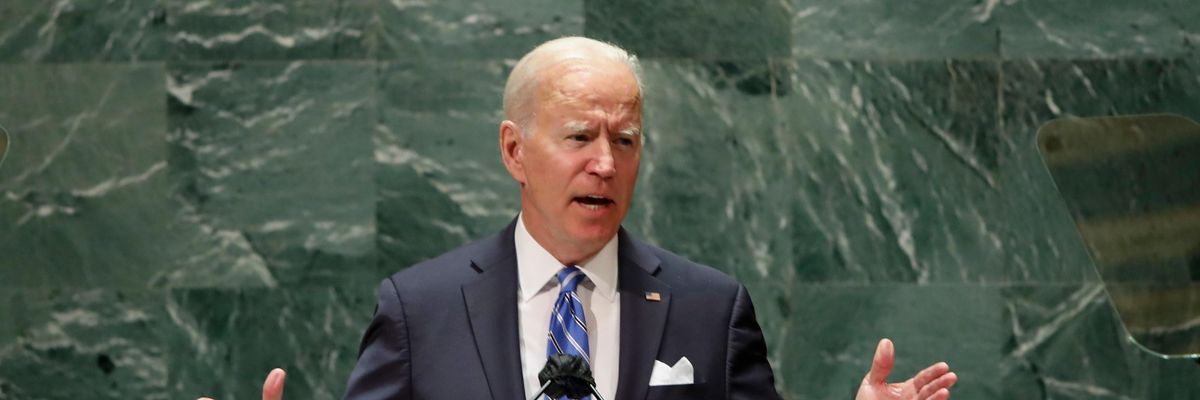
President Joe Biden addresses the 76th Session of the U.N. General Assembly on September 21, 2021 in New York City. (Photo: Eduardo Munoz-Pool/Getty Images)
President Joe Biden announced Tuesday that he intends to work with Congress to double U.S. climate aid to developing countries, a commitment that environmentalists said is a step in the right direction but still woefully inadequate to the scale of the planetary crisis.
"Biden's climate finance pledge today is extraordinarily insufficient."
Biden's pledge came during his address to the United Nations General Assembly in New York, where the U.S. president highlighted the "widespread death and devastation" wrought this year by the human-caused climate crisis, which scientists have said is driving increasingly intense extreme weather events across the globe.
Just last week, the U.N. warned that the planet is on track for 2.7degC of warming by the end of the century--heating that U.N. Secretary-General Antonio Guterres said would be "catastrophic."
"We are fast approaching the point of no return in a literal sense," Biden said in his speech Tuesday. "Will we meet the threat of the more challenging climate already ravaging every part of our world with extreme weather or we will we suffer the merciless march of ever-worsening droughts and floods, more intense fires and hurricanes, longer heatwaves and rising seas?"
"We cannot afford to waste any more time," the president added. "Let's get to work, let's make our better future now. We can do this. It's in our power and capacity."
But green groups were quick to argue Tuesday that Biden's actions and commitments don't match his urgent rhetoric--and come nowhere near meeting U.S. obligations as the largest historical emitter of greenhouse gases.
Karen Orenstein, director of the Climate and Energy Justice program at Friends of the Earth U.S., said in a statement that the president's vow to double the nation's climate funding for low-income countries is akin to "throwing droplets at a fire."
If enacted, Biden's plan would bring U.S. funding levels to approximately $11.4 billion annually by 2024, up from the administration's previous meager commitment of $5.7 billion.
"Biden's international climate finance announcement might seem ambitious given the paralyzing politics in Washington and a Congress still awash in fossil fuel money," said Orenstein. "However, the climate pollution the U.S. has produced is already causing suffering around the world."
"Biden's climate finance pledge today is extraordinarily insufficient compared to the need," Orenstein added, "and out of line with what climate science and justice demand."
Biden's U.N. remarks came a day after the humanitarian group Oxfam International estimated that, overall, wealthy countries are set to fall up to $75 billion short of fulfilling their commitment to provide $100 billion each year from 2020 to 2025 to help developing countries reduce their carbon emissions--and shield themselves from the effects of a crisis they did little to cause.
According to Oxfam, "climate-vulnerable countries could miss out on between $68 billion and $75 billion in total" between 2020 and 2025 unless rich nations step up their contributions.
In a statement Tuesday, the advocacy group ActionAid USA pointed to a recent analysis estimating that--based on its gross national income, population size, and contributions to global CO2 emissions in recent decades--the U.S. should be providing around $43 billion per year to assist countries most vulnerable to the climate emergency.
"President Biden wants to 'rally the world' to action and speaks about leading by example. In order to truly lead, the United States must genuinely do its fair share of climate action," said Brandon Wu, ActionAid USA's director of policy and campaigns. "That means drastic domestic emissions reductions, and massively scaled-up climate finance to enable reductions and support frontline communities in poorer countries."
"What the administration has pledged to date fails to meet the scale of the challenge," Wu added.
Dear Common Dreams reader, It’s been nearly 30 years since I co-founded Common Dreams with my late wife, Lina Newhouser. We had the radical notion that journalism should serve the public good, not corporate profits. It was clear to us from the outset what it would take to build such a project. No paid advertisements. No corporate sponsors. No millionaire publisher telling us what to think or do. Many people said we wouldn't last a year, but we proved those doubters wrong. Together with a tremendous team of journalists and dedicated staff, we built an independent media outlet free from the constraints of profits and corporate control. Our mission has always been simple: To inform. To inspire. To ignite change for the common good. Building Common Dreams was not easy. Our survival was never guaranteed. When you take on the most powerful forces—Wall Street greed, fossil fuel industry destruction, Big Tech lobbyists, and uber-rich oligarchs who have spent billions upon billions rigging the economy and democracy in their favor—the only bulwark you have is supporters who believe in your work. But here’s the urgent message from me today. It's never been this bad out there. And it's never been this hard to keep us going. At the very moment Common Dreams is most needed, the threats we face are intensifying. We need your support now more than ever. We don't accept corporate advertising and never will. We don't have a paywall because we don't think people should be blocked from critical news based on their ability to pay. Everything we do is funded by the donations of readers like you. When everyone does the little they can afford, we are strong. But if that support retreats or dries up, so do we. Will you donate now to make sure Common Dreams not only survives but thrives? —Craig Brown, Co-founder |
President Joe Biden announced Tuesday that he intends to work with Congress to double U.S. climate aid to developing countries, a commitment that environmentalists said is a step in the right direction but still woefully inadequate to the scale of the planetary crisis.
"Biden's climate finance pledge today is extraordinarily insufficient."
Biden's pledge came during his address to the United Nations General Assembly in New York, where the U.S. president highlighted the "widespread death and devastation" wrought this year by the human-caused climate crisis, which scientists have said is driving increasingly intense extreme weather events across the globe.
Just last week, the U.N. warned that the planet is on track for 2.7degC of warming by the end of the century--heating that U.N. Secretary-General Antonio Guterres said would be "catastrophic."
"We are fast approaching the point of no return in a literal sense," Biden said in his speech Tuesday. "Will we meet the threat of the more challenging climate already ravaging every part of our world with extreme weather or we will we suffer the merciless march of ever-worsening droughts and floods, more intense fires and hurricanes, longer heatwaves and rising seas?"
"We cannot afford to waste any more time," the president added. "Let's get to work, let's make our better future now. We can do this. It's in our power and capacity."
But green groups were quick to argue Tuesday that Biden's actions and commitments don't match his urgent rhetoric--and come nowhere near meeting U.S. obligations as the largest historical emitter of greenhouse gases.
Karen Orenstein, director of the Climate and Energy Justice program at Friends of the Earth U.S., said in a statement that the president's vow to double the nation's climate funding for low-income countries is akin to "throwing droplets at a fire."
If enacted, Biden's plan would bring U.S. funding levels to approximately $11.4 billion annually by 2024, up from the administration's previous meager commitment of $5.7 billion.
"Biden's international climate finance announcement might seem ambitious given the paralyzing politics in Washington and a Congress still awash in fossil fuel money," said Orenstein. "However, the climate pollution the U.S. has produced is already causing suffering around the world."
"Biden's climate finance pledge today is extraordinarily insufficient compared to the need," Orenstein added, "and out of line with what climate science and justice demand."
Biden's U.N. remarks came a day after the humanitarian group Oxfam International estimated that, overall, wealthy countries are set to fall up to $75 billion short of fulfilling their commitment to provide $100 billion each year from 2020 to 2025 to help developing countries reduce their carbon emissions--and shield themselves from the effects of a crisis they did little to cause.
According to Oxfam, "climate-vulnerable countries could miss out on between $68 billion and $75 billion in total" between 2020 and 2025 unless rich nations step up their contributions.
In a statement Tuesday, the advocacy group ActionAid USA pointed to a recent analysis estimating that--based on its gross national income, population size, and contributions to global CO2 emissions in recent decades--the U.S. should be providing around $43 billion per year to assist countries most vulnerable to the climate emergency.
"President Biden wants to 'rally the world' to action and speaks about leading by example. In order to truly lead, the United States must genuinely do its fair share of climate action," said Brandon Wu, ActionAid USA's director of policy and campaigns. "That means drastic domestic emissions reductions, and massively scaled-up climate finance to enable reductions and support frontline communities in poorer countries."
"What the administration has pledged to date fails to meet the scale of the challenge," Wu added.
President Joe Biden announced Tuesday that he intends to work with Congress to double U.S. climate aid to developing countries, a commitment that environmentalists said is a step in the right direction but still woefully inadequate to the scale of the planetary crisis.
"Biden's climate finance pledge today is extraordinarily insufficient."
Biden's pledge came during his address to the United Nations General Assembly in New York, where the U.S. president highlighted the "widespread death and devastation" wrought this year by the human-caused climate crisis, which scientists have said is driving increasingly intense extreme weather events across the globe.
Just last week, the U.N. warned that the planet is on track for 2.7degC of warming by the end of the century--heating that U.N. Secretary-General Antonio Guterres said would be "catastrophic."
"We are fast approaching the point of no return in a literal sense," Biden said in his speech Tuesday. "Will we meet the threat of the more challenging climate already ravaging every part of our world with extreme weather or we will we suffer the merciless march of ever-worsening droughts and floods, more intense fires and hurricanes, longer heatwaves and rising seas?"
"We cannot afford to waste any more time," the president added. "Let's get to work, let's make our better future now. We can do this. It's in our power and capacity."
But green groups were quick to argue Tuesday that Biden's actions and commitments don't match his urgent rhetoric--and come nowhere near meeting U.S. obligations as the largest historical emitter of greenhouse gases.
Karen Orenstein, director of the Climate and Energy Justice program at Friends of the Earth U.S., said in a statement that the president's vow to double the nation's climate funding for low-income countries is akin to "throwing droplets at a fire."
If enacted, Biden's plan would bring U.S. funding levels to approximately $11.4 billion annually by 2024, up from the administration's previous meager commitment of $5.7 billion.
"Biden's international climate finance announcement might seem ambitious given the paralyzing politics in Washington and a Congress still awash in fossil fuel money," said Orenstein. "However, the climate pollution the U.S. has produced is already causing suffering around the world."
"Biden's climate finance pledge today is extraordinarily insufficient compared to the need," Orenstein added, "and out of line with what climate science and justice demand."
Biden's U.N. remarks came a day after the humanitarian group Oxfam International estimated that, overall, wealthy countries are set to fall up to $75 billion short of fulfilling their commitment to provide $100 billion each year from 2020 to 2025 to help developing countries reduce their carbon emissions--and shield themselves from the effects of a crisis they did little to cause.
According to Oxfam, "climate-vulnerable countries could miss out on between $68 billion and $75 billion in total" between 2020 and 2025 unless rich nations step up their contributions.
In a statement Tuesday, the advocacy group ActionAid USA pointed to a recent analysis estimating that--based on its gross national income, population size, and contributions to global CO2 emissions in recent decades--the U.S. should be providing around $43 billion per year to assist countries most vulnerable to the climate emergency.
"President Biden wants to 'rally the world' to action and speaks about leading by example. In order to truly lead, the United States must genuinely do its fair share of climate action," said Brandon Wu, ActionAid USA's director of policy and campaigns. "That means drastic domestic emissions reductions, and massively scaled-up climate finance to enable reductions and support frontline communities in poorer countries."
"What the administration has pledged to date fails to meet the scale of the challenge," Wu added.

