SUBSCRIBE TO OUR FREE NEWSLETTER
Daily news & progressive opinion—funded by the people, not the corporations—delivered straight to your inbox.
5
#000000
#FFFFFF
To donate by check, phone, or other method, see our More Ways to Give page.
Daily news & progressive opinion—funded by the people, not the corporations—delivered straight to your inbox.
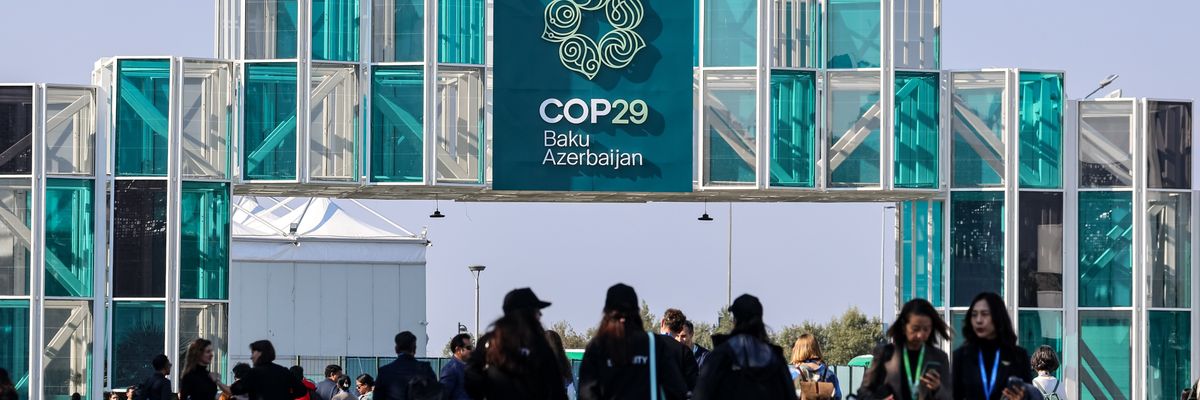
Participants walk by an entrance of COP29 in Baku, the capital of Azerbaijan on November 10, 2024.
"We are hurtling toward 3° of warming; human rights can't withstand dangerous distractions," said one climate justice advocate.
The 2024 United Nations Climate Change Conference has been called the "climate finance" conference, with participants expected to establish a new annual target for providing funds for the Global South to confront the climate crisis—but campaigners on Monday expressed concern that on the first day of the summit, there are already signs leaders will push for "false solutions" that only perpetuate planetary heating.
An annual climate finance target of $100 billion was set by policymakers in 2009, but that pledge expires at the end of 2024 and advocates say it's just a fraction of what is needed to help developing countries invest in climate crisis mitigation and adaptation to planetary heating.
Tasneem Essop, executive director of Climate Action Network, which includes more than 1,900 global civil society groups, told The Guardian that "a down payment of $5 trillion" annually in climate finance is needed, noting that "the debt is much larger."
But Sébastien Duyck, senior attorney for the Center for International Environmental Law, said the Azerbaijani presidency of the 29th Conference of the Parties of the U.N. Framework Convention on Climate Change (COP29) is already looking "to speed up the endorsement of new standards on carbon markets."
"This is extremely alarming. If this moves forward, it would be a real cop-out by governmental delegations gathered in Baku," said Duyck, referring to the capital of Azerbaijan, where COP29 is being held over the next 11 days.
Duyck pointed to new standards that were passed ahead of COP29 by a supervisory body with the aim of operationalizing and expanding carbon markets—pricing mechanisms that allow governments and other entities to trade greenhouse gas emission "credits."
"Fully operationalizing carbon markets on Day 1 would set a terrible precedent for the next two weeks, starting COP29 on a disastrous note and eroding the trust needed to achieve a bold, transformative agreement on finance," said Jax Bongon, climate justice policy officer for IBON International.
Proponents say carbon markets allow wealthy countries or corporations to purchase "carbon credits" from countries in the Global South; in exchange, governments in developing countries are paid to build renewable energy infrastructure, plant trees, or take other sustainable steps.
Those steps are thought to "buy time" for the wealthy country or company to cut down on their own pollution. But the scheme has been exposed as allowing companies to continue polluting without the supposed "offsets" actually helping to mitigate the climate crisis.
Lise Masson, climate justice and energy advocacy officer at Friends of the Earth (FOE), emphasized that "carbon markets are not climate finance, and we cannot accept these neocolonial schemes to be propped up as a success of COP29."
"Decisions at COP29 threaten to open the floodgates for a global carbon market that would have devastating impacts on communities in the Global South, on Indigenous peoples, and on small peasant farmers first and foremost," said Masson.
Marta Scaaf, who directs Amnesty International's climate justice program, warned COP29 delegates may "bypass accountability norms on Day 1 and issue recommendations to govern carbon markets, which are essentially pollution permits."
Essop suggested that carbon markets are being pushed as a false solution in order to save wealthy countries from having to provide what is needed for the Global South to mitigate the climate crisis and adapt to the hurricanes, flooding, drought, and other extreme conditions that have been linked to planetary heating.
"Five trillion dollars is what we come here to demand," Essop said. "Governments out there are absolutely capable of finding the money that does wrong in the world. They found the money for military spending. They found the money for the genocide in Gaza. They find the money to subsidize and support the fossil fuel industry. To come here and say that they do not have money is absolutely untruthful and unacceptable."
Meena Raman of FOE Malaysia stressed that climate finance "isn't charity; it's reparations for a climate debt long overdue."
"Grants must replace loans, and loss and damage funding must also be scaled up tremendously to meet the needs of impacted countries in the Global South," said Raman. "Debt cancellation for the Global South is essential to break cycles of injustice. The money exists: redirecting funds from global military spending and climate justice are paths forward."
The international human rights group Global Witness drove home the point by taking over the web address that some might arrive at if they were looking for more information about COP29.
Visitors to cop29.com on Monday were met with the words "Payback Time."
"We've taken over cop29.com to unite the millions of people demanding justice," said Global Witness. "This summer broke heat records again. Wildfires, droughts, and storms are killing thousands and driving up the cost of food, energy, and insurance. Worse is coming."
"COP29 is our moment," added the group. "The loss and damage fund was created to help developing nations that are being hit hardest by climate chaos... Fossil fuel companies rake in billions. They must pay into the fund to help communities rebuild, adapt, and repair some of the damage they've caused."
Dear Common Dreams reader, It’s been nearly 30 years since I co-founded Common Dreams with my late wife, Lina Newhouser. We had the radical notion that journalism should serve the public good, not corporate profits. It was clear to us from the outset what it would take to build such a project. No paid advertisements. No corporate sponsors. No millionaire publisher telling us what to think or do. Many people said we wouldn't last a year, but we proved those doubters wrong. Together with a tremendous team of journalists and dedicated staff, we built an independent media outlet free from the constraints of profits and corporate control. Our mission has always been simple: To inform. To inspire. To ignite change for the common good. Building Common Dreams was not easy. Our survival was never guaranteed. When you take on the most powerful forces—Wall Street greed, fossil fuel industry destruction, Big Tech lobbyists, and uber-rich oligarchs who have spent billions upon billions rigging the economy and democracy in their favor—the only bulwark you have is supporters who believe in your work. But here’s the urgent message from me today. It's never been this bad out there. And it's never been this hard to keep us going. At the very moment Common Dreams is most needed, the threats we face are intensifying. We need your support now more than ever. We don't accept corporate advertising and never will. We don't have a paywall because we don't think people should be blocked from critical news based on their ability to pay. Everything we do is funded by the donations of readers like you. When everyone does the little they can afford, we are strong. But if that support retreats or dries up, so do we. Will you donate now to make sure Common Dreams not only survives but thrives? —Craig Brown, Co-founder |
The 2024 United Nations Climate Change Conference has been called the "climate finance" conference, with participants expected to establish a new annual target for providing funds for the Global South to confront the climate crisis—but campaigners on Monday expressed concern that on the first day of the summit, there are already signs leaders will push for "false solutions" that only perpetuate planetary heating.
An annual climate finance target of $100 billion was set by policymakers in 2009, but that pledge expires at the end of 2024 and advocates say it's just a fraction of what is needed to help developing countries invest in climate crisis mitigation and adaptation to planetary heating.
Tasneem Essop, executive director of Climate Action Network, which includes more than 1,900 global civil society groups, told The Guardian that "a down payment of $5 trillion" annually in climate finance is needed, noting that "the debt is much larger."
But Sébastien Duyck, senior attorney for the Center for International Environmental Law, said the Azerbaijani presidency of the 29th Conference of the Parties of the U.N. Framework Convention on Climate Change (COP29) is already looking "to speed up the endorsement of new standards on carbon markets."
"This is extremely alarming. If this moves forward, it would be a real cop-out by governmental delegations gathered in Baku," said Duyck, referring to the capital of Azerbaijan, where COP29 is being held over the next 11 days.
Duyck pointed to new standards that were passed ahead of COP29 by a supervisory body with the aim of operationalizing and expanding carbon markets—pricing mechanisms that allow governments and other entities to trade greenhouse gas emission "credits."
"Fully operationalizing carbon markets on Day 1 would set a terrible precedent for the next two weeks, starting COP29 on a disastrous note and eroding the trust needed to achieve a bold, transformative agreement on finance," said Jax Bongon, climate justice policy officer for IBON International.
Proponents say carbon markets allow wealthy countries or corporations to purchase "carbon credits" from countries in the Global South; in exchange, governments in developing countries are paid to build renewable energy infrastructure, plant trees, or take other sustainable steps.
Those steps are thought to "buy time" for the wealthy country or company to cut down on their own pollution. But the scheme has been exposed as allowing companies to continue polluting without the supposed "offsets" actually helping to mitigate the climate crisis.
Lise Masson, climate justice and energy advocacy officer at Friends of the Earth (FOE), emphasized that "carbon markets are not climate finance, and we cannot accept these neocolonial schemes to be propped up as a success of COP29."
"Decisions at COP29 threaten to open the floodgates for a global carbon market that would have devastating impacts on communities in the Global South, on Indigenous peoples, and on small peasant farmers first and foremost," said Masson.
Marta Scaaf, who directs Amnesty International's climate justice program, warned COP29 delegates may "bypass accountability norms on Day 1 and issue recommendations to govern carbon markets, which are essentially pollution permits."
Essop suggested that carbon markets are being pushed as a false solution in order to save wealthy countries from having to provide what is needed for the Global South to mitigate the climate crisis and adapt to the hurricanes, flooding, drought, and other extreme conditions that have been linked to planetary heating.
"Five trillion dollars is what we come here to demand," Essop said. "Governments out there are absolutely capable of finding the money that does wrong in the world. They found the money for military spending. They found the money for the genocide in Gaza. They find the money to subsidize and support the fossil fuel industry. To come here and say that they do not have money is absolutely untruthful and unacceptable."
Meena Raman of FOE Malaysia stressed that climate finance "isn't charity; it's reparations for a climate debt long overdue."
"Grants must replace loans, and loss and damage funding must also be scaled up tremendously to meet the needs of impacted countries in the Global South," said Raman. "Debt cancellation for the Global South is essential to break cycles of injustice. The money exists: redirecting funds from global military spending and climate justice are paths forward."
The international human rights group Global Witness drove home the point by taking over the web address that some might arrive at if they were looking for more information about COP29.
Visitors to cop29.com on Monday were met with the words "Payback Time."
"We've taken over cop29.com to unite the millions of people demanding justice," said Global Witness. "This summer broke heat records again. Wildfires, droughts, and storms are killing thousands and driving up the cost of food, energy, and insurance. Worse is coming."
"COP29 is our moment," added the group. "The loss and damage fund was created to help developing nations that are being hit hardest by climate chaos... Fossil fuel companies rake in billions. They must pay into the fund to help communities rebuild, adapt, and repair some of the damage they've caused."
The 2024 United Nations Climate Change Conference has been called the "climate finance" conference, with participants expected to establish a new annual target for providing funds for the Global South to confront the climate crisis—but campaigners on Monday expressed concern that on the first day of the summit, there are already signs leaders will push for "false solutions" that only perpetuate planetary heating.
An annual climate finance target of $100 billion was set by policymakers in 2009, but that pledge expires at the end of 2024 and advocates say it's just a fraction of what is needed to help developing countries invest in climate crisis mitigation and adaptation to planetary heating.
Tasneem Essop, executive director of Climate Action Network, which includes more than 1,900 global civil society groups, told The Guardian that "a down payment of $5 trillion" annually in climate finance is needed, noting that "the debt is much larger."
But Sébastien Duyck, senior attorney for the Center for International Environmental Law, said the Azerbaijani presidency of the 29th Conference of the Parties of the U.N. Framework Convention on Climate Change (COP29) is already looking "to speed up the endorsement of new standards on carbon markets."
"This is extremely alarming. If this moves forward, it would be a real cop-out by governmental delegations gathered in Baku," said Duyck, referring to the capital of Azerbaijan, where COP29 is being held over the next 11 days.
Duyck pointed to new standards that were passed ahead of COP29 by a supervisory body with the aim of operationalizing and expanding carbon markets—pricing mechanisms that allow governments and other entities to trade greenhouse gas emission "credits."
"Fully operationalizing carbon markets on Day 1 would set a terrible precedent for the next two weeks, starting COP29 on a disastrous note and eroding the trust needed to achieve a bold, transformative agreement on finance," said Jax Bongon, climate justice policy officer for IBON International.
Proponents say carbon markets allow wealthy countries or corporations to purchase "carbon credits" from countries in the Global South; in exchange, governments in developing countries are paid to build renewable energy infrastructure, plant trees, or take other sustainable steps.
Those steps are thought to "buy time" for the wealthy country or company to cut down on their own pollution. But the scheme has been exposed as allowing companies to continue polluting without the supposed "offsets" actually helping to mitigate the climate crisis.
Lise Masson, climate justice and energy advocacy officer at Friends of the Earth (FOE), emphasized that "carbon markets are not climate finance, and we cannot accept these neocolonial schemes to be propped up as a success of COP29."
"Decisions at COP29 threaten to open the floodgates for a global carbon market that would have devastating impacts on communities in the Global South, on Indigenous peoples, and on small peasant farmers first and foremost," said Masson.
Marta Scaaf, who directs Amnesty International's climate justice program, warned COP29 delegates may "bypass accountability norms on Day 1 and issue recommendations to govern carbon markets, which are essentially pollution permits."
Essop suggested that carbon markets are being pushed as a false solution in order to save wealthy countries from having to provide what is needed for the Global South to mitigate the climate crisis and adapt to the hurricanes, flooding, drought, and other extreme conditions that have been linked to planetary heating.
"Five trillion dollars is what we come here to demand," Essop said. "Governments out there are absolutely capable of finding the money that does wrong in the world. They found the money for military spending. They found the money for the genocide in Gaza. They find the money to subsidize and support the fossil fuel industry. To come here and say that they do not have money is absolutely untruthful and unacceptable."
Meena Raman of FOE Malaysia stressed that climate finance "isn't charity; it's reparations for a climate debt long overdue."
"Grants must replace loans, and loss and damage funding must also be scaled up tremendously to meet the needs of impacted countries in the Global South," said Raman. "Debt cancellation for the Global South is essential to break cycles of injustice. The money exists: redirecting funds from global military spending and climate justice are paths forward."
The international human rights group Global Witness drove home the point by taking over the web address that some might arrive at if they were looking for more information about COP29.
Visitors to cop29.com on Monday were met with the words "Payback Time."
"We've taken over cop29.com to unite the millions of people demanding justice," said Global Witness. "This summer broke heat records again. Wildfires, droughts, and storms are killing thousands and driving up the cost of food, energy, and insurance. Worse is coming."
"COP29 is our moment," added the group. "The loss and damage fund was created to help developing nations that are being hit hardest by climate chaos... Fossil fuel companies rake in billions. They must pay into the fund to help communities rebuild, adapt, and repair some of the damage they've caused."