
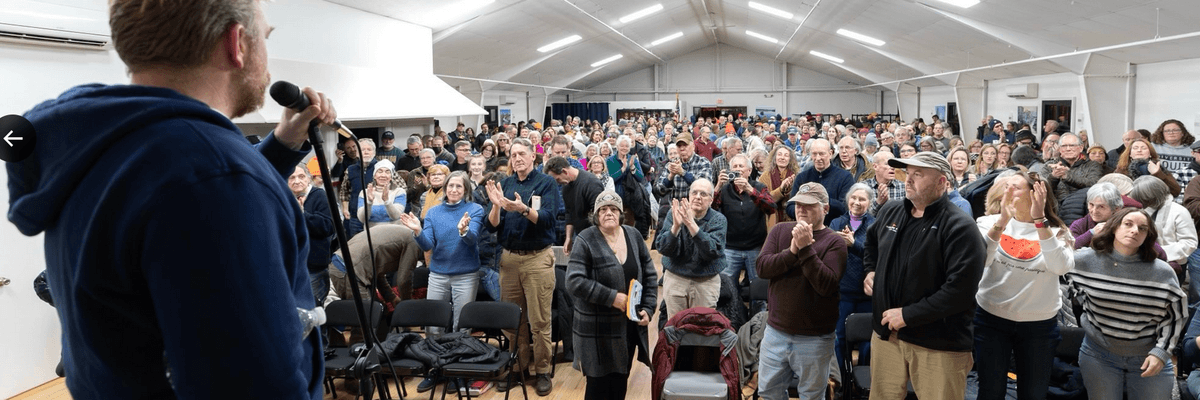
US Senate candidate Graham Platner addresses a crowd in Yarmouth, Maine on January 31, 2026.
Platner Raises 3 Times as Much as Mills, Collins Combined in Small Donations in Final Quarter of 2025
"Remember back when the national media said our campaign was dead?" said the Democratic Senate candidate.
At a campaign event over the weekend, Democratic US Senate candidate Graham Platner repeated a message that's been central to his campaign since it launched last August: that his goal of serving in the Senate is about "movement politics" more than attaining a position of power for himself.
“If we win this race, with this kind of politics and building this kind of organizational capacity,” Platner told the crowd that had packed into the AmVets hall in Yarmouth, Maine on Saturday, “then we get to point to this and show them it works. We get to inspire others in other states. We get to show them that you can win Senate seats with a working-class movement.”
On Monday, new fundraising numbers released by the progressive candidate's campaign on social media showed that Maine voters are responding to Platner's call to help build people-powered movement.
In the fourth quarter of 2025, the veteran and oyster farmer's campaign brought in $3.2 million from people who donated less than $200—about three times the amount collected by Platner's top competitor in the Democratic primary, Gov. Janet Mills, and Sen. Susan Collins (R-Maine) combined.
Mills brought in $822,000 in the fourth quarter while the longtime Republican senator reported $230,000 in donations.
Teachers had the most common occupation among Platner's small-dollar donors, according to the campaign.
Platner released the fundraising data soon after announcing the "207 Tour"—a statewide tour currently scheduled to go until at least May with stops in the southern coastal town of York, Fort Kent on the Canadian border, and tiny inland towns like Liberty and Appleton.
Collins has not faced Mainers at a town hall in over two decades, Platner has noted.
"I don't know how we've reached a time when Mainers cannot count on politicians to show up in their communities and openly and honestly answer questions. Our campaign is doing things differently because I'd actually like to hear from you," said Platner last week. "Wherever you are, I'll see you there."
Beyond small-dollar fundraising, the Platner campaign is aiming to mobilize a grassroots army of volunteers across the state and that’s what the slate of town halls in dozens of communities is designed to help build.
The 207 Tour so far appears to offer more proof that Platner's campaign platform—which demands a Medicare for All system to replace for-profit health insurance, a repeal of Citizens United to "ban billionaires buying elections," and a billionaire minimum tax—is resonating with Maine voters.
He spoke to 500 people in Yarmouth, a town of 9,000 people. That same day, 100 people crowded into a venue in South Paris (population: 2,000), and 85 people joined him Sunday at a town hall in Isleboro, a town of fewer than 600 people which is accessible only by ferry.
In Liberty, Platner was greeted with a standing ovation on Sunday.
"Remember back when the national media said our campaign was dead?" he said on social media, referring to stories that broke just as Mills entered the Democratic primary race in October, pertaining to a tattoo that resembled a Nazi symbol—which had never before raised alarm and which Platner subsequently had covered up—and old Reddit posts he had written that he said no longer reflected his worldview.
The controversies did not slow his momentum, with voters at his campaign events responding positively to Platner's candid comments about how his views have changed throughout his life.
Organizer and attorney Aaron Regunberg said Sunday that Democratic consultants and pundits who wrote off Platner last fall "shouldn’t be allowed to keep being so wrong all the time and still have jobs."
In overall fundraising in the last quarter of 2025, Platner outpaced both of his rivals, reporting $4.6 million in total donations. He has $3.7 million in cash on hand.
Mills reported $2.7 million for the period and has $1.3 million in available cash after the fourth quarter, and Collins raised $2.2 million and has $8 million in cash on hand.
A number of recent polls have also shown Platner favored to win in the primary and general election.
In recent weeks, Platner has taken Collins to task for supporting a funding bill for the Department of Homeland Security even as President Donald Trump's mass deportation campaign came to Maine and swept up numerous people who had not committed any crimes—and for taking credit when Homeland Security Secretary Kristi Noem said US Immigration and Customs Enforcement agents were ending "enhanced" operations in the state.
In Yarmouth, Platner acknowledged he has built a reputation as a bit of a "bomb-throwing populist" with some of his campaign rhetoric—"and I am," he promised.
But he also said he does not want to go to Washington, DC just to "get in fights with people" with whom he disagrees—but to push for policies that his growing "movement" is demanding by working with anyone he can.
"When we're talking about policy that impacts people's lives and livelihoods," he said, "things don't happen just because you're holding grudge against somebody."
"The point is to go down there and pass things and build power," said Platner. "Sometimes it's not going to work, but that's also why we need to build that secondary power—the movement power—to impose [our power] at those times when relationships won't work."
We are at a crossroads
This country and this world are at a monumental crossroads. In a few short weeks, US voters will have an opportunity to beat back the forces of fascism and confront the billionaires who are rigging the economy, our media system, and our democracy, making it increasingly impossible for ordinary people to get by. We’re not just talking about the election. We’re talking about what must be done once these fascist elements are vanquished from power. We need a bolder set of solutions than what either major party has so far been willing to offer and a working-class movement ready to fight like hell for it. Trump didn't emerge from nowhere. The conditions that fueled MAGA authoritarianism were created by decades of radical neoliberal economic policies and a corrupt political system dominated by corporate interests. They slashed taxes on the super-rich, promising that the benefits would trickle down. They said giveaways to the corporate titans would make life more affordable for the rest of us. It was all bullshit. And when a bitter, betrayed populace searches for someone to blame, right-wing demagogues have little trouble finding scapegoats. People know when they're being lied to, but you won't hear any of this from the corporate media. Only independent journalism—powered and funded by people who believe in building a better world—can deliver truly trustworthy daily news. Our Fall Campaign is underway, and we need your help. To power our newsroom through the rest of the year, we need to raise $125,000 by midnight on October 31. So if you share our vision, please contribute whatever you can to sustain our work. |
At a campaign event over the weekend, Democratic US Senate candidate Graham Platner repeated a message that's been central to his campaign since it launched last August: that his goal of serving in the Senate is about "movement politics" more than attaining a position of power for himself.
“If we win this race, with this kind of politics and building this kind of organizational capacity,” Platner told the crowd that had packed into the AmVets hall in Yarmouth, Maine on Saturday, “then we get to point to this and show them it works. We get to inspire others in other states. We get to show them that you can win Senate seats with a working-class movement.”
On Monday, new fundraising numbers released by the progressive candidate's campaign on social media showed that Maine voters are responding to Platner's call to help build people-powered movement.
In the fourth quarter of 2025, the veteran and oyster farmer's campaign brought in $3.2 million from people who donated less than $200—about three times the amount collected by Platner's top competitor in the Democratic primary, Gov. Janet Mills, and Sen. Susan Collins (R-Maine) combined.
Mills brought in $822,000 in the fourth quarter while the longtime Republican senator reported $230,000 in donations.
Teachers had the most common occupation among Platner's small-dollar donors, according to the campaign.
Platner released the fundraising data soon after announcing the "207 Tour"—a statewide tour currently scheduled to go until at least May with stops in the southern coastal town of York, Fort Kent on the Canadian border, and tiny inland towns like Liberty and Appleton.
Collins has not faced Mainers at a town hall in over two decades, Platner has noted.
"I don't know how we've reached a time when Mainers cannot count on politicians to show up in their communities and openly and honestly answer questions. Our campaign is doing things differently because I'd actually like to hear from you," said Platner last week. "Wherever you are, I'll see you there."
Beyond small-dollar fundraising, the Platner campaign is aiming to mobilize a grassroots army of volunteers across the state and that’s what the slate of town halls in dozens of communities is designed to help build.
The 207 Tour so far appears to offer more proof that Platner's campaign platform—which demands a Medicare for All system to replace for-profit health insurance, a repeal of Citizens United to "ban billionaires buying elections," and a billionaire minimum tax—is resonating with Maine voters.
He spoke to 500 people in Yarmouth, a town of 9,000 people. That same day, 100 people crowded into a venue in South Paris (population: 2,000), and 85 people joined him Sunday at a town hall in Isleboro, a town of fewer than 600 people which is accessible only by ferry.
In Liberty, Platner was greeted with a standing ovation on Sunday.
"Remember back when the national media said our campaign was dead?" he said on social media, referring to stories that broke just as Mills entered the Democratic primary race in October, pertaining to a tattoo that resembled a Nazi symbol—which had never before raised alarm and which Platner subsequently had covered up—and old Reddit posts he had written that he said no longer reflected his worldview.
The controversies did not slow his momentum, with voters at his campaign events responding positively to Platner's candid comments about how his views have changed throughout his life.
Organizer and attorney Aaron Regunberg said Sunday that Democratic consultants and pundits who wrote off Platner last fall "shouldn’t be allowed to keep being so wrong all the time and still have jobs."
In overall fundraising in the last quarter of 2025, Platner outpaced both of his rivals, reporting $4.6 million in total donations. He has $3.7 million in cash on hand.
Mills reported $2.7 million for the period and has $1.3 million in available cash after the fourth quarter, and Collins raised $2.2 million and has $8 million in cash on hand.
A number of recent polls have also shown Platner favored to win in the primary and general election.
In recent weeks, Platner has taken Collins to task for supporting a funding bill for the Department of Homeland Security even as President Donald Trump's mass deportation campaign came to Maine and swept up numerous people who had not committed any crimes—and for taking credit when Homeland Security Secretary Kristi Noem said US Immigration and Customs Enforcement agents were ending "enhanced" operations in the state.
In Yarmouth, Platner acknowledged he has built a reputation as a bit of a "bomb-throwing populist" with some of his campaign rhetoric—"and I am," he promised.
But he also said he does not want to go to Washington, DC just to "get in fights with people" with whom he disagrees—but to push for policies that his growing "movement" is demanding by working with anyone he can.
"When we're talking about policy that impacts people's lives and livelihoods," he said, "things don't happen just because you're holding grudge against somebody."
"The point is to go down there and pass things and build power," said Platner. "Sometimes it's not going to work, but that's also why we need to build that secondary power—the movement power—to impose [our power] at those times when relationships won't work."
- 'No War With Venezuela,' Says Maine US Senate Candidate Graham Platner ›
- The Biggest Applause Line From Graham Platner's Labor Day Speech Was About Ending US Bombs in Gaza ›
- Democratic Establishment Targets Maine Working-Class Senate Candidate Graham Platner ›
- New Poll Shows Platner Romping in Dem Primary and Comfortably Ahead of Collins for Maine Senate Seat | Common Dreams ›
- Platner Thanks Small-Dollar Donors After Reporting $4 Million Fundraising Haul in First Quarter | Common Dreams ›
At a campaign event over the weekend, Democratic US Senate candidate Graham Platner repeated a message that's been central to his campaign since it launched last August: that his goal of serving in the Senate is about "movement politics" more than attaining a position of power for himself.
“If we win this race, with this kind of politics and building this kind of organizational capacity,” Platner told the crowd that had packed into the AmVets hall in Yarmouth, Maine on Saturday, “then we get to point to this and show them it works. We get to inspire others in other states. We get to show them that you can win Senate seats with a working-class movement.”
On Monday, new fundraising numbers released by the progressive candidate's campaign on social media showed that Maine voters are responding to Platner's call to help build people-powered movement.
In the fourth quarter of 2025, the veteran and oyster farmer's campaign brought in $3.2 million from people who donated less than $200—about three times the amount collected by Platner's top competitor in the Democratic primary, Gov. Janet Mills, and Sen. Susan Collins (R-Maine) combined.
Mills brought in $822,000 in the fourth quarter while the longtime Republican senator reported $230,000 in donations.
Teachers had the most common occupation among Platner's small-dollar donors, according to the campaign.
Platner released the fundraising data soon after announcing the "207 Tour"—a statewide tour currently scheduled to go until at least May with stops in the southern coastal town of York, Fort Kent on the Canadian border, and tiny inland towns like Liberty and Appleton.
Collins has not faced Mainers at a town hall in over two decades, Platner has noted.
"I don't know how we've reached a time when Mainers cannot count on politicians to show up in their communities and openly and honestly answer questions. Our campaign is doing things differently because I'd actually like to hear from you," said Platner last week. "Wherever you are, I'll see you there."
Beyond small-dollar fundraising, the Platner campaign is aiming to mobilize a grassroots army of volunteers across the state and that’s what the slate of town halls in dozens of communities is designed to help build.
The 207 Tour so far appears to offer more proof that Platner's campaign platform—which demands a Medicare for All system to replace for-profit health insurance, a repeal of Citizens United to "ban billionaires buying elections," and a billionaire minimum tax—is resonating with Maine voters.
He spoke to 500 people in Yarmouth, a town of 9,000 people. That same day, 100 people crowded into a venue in South Paris (population: 2,000), and 85 people joined him Sunday at a town hall in Isleboro, a town of fewer than 600 people which is accessible only by ferry.
In Liberty, Platner was greeted with a standing ovation on Sunday.
"Remember back when the national media said our campaign was dead?" he said on social media, referring to stories that broke just as Mills entered the Democratic primary race in October, pertaining to a tattoo that resembled a Nazi symbol—which had never before raised alarm and which Platner subsequently had covered up—and old Reddit posts he had written that he said no longer reflected his worldview.
The controversies did not slow his momentum, with voters at his campaign events responding positively to Platner's candid comments about how his views have changed throughout his life.
Organizer and attorney Aaron Regunberg said Sunday that Democratic consultants and pundits who wrote off Platner last fall "shouldn’t be allowed to keep being so wrong all the time and still have jobs."
In overall fundraising in the last quarter of 2025, Platner outpaced both of his rivals, reporting $4.6 million in total donations. He has $3.7 million in cash on hand.
Mills reported $2.7 million for the period and has $1.3 million in available cash after the fourth quarter, and Collins raised $2.2 million and has $8 million in cash on hand.
A number of recent polls have also shown Platner favored to win in the primary and general election.
In recent weeks, Platner has taken Collins to task for supporting a funding bill for the Department of Homeland Security even as President Donald Trump's mass deportation campaign came to Maine and swept up numerous people who had not committed any crimes—and for taking credit when Homeland Security Secretary Kristi Noem said US Immigration and Customs Enforcement agents were ending "enhanced" operations in the state.
In Yarmouth, Platner acknowledged he has built a reputation as a bit of a "bomb-throwing populist" with some of his campaign rhetoric—"and I am," he promised.
But he also said he does not want to go to Washington, DC just to "get in fights with people" with whom he disagrees—but to push for policies that his growing "movement" is demanding by working with anyone he can.
"When we're talking about policy that impacts people's lives and livelihoods," he said, "things don't happen just because you're holding grudge against somebody."
"The point is to go down there and pass things and build power," said Platner. "Sometimes it's not going to work, but that's also why we need to build that secondary power—the movement power—to impose [our power] at those times when relationships won't work."
- 'No War With Venezuela,' Says Maine US Senate Candidate Graham Platner ›
- The Biggest Applause Line From Graham Platner's Labor Day Speech Was About Ending US Bombs in Gaza ›
- Democratic Establishment Targets Maine Working-Class Senate Candidate Graham Platner ›
- New Poll Shows Platner Romping in Dem Primary and Comfortably Ahead of Collins for Maine Senate Seat | Common Dreams ›
- Platner Thanks Small-Dollar Donors After Reporting $4 Million Fundraising Haul in First Quarter | Common Dreams ›