SUBSCRIBE TO OUR FREE NEWSLETTER
Daily news & progressive opinion—funded by the people, not the corporations—delivered straight to your inbox.
5
#000000
#FFFFFF
To donate by check, phone, or other method, see our More Ways to Give page.
Daily news & progressive opinion—funded by the people, not the corporations—delivered straight to your inbox.
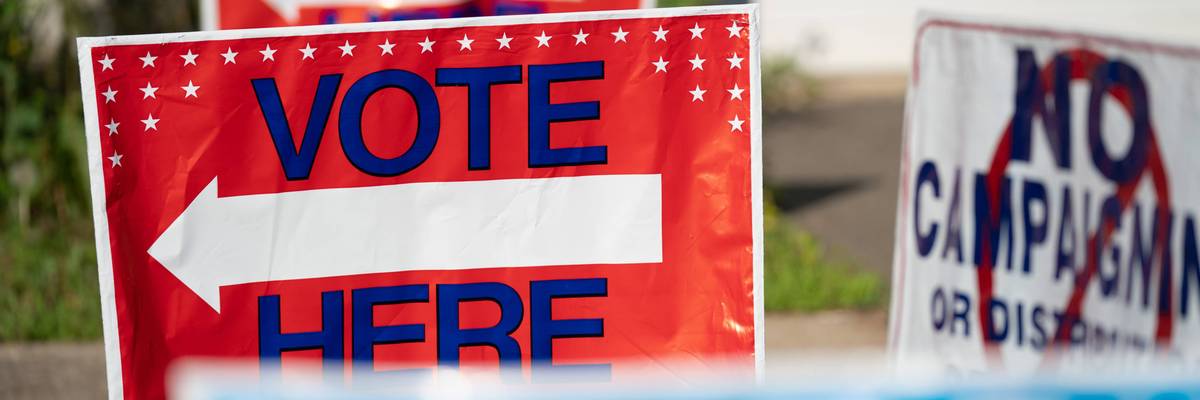
Signs direct voters at a polling location on May 17, 2022 in Mt. Gilead, North Carolina.
"Aggies do what is necessary for our rights, for our survival, and for our people,” said one student organizer at North Carolina A&T State University, the largest historically Black college in the nation.
As early voting began for the state primaries, North Carolina college students found themselves walking more than a mile to cast their ballots after the Republican-controlled State Board of Elections closed polling places on their campuses.
The board, which shifted to a 3-2 GOP majority, voted last month to close a polling site at Western Carolina University and to reject the creation of polling sites at two other colleges—the University of North Carolina at Greensboro (UNC Greensboro), and the North Carolina Agricultural and Technical State University (NC A&T), the largest historically Black college in the nation. Each of these schools had polling places available on campus during the 2024 election.
The decision, which came just weeks before early voting was scheduled to begin, left many of the 40,000 students who attend these schools more than a mile away from the nearest polling place.
It was the latest of many efforts by North Carolina Republicans to restrict voting ahead of the 2026 midterms: They also cut polling place hours in dozens of counties and eliminated early voting on Sundays in some, which dealt a blow to "Souls to the Polls" efforts led by Black churches.
A lawsuit filed late last month by a group of students at the three schools said, “as a result, students who do not have access to private transportation must now walk that distance—which includes walking along a highway that lacks any pedestrian infrastructure—to exercise their right to vote.
The students argued that this violates their access to the ballot and to same-day registration, which is only available during the early voting period.
Last week, a federal judge rejected their demand to open the three polling centers. Jay Pavey, a Republican member of the Jackson County elections board, who voted to close the WCU polling site, dismissed fears that it would limit voting.
“If you really want to vote, you'll find a way to go one mile,” Pavey said.
Despite the hurdles, hundreds of students in the critical battleground state remained determined to cast a ballot as early voting opened.
On Friday, a video posted by the Smoky Mountain News showed dozens of students marching in a line from WCU "to their new polling place," at the Jackson County Recreation Center, "1.7 miles down a busy highway with no sidewalks."
The university and on-campus groups also organized shuttles to and from the polling place.
A similar scene was documented at NC A&T, where about 60 students marched to their nearest polling place at a courthouse more than 1.3 miles away.
The students described their march as a protest against the state's decision, which they viewed as an attempt to limit their power at the ballot box.
The campus is no stranger to standing up against injustice. February 1 marked the 66th anniversary of when four Black NC A&T students launched one of the most pivotal protests of the civil rights movement, sitting down at a segregated Woolworth's lunch counter in downtown Greensboro—an act that sparked a wave of nonviolent civil disobedience across the South.
"Aggies do what is necessary for our rights, for our survival, and for our people,” Jae'lah Monet, one of the student organizers of the march, told Spectrum News 1.
Monet said she and other students will do what is necessary to get students to the polls safely and to demonstrate to the state board the importance of having a polling place on campus. She said several similar events will take place throughout the early voting period.
"We will be there all day, and we will all get a chance to vote," Monet said.
Dear Common Dreams reader, It’s been nearly 30 years since I co-founded Common Dreams with my late wife, Lina Newhouser. We had the radical notion that journalism should serve the public good, not corporate profits. It was clear to us from the outset what it would take to build such a project. No paid advertisements. No corporate sponsors. No millionaire publisher telling us what to think or do. Many people said we wouldn't last a year, but we proved those doubters wrong. Together with a tremendous team of journalists and dedicated staff, we built an independent media outlet free from the constraints of profits and corporate control. Our mission has always been simple: To inform. To inspire. To ignite change for the common good. Building Common Dreams was not easy. Our survival was never guaranteed. When you take on the most powerful forces—Wall Street greed, fossil fuel industry destruction, Big Tech lobbyists, and uber-rich oligarchs who have spent billions upon billions rigging the economy and democracy in their favor—the only bulwark you have is supporters who believe in your work. But here’s the urgent message from me today. It's never been this bad out there. And it's never been this hard to keep us going. At the very moment Common Dreams is most needed, the threats we face are intensifying. We need your support now more than ever. We don't accept corporate advertising and never will. We don't have a paywall because we don't think people should be blocked from critical news based on their ability to pay. Everything we do is funded by the donations of readers like you. When everyone does the little they can afford, we are strong. But if that support retreats or dries up, so do we. Will you donate now to make sure Common Dreams not only survives but thrives? —Craig Brown, Co-founder |
As early voting began for the state primaries, North Carolina college students found themselves walking more than a mile to cast their ballots after the Republican-controlled State Board of Elections closed polling places on their campuses.
The board, which shifted to a 3-2 GOP majority, voted last month to close a polling site at Western Carolina University and to reject the creation of polling sites at two other colleges—the University of North Carolina at Greensboro (UNC Greensboro), and the North Carolina Agricultural and Technical State University (NC A&T), the largest historically Black college in the nation. Each of these schools had polling places available on campus during the 2024 election.
The decision, which came just weeks before early voting was scheduled to begin, left many of the 40,000 students who attend these schools more than a mile away from the nearest polling place.
It was the latest of many efforts by North Carolina Republicans to restrict voting ahead of the 2026 midterms: They also cut polling place hours in dozens of counties and eliminated early voting on Sundays in some, which dealt a blow to "Souls to the Polls" efforts led by Black churches.
A lawsuit filed late last month by a group of students at the three schools said, “as a result, students who do not have access to private transportation must now walk that distance—which includes walking along a highway that lacks any pedestrian infrastructure—to exercise their right to vote.
The students argued that this violates their access to the ballot and to same-day registration, which is only available during the early voting period.
Last week, a federal judge rejected their demand to open the three polling centers. Jay Pavey, a Republican member of the Jackson County elections board, who voted to close the WCU polling site, dismissed fears that it would limit voting.
“If you really want to vote, you'll find a way to go one mile,” Pavey said.
Despite the hurdles, hundreds of students in the critical battleground state remained determined to cast a ballot as early voting opened.
On Friday, a video posted by the Smoky Mountain News showed dozens of students marching in a line from WCU "to their new polling place," at the Jackson County Recreation Center, "1.7 miles down a busy highway with no sidewalks."
The university and on-campus groups also organized shuttles to and from the polling place.
A similar scene was documented at NC A&T, where about 60 students marched to their nearest polling place at a courthouse more than 1.3 miles away.
The students described their march as a protest against the state's decision, which they viewed as an attempt to limit their power at the ballot box.
The campus is no stranger to standing up against injustice. February 1 marked the 66th anniversary of when four Black NC A&T students launched one of the most pivotal protests of the civil rights movement, sitting down at a segregated Woolworth's lunch counter in downtown Greensboro—an act that sparked a wave of nonviolent civil disobedience across the South.
"Aggies do what is necessary for our rights, for our survival, and for our people,” Jae'lah Monet, one of the student organizers of the march, told Spectrum News 1.
Monet said she and other students will do what is necessary to get students to the polls safely and to demonstrate to the state board the importance of having a polling place on campus. She said several similar events will take place throughout the early voting period.
"We will be there all day, and we will all get a chance to vote," Monet said.
As early voting began for the state primaries, North Carolina college students found themselves walking more than a mile to cast their ballots after the Republican-controlled State Board of Elections closed polling places on their campuses.
The board, which shifted to a 3-2 GOP majority, voted last month to close a polling site at Western Carolina University and to reject the creation of polling sites at two other colleges—the University of North Carolina at Greensboro (UNC Greensboro), and the North Carolina Agricultural and Technical State University (NC A&T), the largest historically Black college in the nation. Each of these schools had polling places available on campus during the 2024 election.
The decision, which came just weeks before early voting was scheduled to begin, left many of the 40,000 students who attend these schools more than a mile away from the nearest polling place.
It was the latest of many efforts by North Carolina Republicans to restrict voting ahead of the 2026 midterms: They also cut polling place hours in dozens of counties and eliminated early voting on Sundays in some, which dealt a blow to "Souls to the Polls" efforts led by Black churches.
A lawsuit filed late last month by a group of students at the three schools said, “as a result, students who do not have access to private transportation must now walk that distance—which includes walking along a highway that lacks any pedestrian infrastructure—to exercise their right to vote.
The students argued that this violates their access to the ballot and to same-day registration, which is only available during the early voting period.
Last week, a federal judge rejected their demand to open the three polling centers. Jay Pavey, a Republican member of the Jackson County elections board, who voted to close the WCU polling site, dismissed fears that it would limit voting.
“If you really want to vote, you'll find a way to go one mile,” Pavey said.
Despite the hurdles, hundreds of students in the critical battleground state remained determined to cast a ballot as early voting opened.
On Friday, a video posted by the Smoky Mountain News showed dozens of students marching in a line from WCU "to their new polling place," at the Jackson County Recreation Center, "1.7 miles down a busy highway with no sidewalks."
The university and on-campus groups also organized shuttles to and from the polling place.
A similar scene was documented at NC A&T, where about 60 students marched to their nearest polling place at a courthouse more than 1.3 miles away.
The students described their march as a protest against the state's decision, which they viewed as an attempt to limit their power at the ballot box.
The campus is no stranger to standing up against injustice. February 1 marked the 66th anniversary of when four Black NC A&T students launched one of the most pivotal protests of the civil rights movement, sitting down at a segregated Woolworth's lunch counter in downtown Greensboro—an act that sparked a wave of nonviolent civil disobedience across the South.
"Aggies do what is necessary for our rights, for our survival, and for our people,” Jae'lah Monet, one of the student organizers of the march, told Spectrum News 1.
Monet said she and other students will do what is necessary to get students to the polls safely and to demonstrate to the state board the importance of having a polling place on campus. She said several similar events will take place throughout the early voting period.
"We will be there all day, and we will all get a chance to vote," Monet said.