If successful, these efforts would provide critical relief to hard-working immigrants and put up some guard rails to protect democracy. But No Kings doesn’t directly deal with the broader problems that impact working people, especially job instability and the high costs of housing, healthcare, and education.
What Theory of Change Would Build a Better Economy for Working People?
Every theory of change has two major components: one is the substance of the change and the other is the political vehicle needed to achieve it.
A call for secure jobs at living wages also could lead to a reattachment of working people to politics—to a belief that building a better, more secure society is possible.
For me the the key substantive issue today is job instability. You’re nothing in our society if you can’t hold a job. Yet, over the last several decades we have allowed, as a society, tens of millions of workers to be tossed out of work due to no fault of their own. Stock buybacks, private equity, hedge funds, globalization, and new technologies have been destroying jobs at profitable and unprofitable companies alike. AI is likely to make it all worse.
Breaking Away From Corporate America’s Framework
To find solutions worthy of promotion we need to distinguish between people-centered and capital-centered frameworks. Right now, nearly all the discussion about the problems facing working people flow from a capital-centered perspective. That has led to reliance on financial incentives to encourage corporate job creation, as in the Inflation Reduction Act.
It also has led to thousands of subsidies costing billions of dollars provided by state and local governments to attract and maintain corporate investments to create more job opportunities.
Encouraging job creation in the private sector by subsidies and tax breaks leaves employment decisions to the corporation (unless constrained by strong collective bargaining agreements.) Hiring and firing are seen as sacrosanct corporate rights essential to a free society.
What About a Right to a Job?
A people-centered perspective, is very different. Consider:
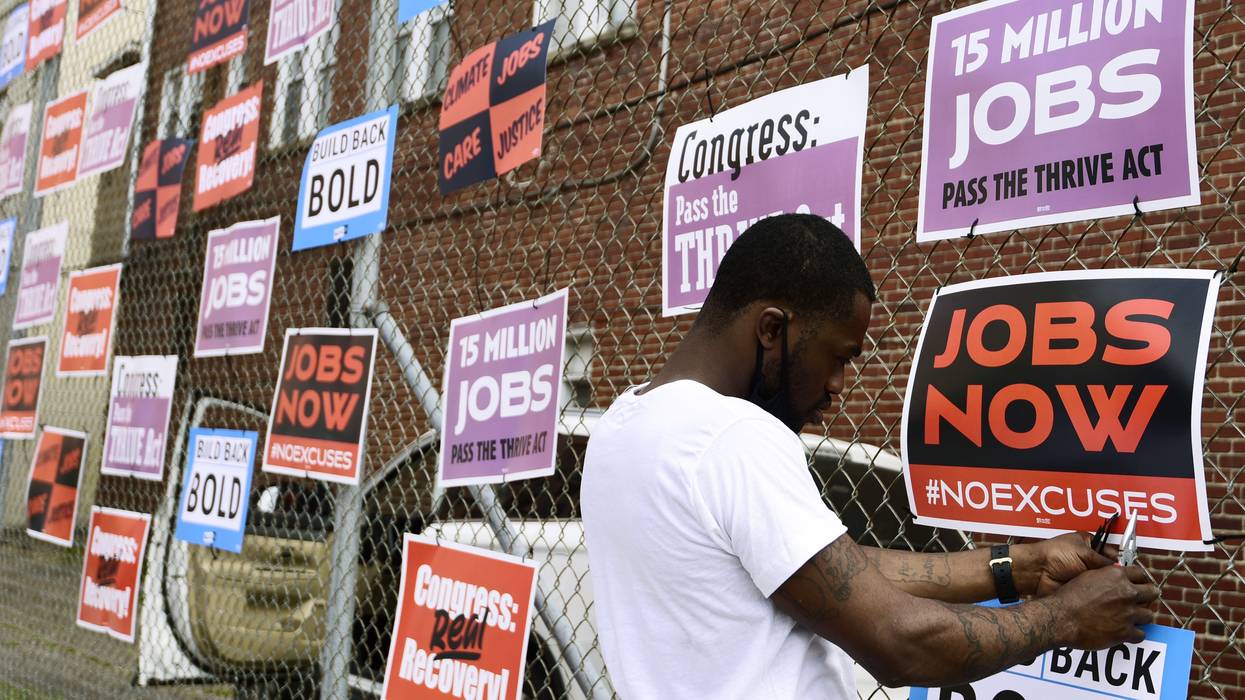
Everyone who is willing and able to work should have the right to a job at a living wage. And if the private sector is unable to provide it, the public sector should.
This idea is so far outside of today’s corporate-centered framework, that it is dismissed out of hand. Won’t job guarantees lead to a bloated public sector causing taxes to rise through the roof? And what would these workers do?
To follow this path we have to change how we value public goods. Right now public infrastructure is starved for investment. Our roads, our bridges, our schools need repair. Our public transit systems are hobbled, the internet in many parts of the country is slow or nonexistent. We need more childcare workers, more teachers, more healthcare providers, and more workers to remediate our deteriorating environment. Sit down with any group of workers and they could make a list of all the work that needs doing. Clearly, the richest society in the history of the world can afford it.
But these public needs have been undermined by a pervasive corporate dogma that government is incapable of good works and that the private sector (which has been churning jobs) is the epitome of efficiency and productivity. Yet Social Security runs well and Medicare is far more efficient than private insurance. Charter schools have yet to prove to be more effective than public schools, and many public universities are every bit as good as private ones. Our libraries work efficiently and so do our emergency services.
Government can work well if we shift our framework from capital first, which abhors public funding, to people first.
A call for secure jobs at living wages also could lead to a reattachment of working people to politics—to a belief that building a better, more secure society is possible. Add in Medicare for All, affordable housing, help with childcare costs, and free higher and vocational education, and we have the makings of a compelling people-first political platform.
How Do We Get There?
For most progressives, the Democratic Party is the one and only vehicle. The goal is to reform it (realignment) by running more candidates like Bernie, AOC, the Squad, and Mandami, as well as a new crop of working-class oriented candidates like Graham Platner in Maine, and James Talerico in Texas.
It’s heartening to see so many working-class candidates take up the reins and run this year. Realignment through working-class candidates has been badly needed. These efforts, we hope, will prove to the party apparatus that waitresses, union leaders, electricians, flight attendants, and even oystermen can run and win. The goal would be to have these worker-oriented candidates become the future leaders of the Democratic Party, forming a bloc that is powerful enough to return the Democrats to their working-class roots.
Going Independent?
But in this difficult moment, realignment is not enough—we also need an outside, independent strategy to credibly compete in places the Democratic Party has abandoned, and where working people have abandoned the Party.
As we found in our survey of 3,000 Midwestern voters, 70% had negative views of the Democrats, and from the get-go a Democratic candidate faces an 8% deficit in voter support when running against an independent while saying exactly the same things.
To reach these working people, we need independent working-class candidates running on a people-first platform like Dan Osborn is doing in Nebraska. The only way he can win against a wealthy Republican incumbent is to distance himself from both parties—escaping what he calls “the two-party doom loop.”
If independent working-class candidates can win, there should be a knock-on effect for reforming the Democratic Party. The outside competition, free from party labels and corporate money, could pressure Democrats to field more working-class candidates.
But say the word “independent” to many union members and they often say something like, “We have to back those who back us—the Dems.” Or as another labor leader told me, “They’re the only friends we have.”
Some also equate “independent” with “spoiler”—a fringe counterproductive effort that takes votes away from the Democrats and elects Republicans.
But, the union political director who prompted this article hit the nail on the head:
This strategy, whether they like it or not, is oriented on realigning the Democratic Party, not acting entirely outside of it. This is a needed one, but not wholly sufficient for the scale of the political crisis in front of us. And the reality is that an increasing number of working-class people do not feel at home in either version of two-party duopoly. But the losses Dems have faced in the industrial Midwest, the South, etc. require both realignment AND independent brute force in order to reclaim our values. It has to be both/and!
A closer look at the country’s political landscape shows 130 US House districts in which the Democrats consistently lose by 25% or more. In those districts there is no Democratic Party to spoil. Instead, these areas could become the proving ground for developing independent working-class candidates under the banner of “Not Red, Not Blue: I’m a Working-Class Independent!”
The Baked-In Ideological Resistance
Why does the Democratic Party need so much pushing and cajoling? Why isn’t it already recruiting hundreds of working-class candidates?
It’s their mindset. The Democrats, from the high officials to the funders, from the consultants to the pollsters, from the candidates to their PR firms—all are stuck in the capital-first framework. Yes, they want to raise taxes on the billionaires and stop the Immigration and Customs Enforcement attacks on immigrants. And yes, they would like to add resources to Obamacare, protect women’s rights, promote better climate policies. All that’s to the good.
But when it comes to challenging the job-destructive behavior of corporate America, their knees knock. Some, but not all the corporate-friendly attitudes come from the need for campaign funds and from having an eye out for future lucrative jobs for themselves, their families, and friends once out of office.
Real change that empowers working people requires an independent electoral strategy that challenges the Democratic Party establishment.
But corporate Democrats also believe that private capital is the engine of prosperity and employment. They see no inherent conflict between labor and capital. Grow the pie and all can prosper. Make sure that everyone has the opportunity to succeed, without discrimination, and that’s fair enough—the procedural essence of equality.
If we dig down deeper, I think most Democratic officials believe that the super rich deserve what they have earned, reaping the rewards of their hard work and talents. In their eyes it is simply insane to suggest that every worker should have a right to a job at a living wage—provided by government if necessary. Make that argument and they will look at you with pity, thinking you are a lost soul living in a fantasy world.
The Populists of the 19th Century
That fantasy world looked very real during the 1880s and 1890s when the Populist movement—the progressive kind—developed a vision that captured the imagination of millions of workers and farmers. Robber barons had control of the shipping, finance, farm machinery, and crop storage, at the time, driving farmers and industrial workers deeper and deeper into peonage.
The Populists responded with a new vision of a cooperative commonwealth with public ownership of railroads, banks, and grain elevators. And they didn’t just dream about it; they formed hundreds of cooperatives that bound these working people together in common enterprises to improve their lives. They also took their crusade into politics, changing the country for decades to come. Depending on their location they ran as Democrats, as Republicans, and as third-party independents, winning thousands of elections.
Although the movement was eventually defeated as a national party, its state and local victories paved the way for the regulation of corporate America during the Progressive era, the establishment of the progressive income tax, and for the economic enhancement of farmers and workers during the New Deal.
We have a long way to go to catch up with the theory of change that gave the Populists so much influence.
But that theory of change is still alive. It starts with believing in what seems impossible now: that workers should have significant power in our government and in our economy.
There’s no way around it. Real change that empowers working people requires an independent electoral strategy that challenges the Democratic Party establishment, even if doing so makes people uncomfortable.