
SUBSCRIBE TO OUR FREE NEWSLETTER
Daily news & progressive opinion—funded by the people, not the corporations—delivered straight to your inbox.
5
#000000
#FFFFFF
To donate by check, phone, or other method, see our More Ways to Give page.


Daily news & progressive opinion—funded by the people, not the corporations—delivered straight to your inbox.
"Before more children are burned alive or buried under rubble, this lawless war must end."
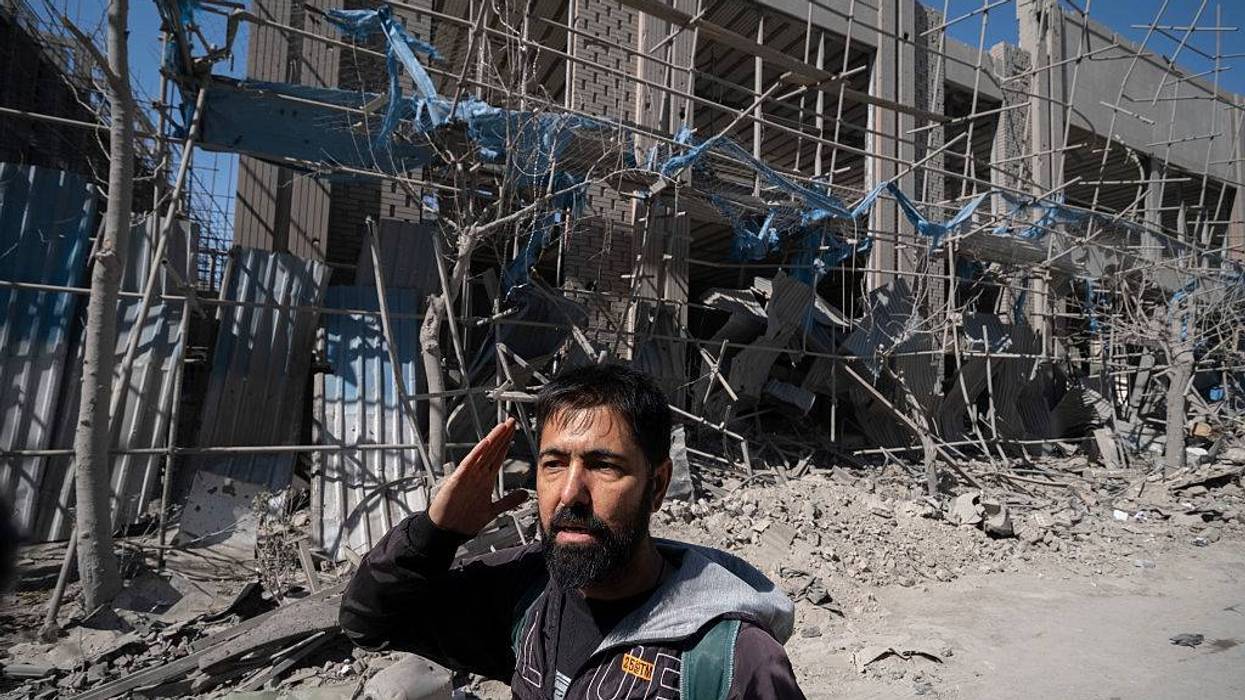
Experts on international law throughout the world have concluded that the unprovoked US-Israeli attack on Iran that began on Saturday is illegal.
Adil Ahmad Haque, a Rutgers Law School professor, wrote an analysis for Just Security published on Monday that called the attacks by the US and Israel a "manifest violation of the United Nations Charter," which "prohibits the use of force against another State unless that use of force is authorized by the UN Security Council or is a necessary and proportionate act of individual or collective self-defense in response to an armed attack."
Haque also argued that Iran, in responding to the attacks, violated the UN Charter by launching drone strikes against US allies throughout the Middle East, even though none of those nations had taken part in the US-Israeli operations.
"The United States, Israel, and Iran, have each violated international law," Haque concluded. "Hundreds of civilians have paid the price. Before more children are burned alive or buried under rubble, this lawless war must end."
Marko Milanovic, a University of Reading School of Law professor, wrote at the blog of the European Journal of International Law that the US-Israeli strikes are "manifestly illegal" and "as plain a violation of the prohibition on the use of force in Article 2(4) of the UN Charter as one could possibly have."
Milanovic also said that, leaving legality aside, the war would likely create a humanitarian disaster.
"Maybe, maybe, something good will come out of this... although I very much doubt it," he wrote. "It is far more likely that many innocent people are about to die, in Iran and possibly in Israel, and that their deaths will be for nothing."
The Center for International Environmental Law (CIEL) condemned the attacks on Iran as illegal under international law and dismissed any claims by US and Israel that they were necessary to liberate Iranians from a tyrannical government.
"Claims that launching an unprovoked and illegal attack is about defending human rights ring hollow," CIEL wrote, "when military strikes have already killed hundreds of civilians and intensified suffering as violence escalates—particularly when those same human rights are flagrantly violated by the US and by Israel, both domestically and abroad. Bombs do not yield peace, democracy, climate justice, or human rights."
Amnesty International secretary general Agnès Callamard described the US-Israeli attack as "a grave threat to multilateralism and to the integrity of the international legal order."
Callamard also said the international community needed "to intensify diplomatic efforts to prevent further military escalation to avert additional civilian harm, and halt any further crimes under international law against populations who have already endured decades of repression."
Human rights organization DAWN demanded that the UN General Assembly call an emergency session to declare the Iran attack a violation of the UN Charter.
Omar Shakir, executive director of DAWN, said that the war is also illegal under the US Constitution, which states that the US Congress has the power to declare war.
"This war is patently illegal," Shakir said, "and it must be stopped."
"The world doesn't need fossil-fueled tech fantasies justifying business as usual for big polluters and Silicon Valley billionaires."
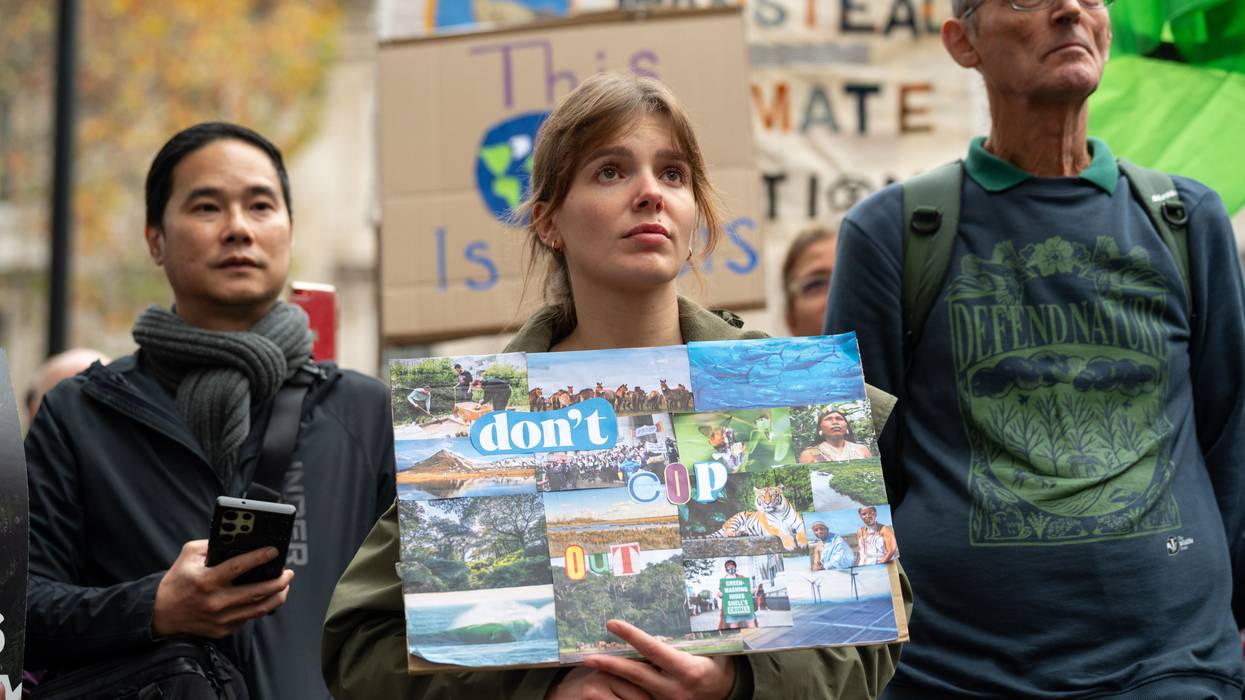
After critics of big polluters warned of "corporate capture" in the lead-up to the United Nations Climate Change Conference based on previous summits, one advocacy group announced Monday that more than 500 carbon capture and storage lobbyists have gained access to COP30 in Belém, Brazil.
CCS—also called carbon capture, use, and storage—involves capturing carbon dioxide, generally from industrial or power generation facilities, and then either finding a use for it or storing it underground. Opponents and skeptics have long called it a risky "false solution" that extends reliance on planet-heating fossil fuels and distracts from a global shift to renewables.
The Center for International Environmental Law identified 531 CCS lobbyists attending this year's ongoing summit—the largest number since CIEL started analyzing registrations for the annual conference. The group explained that the oil and gas industry and other CCS advocates are highlighting the massive energy needs of booming artificial intelligence "to cement further fossil fuel expansion, using carbon capture promises to mask the devastating climate impact."
CIEL fossil economy director Lili Fuhr said in a statement that "the fossil fuel industry has found in AI's energy demand a new narrative to justify its survival—and in carbon capture, the perfect illusion. CCS cannot make fossil fuels 'clean'; it just keeps them burning. It doesn't curb emissions; it locks them in."
"The world... needs a future rooted in renewable energy, accountability, and justice, and a climate process with a robust conflict of interest policy."
"When governments fall for the AI and carbon capture fairytale of the CCS lobbyists, they open a new escape hatch for the fossil fuel industry, undermine global climate efforts, and delay the urgently needed phaseout of coal, oil, and gas," she argued. "The world doesn't need fossil-fueled tech fantasies justifying business as usual for big polluters and Silicon Valley billionaires. It needs a future rooted in renewable energy, accountability, and justice, and a climate process with a robust conflict of interest policy."
Her group found that CCS lobbyists have received more conference passes than not only "any other single nation registered at COP30, except the host country, Brazil (899 delegates)," but also 62 national delegations combined (526 delegates), including 14 from European Union countries, and the total for national delegations from the Group of Seven nations (481 delegates).
While some lobbyists came from CCS-promoting trade associations and companies driving the climate emergency, such as CNPC, ExxonMobil, Oxy, Petrobras, and TotalEnergies, 44 of them are part of national delegations, including Algeria, Azerbaijan, Bahrain, Brazil, Georgia, Honduras, Japan, Kuwait, Libya, Oman, Qatar, Russia, and the United Arab Emirates.
What is the big deal? #CarbonCapture could worsen the #ClimateCrisis.Polluters push carbon capture and storage as a means of trapping their carbon dioxide (CO2) emissions, transporting them, and burying them underground.The technology is:👿 dangerous,👿 expensive, and 👿 proven to fail.
[image or embed]
— Center for International Environmental Law (@ciel.org) November 17, 2025 at 2:12 AM
"What's even more shocking than the fact that hundreds of CCS lobbyists and fossil fuel industry representatives are roaming COP's halls is the fact that governments still invite them in," said CIEL climate and energy director Nikki Reisch. "The continued presence of those who profit from the products heating the planet and making us sick is a reminder that reform of the UN climate talks is long overdue."
"It's past time to show big polluters the door, to put conflict-of-interest rules in place, and to allow voting when consensus is blocked," she declared. "The #COPWeNeed puts people, science, and the law at the center, not profits."
The group's analysis comes after the Kick Big Polluters Out coalition announced Friday that it counted the "largest ever attendance share" for fossil fuel lobbyists, with 1,602 at this year's summit. In addition to CIEL, KBPO's members include the Center for Biological Diversity, Friends of the Earth International, Greenpeace International, Oil Change International, and more.
"The influx of CCS lobbyists at COP30 shows how the AI industry is using the false promise of carbon capture as a lifeline for fossil fuels," Center for Biological Diversity Energy Justice program director and senior attorney Jean Su said Monday. "AI is the love child of Big Tech and the fossil fuel industry. It's critical that COP30 recognizes how the AI boom is threatening our global climate goals and acts swiftly to rein in this dirty industry."
"This historic judgment lays the next building block in corporate climate accountability," said Jasper Tuelings of the Climate Litigation Network.
After a decade of legal proceedings, a German court on Wednesday dismissed a Peruvian farmer's case against energy giant RWE, but both he and green groups still hailed what they called a "landmark ruling" that launched a "new era of accountability" by "setting a powerful precedent."
The farmer, 44-year-old Saúl Luciano Lliuya, grows barley, corn, potatoes, and wheat outside Huaraz, Peru. In 2015, he sued RWE—one of Europe's biggest climate polluters—in Essen, Germany, where the company is headquartered. Although the German utility doesn't operate in Luciano Lliuya's country, he argued that its emissions contributed to the melting of Andean glaciers.
"He said that as a result, Lake Palcacocha—which is located above the city—now has four times as much water than in 2003 and that residents like him were at risk of flooding, especially if blocks of ice were to break off from Palcacocha glacier and fall into the lake, causing it to overflow," according to the BBC. The farmer sought around €17,000, or $19,000, from RWE toward a $3.5 million project to protect Huaraz.
As Reuters reported Wednesday:
Presiding judge Rolf Meyer, at the court in the western city of Hamm, said experts' estimate of the 30-year damage risk to the plaintiff's house of 1% was not enough to take the case further.
Had there been a larger adverse effect, a polluter could have been made to slash emissions or pay damages, Meyer said.
Meyer said the plaintiff's case was argued coherently and that it was "like a microcosm of the world's problems between people of the southern and the northern hemisphere, between the poor and the rich."
"Today the mountains have won," Luciano Lliuya said in a Wednesday statement. "Even if my case doesn't go any further, it has reached an important milestone, and that makes me proud. This ruling shows that the big polluters driving the climate can finally be held legally responsible for the harm they have caused."
"I am, of course, disappointed that the court reached a different conclusion from the glacier scientists who have studied this region for decades and believe my home is at risk," he continued. "We won't receive support from RWE to protect us from the flood risk. But this case was never just about me. It was about all the people who, like us in Huaraz, are already living with the consequences of a crisis we did not create. This ruling opens the door for others to demand justice."
The farmer's lawyer, Roda Verheyen, also framed the decision as a major step forward, saying that "today's ruling is a milestone and will give a tailwind to climate lawsuits against fossil fuel companies, and thus to the move away from fossil fuels worldwide. The plaintiff is grateful to the German courts for the seriousness with which his case was treated."
Other advocates and experts similarly weighed in. Ecojustice climate director Charlie Hatt declared that "this is a historic moment for climate litigation," while University of Oxford professor Thom Wetzer said that "this decadelong case has borne fruit," setting "a remarkable precedent that could enable future cases."
Jasper Tuelings, a strategic adviser with Climate Litigation Network, said that "this historic judgment lays the next building block in corporate climate accountability. Last year's Shell ruling showed us that big polluters have a legal obligation to reduce their future emissions in line with the Paris agreement—today's ruling affirms that these companies can be held accountable for their past emissions too."
The era of major polluters not having to pay for the environmental harms they cause is over. The case between Saul, a Peruvian farmer, and RWE, an energy giant, has shifted the landscape of climate justice. There are over 40 similar ongoing cases. Accountability is coming #SaulvsRWE
[image or embed]
— Friends of the Earth International (@foeint.bsky.social) May 28, 2025 at 8:10 AM
RWE, meanwhile, said in a statement that "the decision of the Hamm Higher Regional Court means that the attempt, supported by German NGOs, to use Mr Luciano Lliuya's lawsuit to create a precedent for holding individual companies responsible for the effects of climate change worldwide under German law has failed."
"RWE has always considered such civil 'climate liability' to be inadmissible under German law," RWE added, warning of "unforeseeable consequences for Germany as an industrial location," and noting that "other German courts have dismissed similar climate lawsuits—for example against Volkswagen, Mercedes-Benz, and BMW."
Despite the company's comments, climate advocates appeared undeterred. Sebastien Duyck, a senior attorney at the Center for International Environmental Law, said that "Saul's breakthrough opens up a well of opportunities for the more than 40 similar cases ongoing. It makes it more likely that those living at the sharp edge of climate change, such as Saul and his community, can succeed in holding heavy emitters to account for the damage they cause."
Friederike Otto, a senior lecturer at the Grantham Institute for Climate Change and the Environment, highlighted how science has evolved since Luciano Lliuya's case began a decade ago, which could impact ongoing and future legal proceedings.
"The science is absolutely clear... Human-induced climate change is already affecting weather and climate extremes in every region across the globe," Otto said, citing the Intergovernmental Panel on Climate Change. "This includes Saul's city of Huaraz and RWE contributed without any doubt to climate change."
"The precedent that this case has set underlines just how important scientific evidence is in the global fight against climate change," Otto added. "Since the case was filed 10 years ago, scientists have developed a large body of evidence showing how much companies and states can be held responsible for climate disasters. This is therefore a landmark moment for climate justice, ensuring that communities living in constant danger can hold carbon majors to account."