SUBSCRIBE TO OUR FREE NEWSLETTER
Daily news & progressive opinion—funded by the people, not the corporations—delivered straight to your inbox.
5
#000000
#FFFFFF
To donate by check, phone, or other method, see our More Ways to Give page.
Daily news & progressive opinion—funded by the people, not the corporations—delivered straight to your inbox.
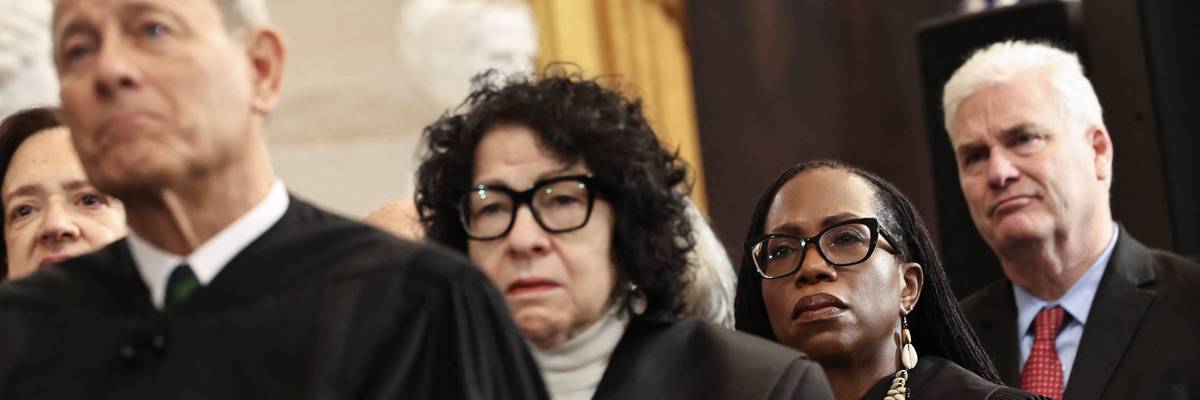
US Supreme Court Justices John Roberts, Sonia Sotomayor, and Ketanji Brown Jackson listen as US President Donald Trump speaks during his inaugural ceremony on January 20, 2025.
"Just as Alabama doubled down on racial discrimination, the court today doubles down on chaos," wrote Justice Sonia Sotomayor.
The US Supreme Court late Tuesday gave Alabama a green light to use an aggressively gerrymandered congressional map that a lower court said was "tainted by intentional race-based discrimination."
The unsigned decision, from which the high court's three liberal justices dissented, enables Alabama's Republican-dominated government to replace its current congressional map, which has two majority-Black districts, with a map that the US Supreme Court struck down in 2023. That map has just one majority-Black district.
In her dissenting opinion, liberal Justice Sonia Sotomayor wrote that "just as Alabama doubled down on racial discrimination, the court today doubles down on chaos."
"In addition to being wrong on the merits, the court’s decision inflicts two grave harms on the public," wrote Sotomayor. "It debases the democratic process by upending Alabama’s entire election in the name of permitting Alabama to discriminate against Black Alabamians. It also corrodes the rule of law by rewarding Alabama’s gamesmanship and outright defiance of court orders."
The liberal justice noted that in order to switch to the map previously struck down by the high court, Alabama election officials "will have to reassign hundreds of thousands of voters across the state to new congressional districts."
"Three of Alabama’s counties will be particularly hard hit because they are split across two congressional districts," Sotomayor noted. "These counties have about 600,000 registered voters between them (roughly 15% of the state’s total number of registered voters).”
Alabama Gov. Kay Ivey, a Republican, postponed US House primary elections in the wake of the Supreme Court's April decision in Louisiana v. Callais, which severely narrowed the 1965 Voting Rights Act’s protections against racial discrimination and paved the way for Alabama and other states to impose new maps ahead of the 2026 midterms.
“The Supreme Court’s shameful ruling allowing Alabama to move forward with a gerrymander that was drawn with the explicit intent to dilute Black voting power—as found by a panel of judges that included two Trump appointees—is an absolute affront to the founding principles of our democracy, and wipes out whatever was left of the court’s credibility,” said Marina Jenkins, executive director of the National Redistricting Foundation. “This country deserves better, and we must continue to work toward federal legislation that not only bans partisan and racial gerrymandering but also ensures that our rights cannot be undermined by captured courts.”
The ruling drew condemnation from the two Democrats in Alabama's US congressional delegation. Rep. Shomari Figures, who was elected to the US House under the independently drawn map that Alabama Republicans are working to replace, said in a statement that "the Supreme Court has now confirmed that there is no longer a Voting Rights Act in America, and states are essentially free to discriminate against minority voters with no consequences."
"This is a dangerous ruling that sets the state and this nation back decades," said Figures.
Rep. Terri Sewell called the ruling "just the latest in a pattern of outrageous Supreme Court decisions that help Republicans desperately cling to power ahead of the midterm elections while diluting Black voices and erasing decades of hard-fought civil rights progress."
"No matter how hard Alabama state officials may try, they will not succeed in silencing our voices," said Sewell. "We will not go back to the Jim Crow era. The fight for fair representation continues."
Dear Common Dreams reader, It’s been nearly 30 years since I co-founded Common Dreams with my late wife, Lina Newhouser. We had the radical notion that journalism should serve the public good, not corporate profits. It was clear to us from the outset what it would take to build such a project. No paid advertisements. No corporate sponsors. No millionaire publisher telling us what to think or do. Many people said we wouldn't last a year, but we proved those doubters wrong. Together with a tremendous team of journalists and dedicated staff, we built an independent media outlet free from the constraints of profits and corporate control. Our mission has always been simple: To inform. To inspire. To ignite change for the common good. Building Common Dreams was not easy. Our survival was never guaranteed. When you take on the most powerful forces—Wall Street greed, fossil fuel industry destruction, Big Tech lobbyists, and uber-rich oligarchs who have spent billions upon billions rigging the economy and democracy in their favor—the only bulwark you have is supporters who believe in your work. But here’s the urgent message from me today. It's never been this bad out there. And it's never been this hard to keep us going. At the very moment Common Dreams is most needed, the threats we face are intensifying. We need your support now more than ever. We don't accept corporate advertising and never will. We don't have a paywall because we don't think people should be blocked from critical news based on their ability to pay. Everything we do is funded by the donations of readers like you. When everyone does the little they can afford, we are strong. But if that support retreats or dries up, so do we. Will you donate now to make sure Common Dreams not only survives but thrives? —Craig Brown, Co-founder |
The US Supreme Court late Tuesday gave Alabama a green light to use an aggressively gerrymandered congressional map that a lower court said was "tainted by intentional race-based discrimination."
The unsigned decision, from which the high court's three liberal justices dissented, enables Alabama's Republican-dominated government to replace its current congressional map, which has two majority-Black districts, with a map that the US Supreme Court struck down in 2023. That map has just one majority-Black district.
In her dissenting opinion, liberal Justice Sonia Sotomayor wrote that "just as Alabama doubled down on racial discrimination, the court today doubles down on chaos."
"In addition to being wrong on the merits, the court’s decision inflicts two grave harms on the public," wrote Sotomayor. "It debases the democratic process by upending Alabama’s entire election in the name of permitting Alabama to discriminate against Black Alabamians. It also corrodes the rule of law by rewarding Alabama’s gamesmanship and outright defiance of court orders."
The liberal justice noted that in order to switch to the map previously struck down by the high court, Alabama election officials "will have to reassign hundreds of thousands of voters across the state to new congressional districts."
"Three of Alabama’s counties will be particularly hard hit because they are split across two congressional districts," Sotomayor noted. "These counties have about 600,000 registered voters between them (roughly 15% of the state’s total number of registered voters).”
Alabama Gov. Kay Ivey, a Republican, postponed US House primary elections in the wake of the Supreme Court's April decision in Louisiana v. Callais, which severely narrowed the 1965 Voting Rights Act’s protections against racial discrimination and paved the way for Alabama and other states to impose new maps ahead of the 2026 midterms.
“The Supreme Court’s shameful ruling allowing Alabama to move forward with a gerrymander that was drawn with the explicit intent to dilute Black voting power—as found by a panel of judges that included two Trump appointees—is an absolute affront to the founding principles of our democracy, and wipes out whatever was left of the court’s credibility,” said Marina Jenkins, executive director of the National Redistricting Foundation. “This country deserves better, and we must continue to work toward federal legislation that not only bans partisan and racial gerrymandering but also ensures that our rights cannot be undermined by captured courts.”
The ruling drew condemnation from the two Democrats in Alabama's US congressional delegation. Rep. Shomari Figures, who was elected to the US House under the independently drawn map that Alabama Republicans are working to replace, said in a statement that "the Supreme Court has now confirmed that there is no longer a Voting Rights Act in America, and states are essentially free to discriminate against minority voters with no consequences."
"This is a dangerous ruling that sets the state and this nation back decades," said Figures.
Rep. Terri Sewell called the ruling "just the latest in a pattern of outrageous Supreme Court decisions that help Republicans desperately cling to power ahead of the midterm elections while diluting Black voices and erasing decades of hard-fought civil rights progress."
"No matter how hard Alabama state officials may try, they will not succeed in silencing our voices," said Sewell. "We will not go back to the Jim Crow era. The fight for fair representation continues."
The US Supreme Court late Tuesday gave Alabama a green light to use an aggressively gerrymandered congressional map that a lower court said was "tainted by intentional race-based discrimination."
The unsigned decision, from which the high court's three liberal justices dissented, enables Alabama's Republican-dominated government to replace its current congressional map, which has two majority-Black districts, with a map that the US Supreme Court struck down in 2023. That map has just one majority-Black district.
In her dissenting opinion, liberal Justice Sonia Sotomayor wrote that "just as Alabama doubled down on racial discrimination, the court today doubles down on chaos."
"In addition to being wrong on the merits, the court’s decision inflicts two grave harms on the public," wrote Sotomayor. "It debases the democratic process by upending Alabama’s entire election in the name of permitting Alabama to discriminate against Black Alabamians. It also corrodes the rule of law by rewarding Alabama’s gamesmanship and outright defiance of court orders."
The liberal justice noted that in order to switch to the map previously struck down by the high court, Alabama election officials "will have to reassign hundreds of thousands of voters across the state to new congressional districts."
"Three of Alabama’s counties will be particularly hard hit because they are split across two congressional districts," Sotomayor noted. "These counties have about 600,000 registered voters between them (roughly 15% of the state’s total number of registered voters).”
Alabama Gov. Kay Ivey, a Republican, postponed US House primary elections in the wake of the Supreme Court's April decision in Louisiana v. Callais, which severely narrowed the 1965 Voting Rights Act’s protections against racial discrimination and paved the way for Alabama and other states to impose new maps ahead of the 2026 midterms.
“The Supreme Court’s shameful ruling allowing Alabama to move forward with a gerrymander that was drawn with the explicit intent to dilute Black voting power—as found by a panel of judges that included two Trump appointees—is an absolute affront to the founding principles of our democracy, and wipes out whatever was left of the court’s credibility,” said Marina Jenkins, executive director of the National Redistricting Foundation. “This country deserves better, and we must continue to work toward federal legislation that not only bans partisan and racial gerrymandering but also ensures that our rights cannot be undermined by captured courts.”
The ruling drew condemnation from the two Democrats in Alabama's US congressional delegation. Rep. Shomari Figures, who was elected to the US House under the independently drawn map that Alabama Republicans are working to replace, said in a statement that "the Supreme Court has now confirmed that there is no longer a Voting Rights Act in America, and states are essentially free to discriminate against minority voters with no consequences."
"This is a dangerous ruling that sets the state and this nation back decades," said Figures.
Rep. Terri Sewell called the ruling "just the latest in a pattern of outrageous Supreme Court decisions that help Republicans desperately cling to power ahead of the midterm elections while diluting Black voices and erasing decades of hard-fought civil rights progress."
"No matter how hard Alabama state officials may try, they will not succeed in silencing our voices," said Sewell. "We will not go back to the Jim Crow era. The fight for fair representation continues."