SUBSCRIBE TO OUR FREE NEWSLETTER
Daily news & progressive opinion—funded by the people, not the corporations—delivered straight to your inbox.
5
#000000
#FFFFFF
To donate by check, phone, or other method, see our More Ways to Give page.


Daily news & progressive opinion—funded by the people, not the corporations—delivered straight to your inbox.
"Catastrophic risks are on the rise, cooperation is on the decline, and we are running out of time."
A "failure of leadership" by the world's most powerful governments and leaders, particularly President Donald Trump, has pushed the annually updated Doomsday Clock closer to midnight than ever, said the Bulletin of Atomic Scientists, the organization that monitors global existential threats including nuclear bombs, on Tuesday.
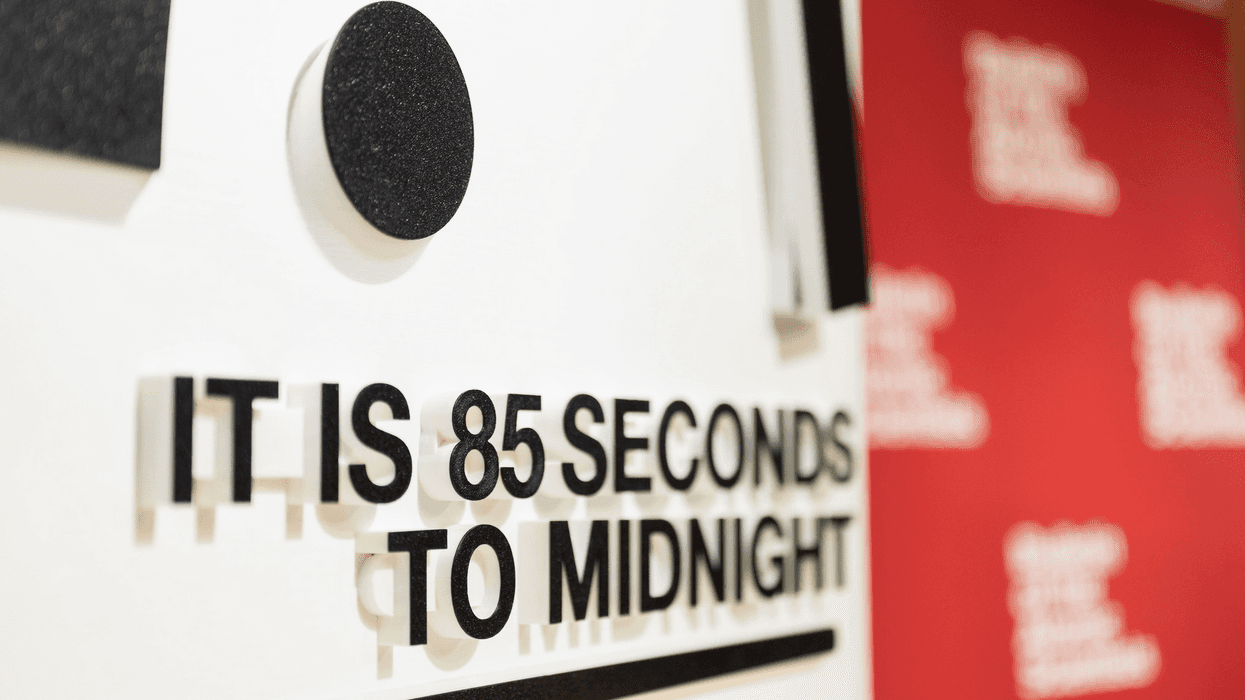
The clock was set to 85 seconds to midnight—or global destruction—four seconds closer than one year ago.
The Bulletin has updated the clock each year since 1947, when scientists set it at seven minutes to midnight, emphasizing that the world had little time to get the proliferation of nuclear weapons under control following the United States' bombing of Hiroshima and Nagasaki in 1945.
The scientists who announced the latest ticking of the clock on Tuesday stressed that a number of other threats appear closer then ever to dooming humanity and called for urgent action to limit nuclear arsenals as well as creating "international guidelines" for the use of artificial intelligence, solving the climate crisis, and forming "multilateral agreements to address global biological threats."
“The Doomsday Clock’s message cannot be clearer. Catastrophic risks are on the rise, cooperation is on the decline, and we are running out of time," said Alexandra Bell, president and CEO of the Bulletin. "Change is both necessary and possible, but the global community must demand swift action from their leaders.”
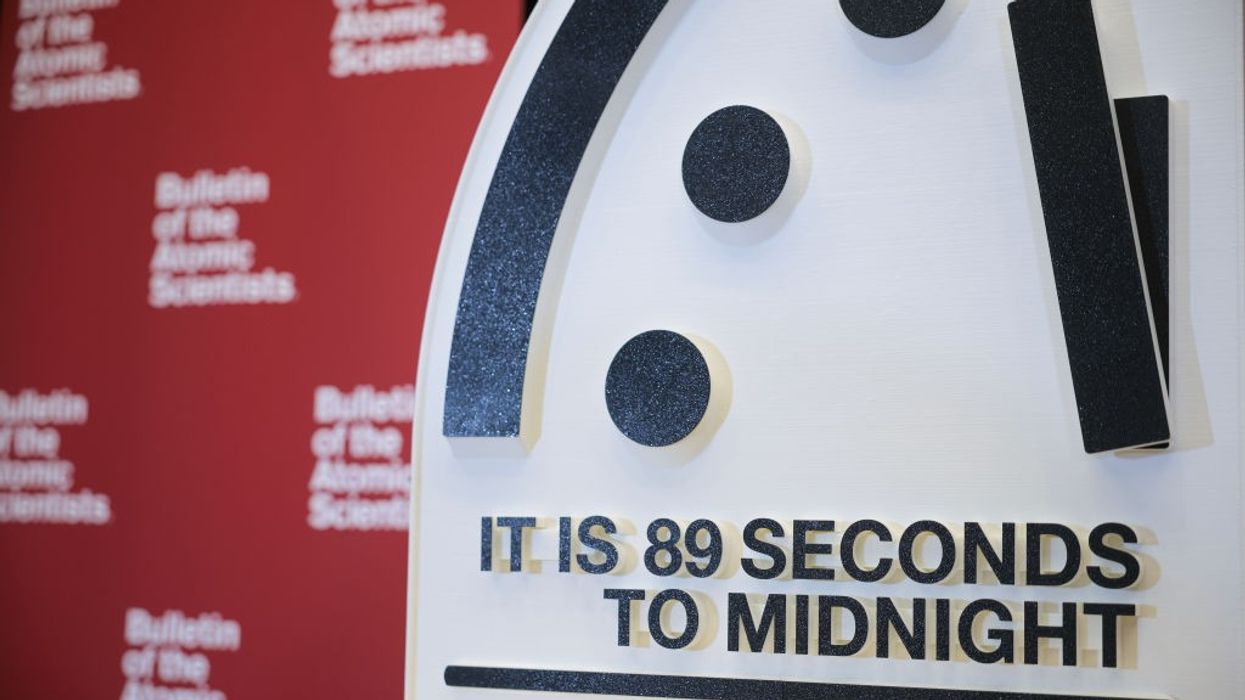
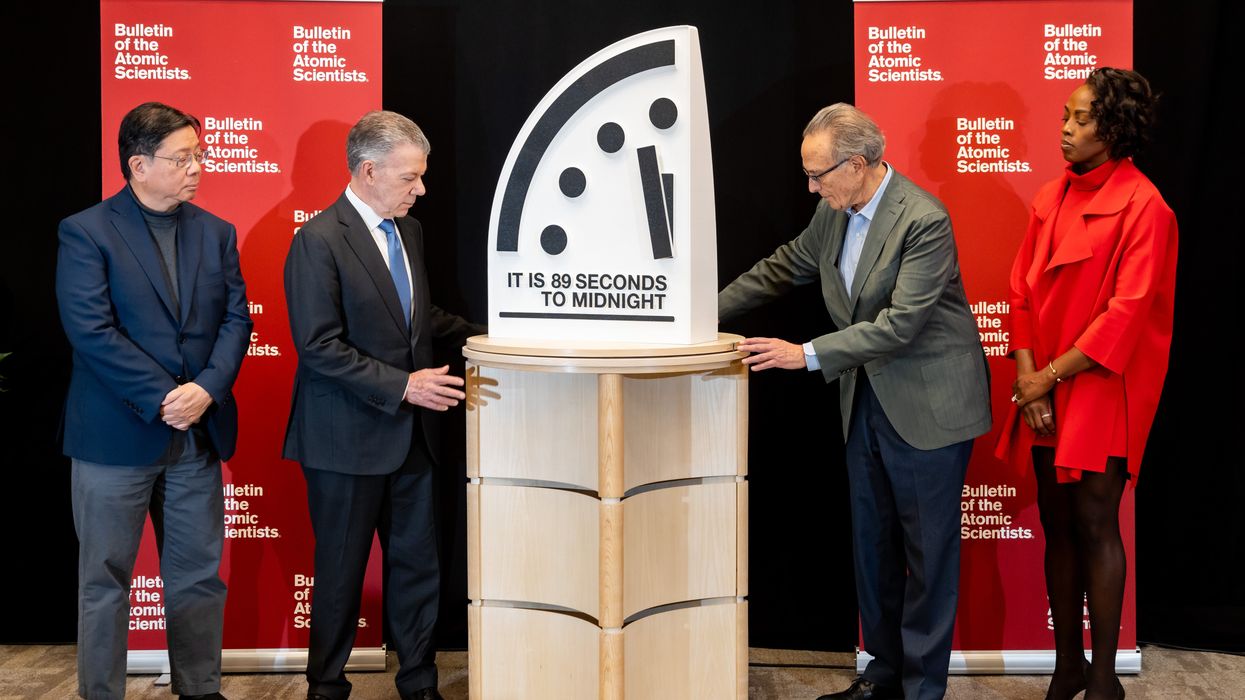
The organization, whose Doomsday Clock is monitored by its Science and Security Board (SASB) and Board of Sponsors, which includes eight Nobel laureates, said that countries including the US, China, and Russia did not heed the Bulletin's warning last year when it moved the clock's hands to 89 seconds to midnight.
Instead, major powers in the past year have become "increasingly aggressive, adversarial, and nationalistic."
"Hard-won global understandings are collapsing, accelerating a winner-takes-all great power competition and undermining the international cooperation critical to reducing the risks of nuclear war, climate change, the misuse of biotechnology, the potential threat of artificial intelligence, and other apocalyptic dangers," said the group. "Far too many leaders have grown complacent and indifferent, in many cases adopting rhetoric and policies that accelerate rather than mitigate these existential risks. Because of this failure of leadership, the Bulletin of the Atomic Scientists Science and Security Board today sets the Doomsday Clock at 85 seconds to midnight, the closest it has ever been to catastrophe."
International failures from 2025 include:
Daniel Holz, chair of the SASB, said that the "dangerous trends" outlined by the Bulletin "are accompanied by another frightening development: the rise of nationalistic autocracies in countries around the world."
"Our greatest challenges require international trust and cooperation, and a world splintering into ‘us versus them’ will leave all of humanity more vulnerable," said Holz.
The Bulletin emphasized that with political will, the world's leaders are entirely capable of pulling humanity "back from the brink."
The US and Russia could resume dialogue about limiting their nuclear arsenals, and all nuclear-armed states could observe the existing moratorium on nuclear testing.
Through multilateral agreements and national regulations, the international community could also cooperate to "reduce the prospect that AI be used to create biological threats."
And in the US, Congress could take action to repudiate Trump's "war on renewable energy, instead providing incentives and investments that will enable rapid reduction in fossil fuel use."
Maria Ressa, co-founder and CEO of Rappler and a 2021 Nobel Peace Prize laureate, said that world leaders must also come to an agreement that the climate crisis, nuclear proliferation, and unregulated AI are grave threats, as the majority of the global community has.
“Without facts, there is no truth. Without truth, there is no trust. And without these, the radical collaboration this moment demands is impossible," said Ressa. "We cannot solve problems we cannot agree exist. We cannot cooperate across borders when we cannot even share the same facts. Nuclear threats, climate collapse, AI risks: none can be addressed without first rebuilding our shared reality. The clock is ticking."
Eighty years have passed since the bombing of Hiroshima, when Kodama’s life and the world changed dramatically. She has not forgotten that day, but she said looking at today’s conflicts, it seems like the world has.
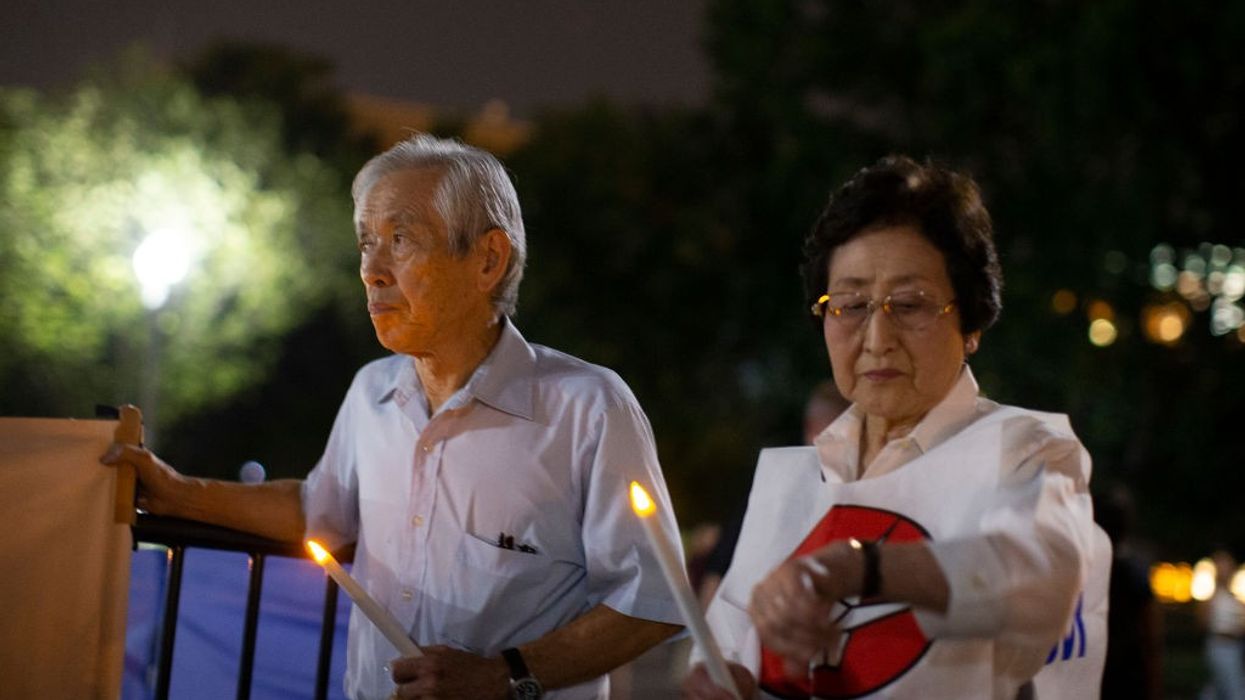
Michiko Kodama was only seven years old when the world’s first nuclear weapon was dropped on her hometown of Hiroshima. Since then, she has dedicated her life to ensuring that her generation remains the only victims of a nuclear holocaust.
“When you witness something like this, you think how can I live? Am I allowed to live? But, I’m glad I’m alive,” Kodama said. “I’m glad I had the life I wanted, and I think it’s because I can tell the stories of those who have passed away.”
Kodama is the assistant secretary general of Nihon Hidankyo, an organization composed of Hibakusha, the Japanese word that refers to the survivors of the Hiroshima and Nagasaki bombings. In 2024, Nihon Hidankyo was awarded the Nobel Peace Prize for their advocacy work on nuclear nonproliferation.
“To fight against nuclear weapons is to preserve life because it is the weapon that is capable of completely destroying the entire Earth. It’s the weapon that’s capable of stopping time,” Kodama, 87, said.
“The atomic bombs that I experienced 80 years ago were like babies compared to today’s nuclear weapons,” said Kodama.
Eighty years have passed since the bombing of Hiroshima, when Kodama’s life and the world changed dramatically. She has not forgotten that day, but she said looking at today’s conflicts, it seems like the world has. And she’s determined to continue reminding the world of the terrors of nuclear weapons.
She remembers being under her desk as the bomb hit. She saw a flash of light followed by an extreme wave of heat. Somehow she survived along with her classmates. She recalled the horrific sight of people who had come to her families’ suburb to try and get relief from the epicenter. People who had been so badly burnt that their skin was coming off their flesh.
“These sorts of images show the differences between conventional weapons and nuclear weapons. It’s just a weapon that is so inhumane, so indiscriminate that we just should not have it,” Kodama said.
The Doomsday Clock, which the Bulletin of the Atomic Scientists created in 1947 to measure how close the world is to man-made catastrophe, signals that the world has moved closer to nuclear catastrophe than it ever has been. In January 2025, the clock was moved one second closer to midnight, sending a stark signal to the global community that we are moving closer toward the brink of nuclear holocaust. The clock currently looms at a mere 89 seconds to midnight.
“I fear that World War III will turn into a nuclear war,” she said.
Nine countries currently have nuclear weapons, and many more are seeking to get it as a deterrent.
“I think it’s a huge mistake,” Kodama said. “Nuclear weapons and humans, and of course the Earth, cannot coexist. I know this from personal experience.”
In June 2025, the US bombed Iran’s nuclear sites out of fear they were getting closer and closer to developing a nuclear weapon. Experts said that Iran’s aspirations will not stop and that other countries could follow its example
“In the span of two weeks, Iran was bombed by two nuclear powers, the US and Israel. That could lead to a perverted logic in which developing the nuclear bomb is seen as their only way to be safe from further attacks,” said Thomas Countryman, president of the board at the Arms Control Association.
Kodama warned that more countries with nuclear weapons would only increase the likelihood that a nuclear holocaust would take place.
Kodama described apocalyptic scenes from when the bomb first hit in the center of Hiroshima. People riding on Hiroshima’s famous tram instantly turned to charcoal; those that didn’t die instantly had their skin stripped off from the heat of the ground, and many ended up jumping in the river for relief where they also died.
Although she was one of the fortunate ones to survive the bombing, the consequences of the bomb continued well after August 6 for Kodama.
“I’ll be a victim of the atomic bomb until I die. Yes, I can’t escape the fact that I was a victim of the atomic bomb” Kodama said.
For example, Kodama recalled how she faced discrimination within Japan as a survivor and was told that would have to live alone without getting married because people at the time did not want their future generations “mixed” with those that survived an atomic bomb. Moreover, even after she married and had kids, her daughter suddenly died at 45 after contracting cancer, which Kodama believes was passed down from herself.
Her mother, father, and two brothers, one of whom was born after the bombing Hiroshima, also died of cancer which she attributed to the effects of radiation exposure.
However, even with the devastating effects of Hiroshima, Kodama warned that the bomb dropped 80 years ago would only cause a fraction of the damage that today’s weapons could inflict.
“The atomic bombs that I experienced 80 years ago were like babies compared to today’s nuclear weapons,” said Kodama.
In fact, just 20 days before the bomb exploded she moved from the center of Hiroshima to a suburb. Everyone in her former school was killed. Kodama noted that in some ways she was lucky because the Hiroshima bomb didn’t completely destroy life.
“When the atomic bomb fell on Hiroshima, it was said that no plants would grow for 80 years, but the following year, those trees in the garden sprouted young shoots,” Kodama said. “If something like that were to happen again, no plants would really grow. They wouldn’t grow for 80 years, or even a hundred years. It would be impossible to survive.”
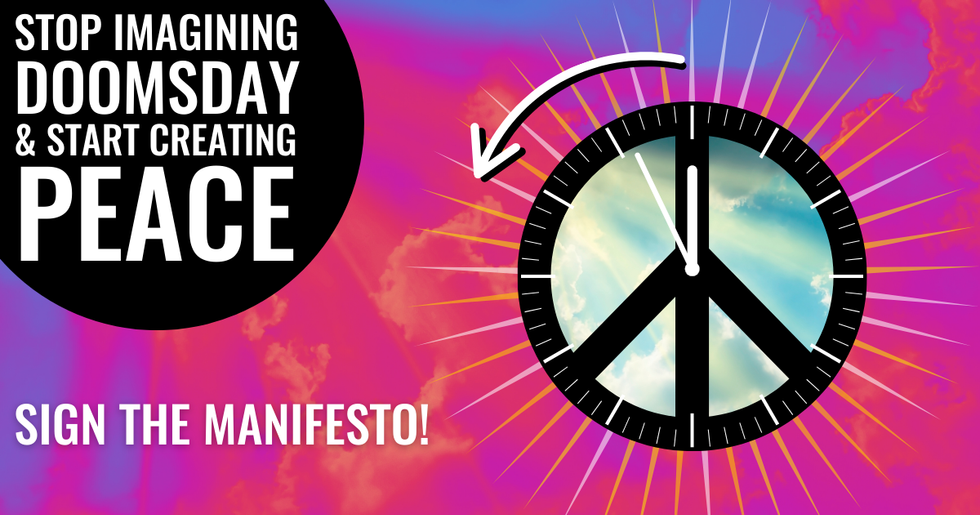
Instead of counting down the minutes and seconds to our extinction, the Peace Clock calls on the U.S. government to take a series of specific, concrete steps toward nuclear disarmament.
This year’s Doomsday Clock Statement landed like a damp squib in a Trump-swamped corporate news cycle on January 28th. The Bulletin of the Atomic Scientists only moved the hands of the Clock forward by one second, from 90 seconds up to 89 seconds to midnight, which must have come as a relief to the few members of the public who heard about it.
But this minimal advance in the hands of the Clock was a strange and misleading top-line for the Bulletin’s actual Doomsday Clock Statement, which was brimming with extremely dire warnings that deserve far greater official and public attention.
This disconnect between the movements of the hands of the Doomsday Clock and Bulletin’s underlying threat assessments is deeply troubling. If the positioning of the hands of the Clock does not accurately reflect the seriousness of the dangers it represents, then the powerful symbolism of the Doomsday Clock is lost, undermining the very purpose for which Albert Einstein, J. Robert Oppenheimer and their colleagues invented it.
The new Clock Statement began, “In 2024, humanity edged ever closer to catastrophe. Trends that have deeply concerned (us) continued, and despite unmistakable signs of danger, national leaders and their societies have failed to do what is needed to change course.”
The original atomic scientists created the Doomsday Clock to symbolize humanity’s suicidal march toward annihilation by nuclear war, and that is still the greatest danger that midnight on the Clock represents, even as it now incorporates the added dangers of climate change, biological threats and disruptive technologies.
The threat assessments in the 2025 Clock statement begin with the warning that the war in Ukraine “still looms over the world,” and that it “could become nuclear at any moment because of a rash decision or through accident or miscalculation.”
It was this danger of escalation to nuclear war over Ukraine that led the Bulletin to move the hands of the Clock forward by 10 seconds in January 2023, from 100 to 90 seconds to midnight.
Since then, despite President Biden’s warning in 2022 that war between Russia and the United States would be the suicidal Third World War that we must avoid at all costs, the U.S. and NATO have blasted through every self-imposed “red line” designed to prevent that, providing Ukraine with tanks, F-16 warplanes, long-range missiles, and approval to use them inside Russia as well as in Ukraine.
The roles of U.S. and NATO personnel in targeting, planning, surveillance, intelligence and secret “special operations” involving Western weapons have escalated into the very war between the United States and Russia that Biden promised to avoid.
So we cannot understand the Bulletin’s decision to move the hands of the Doomsday Clock only one second closer to the global mass suicide it symbolizes, as if these developments in the war between NATO and Russia have not brought us significantly closer to self-destruction than we were two years ago.
The Clock Statement then addresses the crisis in the Middle East. In January 2023, when the Bulletin last moved the hands of the clock forward, the U.S. and Israel were enjoying a false sense of security and normalcy in that region, believing that they had suppressed and tamed armed resistance to Israel’s illegal occupation of Palestine.
Now, since the Palestinian breakout in October 2023 and Israel’s genocide in Gaza, the new Doomsday Clock statement warns that, “Conflict in the Middle East threatens to spiral out of control into a wider war without warning.”
With nuclear-armed Israel threatening to launch a major war on Iran and ready to use its nuclear weapons before it would accept an existential defeat in such a war, and with no real limits to U.S. support for Israeli war-making and genocide, the Bulletin of the Atomic Scientists is right to warn that this could spiral out of control at any moment. Yet it seems to have ignored this danger too in its one-second tick forward of the Doomsday Clock.
While these raging conflicts involving nuclear weapons states may be the most dangerous current flashpoints for a nuclear war, nothing reflects the relentless nature of our accelerating march toward Armageddon more clearly than the determination with which the nuclear weapons powers, led by the United States, are expanding and “modernizing” their nuclear arsenals, even as they complete the dismantling of all Cold War-era arms control treaties and nuclear safeguards.
The 2025 Doomsday Clock Statement makes it clear that the Bulletin’s analysts understand this only too well:
“The countries that possess nuclear weapons are increasing the size and role of their arsenals, investing hundreds of billions of dollars in weapons that can destroy civilization. The nuclear arms control process is collapsing, and high-level contacts among nuclear powers are totally inadequate given the danger at hand.”
And yet they insist that the inexorable advance of these Doomsday plans over the past two years has only brought us one second closer to Doomsday. How can that be?
The next and final sentence in the paragraph on nuclear weapons addresses the dangers of nuclear proliferation, which is the widely predicted result of the failure of the nuclear powers to pursue genuine nuclear disarmament:
“Alarmingly, it is no longer unusual for countries without nuclear weapons to consider developing arsenals of their own—actions that would undermine long-standing nonproliferation efforts and increase the ways in which nuclear war could start.”
The next paragraph in the Doomsday Clock Statement addresses the dangers of the Climate Crisis. It explains that global greenhouse gas emissions are still increasing and global temperatures are still rising, causing extreme weather, floods, tropical cyclones, heat waves, droughts and wildfires on every continent.
“The long-term prognosis for the world’s attempts to deal with climate change remains poor,” it reads, “as most governments fail to enact the financing and policy initiatives necessary to halt global warming.”
But this is just one more dire warning that is not reflected in the hands of the Doomsday Clock.
On biological threats, the Clock statement warns, “Supposedly high-containment biological laboratories continue to be built throughout the world, but oversight regimes for them are not keeping pace, increasing the possibility that pathogens with pandemic potential may escape. Rapid advances in artificial intelligence have increased the risk that terrorists or countries may attain the capability of designing biological weapons for which countermeasures do not exist.”
On disruptive technologies, it warns that, “Systems that incorporate artificial intelligence in military targeting have been used in Ukraine and the Middle East, and several countries are moving to integrate artificial intelligence into their militaries. Such efforts raise questions about the extent to which machines will be allowed to make military decisions—even decisions that could kill on a vast scale, including those related to the use of nuclear weapons.”
The strange decision to only advance the Doomsday Clock by one second appears to be a hedge against the possibility that all these current trends will continue, but that, by some miracle, none of them will actually succeed in destroying us all in the next few decades. This could leave BAS in the embarrassing position of a Chicken Little predicting a calamity that has not come to pass, even as the hands of the Doomsday Clock advance to within a few seconds of midnight.
But this way of thinking defeats the very purpose of the Doomsday Clock, which is to raise the alarm with policy-makers and the public about the dangerous course we are on. The existential dangers we face are only too real, and the failure of our public and private institutions to address and resolve them is the most egregious and potentially suicidal failure in the history of our species.
In abdicating its responsibility to warn us of the gravity of these dangers, the Bulletin of the Atomic Scientists risks turning Einstein and Oppenheimer’s call for sanity into yet another mechanism to normalize the suicidal insanity of our 21st century rulers.
The Bulletin appears to have joined all the other mainstream institutions of American society - the White House, Congress, the military-industrial complex, the Republican and Democratic Parties, the corporate media, Wall Street, academia - in normalizing the collective denial by which our corrupt ruling class lulls the public into sleepwalking toward mass extinction.
Remarkably, while the Bulletin of Atomic Scientists seems to have abandoned its founders’ commitment to the urgency of nuclear disarmament, President Trump apparently recognizes that ending the nuclear arms race would be the crowning diplomatic achievement of his, or any, U.S. presidency.
In off-the-cuff remarks in a video call to the World Economic Forum in Davos on January 23rd, Trump suddenly raised the tantalizing prospect of nuclear disarmament negotiations with Russia and China. Talking about a phone call with President Xi of China, Trump elaborated,
“We’d [Trump and Xi?] like to see denuclearization. In fact, with President Putin, prior to an election result, which was, frankly, ridiculous, we were talking about denuclearization of our two countries, and China would have come along. China has a much smaller, right now, nuclear armament than us or field than us, but they’re going to be catching up at some point over the next four or five years.”
“And I will tell you that President Putin really liked the idea of cutting way back on nuclear. And I think the rest of the world, we would have gotten them to follow. And China would have come along too. China also liked it. Tremendous amounts of money are being spent on nuclear, and the destructive capability is something that we don’t even want to talk about today, because you don’t want to hear it. It’s too depressing.”
“So, we want to see if we can denuclearize, and I think that’s very possible. And I can tell you that President Putin wanted to do it. He and I wanted to do it. We had a good conversation with China. They would have been involved, and that would have been an unbelievable thing for the planet. And I hope it can be started up again.”
What Trump says in these unscripted, off-the-cuff remarks is encouraging. It seems that President Xi reminded Trump of their discussions during his first term, and, at least for a moment, turned his attention to the ultimate “elephant in the room” hanging over all our heads.
As the fate of the world teeters in the hands of an unpredictable U.S. president and the enfeebled Bulletin of the Atomic Scientists muffles the powerful symbolism of its Doomsday Clock, CODEPINK has created an alternative for the precarious times we live in: the Peace Clock. Instead of counting down the minutes and seconds to our extinction, the Peace Clock calls on the U.S. government to take a series of specific, concrete steps toward nuclear disarmament.
That starts with agreeing to Russian and Chinese proposals for a ban on weapons in space and reinstating the 1972 ABM Treaty with Russia, including the removal of formerly prohibited U.S. anti-ballistic-missile installations in Poland and Romania. By such concrete, practical steps, the Peace Clock would, step by step, make the world safer and safer, leading sooner rather than later to its sixth and final step: the complete nuclear disarmament of all the nuclear weapons powers.
You can learn more about the Peace Clock and sign the Peace Clock Manifesto here.