SUBSCRIBE TO OUR FREE NEWSLETTER
Daily news & progressive opinion—funded by the people, not the corporations—delivered straight to your inbox.
5
#000000
#FFFFFF
To donate by check, phone, or other method, see our More Ways to Give page.
Daily news & progressive opinion—funded by the people, not the corporations—delivered straight to your inbox.
A veteran war crimes lawyer argues that "there are solid grounds to investigate Joe Biden, Antony Blinken, and Lloyd Austin for complicity in Israel's crimes."
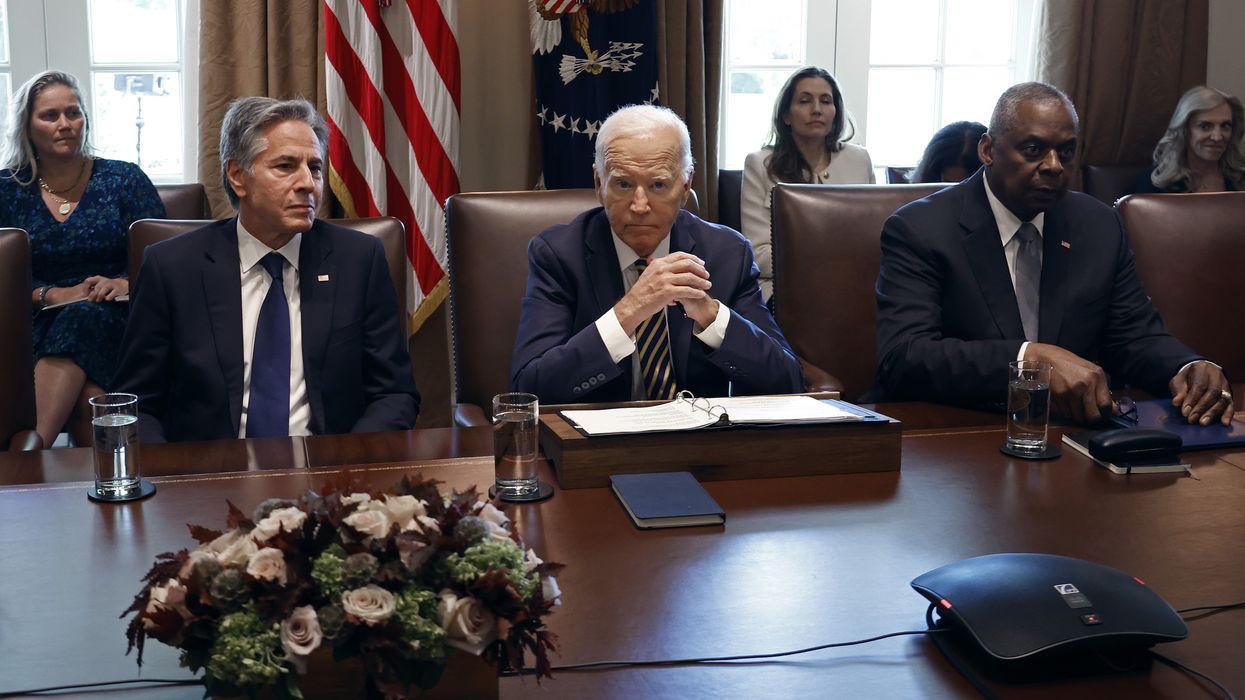
A human rights group revealed Monday that on the last full day of U.S. President Joe Biden's term, it encouraged the International Criminal Court to investigate him and two of his Cabinet members for "aiding and abetting" Israeli war crimes and crimes against humanity in the Gaza Strip.
U.S.-based Democracy for the Arab World Now (DAWN) announced that on January 19, it submitted to the ICC Prosecutor Karim Khan a 172-page communication detailing why the tribunal should probe Biden and his former secretaries of defense and state, Lloyd Austin and Anthony Blinken.
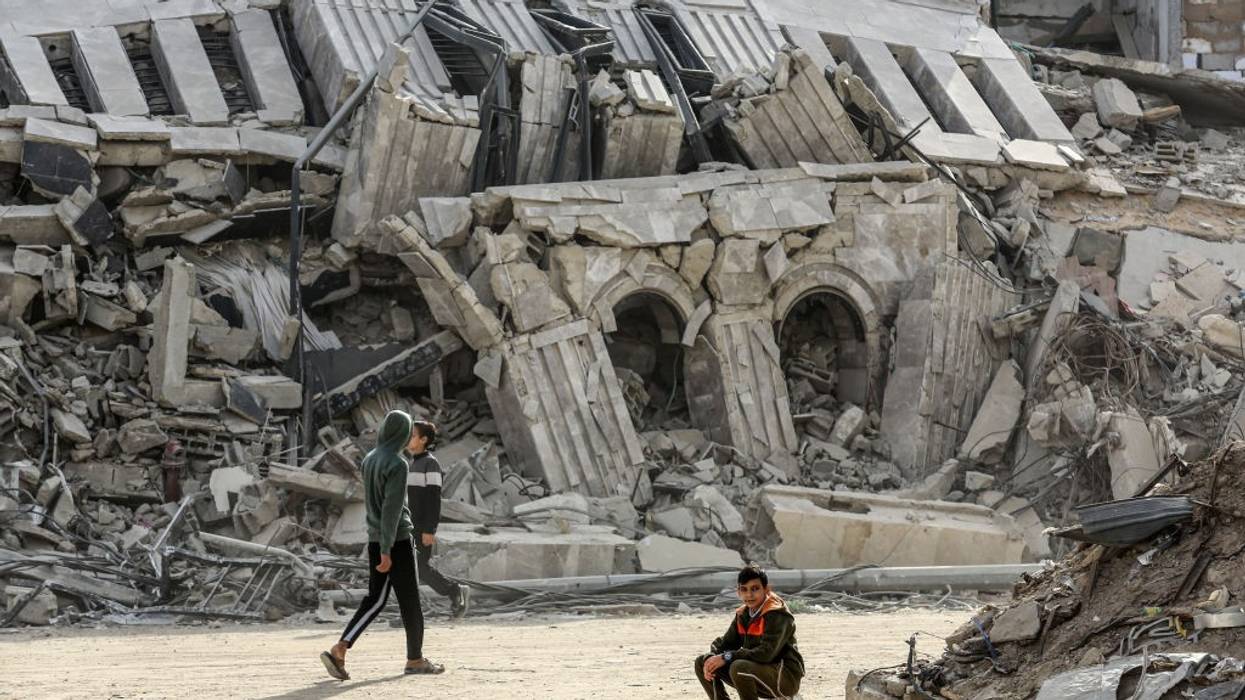
Although a fragile cease-fire took effect in Gaza last month, Israel—backed by the Biden administration and Congress—responded to the Hamas-led October 7, 2023 attack with a 15-month blockade and military assault that killed tens of thousands, possibly hundreds of thousands, of Palestinians and left the territory in ruins.
"There are solid grounds to investigate Joe Biden, Antony Blinken and Lloyd Austin for complicity in Israel's crimes," DAWN board member and veteran war crimes lawyer Reed Brody said in a Monday statement. "The bombs dropped on Palestinian hospitals, schools, and homes are American bombs, the campaign of murder and persecution has been carried out with American support. U.S. officials have been aware of exactly what Israel is doing, and yet their support never stopped."
"By investigating and prosecuting U.S. officials, the ICC can deter and discourage further international support for Israeli crimes in Gaza and demonstrate that no one is above the law."
DAWN's document lays out how the United States, under Biden, "provided unwavering direct military and political support to Israel, even after it became manifest that Israel continued to carry out severe violations of international humanitarian law and human rights." That includes at least $17.9 billion in taxpayer-funded military assistance since October 2023, a 381% increase from the around $3.8 billion a year before Hamas' attack.
"In addition to new arms transfers and sales authorizations, the U.S. used pre-existing contracts and additional emergency military aid measures to expedite the delivery of major arms," the submission continues, also noting "the deployment of U.S.-operated military intelligence and active military operations targeting groups posing threats to Israel on other fronts."
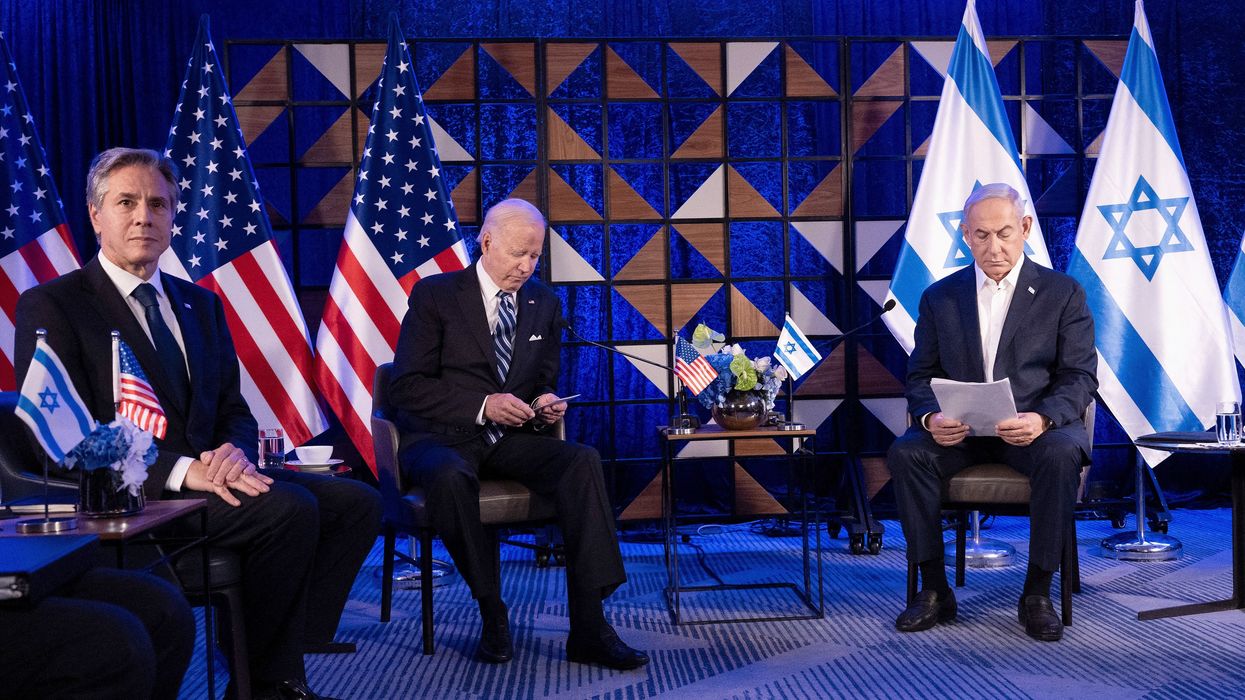
Israel—like the United States—is not a party to the Hague-based ICC, but Palestine is. The court in November issued arrest warrants for Israeli Prime Minister Benjamin Netanyahu, former Israeli Defense Minister Yoav Gallant, and Hamas leader Mohammed Diab Ibrahim Al-Masri, also known as Mohammed Deif, who is dead.
DAWN's submission makes the case that "by continuously and unconditionally providing political support and military
support to Israel while being fully aware of the specific crimes committed by Netanyahu, Gallant, and their subordinates, President Biden, Secretary Blinken, and Secretary Austin contributed intentionally to the commission of those crimes while at least knowing the intention of the group to commit the Israeli crimes, if not aiming of furthering such criminal activity."
The group's executive director, Sarah Leah Whitson, said Monday that "not only did Biden, Blinken, and Secretary Austin ignore and justify the overwhelming evidence of Israel's grotesque and deliberate crimes, overruling their own staff recommendations to halt weapons transfers to Israel, they doubled down by providing Israel with unconditional military and political support to ensure it could carry out its atrocities."
"They provided Israel with not only essential military support but equally essential political support by vetoing multiple cease-fire resolutions at the U.N. Security Council to ensure Israel could continue its crimes," Whitson highlighted. She argued that "by investigating and prosecuting U.S. officials, the ICC can deter and discourage further international support for Israeli crimes in Gaza and demonstrate that no one is above the law."
DAWN also recommended that the ICC consider looking into half a dozen other Biden officials including Jake Sullivan, national security adviser; Gina Raimondo, secretary of commerce; Bonnie Jenkins, under secretary of arms control and international security; Stanley L. Brown, acting assistant secretary for the Bureau of Political-Military Affairs; Amanda Dory, acting under secretary of defense for policy; and Mike Miller, acting director of the Defense Security Cooperation Agency.
"It is important for the international community, and Palestinians in particular, to know that the American people do not support the crimes their elected officials committed in Palestine and that American organizations are doing their part to hold these officials accountable," said Whitson. "We have a duty, not just a right, as American civil society, to exercise our free speech to serve truth and seek justice."
So far, efforts to hold Biden and other U.S. leaders accountable for enabling what many experts around the world have called Israel's genocidal assault on Gaza via the U.S. court system have been unsuccessful. That includes a December lawsuit against Blinken backed by DAWN—which was founded by assassinated Saudi journalist Jamal Khashoggi.
"We have tried every available avenue within the U.S. to stop our government's complicity in the outrageous crimes we've witnessed since October 2023 in Gaza," said Raed Jarrar, DAWN's advocacy director. "When domestic institutions fail to uphold black-letter laws prohibiting military support to commit war crimes, we have a particular responsibility as Americans to hold American officials accountable for their roles in those crimes."
Since Biden left office last month, U.S. President Donald Trump has already welcomed Netanyahu to the White House, responded to the warrants by targeting the ICC with sanctions, and promoted a U.S. takeover of Gaza that would involve ethnically cleansing the territory of Palestinians.
"Trump isn't just obstructing justice; he's trying to burn down the courthouse to prevent anyone from holding Israeli criminals accountable," said Jarrar. "His plan to forcibly displace all Palestinians from Gaza should also merit ICC investigation—not just for aiding and abetting Israeli crimes but for ordering forcible transfer, a crime against humanity under the Rome Statute."
To explore possibilities for how that might change will require a candid assessment of how that image came into focus in the 21st century.
While analyzing the tailspin of the Biden presidency and the failed campaign of Vice President Kamala Harris, few pundits have questioned that militarism is a political necessity as well as a vital tool of U.S. foreign policy.
Harris checked a standard box at the Democratic National Convention when she pledged to maintain “the strongest, most lethal fighting force in the world.” Yet the erosion of the Democratic Party’s base is partly due to the alienation of voters who don’t want to cast their ballot for what they see as a war party.
That perception is especially acute among the young, and notable among African Americans. Many have viewed President Joe Biden’s resolute support for the Israeli war in Gaza as a moral collapse. When Harris remained loyal to it during the fall campaign, her credibility sank.
Conditions may soon shift for the Democratic Party to start moving beyond its war culture.
Events in recent weeks have done nothing to reassure those repelled by the Democratic administration’s approach. Biden’s purported 30-day deadline for Israel to start allowing adequate food into Gaza expired shortly after the election—without Israeli compliance—while the humanitarian disaster in Gaza actually became worse than ever. Biden’s White House pretended otherwise.
The ongoing hellish realities for Palestinian civilians in Gaza caused 40% of Senate Democrats to vote for Sen. Bernie Sanders’ (I-Vt.) post-election resolution to block $20 billion worth of military aid to Israel. But near the end of November, Biden followed up by greenlighting an additional $680 million in arms sales to Israel. While Republicans remained in lockstep for arming Israel, the budding dissent from congressional Democrats remained ineffectual.
On Ukraine war policy, dissent has been rare from Democratic lawmakers. Two years ago, 30 progressive House Democrats sent a letter to Biden that suggested “a proactive diplomatic push” could be useful for achieving a cease-fire—but they quickly withdrew the letter after an angry backlash from hawkish leaders in their own party. (Republican lawmakers are split on Ukraine policy—many want the U.S. to recklessly confront China instead of Russia.)
Few Democrats have mustered more than feeble caveats about open-ended military aid to the Kyiv government, merely watching as the Biden administration repeatedly crosses its own red lines on such matters as approval of longer-range Ukrainian missile strikes into Russia. For the Ukraine war, in the lexicon of high-ranking Democrats, “diplomacy” has been a dirty word.
Overall, the president has accelerated the war train (sometimes hailing more war production as good for the U.S. economy), with party leaders providing fuel and Democratic constituents confined to the caboose. The opinions of the party faithful count for little.
Polling has made clear that an overwhelming majority of Democrats want a U.S. arms embargo against Israel. On Ukraine, a poll early this year found that while less than one-fifth of Democrats wanted to end all military aid to Ukraine, upwards of half wanted to make it conditional on diplomatic talks, a stance firmly rejected by the administration.
Fond of telling the world about the imperative of a “rules-based order” to stop cross-border aggression, Biden and his secretary of State, Antony Blinken, rationalize breaking the rules at will. This year, in the Middle East, the U.S. launched bombing attacks on Yemen, Syria, and Iraq. Objections from leaders of the president’s party have not been audible.
The Democratic Party deserves its image as a party of war. To explore possibilities for how that might change will require a candid assessment of how that image came into focus in the 21st century.
Soon after Barack Obama became president in 2009, he made the “war on terror” explicitly bipartisan. With the Democratic Party in tow, he tripled the number of U.S. troops in Afghanistan, peaking at 100,000 in 2010—swiftly escalating a war inflicting widespread carnage in rural areas out of media sight.
In Iraq, the war effort persisted as the number of U.S. boots on the ground slowly declined. Meanwhile, Obama stepped up drone attacks in Yemen, Pakistan, and Somalia. And with disastrous consequences for Libya, Obama had the United States lead NATO’s seven-month bombing onslaught of that country in 2011, incubating terrorism that expanded far beyond its borders.
Today, the most powerful Democrats are well attuned to the dominant media messaging and the agendas of megadonors, establishment “think tanks,” Pentagon contractors, and their lobbyists swarming Capitol Hill. With the military budget approaching $1 trillion, along with multibillion-dollar weapons shipments to allied nations, corporations of varied sizes make huge profits from war. And revolving doors between arms sellers and government arms buyers never stop spinning.
Conditions may soon shift for the Democratic Party to start moving beyond its war culture. But that will require a willingness to challenge the assumptions of elected Democrats who are in sync with what Martin Luther King Jr. called “the madness of militarism.”
"Failure to do so not only risks our leverage in ceasefire negotiations, it undermines our country's own national security and weakens America's commitment to human rights as a cornerstone of our foreign policy."
Twenty progressives in the U.S. House of Representatives on Tuesday wrote to top Biden administration officials arguing that "the United States government must suspend offensive weapons" to Israel over its destruction of the Gaza Strip, citing federal and international law.
Led by Reps. Summer Lee (D-Pa.) and Greg Casar (D-Texas), the incoming Congressional Progressive Caucus chair, the lawmakers began by thanking U.S. Secretary of State Antony Blinken and Secretary of Defense Lloyd Austin for their October 13 letter threatening to cut off weapons to Israeli Prime Minister Benjamin Netanyahu's government if it did not dramatically improve humanitarian conditions in Gaza.
"However, despite your administration acknowledging that the Netanyahu government did not fully address the United States' concerns over Gaza and has failed to meet all of the conditions stipulated in this letter, the State Department decided not to take further action, including the suspension of offensive military assistance, to ensure full compliance," the Democrats wrote.
"We believe continuing to transfer offensive weapons to the Israeli government prolongs the suffering of the Palestinian people and risks our own national security by sending a message to the world that the U.S. will apply its laws, policies, and international law selectively," they continued. "Furthermore, a failure to act will put Israeli lives in danger by prolonging Netanyahu's war, isolating Israel on the international stage, and creating further instability in the region."
The new letter comes just over a month away from President Joe Biden leaving office and follows one from last week signed by 77 House Democrats—including Casar—that demanded "a full assessment of the status of Israel's compliance with all relevant U.S. policies and laws, including National Security Memorandum 20 (NSM-20) and Section 620I of the Foreign Assistance Act."
This one goes further, explicitly urging the Biden administration to suspend offensive military transfers and warning that "failure to do so not only risks our leverage in cease-fire negotiations, it undermines our country's own national security and weakens America's commitment to human rights as a cornerstone of our foreign policy."
"We remain committed to saving Palestinian and Israeli lives. This means doing everything possible to prioritize the release of hostages, secure a lasting cease-fire deal, and move toward long-term peace," the 20 progressives concluded.
In addition to Lee and Casar, Tuesday's letter was signed by Democratic Reps. Jamaal Bowman (N.Y.), Cori Bush (Mo.), Joaquin Castro (Texas), Lloyd Doggett (Texas), Veronica Escobar (Texas), Jesús "Chuy" García (Ill.), Al Green (Texas), Sara Jacobs (Calif.), Pramila Jayapal (Wash.), Hank Johnson (Ga.), Jim McGovern (Mass.), Alexandria Ocasio-Cortez (N.Y.), Ilhan Omar (Minn.), Mark Pocan (Wis.), Ayanna Pressley (Mass.), Delia C. Ramirez (Ill.), Rashida Tlaib (Mich.), and Bonnie Watson Coleman (N.J.).
It came on the same day as a lawsuit filed by Palestinians and Palestinian Americans accusing the U.S. State Department of creating "unique, insurmountable processes to evade the Leahy Law requirement to sanction abusive Israeli units."
As of Tuesday, the 14-month Israeli assault on Gaza in retaliation for the Hamas-led October 7, 2023 attack has killed at least 45,059 people and wounded another 107,041, according to local officials. Israel's slaughter and starvation of Palestinian civilians have led to a genocide case at the International Court of Justice as well as International Criminal Court arrest warrants for Netanyahu and his former defense minister, Yoav Gallant.
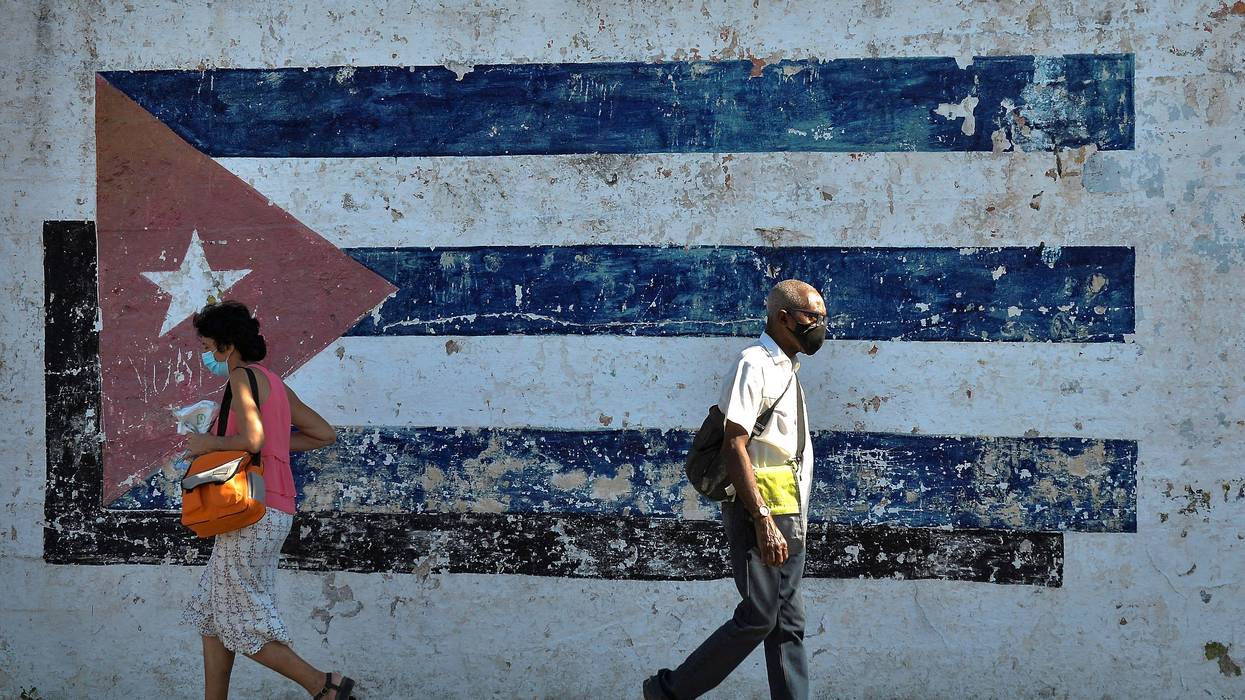
More than 10,000 people and 100 progressive advocacy groups have signed an open letter urging U.S. President Joe Biden to reverse the Trump administration's terrorism designation for Cuba and to reinstate Obama-era policy with the Caribbean island.
"Your policies toward Cuba, which have been more aligned with those of President [Donald] Trump than President [Barack] Obama, are hurting the well-being of the Cuban people and run counter to the will of the majority of U.S. citizens," says the letter, organized by peace campaigners at CodePink. "An important policy change that we urge you to take immediately is to remove Cuba from the list of State Sponsors of Terrorism."
Just days before Biden's inauguration, Trump's Secretary of State Mike Pompeo was roundly criticized for putting Cuba back on the U.S. State Department's list of "State Sponsors of Terrorism."
The Obama White House--in which Biden served as vice president--had removed Cuba from the department's blacklist in 2015, writing that "(i) the Government of Cuba has not provided any support for international terrorism during the preceding six-month period; and (ii) the Government of Cuba has provided assurances that it will not support acts of international terrorism in the future."
In a statement attempting to justify his last-minute decision to re-designate Cuba a "state sponsor of terrorism," Pompeo accused Cuba of "repeatedly providing support for acts of international terrorism in granting safe harbor to terrorists" and engaging "in a range of malign behavior across the region."
These were references to Cuba's refusal to extradite members of Colombia's National Liberation Army (ELN) over alleged involvement in a 2019 bomb attack in Bogota and to the nation's ongoing support for Venezuelan President Nicolas Maduro, who survived a U.S.-backed coup attempt in 2019.
As the new letter explains:
ELN representatives were in Cuba as part of an internationally recognized process of peace negotiations, similar to the one Cuba hosted with the FARC [Revolutionary Armed Forces of Colombia], which was supported by the United States, Norway, Colombia and other nations. In addition, the recently elected Colombian president, [Gustavo] Petro, has asked Cuba to serve as the host country again for peace talks with the ELN, erasing any lingering concern or justification that the United States may have of Cuba's role as anything but a guarantor country for peaceful dialogue.
As a result of Pompeo's terrorism classification, which U.S. Secretary of State Antony Blinken has yet to undo after 20 months, Cuba has been forced to endure additional "sanctions and international financial restrictions that limit Cuba's ability to carry out critical financial transactions, including those needed to advance its efforts to combat the pandemic," the letter notes.
Related Content

Cuba has been dispatching doctors to various parts of the world to help tackle Covid-19, and it has launched an effort to share its homegrown vaccine technology with other countries to expand global supply. In defiance of decades of harmful U.S.-led sanctions, the biggest export of the small island nation, which has a lower child mortality rate than its more powerful and hostile neighbor to the north, is medical care.
Despite Democratic lawmakers' entreaties and Biden's own campaign pledge to abandon Trump's "failed" approach to Cuba--which included implementing more than 200 punitive policies following Obama-era efforts at normalization--the White House has imposed other sanctions in recent months, intensifying Washington's 60-year embargo on the Caribbean island.
"The economic deprivations to which U.S. sanctions contribute have resulted in the mass migration of Cubans, which is currently a major challenge to U.S. interests in border security, as well as causing a humanitarian crisis for the same Cuban people that your administration claims to support," states the letter.
Biden's recent easing of travel restrictions to Cuba is poised to "help Cuban Americans connect with their families," but that's far from enough to redress the deteriorating economic conditions harming millions of people on the island, the letter continues.
When the Obama administration certified the removal of Cuba from the State Department's blacklist in 2015, it declared that the U.S. would "continue to have differences with the Cuban government, but our concerns over a wide range of Cuba's policies and actions fall outside the criteria that is relevant to whether to rescind Cuba's designation as a State Sponsor of Terrorism."
Signatories to the letter contend that "the same situation exists today."
"The United States does have clear differences with the Cuban government--as they do with many governments--but we also have both national and international interests in supporting global pandemic coordination" and in mitigating "Cuba's humanitarian crisis that is causing tens of thousands of Cubans to seek dangerous passage to the United States," says the letter.
At the start of his presidency, Biden said that Cuba's status as a so-called state sponsor of terrorism was "under review," the letter points out.
"Given that removal from the list requires an inquiry into any terrorism-sponsored activity before providing a rescission request to Congress, we request that your administration immediately complete that review and initiate proceedings to remove Cuba from the list," it adds. "Such a move will advance legitimate U.S. security and humanitarian interests and help the future of the Cuban people."
CodePink plans to deliver the letter to various progressive lawmakers this week, including Sen. Bernie Sanders (I-Vt.), Rep. Ilhan Omar (D-Minn.), and Rep. Jim McGovern (D-Mass.). McGovern was one of a few members of Congress who urged Biden to provide aid to Cuba in the wake of last month's catastrophic oil fire.
The anti-war group also intends to deliver the letter to "opposition figures that continue to advocate for hostility toward Cuba," including Sens. Ted Cruz (R-Texas) and Marco Rubio (R-Fla.), as well as Rep. Maria Elvira Salazar (R-Fla.).
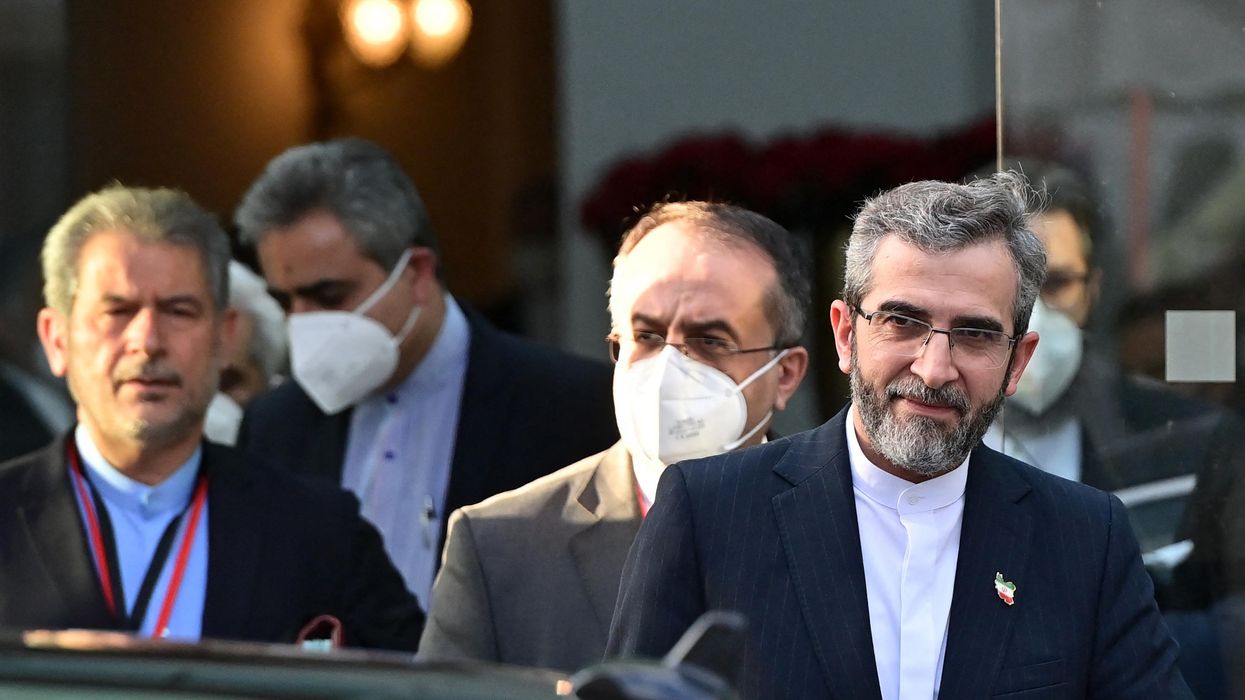
Despite assertions by all parties that the negotiators are "very close" to sealing the deal, the seemingly never-ending nuclear talks with Iran have hit yet another stumbling block.
The main point of contention is Iran's demand that the Islamic Revolutionary Guards Corps be taken off the U.S. list of Foreign Terrorist Organizations, or FTO. Although such a delisting would have few practical consequences, it has brought to the fore President Biden's key challenge with a renewed nuclear deal: Is the political cost of securing the deal higher than the cost of letting it die?
To be clear, the delisting is little more than symbolic to both sides. As Esfandyar Batmanghelidj points out, the FTO designation is only one out of many ways that the IRGC is both sanctioned and classified as a terrorist organization. Even if Biden removes the IRGC from the FTO list, it will remain a Specially Designated Global Terrorist, a decision first taken by Washington in 2007. Nor will foreign companies feel comfortable engaging with companies associated with the IRGC. The Iranians will not benefit practically from the delisting, nor will the United States suffer any tangible loss.
Politically, however, both Tehran and Washington have unnecessarily painted themselves into a corner. At the Doha Forum in Qatar last weekend, Iran's former foreign minister Kamal Kharazi and current adviser to Iran's Supreme Leader, Ayatollah Ali Khamenei, insisted that the IRGC "certainly must be removed" from the FTO list for nuclear talks to succeed. Walking back such categorical statements will be costly.
Similarly, the issue has given ammunition to JCPOA opponents in the U.S. Senate, where it needs the support of at least 41 Senators in order to ensure that a resolution of disapproval of the agreement fails. (It appears very likely in any case that Congress will review the renewed deal under the Iran Nuclear Agreement Review Act of 2015.)
But as opposition to the delisting grows despite its lack of any practical implications, supporters of the agreement in Congress fear that the Biden administration is focusing excessively on the political costs of such a step while underestimating the costs of letting the JCPOA die due to what is essentially a symbolic issue.
Both the Raisi and Biden administrations seem to be committing this mistake. Recent conversations I have held with regional and U.S. players have left me with the strong impression that the risk of escalation toward a military confrontation is greater than many in Washington have assumed -- myself included.
Few believe that Tehran will refrain from expanding its nuclear program if the talks fail. The Biden administration has already made clear that, under such a scenario, it will have little choice but to turn up the pressure on Iran. One avenue would be to condemn Iran at the IAEA Board of Governors and refer the matter to the U.N. Security Council. At that point, Iranian sources tell me, Tehran will kick out all IAEA inspectors and deny its inspectors access to Iran's nuclear sites.
At the U.N. Security Council, Russia will likely veto any new resolution against Iran. EU members, however, may then trigger snapback sanctions as provided by U.N. Security Council Resolution 2231, the resolution that endorsed and made the JCPOA binding in 2015. Neither Russia nor China can veto the snapback resolution, thus subjecting Tehran to U.N. Security Council Chapter 7 sanctions once more.
According to Nasser Hadian, a prominent Iranian academic with extensive access to Iranian national security officials, Tehran has already planned for this scenario and will respond by giving notification of its intention to withdraw from the Nuclear Non-Proliferation Treaty. After the mandatory 3-month notice period, Iran would no longer be bound to any of the restrictions the Treaty imposes on Iran, including a commitment not to build nuclear weapons. At that point, Iran plans to adopt a policy of "creative ambiguity," a play on Israel's nuclear posture of "strategic ambiguity," according to Hadian. Without direct access or insight into Iran's nuclear program, the world will be left guessing whether Iran is building a bomb. And, after a few months, the world will be guessing whether Iran already has built one.
Needless to say, Washington will perceive such a measure by Iran as a major -- perhaps unprecedented -- provocation and escalation. The United States will likely respond to Iran's notification to withdraw from the NPT by building a credible military option, which likely will include moving aircraft carrier task forces to the Persian Gulf. Tensions will rise precipitously. A single spark or miscalculation could be enough to start a war.
And contrary to earlier expectations in Saudi Arabia and the United Arab Emirates, Iran has already decided to launch ballistic missiles against these countries within the first 48 hours after the first military blows are exchanged between the United States and Iran, according to Hadian. This has also been communicated to Riyadh and Abu Dhabi, he asserts.
Even if the United States avoids the U.N. route, its other options to pressure Iran also carry significant escalation risks. One option at Biden's disposal would see U.S. warships intercepting and confiscating Iranian oil tankers on the high seas and then selling their cargo in order to strangle Iran's export income without diminishing global oil supplies. While it is difficult to describe this as anything other than piracy, it is far from inconceivable: the Biden administration has already confiscated one such tanker, sold the oil, and kept the proceeds.
Mindful of Biden's limited options when it comes to imposing new sanctions, this would be an obvious means of applying new pressure. Tehran currently has 25 million barrels of oil stored on leased tanks. With oil selling at anywhere between $90 and $110 a barrel, that amounts to roughly somewhere between $2.3 and $2.7 billion or nearly half the amount of Iranian funds currently frozen in foreign banks. Exercising such an option would very likely provoke Iran to retaliate. This could include attacks against U.S. troops in Iraq, which the Biden administration likely would treat as a declaration of war, even if conducted by Iran-aligned Iraqi militias and not Iran itself.
The Iranians may very well be bluffing. These decisions may not have been taken. And even if they are, they can always be reversed. The inevitability of these scenarios cannot be assumed. What appears clear, however, is that neither Iran nor the United States can increase pressure on the other if the JCPOA collapses without risking dangerous escalation, including military conflict. The main reason there is no such escalation right now is precisely because of the hope that the JCPOA may still be revived.
Consequently, failure to secure the nuclear deal will very likely lead to unpredictable and possibly uncontrollable escalation - and almost certainly skyrocketing oil and gas prices - only months before the midterm elections in November. The political costs -- for both the Biden and Raisi administrations -- will be immense. The political costs to both the United States and Iran of either delisting the IRGC or dropping the demand to delist, respectively, pale in comparison.
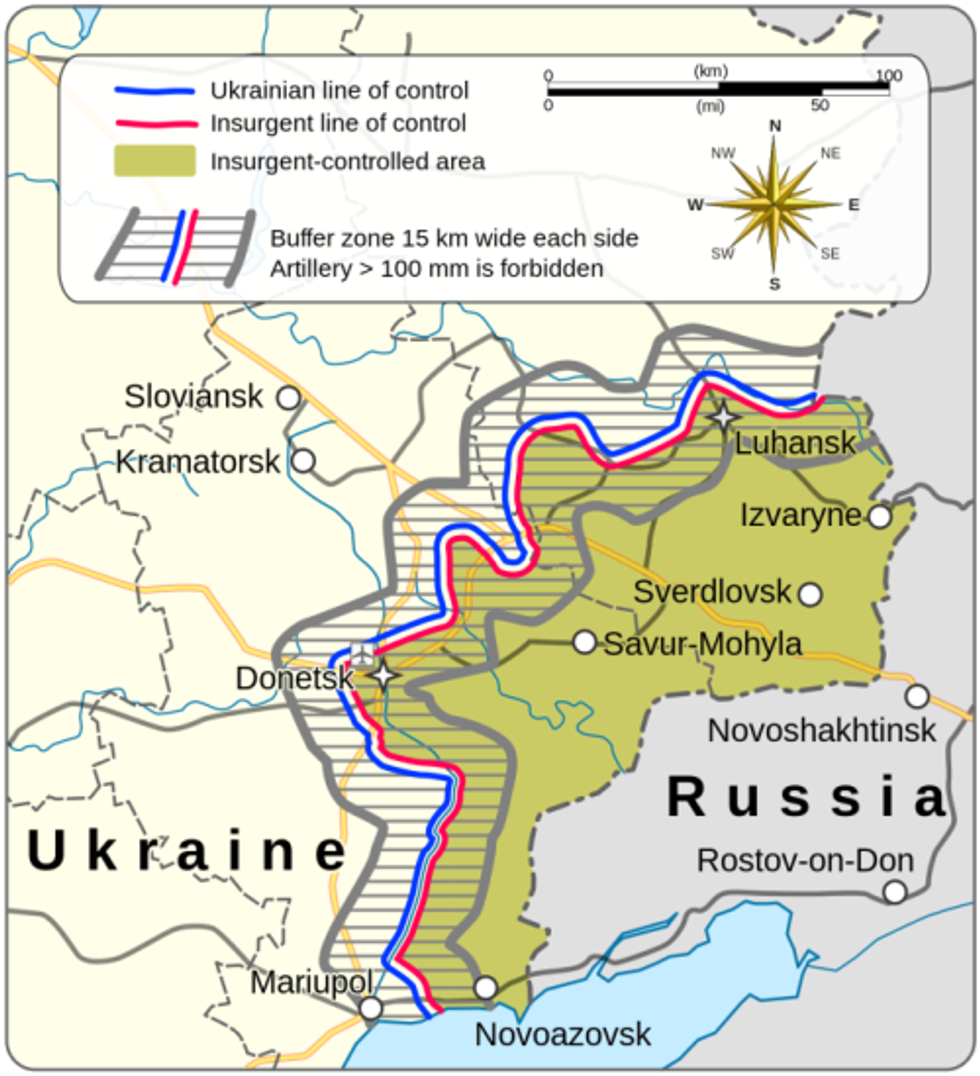
A report in Covert Action Magazine from the self-declared Donetsk People's Republic in Eastern Ukraine describes grave fears of a new offensive by Ukrainian government forces, after increased shelling, a drone strike by a Turkish-built drone and an attack on Staromaryevka, a village inside the buffer zone established by the 2014-15 Minsk Accords.
The People's Republics of Donetsk (DPR) and Luhansk (LPR), which declared independence in response to the U.S.-backed coup in Ukraine in 2014, have once again become flashpoints in the intensifying Cold War between the United States and Russia. The U.S. and NATO appear to be fully supporting a new government offensive against these Russian-backed enclaves, which could quickly escalate into a full-blown international military conflict.
What we are watching in Ukraine, Syria, Taiwan and the South China Sea are the opening salvos of an age of more ideological wars that may well be just as futile, deadly and self-defeating as the "war on terror," and much more dangerous to the United States.
The last time this area became an international tinderbox was in April, when the anti-Russian government of Ukraine threatened an offensive against Donetsk and Luhansk, and Russia assembled thousands of troops along Ukraine's eastern border.
On that occasion, Ukraine and NATO blinked and called off the offensive. This time around, Russia has again assembled an estimated 90,000 troops near its border with Ukraine. Will Russia once more deter an escalation of the war, or are Ukraine, the United States and NATO seriously preparing to press ahead at the risk of war with Russia?
Since April, the U.S. and its allies have been stepping up their military support for Ukraine. After a March announcement of $125 million in military aid, including armed coastal patrol boats and radar equipment, the U.S. then gave Ukraine another $150 million package in June. This included radar, communications, and electronic warfare equipment for the Ukrainian Air Force, bringing total military aid to Ukraine since the U.S.-backed coup in 2014 to $2.5 billion. This latest package appears to include deploying U.S. training personnel to Ukrainian air bases.
Turkey is supplying Ukraine with the same drones it provided to Azerbaijan for its war with Armenia over the disputed territory of Nagorno-Karabakh in 2020. That war killed at least 6,000 people and has recently flared up again, one year after a Russian-brokered ceasefire. Turkish drones wreaked havoc on Armenian troops and civilians alike in Nagorno-Karabakh, and their use in Ukraine would be a horrific escalation of violence against the people of Donetsk and Luhansk.
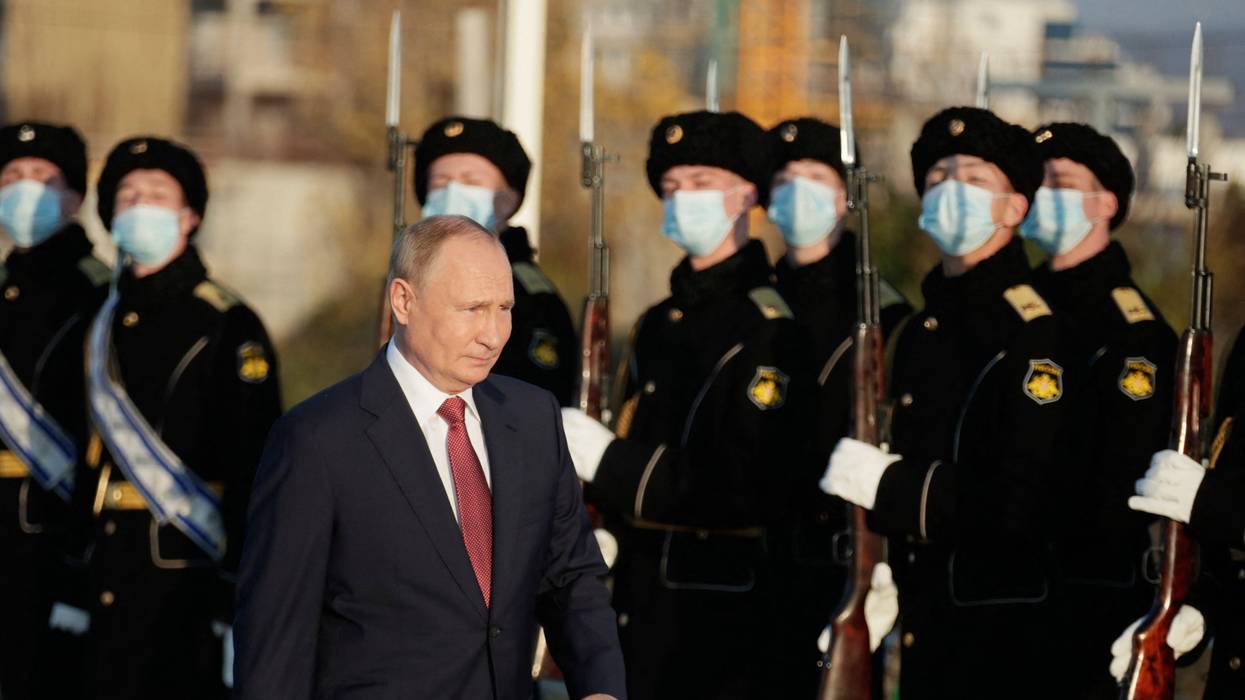
The ratcheting up of U.S. and NATO support for government forces in Ukraine's civil war is having ever-worsening diplomatic consequences. At the beginning of October, NATO expelled eight Russian liaison officers from NATO Headquarters in Brussels, accusing them of spying. Under Secretary of State Victoria Nuland, the manager of the 2014 coup in Ukraine, was dispatched to Moscow in October, ostensibly to calm tensions. Nuland failed so spectacularly that, only a week later, Russia ended 30 years of engagement with NATO, and ordered NATO's office in Moscow closed.
Nuland reportedly tried to reassure Moscow that the United States and NATO were still committed to the 2014 and 2015 Minsk Accords on Ukraine, which include a ban on offensive military operations and a promise of greater autonomy for Donetsk and Luhansk within Ukraine. But her assurances were belied by Defense Secretary Austin when he met with Ukraine's President Zelensky in Kiev on October 18, reiterating U.S. support for Ukraine's future membership in NATO, promising further military support and blaming Russia for "perpetuating the war in Eastern Ukraine."
More extraordinary, but hopefully more successful, was CIA Director William Burns's visit to Moscow on November 2nd and 3rd, during which he met with senior Russian military and intelligence officials and spoke by phone with President Putin.
A mission like this is not usually part of the CIA Director's duties. But after Biden promised a new era of American diplomacy, his foreign policy team is now widely acknowledged to have instead brought U.S. relations with Russia and China to all-time lows.
Judging from the March meeting of Secretary of State Blinken and National Security Advisor Sullivan with Chinese officials in Alaska, Biden's meeting with Putin in Vienna in June, and Under Secretary Nuland's recent visit to Moscow, U.S. officials have reduced their encounters with Russian and Chinese officials to mutual recriminations designed for domestic consumption instead of seriously trying to resolve policy differences. In Nuland's case, she also misled the Russians about the U.S. commitment, or lack of it, to the Minsk Accords. So who could Biden send to Moscow for a serious diplomatic dialogue with the Russians about Ukraine?
In 2002, as Under Secretary of State for Near Eastern Affairs, William Burns wrote a prescient but unheeded 10-page memo to Secretary of State Powell, warning him of the many ways that a U.S. invasion of Iraq could "unravel" and create a "perfect storm" for American interests. Burns is a career diplomat and a former U.S. ambassador to Moscow, and may be the only member of this administration with the diplomatic skills and experience to actually listen to the Russians and engage seriously with them.
The Russians presumably told Burns what they have said in public: that U.S. policy is in danger of crossing "red lines" that would trigger decisive and irrevocable Russian responses. Russia has long warned that one red line would be NATO membership for Ukraine and/or Georgia.
But there are clearly other red lines in the creeping U.S. and NATO military presence in and around Ukraine and in the increasing U.S. military support for the Ukrainian government forces assaulting Donetsk and Luhansk. Putin has warned against the build-up of NATO's military infrastructure in Ukraine and has accused both Ukraine and NATO of destabilizing actions, including in the Black Sea.
With Russian troops amassed at Ukraine's border for a second time this year, a new Ukrainian offensive that threatens the existence of the DPR and LPR would surely cross another red line, while increasing U.S. and NATO military support for Ukraine may be dangerously close to crossing yet another one.
So did Burns come back from Moscow with a clearer picture of exactly what Russia's red lines are? We had better hope so. Even U.S. military websites acknowledge that U.S. policy in Ukraine is "backfiring."
Russia expert Andrew Weiss, who worked under William Burns at the Carnegie Endowment for International Peace, acknowledged to Michael Crowley of The New York Times that Russia has "escalation dominance" in Ukraine and that, if push comes to shove, Ukraine is simply more important to Russia than to the United States. It therefore makes no sense for the United States to risk triggering World War III over Ukraine, unless it actually wants to trigger World War III.
During the Cold War, both sides developed clear understandings of each other's "red lines." Along with a large helping of dumb luck, we can thank those understandings for our continued existence. What makes today's world even more dangerous than the world of the 1950s or the 1980s is that recent U.S. leaders have cavalierly jettisoned the bilateral nuclear treaties and vital diplomatic relationships that their grandparents forged to stop the Cold War from turning into a hot one.
Presidents Eisenhower and Kennedy, with the help of Under Secretary of State Averell Harriman and others, conducted negotiations that spanned two administrations, between 1958 and 1963, to achieve a partial Nuclear Test Ban Treaty that was the first of a series of bilateral arms control treaties. By contrast, the only continuity between Trump, Biden and Under Secretary Victoria Nuland seems to be a startling lack of imagination that blinds them to any possible future beyond a zero-sum, non-negotiable, and yet still unattainable "U.S. Uber Alles" global hegemony.
But Americans should beware of romanticizing the "old" Cold War as a time of peace, simply because we somehow managed to dodge a world-ending nuclear holocaust. U.S. Korean and Vietnam War veterans know better, as do the people in countries across the global South that became bloody battlefields in the ideological struggle between the United States and the U.S.S.R.
Three decades after declaring victory in the Cold War, and after the self-inflicted chaos of the U.S. "Global War on Terror," U.S. military planners have settled on a new Cold War as the most persuasive pretext to perpetuate their trillion dollar war machine and their unattainable ambition to dominate the entire planet. Instead of asking the U.S. military to adapt to more new challenges it is clearly not up for, U.S. leaders decided to revert to their old conflict with Russia and China to justify the existence and ridiculous expense of their ineffective but profitable war machine.
But the very nature of a Cold War is that it involves the threat and use of force, overt and covert, to contest the political allegiances and economic structures of countries across the world. In our relief at the U.S. withdrawal from Afghanistan, which both Trump and Biden have used to symbolize the "end of endless war," we should have no illusions that either of them is offering us a new age of peace.
Quite the contrary. What we are watching in Ukraine, Syria, Taiwan and the South China Sea are the opening salvos of an age of more ideological wars that may well be just as futile, deadly and self-defeating as the "war on terror," and much more dangerous to the United States.
A war with Russia or China would risk escalating into World War III. As Andrew Weiss told the Times on Ukraine, Russia and China would have conventional "escalation dominance," as well as simply more at stake in wars on their own borders than the United States does.
So what would the United States do if it were losing a major war with Russia or China? U.S. nuclear weapons policy has always kept a "first strike" option open in case of precisely this scenario.
The current U.S. $1.7 trillion plan for a whole range of new nuclear weapons therefore seems to be a response to the reality that the United States cannot expect to defeat Russia and China in conventional wars on their own borders.
But the paradox of nuclear weapons is that the most powerful weapons ever created have no practical value as actual weapons of war, since there can be no winner in a war that kills everybody. Any use of nuclear weapons would quickly trigger a massive use of them by one side or the other, and the war would soon be over for all of us. The only winners would be a few species of radiation-resistant insects and other very small creatures.
Neither Obama, Trump nor Biden has dared to present their reasons for risking World War III over Ukraine or Taiwan to the American public, because there is no good reason. Risking a nuclear holocaust to appease the military-industrial complex is as insane as destroying the climate and the natural world to appease the fossil fuel industry.
So we had better hope that CIA DIrector Burns not only came back from Moscow with a clear picture of Russia's "red lines," but that President Biden and his colleagues understand what Burns told them and what is at stake in Ukraine. They must step back from the brink of a U.S.-Russia war, and then from the larger Cold War with China and Russia that they have so blindly and foolishly stumbled into.
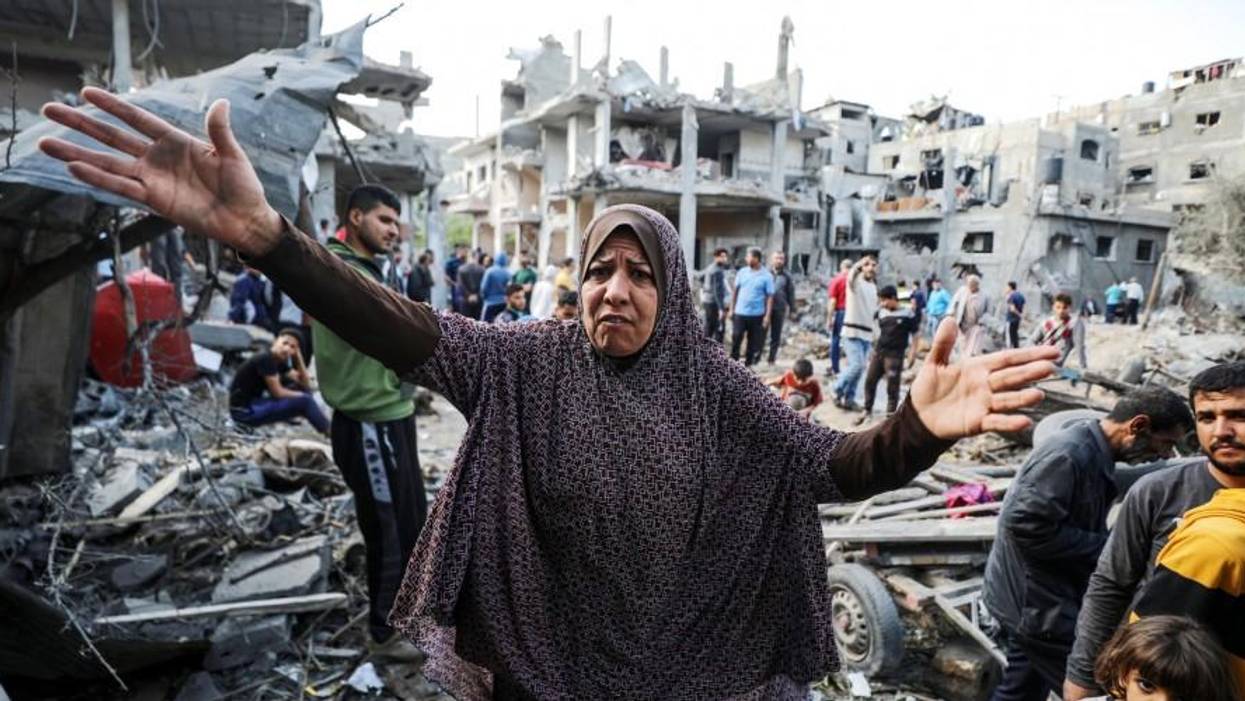
The world is reeling in horror at the latest Israeli massacre of hundreds of men, women and children in Gaza. Much of the world is also shocked by the role of the United States in this crisis, as it keeps providing Israel with weapons to kill Palestinian civilians, in violation of U.S. and international law, and has repeatedly blocked action by the UN Security Council to impose a ceasefire or hold Israel accountable for its war crimes.
In contrast to U.S. actions, in nearly every speech or interview, U.S. Secretary of State Antony Blinken keeps promising to uphold and defend the "rules-based order." But he has never clarified whether he means the universal rules of the United Nations Charter and international law, or some other set of rules he has yet to define. What rules could possibly legitimize the kind of destruction we just witnessed in Gaza, and who would want to live in a world ruled by them?
We have both spent many years protesting the violence and chaos the United States and its allies inflict on millions of people around the world by violating the UN Charter's prohibition against the threat or use of military force, and we have always insisted that the U.S. government should comply with the rules-based order of international law.
"What rules could possibly legitimize the kind of destruction we just witnessed in Gaza, and who would want to live in a world ruled by them?"But even as the United States' illegal wars and support for allies like Israel and Saudi Arabia have reduced cities to rubble and left country after country mired in intractable violence and chaos, U.S. leaders have refused to even acknowledge that aggressive and destructive U.S. and allied military operations violate the rules-based order of the United Nations Charter and international law.
President Trump was clear that he was not interested in following any "global rules," only supporting U.S. national interests. His National Security Advisor John Bolton explicitly prohibited National Security Council staff attending the 2018 G20 Summit in Argentina from even uttering the words "rules-based order."
So you might expect us to welcome Blinken's stated commitment to the "rules-based order" as a long-overdue reversal in U.S. policy. But when it comes to a vital principle like this, it is actions that count, and the Biden administration has yet to take any decisive action to bring U.S. foreign policy into compliance with the UN Charter or international law.
For Secretary Blinken, the concept of a "rules-based order" seems to serve mainly as a cudgel with which to attack China and Russia. At a May 7 UN Security Council meeting, Russian Foreign Minister Sergei Lavrov suggested that instead of accepting the already existing rules of international law, the United States and its allies are trying to come up with "other rules developed in closed, non-inclusive formats, and then imposed on everyone else."
The UN Charter and the rules of international law were developed in the 20th century precisely to codify the unwritten and endlessly contested rules of customary international law with explicit, written rules that would be binding on all nations.
The United States played a leading role in this legalist movement in international relations, from the Hague Peace Conferences at the turn of the 20th century to the signing of the United Nations Charter in San Francisco in 1945 and the revised Geneva Conventions in 1949, including the new Fourth Geneva Convention to protect civilians, like the countless numbers killed by American weapons in Afghanistan, Iraq, Syria, Yemen and Gaza.
As President Franklin Roosevelt described the plan for the United Nations to a joint session of Congress on his return from Yalta in 1945:
"It ought to spell the end of the system of unilateral action, the exclusive alliances, the spheres of influence, the balances of power, and all the other expedients that have been tried for centuries - and have always failed. We propose to substitute for all these a universal organization in which all peace-loving nations will finally have a chance to join. I am confident that the Congress and the American people will accept the results of this conference as the beginning of a permanent structure of peace."
But America's post-Cold War triumphalism eroded U.S. leaders' already half-hearted commitment to those rules. The neocons argued that they were no longer relevant and that the United States must be ready to impose order on the world by the unilateral threat and use of military force, exactly what the UN Charter prohibits. Madeleine Albright and other Democratic leaders embraced new doctrines of "humanitarian intervention" and a "responsibility to protect" to try to carve out politically persuasive exceptions to the explicit rules of the UN Charter.
America's "endless wars," its revived Cold War on Russia and China, its blank check for the Israeli occupation and the political obstacles to crafting a more peaceful and sustainable future are some of the fruits of these bipartisan efforts to challenge and weaken the rules-based order.
Today, far from being a leader of the international rules-based system, the United States is an outlier. It has failed to sign or ratify about fifty important and widely accepted multilateral treaties on everything from children's rights to arms control. Its unilateral sanctions against Cuba, Iran, Venezuela and other countries are themselves violations of international law, and the new Biden administration has shamefully failed to lift these illegal sanctions, ignoring UN Secretary-General Antonio Guterres' request to suspend such unilateral coercive measures during the pandemic.
So is Blinken's "rules-based order" a recommitment to President Roosevelt's "permanent structure of peace," or is it in fact a renunciation of the United Nations Charter and its purpose, which is peace and security for all of humanity?
In the light of Biden's first few months in power, it appears to be the latter. Instead of designing a foreign policy based on the principles and rules of the UN Charter and the goal of a peaceful world, Biden's policy seems to start from the premises of a $753 billion U.S. military budget, 800 overseas military bases, endless U.S. and allied wars and massacres, and massive weapons sales to repressive regimes. Then it works backward to formulate a policy framework to somehow justify all that.
Once a "war on terror" that only fuels terrorism, violence and chaos was no longer politically viable, hawkish U.S. leaders--both Republicans and Democrats--seem to have concluded that a return to the Cold War was the only plausible way to perpetuate America's militarist foreign policy and multi-trillion-dollar war machine.
But that raised a new set of contradictions. For 40 years, the Cold War was justified by the ideological struggle between the capitalist and communist economic systems. But the U.S.S.R. disintegrated and Russia is now a capitalist country. China is still governed by its Communist Party, but has a managed, mixed economy similar to that of Western Europe in the years after the Second World War - an efficient and dynamic economic system that has lifted hundreds of millions of people out of poverty in both cases.
So how can these U.S. leaders justify their renewed Cold War? They have floated the notion of a struggle between "democracy and authoritarianism." But the United States supports too many horrific dictatorships around the world, especially in the Middle East, to make that a convincing pretext for a Cold War against Russia and China.
A U.S. "global war on authoritarianism" would require confronting repressive U.S. allies like Egypt, Israel, Saudi Arabia and the United Arab Emirates, not arming them to the teeth and shielding them from international accountability as the United States is doing.
So, just as American and British leaders settled on non-existent "WMD"s as the pretext they could all agree on to justify their war on Iraq, the U.S. and its allies have settled on defending a vague, undefined "rules-based order" as the justification for their revived Cold War on Russia and China.
But like the emperor's new clothes in the fable and the WMDs in Iraq, the United States' new rules don't really exist. They are just its latest smokescreen for a foreign policy based on illegal threats and uses of force and a doctrine of "might makes right."
We challenge President Biden and Secretary Blinken to prove us wrong by actually joining the rules-based order of the UN Charter and international law. That would require a genuine commitment to a very different and more peaceful future, with appropriate contrition and accountability for the United States' and its allies' systematic violations of the UN Charter and international law, and the countless violent deaths, ruined societies and widespread chaos they have caused.