
SUBSCRIBE TO OUR FREE NEWSLETTER
Daily news & progressive opinion—funded by the people, not the corporations—delivered straight to your inbox.
5
#000000
#FFFFFF
To donate by check, phone, or other method, see our More Ways to Give page.


Daily news & progressive opinion—funded by the people, not the corporations—delivered straight to your inbox.
"Every single Democrat who voted for this is not taking the threat of Trump remotely seriously and should be disqualified from any leadership positions moving forward," said Georgia State Rep. Ruwa Romman.
Legislation that would have handed President-elect Donald Trump sweeping power to investigate and shutter news outlets, government watchdogs, humanitarian organizations, and other nonprofits was defeated in the House of Representatives on Tuesday after a coalition of progressive advocacy groups and lawmakers mobilized against it, warning of the bill's dire implications for the right to dissent.
But 52 Democratic lawmakers—including Reps. Adam Schiff (D-Calif.), Henry Cuellar (D-Texas), and Ritchie Torres (D-N.Y.)—apparently did not share the grave concerns expressed by the ACLU and other leading rights groups, opting to vote alongside 204 Republicans in favor of the bill.
One Republican, Rep. Thomas Massie of Kentucky, joined 144 Democrats in voting no.
The measure ultimately fell short of the two-thirds majority needed to approve legislation under the fast-track procedure used by the bill's supporters, but progressives wasted no time spotlighting the Democrats who supported the measure.
"If you're looking for a handy list of Democrats who have no fucking clue what is about to hit and need their spines stiffened ASAP, this is a good place to start,"
wrote Leah Greenberg, co-executive director of the advocacy group Indivisible.
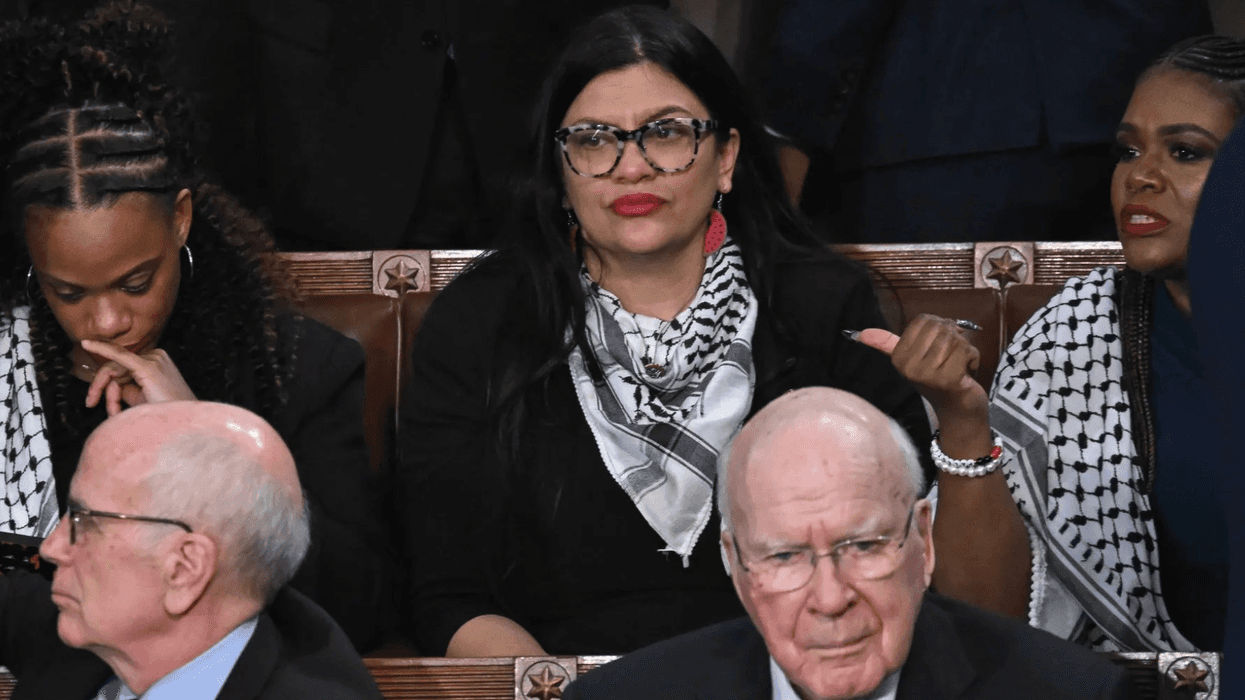
Rep. Rashida Tlaib (D-Mich.), who
vocally opposed the legislation, wrote that "these 52 Democrats voted to give Trump the power to shut down any nonprofit he wants."
"The NAACP, ACLU, Planned Parenthood, no organization would be safe," Tlaib added. "Shameful."
If passed, the Stop Terror-Financing and Tax Penalties on American Hostages Act would grant the Treasury Department—soon to be under the control of a Trump nominee—the authority to unilaterally strip nonprofits of their tax-exempt status by deeming them supporters of terrorism.
The bill could be revived in the next Congress, which is likely to be under full Republican control.
Kia Hamadanchy, senior policy counsel with the ACLU, toldThe Intercept late Tuesday that "we will continue our sustained opposition."
It is already illegal under U.S. law to provide material backing for terrorism, and the executive branch has significant authority to target groups it considers terrorist-supporting.
"This isn't just an attack on our communities; it's a fundamental threat to free speech and democracy."
The ACLU
noted ahead of Tuesday's vote that while the bill contains "a 90-day 'cure' period in which a designated nonprofit can mount a defense, it is a mere illusion of due process."
"The government may deny organizations its reasons and evidence against them, leaving the nonprofit unable to rebut allegations," the group said. "This means that a nonprofit could be left entirely in the dark about what conduct the government believes qualifies as 'support,' making it virtually impossible to clear its name."
Opponents of the bill warned that Palestinian rights organizations would be uniquely imperiled if it passed.
"This bill dangerously weaponizes the Treasury against nonprofit organizations and houses of worship—Christian, Jewish, or Muslim—that dare to support Palestinian and Lebanese human rights or criticize Israel's genocidal actions," said Robert McCaw, director of government affairs at the Council on American-Islamic Relations.
"Allowing such sweeping, unchecked power would set a chilling precedent, enabling the government to selectively target and suppress voices of dissent under the guise of national security," McCaw added. "This isn't just an attack on our communities; it's a fundamental threat to free speech and democracy."
Georgia State Rep. Ruwa Romman (D-97), a Palestinian American, echoed that sentiment following Tuesday's vote and condemned the legislation's 52 Democratic supporters.
"Every single Democrat who voted for this is not taking the threat of Trump remotely seriously and should be disqualified from any leadership positions moving forward," Romman wrote on social media. "This is no longer business as usual. To agree to give him this kind of power is beyond egregious."
The Michigan Democrat warned that the bill "gives Trump and his incoming administration dictatorial powers to target nonprofit organizations as political enemies without due process."
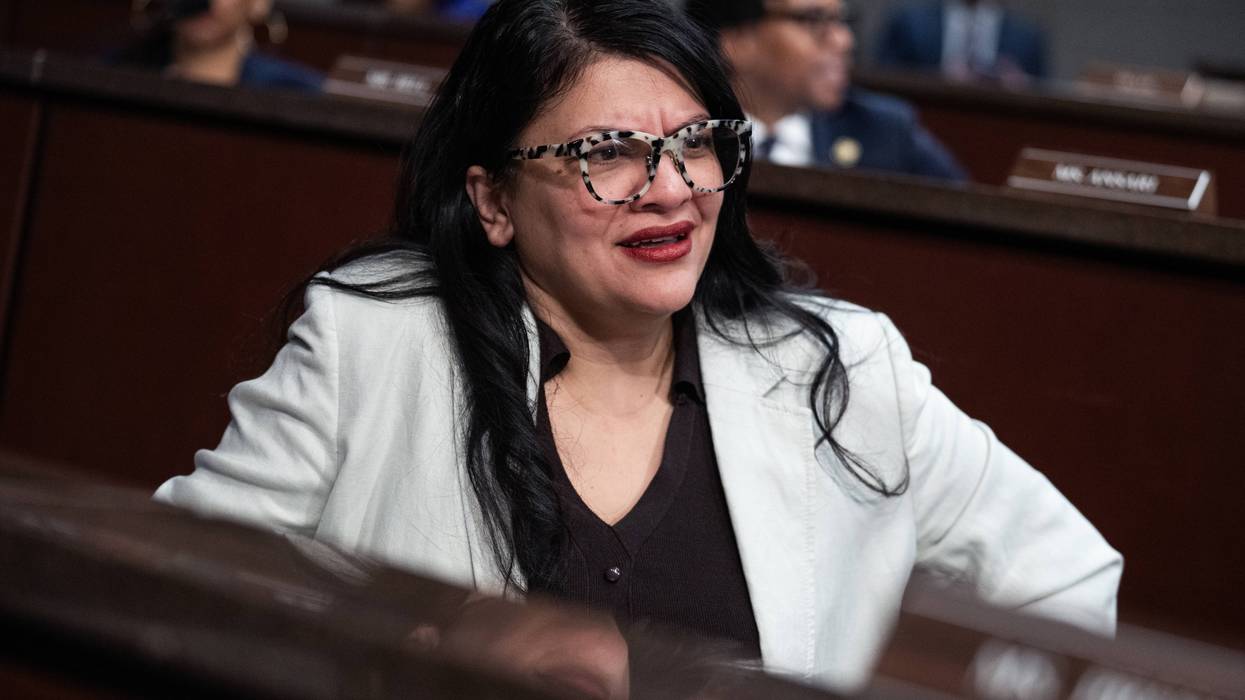
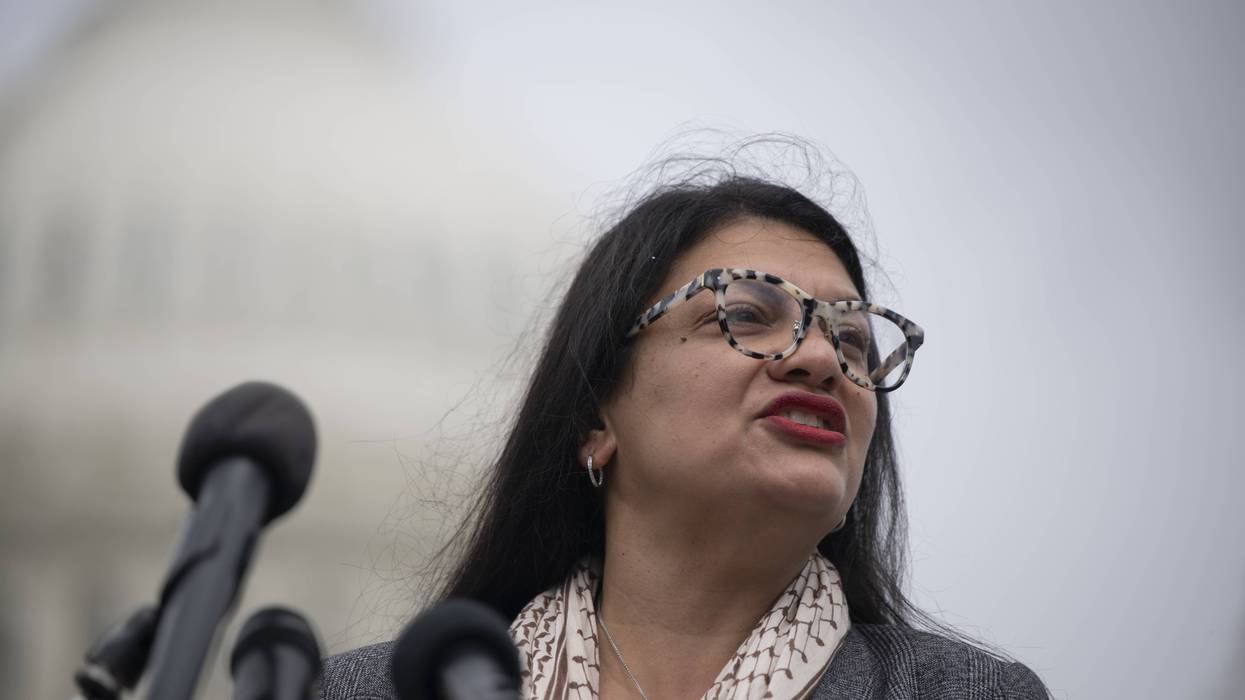
U.S. Congresswoman Rashida Tlaib on Tuesday was among multiple progressives and other Democrats who forcefully spoke out against legislation that would empower President-elect Donald Trump to strip nonprofits of their tax-exempt status.
Highlighting a letter that a diverse coalition led by the ACLU sent to Congress in September, Tlaib (D-Mich.) took aim at H.R. 9495, or the Stop Terror-Financing and Tax Penalties on American Hostages Act, on social media.
"No excuses," she said. "Every single one of my Democratic colleagues should be voting against this bill that gives Trump and his incoming administration dictatorial powers to target nonprofit organizations as political enemies without due process."
Tlaib, the only Palestinian American in Congress, has been a leading critic of U.S. support for the Israeli war on the Gaza Strip. H.R. 9495 is widely seen as an effort to further crack down on protests against the ongoing assault, though opponents of the proposal warn it could also be used to target groups advocating for issues including the environment and reproductive freedom.
The bill would let the Treasury secretary designate an organization as "terrorist-supporting" without any explanation or proof, and then end its 501(c)(3) status. That language is paired with legislation to provide tax relief for people detained or held hostage abroad and their spouses, a decision that critics say was made to force through the nonprofit policy.
Multiple members of Congress spoke out against the proposed attack on nonprofits both online and on the House floor, where the bill was debated and then a recorded vote was requested and postponed on Tuesday evening.
"H.R. 9495 is a giant threat to free speech," declared progressive Rep. Summer Lee (D-Pa.). "It gives Trump unchecked power to label any nonprofit as 'terrorist-supporting' without evidence or due process—opening the door to crush his opposition and silence dissent."
Tlaib and Lee's fellow "Squad" member Ilhan Omar (D-Minn.) similarly warned that "this is a dangerous threat to free speech. No one person should have the authority to silence organizations that dare to challenge government policies or speak uncomfortable truths."
Congresswoman Delia C. Ramirez (D-Ill.) stressed that "dissent is a fundamental part of democracy."
"Emboldened by the possibility of an unchallenged campaign of retaliation and persecution, Republicans are bringing H.R. 9495 to the floor AGAIN to give Trump the power to brand any organization that opposes him or his administration as a 'terrorist,'" she said. "I voted no once, and I will be voting NO again!"
A version of the policy targeting nonprofits previously passed the Republican-held House in April but stalled in the Democrat-controlled Senate. In addition to a White House victory in last week's election, the GOP won both chambers of Congress—meaning that even if H.R. 9495 fails now, it could be revived again next year.
Two outgoing House progressives who lost primaries to candidates backed by the American Israel Public Affairs Committee (AIPAC)—Reps. Jamaal Bowman (D-N.Y.) and Cori Bush (D-Mo.)—also blasted H.R. 9495 on Tuesday.
"H.R. 9495 would give Donald Trump unprecedented power to shut down any nonprofit or group that he disagrees with," said Bush. "This is a dangerous threat to our democracy. Congress must vote NO and stop it in its tracks."
Bowman argued that it "will sink us further into authoritarianism. It is an extremely dangerous bill that would give the government unlimited power to stop the work of humanitarian groups and target political enemies. All without transparency or evidence."
"This bill puts organizations like American Muslims for Palestine, American Immigration Council, and ColorOfChange at risk along with so many others doing the critical work of advocating for human rights and making sure starving children are fed and cared for," he continued. "The effects of H.R. 9495 aren't limited to just those organizations. Any nonprofit that crosses the executive branch could be targeted."
"This is authoritarianism and no Democrat should support this bill," Bowman added. "The unchecked powers granted by H.R. 9495 are ripe for abuse and any member of Congress who votes yes on it cannot honestly claim to support peace, justice, and freedom of speech."
Advocacy groups also continued to sound the alarm about the legislation ahead of the anticipated House vote.
"In any other context, this legislation would be seen for what it is, a play from the authoritarian leader's playbook," Paul O'Brien, executive director at Amnesty International USA, said in a Tuesday statement. "Members of Congress must recognize the danger posed and vote down this bill that could shrink civic space and silence civil society organizations."
The Michigan Democrat is not morally wrong for refusing to support the Harris campaign. But her refusal, I submit, is politically mistaken.
Democracy is on the ballot this Tuesday.
The election is only one step in a protracted process.
Between the election, and the presidential inauguration on January 21, 2025, there is an almost three-month long period—what Barton Gellman has called “an interregnum”—that will furnish Trump and his team of MAGA attorneys with many opportunities to litigate, intimidate, obstruct, and even attempt to overturn a Harris-Walz electoral victory by legalistic if not legal means.
Democrats and democrats more generally have learned the lessons of 2020, and have organized an extensive legal effort, headed up by Marc Elias, to defeat election obstruction in the courts. The need to hold the line politically against such obstruction is well understood.
But this will only be necessary if Kamala Harriswins the election.
And this will only happen if she is able to obtain enough votes in the crucial swing states necessary to win 270 electoral votes. Winning the popular vote will not be enough. The Electoral College is where this election will ultimately be decided. This is why the Harris-Walz campaign has been campaigning so furiously in Georgia, Arizona, North Carolina, Nevada, Wisconsin, and especially Pennsylvania and Michigan.
Tlaib is a brave and savvy political leader who has consistently spoken up against oppression and who, as the only Palestinian-American in Congress, has spoken bravely on behalf of Palestinians in the face of outright hostility expressed by Republicans but also by many Democrats.
And because the race is so tight, and every vote counts, and because so much of importance rides on the outcome, it is important, now, to think critically, in an intelligent way, about a very disappointing thing which happened this weekend: Congresswoman Rashida Tlaib’s unfortunate refusal, at a UAW campaign rally in Detroit, to endorse the Harris-Walz ticket.
Tlaib’s rationale is both straightforward and legitimate: the Biden administration’s strong and unwavering support for Israel’s criminal campaign of murder and destruction of Palestinians in Gaza, and the Democratic Party’s refusal to allow even one Palestinian-American to give voice to Palestinian concerns at the party’s convention last summer, represent intolerable disregard for Palestinian lives. As she explained: “Our trauma and pain feel unseen and ignored by both parties. One party uses our identity as a slur, and the other refuses to hear from us. Where is the shared humanity? Ignoring us won’t stop the genocide.”
Tlaib is a brave and savvy political leader who has consistently spoken up against oppression and who, as the only Palestinian-American in Congress, has spoken bravely on behalf of Palestinians in the face of outright hostility expressed by Republicans but also by many Democrats.
When she was attacked last year for her criticisms of Israeli war crimes, I strongly defended her in two pieces, published in rapid succession, that received substantial attention: “To Censure Rashida Tlaib Would Be to Censure Democracy Itself,” “and ““The Attacks on Rashida Tlaib Are Attacks on the Ethos of Pluralist Democracy .” In a third piece, “Defending and Respecting Rashida Tlaib’s Standpoint Does Not Mean Abandoning My Own ,” I also offered a sympathetic criticism of some of her rhetoric, which I thought alienated many allies to her cause.
It is in this spirit that I am writing now. I am not one of those who believes that Palestinian and Arab-Americans are under a moral duty to vote for the Harris-Walz ticket, or that they are somehow morally blameworthy should they refuse to so vote on grounds of either conscience or simple identity. For all politics involves mobilizing identity, and the Harris campaign is going all out to mobilize women in support of reproductive freedom and women’s health--as it should do.
Tlaib is not only a Palestinian-American citizen. She is also a member of Congress and leader of the Democratic Party and the progressive left more generally.
As I stated last week, in “A Few Words to Those Currently 'Uncommitted' to Voting for Harris ,“ many Arab-Americans are clearly so disgusted by Biden administration policy that they cannot support Harris, and it would be both foolish and morally tone deaf to tell them that their sense of identity is less important than any other. Arab-American fellow citizens have a right to feel outraged and ignored and to act accordingly.
At the same time, I also observed that:
’Uncommitted’ voters in some swing states, especially Michigan and Arizona, can turn the election for Trump or against him, and thus for racist authoritarianism or against it. Such voters can have an outsized influence on the future of American politics and thus the future of the world. There is an enormous political responsibility in this, a point recognized in an open letter circulated this week by Arizona Palestinian, Arab, Muslim, and progressive Democrats and community leaders, which emphasizes that ‘voting for Harris is not a personal endorsement of her or of the policy decisions of the administration in which she served. It’s an assessment of the best possible option to continue fighting for an end to the genocide, a free Palestine, and all else that we hold dear.’
The question I want to pose here regarding Tlaib’s decision is a question of political responsibility.
Tlaib is a Palestinian-American citizen, whose family is currently in danger in Israel-Palestine. As a citizen and as a conscientious moral individual, she has every right to refuse to support or to vote for Harris, by abstaining, or voting for Jill Stein, or whatever. It would be presumptuous for anyone to judge her as an individual, for only she knows what the current destruction of Palestine means to her and those whom she holds most dear.
But Tlaib is not only a Palestinian-American citizen. She is also a member of Congress and leader of the Democratic Party and the progressive left more generally.
And she has a distinct political responsibility that comes with this leadership. It requires that she be accountable to her constituents. But it also requires the she exercise the judgment necessary to truly lead, and to act publicly in ways that promote the interests of her constituents; the policies she cares about; and the survival of democracy itself. What she does publicly is by nature about much more than her. And her decisions carry more weight than ordinary citizen decisions.
A second Trump administration, especially linked to a buoyed MAGA Republican Congress, would be a simple disaster for everything that Rashida Tlaib has long bravely supported, from civil liberties to the dignified treatment of immigrants—including Arab immigrants—to justice for Palestinians. For Trump is an ally of Netanyahu and his Greater Israel agenda, and he will surely green-light even more aggression, dispossession, destruction and death for Palestinians than we have seen over the past year.
Rashida Tlaib is not morally wrong for refusing to support the Harris campaign. But her refusal, I submit, is politically mistaken, because it is likely to bring about results that are politically noxious for her supporters and their values, and for American democracy more generally.
A second Trump administration, especially linked to a buoyed MAGA Republican Congress, would be a simple disaster for everything that Rashida Tlaib has long bravely supported.
Back in early January 2019, Rep. Rashida Tlaib, then newly elected to her first Congressional term, made a bold and highly publicized declaration: “We’re going to impeach the motherfucker!” She was immediately attacked for her lack of “civility.” One of many, I defended her, in three pieces” “On Calls to Impeach the Motherfucker,” “Why We Need to Listen to Rashida Tlaib,” and “Is ‘Motherfucker’ the Concept Political Science Now Needs?”
My basic point was a simple one: Tlaib’s controversial comments were entirely appropriate ways of talking about tyrannical then-president Trump, and her candor indeed established her as an outspoken and exemplary defender of democracy, a true leader of her party. In doing so, I quoted from her “offending” January speech:
President Donald Trump is a direct and serious threat to our country. On an almost daily basis, he attacks our Constitution, our democracy, the rule of law and the people who are in this country. His conduct has created a constitutional crisis that we must confront now. . . Each passing day brings new damage to the countless people hurt by this lawless president’s actions. We cannot undo the trauma that he is causing to our people, and this nation. Those most vulnerable to his administration’s cruelty are counting on us to act — act to remove the president and put this country on a path to true justice. . . his is not just about Donald Trump. This is about all of us. What should we be as a nation? Who should we be as a people? In the face of this constitutional crisis, we must rise. We must rise to defend our Constitution, to defend our democracy, and to defend that bedrock principle that no one is above the law, not even the President of the United States.
More powerful words in defense of democracy have rarely been spoken by a U.S. Congressperson.
It is obvious that much has changed since then. And especially since October 7, 2023, when a brutal Hamas attack on Israel precipitated almost a year of Israeli attacks on Gaza (and the West Bank, and Lebanon), attacks so brutal, destructive, and murderous that they do not even merit the description “retaliation.” This Israeli policy has been deplorable and criminal, and it deserves to be vocally criticized.
In the past year, Tlaib’s brave action as the lone Palestinian voice of and for Palestinians in the U.S. has been exemplary. Her call for a cease-fire, her denunciation of the Israeli war and of U.S. military support for it, her calls for Palestinian self-determination—she has done these things as only she could do them. And in doing these things, she has acted not only on behalf of the rights of Palestinians—an eminently noble commitment!—but on behalf of a more accountable, humane, and just U.S. foreign policy, in the Middle East and more generally. She has called out the hypocritical aspects of the Biden administration claim to be all about “democracy,” and she has done so in the name of democracy itself.
And it is concern for democracy that will hopefully lead her, at the last moment, to endorse the Harris-Walz ticket.
Tlaib, through her well-earned influence with scores of thousands of Arab-American citizens, especially in Michigan, can still– even in this late moment—well turn the outcome of this election. By making a statement like the open letter circulated by Arizona Palestinian, Arab, Muslim, and progressive Democrats, and declaring that “voting for Harris is not a personal endorsement . . . . It’s an assessment of the best possible option to continue fighting for an end to the genocide, a free Palestine, and all else that we hold dear,” she can help to elect Harris and to keep Trump at bay. In doing so, she would also further cement her stature as a Democratic leader and indeed she would strengthen the party’s Progressive Caucus and especially her “Squad” colleagues.
Alternatively, she can decline to say anything. This might be the righteous choice. But it may well produce the worst possible political outcome—a second Trump administration.
Tlaib bears a tremendous burden of responsibility.
I hope she foregoes the righteous choice in favor of the politically right one.
A great deal hangs in the balance for us all.