SUBSCRIBE TO OUR FREE NEWSLETTER
Daily news & progressive opinion—funded by the people, not the corporations—delivered straight to your inbox.
5
#000000
#FFFFFF
To donate by check, phone, or other method, see our More Ways to Give page.
Daily news & progressive opinion—funded by the people, not the corporations—delivered straight to your inbox.
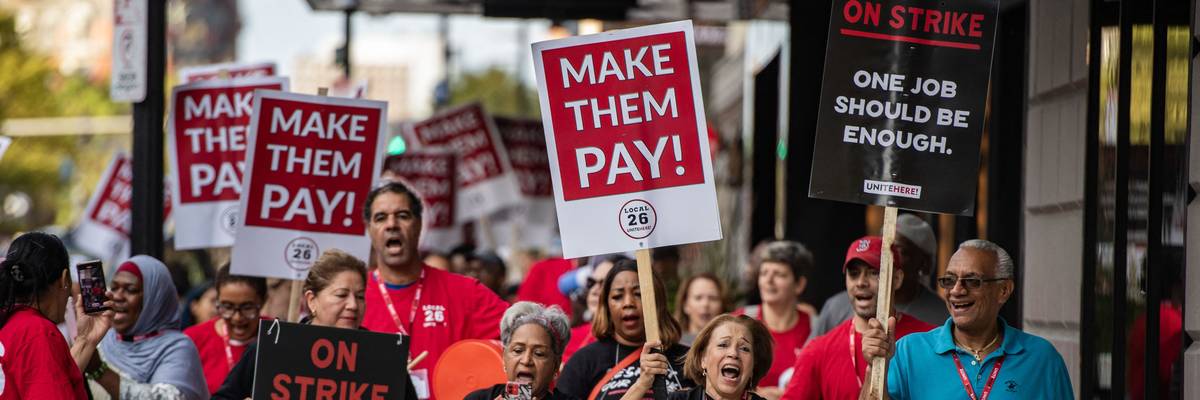
US hotel workers demonstrate as they strike over the Labor Day holiday weekend outside of the Boston Park Plaza Hotel in Boston, Massachusetts, on September 2, 2024.
If we want the Democrats, or the Republicans, or any political party to enact a political agenda that effectively addresses the real concerns of working Americans, we must build a movement that enhances and applies the power of working Americans.
Democrats are eager to recapture the House, and perhaps even the Senate, in this November’s elections. They are banking in part on the customary midterm pendulum swing and in part on backlash against President Donald Trump’s unhinged, cult-like governing style (despite the ineffectiveness of this strategy throughout several election cycles). They also hope to reclaim their reputation as the party of the working class.
As a lifelong labor activist, I am gratified whenever people in electoral politics say they want to uplift the American worker. But I admit some skepticism—particularly since both major parties spent a generation or more embracing the neoliberal consensus that the government should surrender to giant multinational corporations and their wealthy executives and investors. Working people are not stupid; they know most prominent Democrats and all pre-MAGA Republicans advanced an agenda that eviscerated worker interests at home and sent tens of millions of jobs abroad. (Many unions, especially those in manufacturing, opposed the North American Free Trade Agreement when George H.W. Bush negotiated it and when William J. Clinton signed it.) Public frustration and outrage have shaken politicians’ commitment to neoliberalism (rhetorically, at least), but will it be replaced by a program that advances the real interests of the people who rely on their own labor to make ends meet?
Now that he is back in office, Trump has abandoned any pretense of being pro-worker. He has stripped a million federal employees of the right to bargain collectively, gutted overtime rules and other workplace protections, crippled the National Labor Relations Board (NLRB), and deprived millions of working people of health and food benefits. He is proud and loud about protecting artificial intelligence from effective regulation just as employers start using it to mow down thousands—and ultimately millions—of jobs. Will the Democrats offer a real alternative for working people?
Some Democrats seem to be focused on the performative—searching for candidates who project non-elite “authenticity.” You know, candidates who know how to operate power tools and who drink beer from plastic cups. Don’t get me wrong, I think it’s great to run candidates who actually work for a living, but that’s not a comprehensive strategy. Working people want—and demand—actual change in how our leaders govern, not just how they look on TV (or TikTok). If the Democrats fail to articulate and deliver a legitimately pro-worker agenda, working people will continue to look elsewhere—perhaps voting for “none of the above.” (Note that, although the 2024 presidential election was proclaimed to be about the survival of our nation and its sacred values, more eligible voters stayed home than voted for either Trump or former Vice President Kamala Harris.)
Congress has failed to adopt legislation to enable workers to build their own power because workers do not have enough power to force Congress to do so.
Just as slick candidate packaging is not enough, the same is true of hollow “messaging.” Working people—like most voters—are tired of promises that bloom just before Election Day and wither right after. To represent workers effectively, elected officials will have to take political risks and challenge the power of the corporate elite, fighting for measures that tackle unaffordable healthcare, the housing crisis, and the vast (and growing) inequalities of wealth and income.
This seems so obvious it raises the question of why elected officials have ignored working voters’ real interests for so long. Here’s the key: Politicians will only stand up to corporate interests and press for meaningful pro-worker change if working people have enough leverage to force them to do so. For the past several decades our elected leaders chose a neoliberal path because the giant multinational companies and the ultra wealthy had the power to demand it—and working people did not have the countervailing power to resist it and to advance their own interests. It is no coincidence that the pro-corporate political consensus arose at precisely the same time that union membership plummeted in the United States. Although public approval of unions is as high as it has been in decades, the percentage of working people who are actually represented by unions is near an all-time low: about 10% of all workers and less than 6% in the private sector.
As the great United Auto Workers union leader Walter Reuther said, no one gives you anything you’re not strong enough to take for yourself. Working people need to build, or rebuild, the power to insist that politicians act in their interests, not just those of the corporate elite. Here’s a concrete example at the heart of building worker power: One of the reasons unions are so small now is that federal labor law has failed to protect workers’ right to organize and to engage in collective bargaining. There are plenty of great ideas for reforming US labor law. The Employee Free Choice Act, first introduced in 2006, would have streamlined the way the NLRB governs union organizing efforts. Opposition from pro-business senators (including some Democrats), together with the threat of a GOP filibuster, doomed it—even when Barack Obama was in the White House and the Democrats controlled both chambers. The Protect the Right to Organize Act, or “PRO Act,” would have addressed a whole range of structural and substantive problems with US labor law. It did not make it to full floor votes even when the Democrats controlled both the House and the Senate in 2021.
Why did Congress fail to adopt either of these essential bills, even when Democrats were in power? Because elected leaders—including Democrats—did not feel political pressure or fear political fallout. It’s like a Zen koan: Congress has failed to adopt legislation to enable workers to build their own power because workers do not have enough power to force Congress to do so.
Bottom line: If we want the Democrats, or the Republicans, or any political party to enact a political agenda that effectively addresses the real concerns of working Americans, we must build a movement that enhances and applies the power of working Americans. Unless and until we create a larger, stronger labor movement, politicians will not feel enough pressure to do the right thing for working people. Leverage is how politics work, and we should act accordingly. We should roll up our sleeves and get busy organizing in the workplace so we can assert real influence in the halls of government.
Dear Common Dreams reader, It’s been nearly 30 years since I co-founded Common Dreams with my late wife, Lina Newhouser. We had the radical notion that journalism should serve the public good, not corporate profits. It was clear to us from the outset what it would take to build such a project. No paid advertisements. No corporate sponsors. No millionaire publisher telling us what to think or do. Many people said we wouldn't last a year, but we proved those doubters wrong. Together with a tremendous team of journalists and dedicated staff, we built an independent media outlet free from the constraints of profits and corporate control. Our mission has always been simple: To inform. To inspire. To ignite change for the common good. Building Common Dreams was not easy. Our survival was never guaranteed. When you take on the most powerful forces—Wall Street greed, fossil fuel industry destruction, Big Tech lobbyists, and uber-rich oligarchs who have spent billions upon billions rigging the economy and democracy in their favor—the only bulwark you have is supporters who believe in your work. But here’s the urgent message from me today. It's never been this bad out there. And it's never been this hard to keep us going. At the very moment Common Dreams is most needed, the threats we face are intensifying. We need your support now more than ever. We don't accept corporate advertising and never will. We don't have a paywall because we don't think people should be blocked from critical news based on their ability to pay. Everything we do is funded by the donations of readers like you. When everyone does the little they can afford, we are strong. But if that support retreats or dries up, so do we. Will you donate now to make sure Common Dreams not only survives but thrives? —Craig Brown, Co-founder |
Democrats are eager to recapture the House, and perhaps even the Senate, in this November’s elections. They are banking in part on the customary midterm pendulum swing and in part on backlash against President Donald Trump’s unhinged, cult-like governing style (despite the ineffectiveness of this strategy throughout several election cycles). They also hope to reclaim their reputation as the party of the working class.
As a lifelong labor activist, I am gratified whenever people in electoral politics say they want to uplift the American worker. But I admit some skepticism—particularly since both major parties spent a generation or more embracing the neoliberal consensus that the government should surrender to giant multinational corporations and their wealthy executives and investors. Working people are not stupid; they know most prominent Democrats and all pre-MAGA Republicans advanced an agenda that eviscerated worker interests at home and sent tens of millions of jobs abroad. (Many unions, especially those in manufacturing, opposed the North American Free Trade Agreement when George H.W. Bush negotiated it and when William J. Clinton signed it.) Public frustration and outrage have shaken politicians’ commitment to neoliberalism (rhetorically, at least), but will it be replaced by a program that advances the real interests of the people who rely on their own labor to make ends meet?
Now that he is back in office, Trump has abandoned any pretense of being pro-worker. He has stripped a million federal employees of the right to bargain collectively, gutted overtime rules and other workplace protections, crippled the National Labor Relations Board (NLRB), and deprived millions of working people of health and food benefits. He is proud and loud about protecting artificial intelligence from effective regulation just as employers start using it to mow down thousands—and ultimately millions—of jobs. Will the Democrats offer a real alternative for working people?
Some Democrats seem to be focused on the performative—searching for candidates who project non-elite “authenticity.” You know, candidates who know how to operate power tools and who drink beer from plastic cups. Don’t get me wrong, I think it’s great to run candidates who actually work for a living, but that’s not a comprehensive strategy. Working people want—and demand—actual change in how our leaders govern, not just how they look on TV (or TikTok). If the Democrats fail to articulate and deliver a legitimately pro-worker agenda, working people will continue to look elsewhere—perhaps voting for “none of the above.” (Note that, although the 2024 presidential election was proclaimed to be about the survival of our nation and its sacred values, more eligible voters stayed home than voted for either Trump or former Vice President Kamala Harris.)
Congress has failed to adopt legislation to enable workers to build their own power because workers do not have enough power to force Congress to do so.
Just as slick candidate packaging is not enough, the same is true of hollow “messaging.” Working people—like most voters—are tired of promises that bloom just before Election Day and wither right after. To represent workers effectively, elected officials will have to take political risks and challenge the power of the corporate elite, fighting for measures that tackle unaffordable healthcare, the housing crisis, and the vast (and growing) inequalities of wealth and income.
This seems so obvious it raises the question of why elected officials have ignored working voters’ real interests for so long. Here’s the key: Politicians will only stand up to corporate interests and press for meaningful pro-worker change if working people have enough leverage to force them to do so. For the past several decades our elected leaders chose a neoliberal path because the giant multinational companies and the ultra wealthy had the power to demand it—and working people did not have the countervailing power to resist it and to advance their own interests. It is no coincidence that the pro-corporate political consensus arose at precisely the same time that union membership plummeted in the United States. Although public approval of unions is as high as it has been in decades, the percentage of working people who are actually represented by unions is near an all-time low: about 10% of all workers and less than 6% in the private sector.
As the great United Auto Workers union leader Walter Reuther said, no one gives you anything you’re not strong enough to take for yourself. Working people need to build, or rebuild, the power to insist that politicians act in their interests, not just those of the corporate elite. Here’s a concrete example at the heart of building worker power: One of the reasons unions are so small now is that federal labor law has failed to protect workers’ right to organize and to engage in collective bargaining. There are plenty of great ideas for reforming US labor law. The Employee Free Choice Act, first introduced in 2006, would have streamlined the way the NLRB governs union organizing efforts. Opposition from pro-business senators (including some Democrats), together with the threat of a GOP filibuster, doomed it—even when Barack Obama was in the White House and the Democrats controlled both chambers. The Protect the Right to Organize Act, or “PRO Act,” would have addressed a whole range of structural and substantive problems with US labor law. It did not make it to full floor votes even when the Democrats controlled both the House and the Senate in 2021.
Why did Congress fail to adopt either of these essential bills, even when Democrats were in power? Because elected leaders—including Democrats—did not feel political pressure or fear political fallout. It’s like a Zen koan: Congress has failed to adopt legislation to enable workers to build their own power because workers do not have enough power to force Congress to do so.
Bottom line: If we want the Democrats, or the Republicans, or any political party to enact a political agenda that effectively addresses the real concerns of working Americans, we must build a movement that enhances and applies the power of working Americans. Unless and until we create a larger, stronger labor movement, politicians will not feel enough pressure to do the right thing for working people. Leverage is how politics work, and we should act accordingly. We should roll up our sleeves and get busy organizing in the workplace so we can assert real influence in the halls of government.
Democrats are eager to recapture the House, and perhaps even the Senate, in this November’s elections. They are banking in part on the customary midterm pendulum swing and in part on backlash against President Donald Trump’s unhinged, cult-like governing style (despite the ineffectiveness of this strategy throughout several election cycles). They also hope to reclaim their reputation as the party of the working class.
As a lifelong labor activist, I am gratified whenever people in electoral politics say they want to uplift the American worker. But I admit some skepticism—particularly since both major parties spent a generation or more embracing the neoliberal consensus that the government should surrender to giant multinational corporations and their wealthy executives and investors. Working people are not stupid; they know most prominent Democrats and all pre-MAGA Republicans advanced an agenda that eviscerated worker interests at home and sent tens of millions of jobs abroad. (Many unions, especially those in manufacturing, opposed the North American Free Trade Agreement when George H.W. Bush negotiated it and when William J. Clinton signed it.) Public frustration and outrage have shaken politicians’ commitment to neoliberalism (rhetorically, at least), but will it be replaced by a program that advances the real interests of the people who rely on their own labor to make ends meet?
Now that he is back in office, Trump has abandoned any pretense of being pro-worker. He has stripped a million federal employees of the right to bargain collectively, gutted overtime rules and other workplace protections, crippled the National Labor Relations Board (NLRB), and deprived millions of working people of health and food benefits. He is proud and loud about protecting artificial intelligence from effective regulation just as employers start using it to mow down thousands—and ultimately millions—of jobs. Will the Democrats offer a real alternative for working people?
Some Democrats seem to be focused on the performative—searching for candidates who project non-elite “authenticity.” You know, candidates who know how to operate power tools and who drink beer from plastic cups. Don’t get me wrong, I think it’s great to run candidates who actually work for a living, but that’s not a comprehensive strategy. Working people want—and demand—actual change in how our leaders govern, not just how they look on TV (or TikTok). If the Democrats fail to articulate and deliver a legitimately pro-worker agenda, working people will continue to look elsewhere—perhaps voting for “none of the above.” (Note that, although the 2024 presidential election was proclaimed to be about the survival of our nation and its sacred values, more eligible voters stayed home than voted for either Trump or former Vice President Kamala Harris.)
Congress has failed to adopt legislation to enable workers to build their own power because workers do not have enough power to force Congress to do so.
Just as slick candidate packaging is not enough, the same is true of hollow “messaging.” Working people—like most voters—are tired of promises that bloom just before Election Day and wither right after. To represent workers effectively, elected officials will have to take political risks and challenge the power of the corporate elite, fighting for measures that tackle unaffordable healthcare, the housing crisis, and the vast (and growing) inequalities of wealth and income.
This seems so obvious it raises the question of why elected officials have ignored working voters’ real interests for so long. Here’s the key: Politicians will only stand up to corporate interests and press for meaningful pro-worker change if working people have enough leverage to force them to do so. For the past several decades our elected leaders chose a neoliberal path because the giant multinational companies and the ultra wealthy had the power to demand it—and working people did not have the countervailing power to resist it and to advance their own interests. It is no coincidence that the pro-corporate political consensus arose at precisely the same time that union membership plummeted in the United States. Although public approval of unions is as high as it has been in decades, the percentage of working people who are actually represented by unions is near an all-time low: about 10% of all workers and less than 6% in the private sector.
As the great United Auto Workers union leader Walter Reuther said, no one gives you anything you’re not strong enough to take for yourself. Working people need to build, or rebuild, the power to insist that politicians act in their interests, not just those of the corporate elite. Here’s a concrete example at the heart of building worker power: One of the reasons unions are so small now is that federal labor law has failed to protect workers’ right to organize and to engage in collective bargaining. There are plenty of great ideas for reforming US labor law. The Employee Free Choice Act, first introduced in 2006, would have streamlined the way the NLRB governs union organizing efforts. Opposition from pro-business senators (including some Democrats), together with the threat of a GOP filibuster, doomed it—even when Barack Obama was in the White House and the Democrats controlled both chambers. The Protect the Right to Organize Act, or “PRO Act,” would have addressed a whole range of structural and substantive problems with US labor law. It did not make it to full floor votes even when the Democrats controlled both the House and the Senate in 2021.
Why did Congress fail to adopt either of these essential bills, even when Democrats were in power? Because elected leaders—including Democrats—did not feel political pressure or fear political fallout. It’s like a Zen koan: Congress has failed to adopt legislation to enable workers to build their own power because workers do not have enough power to force Congress to do so.
Bottom line: If we want the Democrats, or the Republicans, or any political party to enact a political agenda that effectively addresses the real concerns of working Americans, we must build a movement that enhances and applies the power of working Americans. Unless and until we create a larger, stronger labor movement, politicians will not feel enough pressure to do the right thing for working people. Leverage is how politics work, and we should act accordingly. We should roll up our sleeves and get busy organizing in the workplace so we can assert real influence in the halls of government.