SUBSCRIBE TO OUR FREE NEWSLETTER
Daily news & progressive opinion—funded by the people, not the corporations—delivered straight to your inbox.
5
#000000
#FFFFFF
To donate by check, phone, or other method, see our More Ways to Give page.
Daily news & progressive opinion—funded by the people, not the corporations—delivered straight to your inbox.
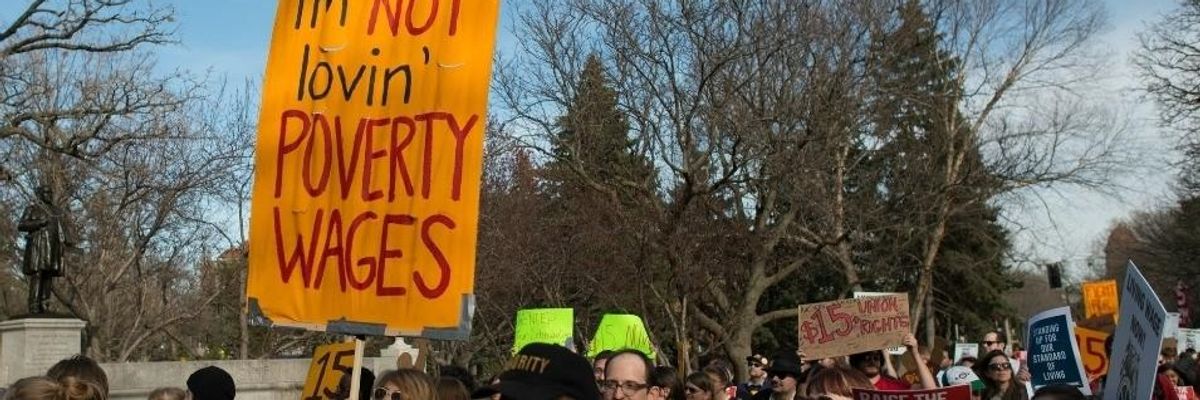
"Across our history, access to economic and political power has been unforgivably shaped by racial and gender discrimination, as well as by discrimination based on immigration status, by sexual orientation and identity discrimination, and by ableism," reads a new report. "What we need, then, is a labor law capable of empowering all workers to demand a truly equitable American democracy and a genuinely equitable American economy."(Photo: Fibonacci Blue/Flickr/cc)
To effectively combat economic inequality and even the playing field between corporations and the people they employ, a new report argues, the U.S. must entirely overhaul labor laws to provide a "clean slate" for all workers.
Two academics at Harvard Law School joined with more than 70 labor leaders, activists, and economists to publish the report, entitled "Clean Slate for Worker Power: Building a Just Economy and Democracy."
The document, which took two years for professors Sharon Block and Benjamin Sachs to develop, makes a number of recommendations for placing power in the hands of workers--giving them more rights in the workplace than they had at the height of the labor movement and in the 1950s, when union membership in the U.S. was at its highest, at 35%.
"Across our history, access to economic and political power has been unforgivably shaped by racial and gender discrimination, as well as by discrimination based on immigration status, by sexual orientation and identity discrimination, and by ableism," reads the report. "What we need, then, is a labor law capable of empowering all workers to demand a truly equitable American democracy and a genuinely equitable American economy."
Only 6.2% of private sector workers in the U.S. today are union members. This decline has come about as employers intimidate workers into remaining unrepresented and require union leaders to obtain the favor of a majority of workers in order to gain bargaining rights.
Under Block and Sachs's blueprint, companies would be prohibited from compelling employees to attend anti-union meetings or presentations--which have been used by some of the biggest employers in the country--and required to recognize a union once just 25% of workers sign union cards.
"Democracy at work should be a right, not a fight," reads the report. "For too long, securing power and voice at work has required workers to fight herculean battles against nearly impossible odds."
Other recommendations include:
Sectoral bargaining, which is common in Europe and supported by two Democratic presidential candidates--Sens. Bernie Sanders (I-Vt.) and Elizabeth Warren (D-Mass.)--is another major proposal in the report.
"Through sectoral bargaining, labor law can take wages out of competition, relieving the downward pressure on pay that has so greatly contributed to the increase in income inequality," Block and Sachs wrote in Newsweek on Thursday. "It would also reduce the incentives that firms now feel to fight unionization, and it would solve the puzzle--which plagues multiple industries and the gig economy--of who qualifies as an 'employee.' Since all workers would be covered by sectoral agreements, it would no longer matter very much who is an employee and who is not."
The report also advocates for improving upon the labor laws passed in the early-to-mid 20th century by extending protections and collective bargaining rights to many workers who don't have them, many of whom are women and people of color.
The labor movement has been largely exclusionary to domestic workers, farmworkers, incarcerated and undocumented people, and independent contractors, Block and Sachs write.
"By starting from a 'clean slate,' we can rethink the historical racist and sexist forces that shaped the current, limited landscape," the report reads.
The proposals were developed with the input of labor leaders including Ai-Jen Poo of the National Domestic Workers Alliance, Saket Soni of the National Guestworker Alliance, Nicole Berner of the SEIU.
The report won praise on social media Thursday from workers' rights advocates:
"Fundamentally redesigning our labor laws, rather than pursuing incremental reforms to our current laws, would provide the foundation for building powerful organizations for working people," the authors wrote in Newsweek. "At a time when the foundations of our democracy are being questioned, the project of creating a widespread system of workplace democracy is urgent."
Dear Common Dreams reader, It’s been nearly 30 years since I co-founded Common Dreams with my late wife, Lina Newhouser. We had the radical notion that journalism should serve the public good, not corporate profits. It was clear to us from the outset what it would take to build such a project. No paid advertisements. No corporate sponsors. No millionaire publisher telling us what to think or do. Many people said we wouldn't last a year, but we proved those doubters wrong. Together with a tremendous team of journalists and dedicated staff, we built an independent media outlet free from the constraints of profits and corporate control. Our mission has always been simple: To inform. To inspire. To ignite change for the common good. Building Common Dreams was not easy. Our survival was never guaranteed. When you take on the most powerful forces—Wall Street greed, fossil fuel industry destruction, Big Tech lobbyists, and uber-rich oligarchs who have spent billions upon billions rigging the economy and democracy in their favor—the only bulwark you have is supporters who believe in your work. But here’s the urgent message from me today. It's never been this bad out there. And it's never been this hard to keep us going. At the very moment Common Dreams is most needed, the threats we face are intensifying. We need your support now more than ever. We don't accept corporate advertising and never will. We don't have a paywall because we don't think people should be blocked from critical news based on their ability to pay. Everything we do is funded by the donations of readers like you. When everyone does the little they can afford, we are strong. But if that support retreats or dries up, so do we. Will you donate now to make sure Common Dreams not only survives but thrives? —Craig Brown, Co-founder |
To effectively combat economic inequality and even the playing field between corporations and the people they employ, a new report argues, the U.S. must entirely overhaul labor laws to provide a "clean slate" for all workers.
Two academics at Harvard Law School joined with more than 70 labor leaders, activists, and economists to publish the report, entitled "Clean Slate for Worker Power: Building a Just Economy and Democracy."
The document, which took two years for professors Sharon Block and Benjamin Sachs to develop, makes a number of recommendations for placing power in the hands of workers--giving them more rights in the workplace than they had at the height of the labor movement and in the 1950s, when union membership in the U.S. was at its highest, at 35%.
"Across our history, access to economic and political power has been unforgivably shaped by racial and gender discrimination, as well as by discrimination based on immigration status, by sexual orientation and identity discrimination, and by ableism," reads the report. "What we need, then, is a labor law capable of empowering all workers to demand a truly equitable American democracy and a genuinely equitable American economy."
Only 6.2% of private sector workers in the U.S. today are union members. This decline has come about as employers intimidate workers into remaining unrepresented and require union leaders to obtain the favor of a majority of workers in order to gain bargaining rights.
Under Block and Sachs's blueprint, companies would be prohibited from compelling employees to attend anti-union meetings or presentations--which have been used by some of the biggest employers in the country--and required to recognize a union once just 25% of workers sign union cards.
"Democracy at work should be a right, not a fight," reads the report. "For too long, securing power and voice at work has required workers to fight herculean battles against nearly impossible odds."
Other recommendations include:
Sectoral bargaining, which is common in Europe and supported by two Democratic presidential candidates--Sens. Bernie Sanders (I-Vt.) and Elizabeth Warren (D-Mass.)--is another major proposal in the report.
"Through sectoral bargaining, labor law can take wages out of competition, relieving the downward pressure on pay that has so greatly contributed to the increase in income inequality," Block and Sachs wrote in Newsweek on Thursday. "It would also reduce the incentives that firms now feel to fight unionization, and it would solve the puzzle--which plagues multiple industries and the gig economy--of who qualifies as an 'employee.' Since all workers would be covered by sectoral agreements, it would no longer matter very much who is an employee and who is not."
The report also advocates for improving upon the labor laws passed in the early-to-mid 20th century by extending protections and collective bargaining rights to many workers who don't have them, many of whom are women and people of color.
The labor movement has been largely exclusionary to domestic workers, farmworkers, incarcerated and undocumented people, and independent contractors, Block and Sachs write.
"By starting from a 'clean slate,' we can rethink the historical racist and sexist forces that shaped the current, limited landscape," the report reads.
The proposals were developed with the input of labor leaders including Ai-Jen Poo of the National Domestic Workers Alliance, Saket Soni of the National Guestworker Alliance, Nicole Berner of the SEIU.
The report won praise on social media Thursday from workers' rights advocates:
"Fundamentally redesigning our labor laws, rather than pursuing incremental reforms to our current laws, would provide the foundation for building powerful organizations for working people," the authors wrote in Newsweek. "At a time when the foundations of our democracy are being questioned, the project of creating a widespread system of workplace democracy is urgent."
To effectively combat economic inequality and even the playing field between corporations and the people they employ, a new report argues, the U.S. must entirely overhaul labor laws to provide a "clean slate" for all workers.
Two academics at Harvard Law School joined with more than 70 labor leaders, activists, and economists to publish the report, entitled "Clean Slate for Worker Power: Building a Just Economy and Democracy."
The document, which took two years for professors Sharon Block and Benjamin Sachs to develop, makes a number of recommendations for placing power in the hands of workers--giving them more rights in the workplace than they had at the height of the labor movement and in the 1950s, when union membership in the U.S. was at its highest, at 35%.
"Across our history, access to economic and political power has been unforgivably shaped by racial and gender discrimination, as well as by discrimination based on immigration status, by sexual orientation and identity discrimination, and by ableism," reads the report. "What we need, then, is a labor law capable of empowering all workers to demand a truly equitable American democracy and a genuinely equitable American economy."
Only 6.2% of private sector workers in the U.S. today are union members. This decline has come about as employers intimidate workers into remaining unrepresented and require union leaders to obtain the favor of a majority of workers in order to gain bargaining rights.
Under Block and Sachs's blueprint, companies would be prohibited from compelling employees to attend anti-union meetings or presentations--which have been used by some of the biggest employers in the country--and required to recognize a union once just 25% of workers sign union cards.
"Democracy at work should be a right, not a fight," reads the report. "For too long, securing power and voice at work has required workers to fight herculean battles against nearly impossible odds."
Other recommendations include:
Sectoral bargaining, which is common in Europe and supported by two Democratic presidential candidates--Sens. Bernie Sanders (I-Vt.) and Elizabeth Warren (D-Mass.)--is another major proposal in the report.
"Through sectoral bargaining, labor law can take wages out of competition, relieving the downward pressure on pay that has so greatly contributed to the increase in income inequality," Block and Sachs wrote in Newsweek on Thursday. "It would also reduce the incentives that firms now feel to fight unionization, and it would solve the puzzle--which plagues multiple industries and the gig economy--of who qualifies as an 'employee.' Since all workers would be covered by sectoral agreements, it would no longer matter very much who is an employee and who is not."
The report also advocates for improving upon the labor laws passed in the early-to-mid 20th century by extending protections and collective bargaining rights to many workers who don't have them, many of whom are women and people of color.
The labor movement has been largely exclusionary to domestic workers, farmworkers, incarcerated and undocumented people, and independent contractors, Block and Sachs write.
"By starting from a 'clean slate,' we can rethink the historical racist and sexist forces that shaped the current, limited landscape," the report reads.
The proposals were developed with the input of labor leaders including Ai-Jen Poo of the National Domestic Workers Alliance, Saket Soni of the National Guestworker Alliance, Nicole Berner of the SEIU.
The report won praise on social media Thursday from workers' rights advocates:
"Fundamentally redesigning our labor laws, rather than pursuing incremental reforms to our current laws, would provide the foundation for building powerful organizations for working people," the authors wrote in Newsweek. "At a time when the foundations of our democracy are being questioned, the project of creating a widespread system of workplace democracy is urgent."