SUBSCRIBE TO OUR FREE NEWSLETTER
Daily news & progressive opinion—funded by the people, not the corporations—delivered straight to your inbox.
5
#000000
#FFFFFF
To donate by check, phone, or other method, see our More Ways to Give page.
Daily news & progressive opinion—funded by the people, not the corporations—delivered straight to your inbox.
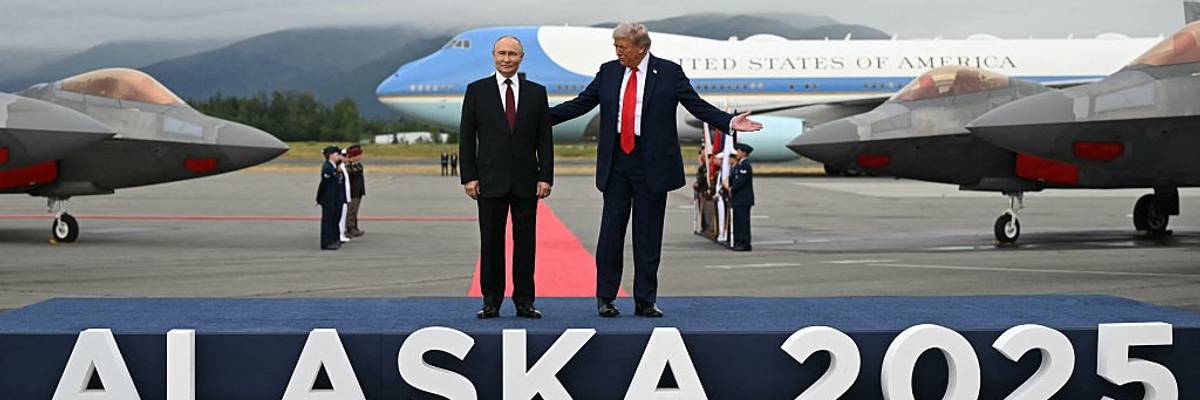
US President Donald Trump (R) and Russian President Vladimir Putin pose on a podium on the tarmac after they arrived at Joint Base Elmendorf-Richardson in Anchorage, Alaska, on August 15, 2025.
Common security lessons for the US and Russia in a world without arms control.
The following article was initially written at the request of Oleg Bodrov, a Russian physicist with commitments to peace and environmental sustainability and safety. I met Oleg about a decade ago during the World Conference against A- & H- Bombs in Hiroshima, and today we both serve on the board of the International Peace Bureau, a Nobel Peace Prize recipient organization. In addition to serving on IPB’s board, Oleg is chairman of the Public Council of the South Coast of the Gulf of Finland. He lives outside of St. Petersburg and does what he can given the limits of the possible in Putin’s Russia. When he and I last spoke, Ukrainian drones had devastated a massive Russian oil refinery, spewing toxins into the Baltic Sea and across many Russian communities. With Ukrainian drones flying overhead he hadn’t slept the previous night, making Oleg one more innocent caught in that mutually disastrous war.
In our exchanges, Oleg came up with a proposal to take a small step toward bridging the divisions of the new US-Russian Cold War and building for the time when the missiles, drones, and guns of the Ukraine War have been silenced. His idea: I should write an article that shared US peace movement thinking and named actions that can reduce the increasingly perilous military tensions and serve as foundations for a future era of US-NATO-Russian Common security. Oleg would translate the article and arrange for its publication in a Russian scientific journal. As we corresponded about the article’s publication, it occurred to us that it might also prove helpful for US readers, hence its publication here in Common Dreams. Where this will lead, only time will tell. But the truth is that both the US and Russia are going to be around for a long time, and a just and peaceful Common Security order will be essential for this and future generations.
The Bulletin of the Atomic Scientists’ Doomsday Clock report warns us that we face Cuban Missile Crisis level danger. Back then, in 1962, senior officials in the Kennedy administration thought the odds of the missile crisis leading to a nuclear war were 50-50. In the aftermath of the eyeball-to-eyeball nuclear confrontation, Daniel Ellsberg, a senior Kennedy nuclear adviser, became so pessimistic about humanity’s future that, not expecting to live to an old age, he ceased paying into his pension fund.
But both President John F. Kennedy and Chairman Nikita Khrushchev, along with their ruling circles, were sufficiently sobered by the specter of nuclear annihilation. They moved quickly to negotiate the Limited Test Ban Treaty. Their successors built on this foundation, constructing the six-decade-old arms control regime. They negotiated treaties from the Nuclear Nonproliferation Treaty to the SALT and START agreements. They limited, but failed to erase, the dangers of nuclear annihilation.
That arms control regime is now history. First came the loss of the Anti-Ballistic Missile Treaty almost 25 years ago. Then came the expiration of the New START Treaty. Now, President Donald Trump is obsessed with resuming nuclear-weapons testing, and both the US and Russia are moving to deploy new nuclear-capable missile systems.
Predictably, more and more nations are learning a lesson from North Korea: Great powers will not attack you if you have a nuclear arsenal.
Adding to nuclear dangers, Beijing is increasing its nuclear arsenal in pursuit of parity with Moscow and Washington. We are becoming three nuclear-armed scorpions in a bottle. This, together with Russian concerns about the French and British nuclear arsenals, complicates any possible future arms reduction diplomacy. The inability of the US, Russia, and China to find common ground—or even to agree on a least common denominator consensus document—was a major factor that dictated the third consecutive failure of the Nuclear Nonproliferation Treaty (NPT) Review Conference this past May.
The geopolitical landscape is further complicated by the US-Israeli-Iran war. During that conflict, President Trump speculated about possible low-yield nuclear attacks against Iran’s nuclear infrastructure.
Predictably, more and more nations are learning a lesson from North Korea: Great powers will not attack you if you have a nuclear arsenal. Political pressures for nuclear-weapons proliferation are therefore building in threshold nations from Seoul to Stockholm, including Iran, Poland, and Japan, among others.
Political realism and the survival of our species point in two complementary directions. As the Japanese A-bomb survivors and their organization Nihon Hidankyo (awarded the 2024 Nobel Peace Prize) warn, it should be obvious: “Human beings and nuclear weapons cannot coexist.”
We have already had too many close calls with extinction: false nuclear alerts, mistaken launch orders, accidents, and geopolitical miscalculations. And as Nobel Peace Laureate Joseph Rotblat, the founder of the Pugwash Conferences and the only senior Manhattan Project scientist to quit for reasons of conscience, explained, humanity faces a stark choice. We can either completely eliminate the world’s nuclear arsenals, or we will see their proliferation and eventual use. Why? Because no nation will long tolerate what it perceives as an unjust and threatening imbalance of power—in this case, the imbalance of nuclear terror.
Even in the best of circumstances, it will take valuable time—possibly more time than we have—to build the trust and to conduct the negotiations needed for a nuclear-weapon-free world. This, in turn, forces us to learn another lesson from US-Russian history: the possibility of Common Security. In crisis, as our Chinese friends remind us, there is opportunity as well as danger.
In the 1980s humanity faced a similar situation. The two great powers flirted with triggering a catastrophic war that could have caused a nuclear winter. The US and the Soviet Union brought the world to the nuclear brink with the planned deployments of SS-20, cruise, and Pershing II missiles.
The combination of popular movements calling for a halt to the nuclear arms race, and President Mikhail Gorbachev’s understanding that military spending had to be reduced if the Soviet economy were to be salvaged, led Swedish Prime Minister Olof Palme to convene the Independent Commission on Disarmament and Security Issues.
With the collapse of the Soviet Union and the rise of the Bush regime, great power relations reverted to the rules of the game among Mafia families.
Georgi Arbatov, the most senior military adviser to Gorbachev, later wrote about the commission’s work and its world-changing recommendations. In meetings with former US Secretary of State Cyrus Vance and leaders from Austria, Germany, Norway, India, and elsewhere, “a new approach to nuclear arms emerged.” Its essence, in Arbatov’s words, was that “we cannot guarantee our own security at the expense or detriment of someone else’s, but only on the basis of mutual interests.”
To reverse the spiraling arms race, each side needed to name the other’s actions that were most threatening to it and then negotiate agreements that would remove those threats without weakening anyone’s security. Those difficult negotiations led in 1987 to the Intermediate-Range Nuclear Forces Treaty, which prohibited the SS-20, cruise, and Pershing II deployments, and functionally ended the Cold War two years before the Berlin Wall fell.
Context is almost everything. Reflecting on the failure of the 2026 NPT Review Conference, Vietnamese Ambassador Do Hung Viet, the conference president, commented that it is a “fair judgment” to conclude that the US-Iran impasse, which “hung over our heads from the beginning,” together with the Ukraine War and North Korea’s nuclear arsenal, made consensus impossible. “Political concerns,” he said—including the race for artificial intelligence supremacy—“were overwhelming.”
As generations succeed one another, knowledge and wisdom are inevitably lost as well as gained. After two calamitous world wars that claimed between 75 and 97 million lives, the surviving great powers sought “to save succeeding generations from the scourge of war.” They attempted to do so while simultaneously securing their imperial powers and privileges. Thus Article 1 of the United Nations Charter committed governments “to maintain international peace and security, and to that end: to take effective collective measures for the prevention and removal of threats to the peace…”
For the most part, this first commitment was honored—with significant exceptions in Indochina, Afghanistan, and interventions in Eastern Europe and the Caribbean. However, with the collapse of the Soviet Union and the rise of the Bush regime, great power relations reverted to the rules of the game among Mafia families. Drunk with arrogance, the US Bush government boasted: “We’re an empire now, and when we act, we create our own reality. And while you’re studying that reality, we’ll act again, creating other new realities… We’re history’s actors.”
Washington’s arrogance of power continued into the 1990s with the Bill Clinton Administration. Rather than respect Russian history, political culture, sensitivities, and ordinary Russians’ need for economic security, Clinton and his mandarins imposed another cataclysmic revolutionary change: neoliberal economic shock therapy. The result was massive dislocation, impoverishment, a rising death rate, and the restoration of an authoritarian government in Moscow.
Russia’s political and economic systems imploded during Boris Yeltsin’s rule. Despite George Kennan’s warning—Kennan was the architect of Cold War containment—that NATO expansion would lead to disastrous conflict; President Clinton did exactly that in 1999. He initiated NATO enlargement, bringing Poland, Hungary, and the Czech Republic into the alliance. As “history’s actors,” Bush II added seven Central and Eastern European nations to NATO in 2004. Then, in 2008, against the advice of his senior adviser Fiona Hill and over the opposition of Germany and France, Bush the Lesser forced an invitation to Ukraine and Georgia through NATO’s summit.
Given Russia’s memories of invasions from the west—Napoleon, the Kaiser, and Hitler—the Kremlin responded as Kennan and Hill had predicted. In an obvious breach of the UN Charter, the ostensibly defensive Russian invasion of Georgia followed. Meanwhile, even without Kiev becoming a formal NATO member, and in response to the alliance’s expanding military presence in Ukraine, President Putin reportedly began planning what became the disastrous “special military operation” as early as 2007. Even before, among the earliest and most egregious Bush-Cheney acts was the withdrawal from the Anti-Ballistic Missile Treaty, then a cornerstone of arms control.
The little remaining mutual trust between the West and Russia was among the first casualties of the war. The war also spurred further NATO expansion, with Finland and Sweden joining the alliance and thus doubling the line of contact between NATO and Russia. In addition to the hundreds of thousands of Ukrainian and Russian casualties, US-Russian arms control agreements, including New START and Open Skies, became collateral damage. The new Cold War became even more dangerous as the US military-industrial complex and the Kremlin pressed to “modernize” their nuclear forces, and as European nations—fearing what Russian territorial ambitions might become—laid the foundations for a new European military superpower.
There is a mistaken but widespread belief that nuclear weapons have not been used since the atomic bombing of Nagasaki. This is wrong. As Daniel Ellsberg later wrote, during international crises and wars, US presidents have prepared to initiate nuclear war and have threatened to do so. They have done so in the same way that an armed robber points his gun at his victim’s head: Whether or not the trigger is pulled, the gun has been used. Not only during the Cuban Missile Crisis, but repeatedly during wars and interventions in the Middle East, the Vietnam War, the Taiwan Strait, and other crises, the United States has resorted to nuclear extortion. As former US Defense Secretary Harold Brown put it, with the US first-strike capacity and doctrine in place, our conventional forces become “meaningful instruments of military and political power.”
Noam Chomsky put it differently: “That means that under this umbrella of strategic nuclear weapons… we have succeeded in sufficiently intimidating anyone who might help protect people we are determined to attack.”
Although current geopolitical and technological landscapes are very different from those at the height of the first Cold War, we are not without diplomatic structures and models that can serve as foundations for trust-building dialogue and negotiations.
The United States is not the only nuclear power that has practiced nuclear blackmail. Every other nuclear-weapons state has done so at least once. As early as 1956, Prime Minister Nikolai Bulganin threatened London and Paris, hoping that the threat would force their withdrawal from Egypt during the Suez War. More recently, and to considerable effect, President Putin and former President and current Deputy Chairman of the Russian Security Council Dmitry Medvedev have engaged in nuclear saber-rattling.
Nuclear powers seek to legitimize their arsenals and “modernization” on the basis of deterrence theory—the idea that each new development is necessitated by the need to prevent a nuclear attack by a rival. In reality, the George H.W. Bush administration’s initial “Doctrine for Joint Nuclear Operations” gave the game away. As that document stated, “The focus of US deterrence efforts is… to influence potential adversaries to withhold actions intended to harm US national interests” The same applies to all other nuclear-weapons states. And as the history of false alerts, mistaken launch orders, accidents, and ill-conceived aggressions demonstrates, deterrence only works—until it doesn’t.
Even before the New START Treaty’s limit of 1,550 deployed strategic missiles expired, Washington and Moscow were arms racing. The US is spending $1.7 trillion to “modernize” and replace its entire nuclear triad—including its “use-them-or-lose-them” first-strike land-based intercontinental ballistic missiles (ICBMs)—and is racing to renew warhead pit production.
Seeking to maintain parity, Russia is also developing and moving to deploy a range of new strategic-range weapons. These include a hypersonic boost-glide vehicle carried by the Sarmat “super-heavy” ICBM; an air-launched hypersonic ballistic missile capable of evasive maneuvers; a nuclear-powered cruise missile of “unlimited range”; a nuclear-powered unmanned underwater vehicle of “unlimited range”; and a sea-launched hypersonic missile.
President Trump, committed to regaining nuclear and high-tech superiority and to prevailing in the artificial intelligence competition with China, also seeks to spend trillions of dollars on his “Golden Dome” missile defense system. It will never work, but it will be profoundly destabilizing and will bankrupt the United States.
Making matters still more dangerous, US-Russian military-to-military communications are at their nadir. Moscow has made clear that it is disinterested in renewed risk reduction and arms control diplomacy until it is satisfied with the outcome of the Ukraine War.
Rebuilding trust is essential for any risk and arms reductions, but it will require patience and steadfast commitments on all sides. It seems clear that negotiating a new European security system will only become possible when the post-Ukraine War dust settles over the European strategic landscape. Similarly, greater clarity about Washington’s commitment to NATO, and about the credibility of massive European rearmament, will be critically important factors in approaching any new risk-reduction and strategic-stability negotiations.
In approaching the urgent need to restore stability to US-Russian-European relations, we should reflect on the differences between Western and Chinese approaches to arms control diplomacy. We can learn from the Chinese.
The Western approach has been an exclusive focus on negotiations about particular nuclear-weapons systems and doctrines. Chinese diplomats and leaders, on the other hand, wisely think it necessary to identify and address the underlying causes that drive nuclear arms races and potential conflict.
Given that there is no military solution to the Ukraine War, it is past time for a ceasefire, for compromises, and for multidimensional peace negotiations—Ukraine-Russia, EU-Russia, US-Russia. Only then can we begin to address the existential US-Russian nuclear risks with Common Security diplomacy.
Although current geopolitical and technological landscapes are very different from those at the height of the first Cold War, we are not without diplomatic structures and models that can serve as foundations for trust-building dialogue and negotiations.
Among these resources is the Organization for Security and Cooperation in Europe (OSCE). A post-Ukraine War 21st-century version of that conference could be a constructive way to begin building a new Common Security order. Although its 57 European, North American, and Asian member states have reduced their financial and other commitments to the OSCE—which is mandated to work for stability, peace, and democracy in Europe—it can still serve as a neutral forum for diplomatic engagement and negotiations for a new Eurasian and Euro-Atlantic order.
The OSCE grew out of the 1973 Conference on Security and Co-operation in Europe (CSCE), “a multilateral forum for dialogue and negotiation between East and West.” Among its initiatives was the Helsinki Process, involving 35 nations that agreed to the inviolability of post-World War II frontiers, reinforced commitments to human rights, and facilitated the institutionalization of the OSCE.
Track II and other discussions among Europeans, Russians, and Americans have continued despite the war, and they have identified numerous traditional paths to nuclear risk reduction and arms control possibilities. A laundry list of sometimes competing proposals has been developed and can be drawn on when the time is ripe.
We can create visions and policies that reduce the growing nuclear danger and lead to arms control, common security, and nuclear disarmament.
Alexey Arbatov, of the Center for International Security at the Primakov Institute in Moscow, identified two conditions essential for arms control diplomacy during the Cold War: “a state of mutual nuclear deterrence” and “the emergence of approximate equality (parity) of strategic forces” of the dominant nuclear powers. A new conceptual approach, he argues, requires acknowledging the realities of multilateral deterrence, incorporating the security interests of all nuclear-armed states, and rebuilding strategic stability through inclusive frameworks rather than bilateral bargains. Chinese, French, and British nuclear arsenals, plus the nuclear four outside the NPT regime, must be factored into any negotiations. We are thus challenged by at least a four-dimensional diplomatic puzzle, and finding a solution is an urgent necessity.
There is a third requirement without which there can be no exit from a bellicose and mutually debilitating future: trust. It can only be developed over time, through patient confidence-building measures. These could include continuing to honor New START deployment limits and refraining from uploading additional warheads onto existing missiles. Wolfgang Richter, a former German colonel now associated with the Geneva Centre for Security Policy, writes that overcoming the current vicious circle of distrust requires “renewed and credible mutual commitment confirming that the independence and territorial integrity of states will be respected.” This could be achieved by a settlement of the Russia-Ukraine War and by trust-building initiatives between Russia and its European neighbors.
Even before the Ukraine War ends and opens the way for risk reduction and arms control negotiations, many on both sides of the US-Russia divide agree that the first priority must be preventing a resumption of nuclear-weapons testing, which President Trump has threatened. Related, and possibly of equal importance, is to honor and sustain the Nuclear Nonproliferation Treaty in the wake of the recent failed review conference.
Another limited but encouraging proposal is to convene a US-Russia-China leadership summit, at which a version of the Reagan-Gorbachev warning—that nuclear war can never be won and must not be fought—is reiterated. This would open the way for officials and experts to explore jointly how to reduce nuclear risk.
Unhinged and dangerous as he is, we need to acknowledge that despite his recent nuclear threat to Iran, over the years Trump has been willing to talk with Russia, and he has repeatedly stated that he wants movement toward denuclearization. Not that he has done much to make that happen.
Given the political environment in most European countries, and with Germany and France now competing for European military leadership as confidence in NATO wanes, initiatives for risk reduction and greater strategic stability inevitably lie with Washington and Moscow. If progress can be made by the US and Russia, Europeans could then be brought in.
Military-to-military communication needs to be revitalized, perhaps beginning with crisis communications, especially as drone warfare and wayward Ukrainian and Russian drones increase the danger of miscalculation. Building on the tradition of the Vienna Document, communication could then be expanded regarding troop movements, military exercises, and more. Addressing the growing military competition for control of the Arctic could be one place to begin.
Even though Russia and the United States have functionally withdrawn from the Open Skies verification treaty, 32 member states continue to honor it. A return to Russian and US participation would be a comparatively easy means to signal intentions to improve relations, and an important step toward trust building.
Like cultural exchanges in the past, trust can be built in many ways by renewing cooperative commitments. Low-hanging fruit could include building on the decades-long International Space Station collaboration; renewed scientific cooperation across the Arctic, where thawing permafrost poses increasing climate and health dangers; and, always, people-to-people exchanges.
Magic wands are in short supply. As the biblical proverb advises, “Where there is no vision, the people perish.” Across the lines and structures that divide us, like the Hibakusha and the men and women who preserved human survival through the worst of the Cold War, we can create visions and policies that reduce the growing nuclear danger and lead to arms control, common security, and nuclear disarmament. Naming, dialogue, and debate are essential building blocks to get there.
Dear Common Dreams reader, It’s been nearly 30 years since I co-founded Common Dreams with my late wife, Lina Newhouser. We had the radical notion that journalism should serve the public good, not corporate profits. It was clear to us from the outset what it would take to build such a project. No paid advertisements. No corporate sponsors. No millionaire publisher telling us what to think or do. Many people said we wouldn't last a year, but we proved those doubters wrong. Together with a tremendous team of journalists and dedicated staff, we built an independent media outlet free from the constraints of profits and corporate control. Our mission has always been simple: To inform. To inspire. To ignite change for the common good. Building Common Dreams was not easy. Our survival was never guaranteed. When you take on the most powerful forces—Wall Street greed, fossil fuel industry destruction, Big Tech lobbyists, and uber-rich oligarchs who have spent billions upon billions rigging the economy and democracy in their favor—the only bulwark you have is supporters who believe in your work. But here’s the urgent message from me today. It's never been this bad out there. And it's never been this hard to keep us going. At the very moment Common Dreams is most needed, the threats we face are intensifying. We need your support now more than ever. We don't accept corporate advertising and never will. We don't have a paywall because we don't think people should be blocked from critical news based on their ability to pay. Everything we do is funded by the donations of readers like you. When everyone does the little they can afford, we are strong. But if that support retreats or dries up, so do we. Will you donate now to make sure Common Dreams not only survives but thrives? —Craig Brown, Co-founder |
The following article was initially written at the request of Oleg Bodrov, a Russian physicist with commitments to peace and environmental sustainability and safety. I met Oleg about a decade ago during the World Conference against A- & H- Bombs in Hiroshima, and today we both serve on the board of the International Peace Bureau, a Nobel Peace Prize recipient organization. In addition to serving on IPB’s board, Oleg is chairman of the Public Council of the South Coast of the Gulf of Finland. He lives outside of St. Petersburg and does what he can given the limits of the possible in Putin’s Russia. When he and I last spoke, Ukrainian drones had devastated a massive Russian oil refinery, spewing toxins into the Baltic Sea and across many Russian communities. With Ukrainian drones flying overhead he hadn’t slept the previous night, making Oleg one more innocent caught in that mutually disastrous war.
In our exchanges, Oleg came up with a proposal to take a small step toward bridging the divisions of the new US-Russian Cold War and building for the time when the missiles, drones, and guns of the Ukraine War have been silenced. His idea: I should write an article that shared US peace movement thinking and named actions that can reduce the increasingly perilous military tensions and serve as foundations for a future era of US-NATO-Russian Common security. Oleg would translate the article and arrange for its publication in a Russian scientific journal. As we corresponded about the article’s publication, it occurred to us that it might also prove helpful for US readers, hence its publication here in Common Dreams. Where this will lead, only time will tell. But the truth is that both the US and Russia are going to be around for a long time, and a just and peaceful Common Security order will be essential for this and future generations.
The Bulletin of the Atomic Scientists’ Doomsday Clock report warns us that we face Cuban Missile Crisis level danger. Back then, in 1962, senior officials in the Kennedy administration thought the odds of the missile crisis leading to a nuclear war were 50-50. In the aftermath of the eyeball-to-eyeball nuclear confrontation, Daniel Ellsberg, a senior Kennedy nuclear adviser, became so pessimistic about humanity’s future that, not expecting to live to an old age, he ceased paying into his pension fund.
But both President John F. Kennedy and Chairman Nikita Khrushchev, along with their ruling circles, were sufficiently sobered by the specter of nuclear annihilation. They moved quickly to negotiate the Limited Test Ban Treaty. Their successors built on this foundation, constructing the six-decade-old arms control regime. They negotiated treaties from the Nuclear Nonproliferation Treaty to the SALT and START agreements. They limited, but failed to erase, the dangers of nuclear annihilation.
That arms control regime is now history. First came the loss of the Anti-Ballistic Missile Treaty almost 25 years ago. Then came the expiration of the New START Treaty. Now, President Donald Trump is obsessed with resuming nuclear-weapons testing, and both the US and Russia are moving to deploy new nuclear-capable missile systems.
Predictably, more and more nations are learning a lesson from North Korea: Great powers will not attack you if you have a nuclear arsenal.
Adding to nuclear dangers, Beijing is increasing its nuclear arsenal in pursuit of parity with Moscow and Washington. We are becoming three nuclear-armed scorpions in a bottle. This, together with Russian concerns about the French and British nuclear arsenals, complicates any possible future arms reduction diplomacy. The inability of the US, Russia, and China to find common ground—or even to agree on a least common denominator consensus document—was a major factor that dictated the third consecutive failure of the Nuclear Nonproliferation Treaty (NPT) Review Conference this past May.
The geopolitical landscape is further complicated by the US-Israeli-Iran war. During that conflict, President Trump speculated about possible low-yield nuclear attacks against Iran’s nuclear infrastructure.
Predictably, more and more nations are learning a lesson from North Korea: Great powers will not attack you if you have a nuclear arsenal. Political pressures for nuclear-weapons proliferation are therefore building in threshold nations from Seoul to Stockholm, including Iran, Poland, and Japan, among others.
Political realism and the survival of our species point in two complementary directions. As the Japanese A-bomb survivors and their organization Nihon Hidankyo (awarded the 2024 Nobel Peace Prize) warn, it should be obvious: “Human beings and nuclear weapons cannot coexist.”
We have already had too many close calls with extinction: false nuclear alerts, mistaken launch orders, accidents, and geopolitical miscalculations. And as Nobel Peace Laureate Joseph Rotblat, the founder of the Pugwash Conferences and the only senior Manhattan Project scientist to quit for reasons of conscience, explained, humanity faces a stark choice. We can either completely eliminate the world’s nuclear arsenals, or we will see their proliferation and eventual use. Why? Because no nation will long tolerate what it perceives as an unjust and threatening imbalance of power—in this case, the imbalance of nuclear terror.
Even in the best of circumstances, it will take valuable time—possibly more time than we have—to build the trust and to conduct the negotiations needed for a nuclear-weapon-free world. This, in turn, forces us to learn another lesson from US-Russian history: the possibility of Common Security. In crisis, as our Chinese friends remind us, there is opportunity as well as danger.
In the 1980s humanity faced a similar situation. The two great powers flirted with triggering a catastrophic war that could have caused a nuclear winter. The US and the Soviet Union brought the world to the nuclear brink with the planned deployments of SS-20, cruise, and Pershing II missiles.
The combination of popular movements calling for a halt to the nuclear arms race, and President Mikhail Gorbachev’s understanding that military spending had to be reduced if the Soviet economy were to be salvaged, led Swedish Prime Minister Olof Palme to convene the Independent Commission on Disarmament and Security Issues.
With the collapse of the Soviet Union and the rise of the Bush regime, great power relations reverted to the rules of the game among Mafia families.
Georgi Arbatov, the most senior military adviser to Gorbachev, later wrote about the commission’s work and its world-changing recommendations. In meetings with former US Secretary of State Cyrus Vance and leaders from Austria, Germany, Norway, India, and elsewhere, “a new approach to nuclear arms emerged.” Its essence, in Arbatov’s words, was that “we cannot guarantee our own security at the expense or detriment of someone else’s, but only on the basis of mutual interests.”
To reverse the spiraling arms race, each side needed to name the other’s actions that were most threatening to it and then negotiate agreements that would remove those threats without weakening anyone’s security. Those difficult negotiations led in 1987 to the Intermediate-Range Nuclear Forces Treaty, which prohibited the SS-20, cruise, and Pershing II deployments, and functionally ended the Cold War two years before the Berlin Wall fell.
Context is almost everything. Reflecting on the failure of the 2026 NPT Review Conference, Vietnamese Ambassador Do Hung Viet, the conference president, commented that it is a “fair judgment” to conclude that the US-Iran impasse, which “hung over our heads from the beginning,” together with the Ukraine War and North Korea’s nuclear arsenal, made consensus impossible. “Political concerns,” he said—including the race for artificial intelligence supremacy—“were overwhelming.”
As generations succeed one another, knowledge and wisdom are inevitably lost as well as gained. After two calamitous world wars that claimed between 75 and 97 million lives, the surviving great powers sought “to save succeeding generations from the scourge of war.” They attempted to do so while simultaneously securing their imperial powers and privileges. Thus Article 1 of the United Nations Charter committed governments “to maintain international peace and security, and to that end: to take effective collective measures for the prevention and removal of threats to the peace…”
For the most part, this first commitment was honored—with significant exceptions in Indochina, Afghanistan, and interventions in Eastern Europe and the Caribbean. However, with the collapse of the Soviet Union and the rise of the Bush regime, great power relations reverted to the rules of the game among Mafia families. Drunk with arrogance, the US Bush government boasted: “We’re an empire now, and when we act, we create our own reality. And while you’re studying that reality, we’ll act again, creating other new realities… We’re history’s actors.”
Washington’s arrogance of power continued into the 1990s with the Bill Clinton Administration. Rather than respect Russian history, political culture, sensitivities, and ordinary Russians’ need for economic security, Clinton and his mandarins imposed another cataclysmic revolutionary change: neoliberal economic shock therapy. The result was massive dislocation, impoverishment, a rising death rate, and the restoration of an authoritarian government in Moscow.
Russia’s political and economic systems imploded during Boris Yeltsin’s rule. Despite George Kennan’s warning—Kennan was the architect of Cold War containment—that NATO expansion would lead to disastrous conflict; President Clinton did exactly that in 1999. He initiated NATO enlargement, bringing Poland, Hungary, and the Czech Republic into the alliance. As “history’s actors,” Bush II added seven Central and Eastern European nations to NATO in 2004. Then, in 2008, against the advice of his senior adviser Fiona Hill and over the opposition of Germany and France, Bush the Lesser forced an invitation to Ukraine and Georgia through NATO’s summit.
Given Russia’s memories of invasions from the west—Napoleon, the Kaiser, and Hitler—the Kremlin responded as Kennan and Hill had predicted. In an obvious breach of the UN Charter, the ostensibly defensive Russian invasion of Georgia followed. Meanwhile, even without Kiev becoming a formal NATO member, and in response to the alliance’s expanding military presence in Ukraine, President Putin reportedly began planning what became the disastrous “special military operation” as early as 2007. Even before, among the earliest and most egregious Bush-Cheney acts was the withdrawal from the Anti-Ballistic Missile Treaty, then a cornerstone of arms control.
The little remaining mutual trust between the West and Russia was among the first casualties of the war. The war also spurred further NATO expansion, with Finland and Sweden joining the alliance and thus doubling the line of contact between NATO and Russia. In addition to the hundreds of thousands of Ukrainian and Russian casualties, US-Russian arms control agreements, including New START and Open Skies, became collateral damage. The new Cold War became even more dangerous as the US military-industrial complex and the Kremlin pressed to “modernize” their nuclear forces, and as European nations—fearing what Russian territorial ambitions might become—laid the foundations for a new European military superpower.
There is a mistaken but widespread belief that nuclear weapons have not been used since the atomic bombing of Nagasaki. This is wrong. As Daniel Ellsberg later wrote, during international crises and wars, US presidents have prepared to initiate nuclear war and have threatened to do so. They have done so in the same way that an armed robber points his gun at his victim’s head: Whether or not the trigger is pulled, the gun has been used. Not only during the Cuban Missile Crisis, but repeatedly during wars and interventions in the Middle East, the Vietnam War, the Taiwan Strait, and other crises, the United States has resorted to nuclear extortion. As former US Defense Secretary Harold Brown put it, with the US first-strike capacity and doctrine in place, our conventional forces become “meaningful instruments of military and political power.”
Noam Chomsky put it differently: “That means that under this umbrella of strategic nuclear weapons… we have succeeded in sufficiently intimidating anyone who might help protect people we are determined to attack.”
Although current geopolitical and technological landscapes are very different from those at the height of the first Cold War, we are not without diplomatic structures and models that can serve as foundations for trust-building dialogue and negotiations.
The United States is not the only nuclear power that has practiced nuclear blackmail. Every other nuclear-weapons state has done so at least once. As early as 1956, Prime Minister Nikolai Bulganin threatened London and Paris, hoping that the threat would force their withdrawal from Egypt during the Suez War. More recently, and to considerable effect, President Putin and former President and current Deputy Chairman of the Russian Security Council Dmitry Medvedev have engaged in nuclear saber-rattling.
Nuclear powers seek to legitimize their arsenals and “modernization” on the basis of deterrence theory—the idea that each new development is necessitated by the need to prevent a nuclear attack by a rival. In reality, the George H.W. Bush administration’s initial “Doctrine for Joint Nuclear Operations” gave the game away. As that document stated, “The focus of US deterrence efforts is… to influence potential adversaries to withhold actions intended to harm US national interests” The same applies to all other nuclear-weapons states. And as the history of false alerts, mistaken launch orders, accidents, and ill-conceived aggressions demonstrates, deterrence only works—until it doesn’t.
Even before the New START Treaty’s limit of 1,550 deployed strategic missiles expired, Washington and Moscow were arms racing. The US is spending $1.7 trillion to “modernize” and replace its entire nuclear triad—including its “use-them-or-lose-them” first-strike land-based intercontinental ballistic missiles (ICBMs)—and is racing to renew warhead pit production.
Seeking to maintain parity, Russia is also developing and moving to deploy a range of new strategic-range weapons. These include a hypersonic boost-glide vehicle carried by the Sarmat “super-heavy” ICBM; an air-launched hypersonic ballistic missile capable of evasive maneuvers; a nuclear-powered cruise missile of “unlimited range”; a nuclear-powered unmanned underwater vehicle of “unlimited range”; and a sea-launched hypersonic missile.
President Trump, committed to regaining nuclear and high-tech superiority and to prevailing in the artificial intelligence competition with China, also seeks to spend trillions of dollars on his “Golden Dome” missile defense system. It will never work, but it will be profoundly destabilizing and will bankrupt the United States.
Making matters still more dangerous, US-Russian military-to-military communications are at their nadir. Moscow has made clear that it is disinterested in renewed risk reduction and arms control diplomacy until it is satisfied with the outcome of the Ukraine War.
Rebuilding trust is essential for any risk and arms reductions, but it will require patience and steadfast commitments on all sides. It seems clear that negotiating a new European security system will only become possible when the post-Ukraine War dust settles over the European strategic landscape. Similarly, greater clarity about Washington’s commitment to NATO, and about the credibility of massive European rearmament, will be critically important factors in approaching any new risk-reduction and strategic-stability negotiations.
In approaching the urgent need to restore stability to US-Russian-European relations, we should reflect on the differences between Western and Chinese approaches to arms control diplomacy. We can learn from the Chinese.
The Western approach has been an exclusive focus on negotiations about particular nuclear-weapons systems and doctrines. Chinese diplomats and leaders, on the other hand, wisely think it necessary to identify and address the underlying causes that drive nuclear arms races and potential conflict.
Given that there is no military solution to the Ukraine War, it is past time for a ceasefire, for compromises, and for multidimensional peace negotiations—Ukraine-Russia, EU-Russia, US-Russia. Only then can we begin to address the existential US-Russian nuclear risks with Common Security diplomacy.
Although current geopolitical and technological landscapes are very different from those at the height of the first Cold War, we are not without diplomatic structures and models that can serve as foundations for trust-building dialogue and negotiations.
Among these resources is the Organization for Security and Cooperation in Europe (OSCE). A post-Ukraine War 21st-century version of that conference could be a constructive way to begin building a new Common Security order. Although its 57 European, North American, and Asian member states have reduced their financial and other commitments to the OSCE—which is mandated to work for stability, peace, and democracy in Europe—it can still serve as a neutral forum for diplomatic engagement and negotiations for a new Eurasian and Euro-Atlantic order.
The OSCE grew out of the 1973 Conference on Security and Co-operation in Europe (CSCE), “a multilateral forum for dialogue and negotiation between East and West.” Among its initiatives was the Helsinki Process, involving 35 nations that agreed to the inviolability of post-World War II frontiers, reinforced commitments to human rights, and facilitated the institutionalization of the OSCE.
Track II and other discussions among Europeans, Russians, and Americans have continued despite the war, and they have identified numerous traditional paths to nuclear risk reduction and arms control possibilities. A laundry list of sometimes competing proposals has been developed and can be drawn on when the time is ripe.
We can create visions and policies that reduce the growing nuclear danger and lead to arms control, common security, and nuclear disarmament.
Alexey Arbatov, of the Center for International Security at the Primakov Institute in Moscow, identified two conditions essential for arms control diplomacy during the Cold War: “a state of mutual nuclear deterrence” and “the emergence of approximate equality (parity) of strategic forces” of the dominant nuclear powers. A new conceptual approach, he argues, requires acknowledging the realities of multilateral deterrence, incorporating the security interests of all nuclear-armed states, and rebuilding strategic stability through inclusive frameworks rather than bilateral bargains. Chinese, French, and British nuclear arsenals, plus the nuclear four outside the NPT regime, must be factored into any negotiations. We are thus challenged by at least a four-dimensional diplomatic puzzle, and finding a solution is an urgent necessity.
There is a third requirement without which there can be no exit from a bellicose and mutually debilitating future: trust. It can only be developed over time, through patient confidence-building measures. These could include continuing to honor New START deployment limits and refraining from uploading additional warheads onto existing missiles. Wolfgang Richter, a former German colonel now associated with the Geneva Centre for Security Policy, writes that overcoming the current vicious circle of distrust requires “renewed and credible mutual commitment confirming that the independence and territorial integrity of states will be respected.” This could be achieved by a settlement of the Russia-Ukraine War and by trust-building initiatives between Russia and its European neighbors.
Even before the Ukraine War ends and opens the way for risk reduction and arms control negotiations, many on both sides of the US-Russia divide agree that the first priority must be preventing a resumption of nuclear-weapons testing, which President Trump has threatened. Related, and possibly of equal importance, is to honor and sustain the Nuclear Nonproliferation Treaty in the wake of the recent failed review conference.
Another limited but encouraging proposal is to convene a US-Russia-China leadership summit, at which a version of the Reagan-Gorbachev warning—that nuclear war can never be won and must not be fought—is reiterated. This would open the way for officials and experts to explore jointly how to reduce nuclear risk.
Unhinged and dangerous as he is, we need to acknowledge that despite his recent nuclear threat to Iran, over the years Trump has been willing to talk with Russia, and he has repeatedly stated that he wants movement toward denuclearization. Not that he has done much to make that happen.
Given the political environment in most European countries, and with Germany and France now competing for European military leadership as confidence in NATO wanes, initiatives for risk reduction and greater strategic stability inevitably lie with Washington and Moscow. If progress can be made by the US and Russia, Europeans could then be brought in.
Military-to-military communication needs to be revitalized, perhaps beginning with crisis communications, especially as drone warfare and wayward Ukrainian and Russian drones increase the danger of miscalculation. Building on the tradition of the Vienna Document, communication could then be expanded regarding troop movements, military exercises, and more. Addressing the growing military competition for control of the Arctic could be one place to begin.
Even though Russia and the United States have functionally withdrawn from the Open Skies verification treaty, 32 member states continue to honor it. A return to Russian and US participation would be a comparatively easy means to signal intentions to improve relations, and an important step toward trust building.
Like cultural exchanges in the past, trust can be built in many ways by renewing cooperative commitments. Low-hanging fruit could include building on the decades-long International Space Station collaboration; renewed scientific cooperation across the Arctic, where thawing permafrost poses increasing climate and health dangers; and, always, people-to-people exchanges.
Magic wands are in short supply. As the biblical proverb advises, “Where there is no vision, the people perish.” Across the lines and structures that divide us, like the Hibakusha and the men and women who preserved human survival through the worst of the Cold War, we can create visions and policies that reduce the growing nuclear danger and lead to arms control, common security, and nuclear disarmament. Naming, dialogue, and debate are essential building blocks to get there.
The following article was initially written at the request of Oleg Bodrov, a Russian physicist with commitments to peace and environmental sustainability and safety. I met Oleg about a decade ago during the World Conference against A- & H- Bombs in Hiroshima, and today we both serve on the board of the International Peace Bureau, a Nobel Peace Prize recipient organization. In addition to serving on IPB’s board, Oleg is chairman of the Public Council of the South Coast of the Gulf of Finland. He lives outside of St. Petersburg and does what he can given the limits of the possible in Putin’s Russia. When he and I last spoke, Ukrainian drones had devastated a massive Russian oil refinery, spewing toxins into the Baltic Sea and across many Russian communities. With Ukrainian drones flying overhead he hadn’t slept the previous night, making Oleg one more innocent caught in that mutually disastrous war.
In our exchanges, Oleg came up with a proposal to take a small step toward bridging the divisions of the new US-Russian Cold War and building for the time when the missiles, drones, and guns of the Ukraine War have been silenced. His idea: I should write an article that shared US peace movement thinking and named actions that can reduce the increasingly perilous military tensions and serve as foundations for a future era of US-NATO-Russian Common security. Oleg would translate the article and arrange for its publication in a Russian scientific journal. As we corresponded about the article’s publication, it occurred to us that it might also prove helpful for US readers, hence its publication here in Common Dreams. Where this will lead, only time will tell. But the truth is that both the US and Russia are going to be around for a long time, and a just and peaceful Common Security order will be essential for this and future generations.
The Bulletin of the Atomic Scientists’ Doomsday Clock report warns us that we face Cuban Missile Crisis level danger. Back then, in 1962, senior officials in the Kennedy administration thought the odds of the missile crisis leading to a nuclear war were 50-50. In the aftermath of the eyeball-to-eyeball nuclear confrontation, Daniel Ellsberg, a senior Kennedy nuclear adviser, became so pessimistic about humanity’s future that, not expecting to live to an old age, he ceased paying into his pension fund.
But both President John F. Kennedy and Chairman Nikita Khrushchev, along with their ruling circles, were sufficiently sobered by the specter of nuclear annihilation. They moved quickly to negotiate the Limited Test Ban Treaty. Their successors built on this foundation, constructing the six-decade-old arms control regime. They negotiated treaties from the Nuclear Nonproliferation Treaty to the SALT and START agreements. They limited, but failed to erase, the dangers of nuclear annihilation.
That arms control regime is now history. First came the loss of the Anti-Ballistic Missile Treaty almost 25 years ago. Then came the expiration of the New START Treaty. Now, President Donald Trump is obsessed with resuming nuclear-weapons testing, and both the US and Russia are moving to deploy new nuclear-capable missile systems.
Predictably, more and more nations are learning a lesson from North Korea: Great powers will not attack you if you have a nuclear arsenal.
Adding to nuclear dangers, Beijing is increasing its nuclear arsenal in pursuit of parity with Moscow and Washington. We are becoming three nuclear-armed scorpions in a bottle. This, together with Russian concerns about the French and British nuclear arsenals, complicates any possible future arms reduction diplomacy. The inability of the US, Russia, and China to find common ground—or even to agree on a least common denominator consensus document—was a major factor that dictated the third consecutive failure of the Nuclear Nonproliferation Treaty (NPT) Review Conference this past May.
The geopolitical landscape is further complicated by the US-Israeli-Iran war. During that conflict, President Trump speculated about possible low-yield nuclear attacks against Iran’s nuclear infrastructure.
Predictably, more and more nations are learning a lesson from North Korea: Great powers will not attack you if you have a nuclear arsenal. Political pressures for nuclear-weapons proliferation are therefore building in threshold nations from Seoul to Stockholm, including Iran, Poland, and Japan, among others.
Political realism and the survival of our species point in two complementary directions. As the Japanese A-bomb survivors and their organization Nihon Hidankyo (awarded the 2024 Nobel Peace Prize) warn, it should be obvious: “Human beings and nuclear weapons cannot coexist.”
We have already had too many close calls with extinction: false nuclear alerts, mistaken launch orders, accidents, and geopolitical miscalculations. And as Nobel Peace Laureate Joseph Rotblat, the founder of the Pugwash Conferences and the only senior Manhattan Project scientist to quit for reasons of conscience, explained, humanity faces a stark choice. We can either completely eliminate the world’s nuclear arsenals, or we will see their proliferation and eventual use. Why? Because no nation will long tolerate what it perceives as an unjust and threatening imbalance of power—in this case, the imbalance of nuclear terror.
Even in the best of circumstances, it will take valuable time—possibly more time than we have—to build the trust and to conduct the negotiations needed for a nuclear-weapon-free world. This, in turn, forces us to learn another lesson from US-Russian history: the possibility of Common Security. In crisis, as our Chinese friends remind us, there is opportunity as well as danger.
In the 1980s humanity faced a similar situation. The two great powers flirted with triggering a catastrophic war that could have caused a nuclear winter. The US and the Soviet Union brought the world to the nuclear brink with the planned deployments of SS-20, cruise, and Pershing II missiles.
The combination of popular movements calling for a halt to the nuclear arms race, and President Mikhail Gorbachev’s understanding that military spending had to be reduced if the Soviet economy were to be salvaged, led Swedish Prime Minister Olof Palme to convene the Independent Commission on Disarmament and Security Issues.
With the collapse of the Soviet Union and the rise of the Bush regime, great power relations reverted to the rules of the game among Mafia families.
Georgi Arbatov, the most senior military adviser to Gorbachev, later wrote about the commission’s work and its world-changing recommendations. In meetings with former US Secretary of State Cyrus Vance and leaders from Austria, Germany, Norway, India, and elsewhere, “a new approach to nuclear arms emerged.” Its essence, in Arbatov’s words, was that “we cannot guarantee our own security at the expense or detriment of someone else’s, but only on the basis of mutual interests.”
To reverse the spiraling arms race, each side needed to name the other’s actions that were most threatening to it and then negotiate agreements that would remove those threats without weakening anyone’s security. Those difficult negotiations led in 1987 to the Intermediate-Range Nuclear Forces Treaty, which prohibited the SS-20, cruise, and Pershing II deployments, and functionally ended the Cold War two years before the Berlin Wall fell.
Context is almost everything. Reflecting on the failure of the 2026 NPT Review Conference, Vietnamese Ambassador Do Hung Viet, the conference president, commented that it is a “fair judgment” to conclude that the US-Iran impasse, which “hung over our heads from the beginning,” together with the Ukraine War and North Korea’s nuclear arsenal, made consensus impossible. “Political concerns,” he said—including the race for artificial intelligence supremacy—“were overwhelming.”
As generations succeed one another, knowledge and wisdom are inevitably lost as well as gained. After two calamitous world wars that claimed between 75 and 97 million lives, the surviving great powers sought “to save succeeding generations from the scourge of war.” They attempted to do so while simultaneously securing their imperial powers and privileges. Thus Article 1 of the United Nations Charter committed governments “to maintain international peace and security, and to that end: to take effective collective measures for the prevention and removal of threats to the peace…”
For the most part, this first commitment was honored—with significant exceptions in Indochina, Afghanistan, and interventions in Eastern Europe and the Caribbean. However, with the collapse of the Soviet Union and the rise of the Bush regime, great power relations reverted to the rules of the game among Mafia families. Drunk with arrogance, the US Bush government boasted: “We’re an empire now, and when we act, we create our own reality. And while you’re studying that reality, we’ll act again, creating other new realities… We’re history’s actors.”
Washington’s arrogance of power continued into the 1990s with the Bill Clinton Administration. Rather than respect Russian history, political culture, sensitivities, and ordinary Russians’ need for economic security, Clinton and his mandarins imposed another cataclysmic revolutionary change: neoliberal economic shock therapy. The result was massive dislocation, impoverishment, a rising death rate, and the restoration of an authoritarian government in Moscow.
Russia’s political and economic systems imploded during Boris Yeltsin’s rule. Despite George Kennan’s warning—Kennan was the architect of Cold War containment—that NATO expansion would lead to disastrous conflict; President Clinton did exactly that in 1999. He initiated NATO enlargement, bringing Poland, Hungary, and the Czech Republic into the alliance. As “history’s actors,” Bush II added seven Central and Eastern European nations to NATO in 2004. Then, in 2008, against the advice of his senior adviser Fiona Hill and over the opposition of Germany and France, Bush the Lesser forced an invitation to Ukraine and Georgia through NATO’s summit.
Given Russia’s memories of invasions from the west—Napoleon, the Kaiser, and Hitler—the Kremlin responded as Kennan and Hill had predicted. In an obvious breach of the UN Charter, the ostensibly defensive Russian invasion of Georgia followed. Meanwhile, even without Kiev becoming a formal NATO member, and in response to the alliance’s expanding military presence in Ukraine, President Putin reportedly began planning what became the disastrous “special military operation” as early as 2007. Even before, among the earliest and most egregious Bush-Cheney acts was the withdrawal from the Anti-Ballistic Missile Treaty, then a cornerstone of arms control.
The little remaining mutual trust between the West and Russia was among the first casualties of the war. The war also spurred further NATO expansion, with Finland and Sweden joining the alliance and thus doubling the line of contact between NATO and Russia. In addition to the hundreds of thousands of Ukrainian and Russian casualties, US-Russian arms control agreements, including New START and Open Skies, became collateral damage. The new Cold War became even more dangerous as the US military-industrial complex and the Kremlin pressed to “modernize” their nuclear forces, and as European nations—fearing what Russian territorial ambitions might become—laid the foundations for a new European military superpower.
There is a mistaken but widespread belief that nuclear weapons have not been used since the atomic bombing of Nagasaki. This is wrong. As Daniel Ellsberg later wrote, during international crises and wars, US presidents have prepared to initiate nuclear war and have threatened to do so. They have done so in the same way that an armed robber points his gun at his victim’s head: Whether or not the trigger is pulled, the gun has been used. Not only during the Cuban Missile Crisis, but repeatedly during wars and interventions in the Middle East, the Vietnam War, the Taiwan Strait, and other crises, the United States has resorted to nuclear extortion. As former US Defense Secretary Harold Brown put it, with the US first-strike capacity and doctrine in place, our conventional forces become “meaningful instruments of military and political power.”
Noam Chomsky put it differently: “That means that under this umbrella of strategic nuclear weapons… we have succeeded in sufficiently intimidating anyone who might help protect people we are determined to attack.”
Although current geopolitical and technological landscapes are very different from those at the height of the first Cold War, we are not without diplomatic structures and models that can serve as foundations for trust-building dialogue and negotiations.
The United States is not the only nuclear power that has practiced nuclear blackmail. Every other nuclear-weapons state has done so at least once. As early as 1956, Prime Minister Nikolai Bulganin threatened London and Paris, hoping that the threat would force their withdrawal from Egypt during the Suez War. More recently, and to considerable effect, President Putin and former President and current Deputy Chairman of the Russian Security Council Dmitry Medvedev have engaged in nuclear saber-rattling.
Nuclear powers seek to legitimize their arsenals and “modernization” on the basis of deterrence theory—the idea that each new development is necessitated by the need to prevent a nuclear attack by a rival. In reality, the George H.W. Bush administration’s initial “Doctrine for Joint Nuclear Operations” gave the game away. As that document stated, “The focus of US deterrence efforts is… to influence potential adversaries to withhold actions intended to harm US national interests” The same applies to all other nuclear-weapons states. And as the history of false alerts, mistaken launch orders, accidents, and ill-conceived aggressions demonstrates, deterrence only works—until it doesn’t.
Even before the New START Treaty’s limit of 1,550 deployed strategic missiles expired, Washington and Moscow were arms racing. The US is spending $1.7 trillion to “modernize” and replace its entire nuclear triad—including its “use-them-or-lose-them” first-strike land-based intercontinental ballistic missiles (ICBMs)—and is racing to renew warhead pit production.
Seeking to maintain parity, Russia is also developing and moving to deploy a range of new strategic-range weapons. These include a hypersonic boost-glide vehicle carried by the Sarmat “super-heavy” ICBM; an air-launched hypersonic ballistic missile capable of evasive maneuvers; a nuclear-powered cruise missile of “unlimited range”; a nuclear-powered unmanned underwater vehicle of “unlimited range”; and a sea-launched hypersonic missile.
President Trump, committed to regaining nuclear and high-tech superiority and to prevailing in the artificial intelligence competition with China, also seeks to spend trillions of dollars on his “Golden Dome” missile defense system. It will never work, but it will be profoundly destabilizing and will bankrupt the United States.
Making matters still more dangerous, US-Russian military-to-military communications are at their nadir. Moscow has made clear that it is disinterested in renewed risk reduction and arms control diplomacy until it is satisfied with the outcome of the Ukraine War.
Rebuilding trust is essential for any risk and arms reductions, but it will require patience and steadfast commitments on all sides. It seems clear that negotiating a new European security system will only become possible when the post-Ukraine War dust settles over the European strategic landscape. Similarly, greater clarity about Washington’s commitment to NATO, and about the credibility of massive European rearmament, will be critically important factors in approaching any new risk-reduction and strategic-stability negotiations.
In approaching the urgent need to restore stability to US-Russian-European relations, we should reflect on the differences between Western and Chinese approaches to arms control diplomacy. We can learn from the Chinese.
The Western approach has been an exclusive focus on negotiations about particular nuclear-weapons systems and doctrines. Chinese diplomats and leaders, on the other hand, wisely think it necessary to identify and address the underlying causes that drive nuclear arms races and potential conflict.
Given that there is no military solution to the Ukraine War, it is past time for a ceasefire, for compromises, and for multidimensional peace negotiations—Ukraine-Russia, EU-Russia, US-Russia. Only then can we begin to address the existential US-Russian nuclear risks with Common Security diplomacy.
Although current geopolitical and technological landscapes are very different from those at the height of the first Cold War, we are not without diplomatic structures and models that can serve as foundations for trust-building dialogue and negotiations.
Among these resources is the Organization for Security and Cooperation in Europe (OSCE). A post-Ukraine War 21st-century version of that conference could be a constructive way to begin building a new Common Security order. Although its 57 European, North American, and Asian member states have reduced their financial and other commitments to the OSCE—which is mandated to work for stability, peace, and democracy in Europe—it can still serve as a neutral forum for diplomatic engagement and negotiations for a new Eurasian and Euro-Atlantic order.
The OSCE grew out of the 1973 Conference on Security and Co-operation in Europe (CSCE), “a multilateral forum for dialogue and negotiation between East and West.” Among its initiatives was the Helsinki Process, involving 35 nations that agreed to the inviolability of post-World War II frontiers, reinforced commitments to human rights, and facilitated the institutionalization of the OSCE.
Track II and other discussions among Europeans, Russians, and Americans have continued despite the war, and they have identified numerous traditional paths to nuclear risk reduction and arms control possibilities. A laundry list of sometimes competing proposals has been developed and can be drawn on when the time is ripe.
We can create visions and policies that reduce the growing nuclear danger and lead to arms control, common security, and nuclear disarmament.
Alexey Arbatov, of the Center for International Security at the Primakov Institute in Moscow, identified two conditions essential for arms control diplomacy during the Cold War: “a state of mutual nuclear deterrence” and “the emergence of approximate equality (parity) of strategic forces” of the dominant nuclear powers. A new conceptual approach, he argues, requires acknowledging the realities of multilateral deterrence, incorporating the security interests of all nuclear-armed states, and rebuilding strategic stability through inclusive frameworks rather than bilateral bargains. Chinese, French, and British nuclear arsenals, plus the nuclear four outside the NPT regime, must be factored into any negotiations. We are thus challenged by at least a four-dimensional diplomatic puzzle, and finding a solution is an urgent necessity.
There is a third requirement without which there can be no exit from a bellicose and mutually debilitating future: trust. It can only be developed over time, through patient confidence-building measures. These could include continuing to honor New START deployment limits and refraining from uploading additional warheads onto existing missiles. Wolfgang Richter, a former German colonel now associated with the Geneva Centre for Security Policy, writes that overcoming the current vicious circle of distrust requires “renewed and credible mutual commitment confirming that the independence and territorial integrity of states will be respected.” This could be achieved by a settlement of the Russia-Ukraine War and by trust-building initiatives between Russia and its European neighbors.
Even before the Ukraine War ends and opens the way for risk reduction and arms control negotiations, many on both sides of the US-Russia divide agree that the first priority must be preventing a resumption of nuclear-weapons testing, which President Trump has threatened. Related, and possibly of equal importance, is to honor and sustain the Nuclear Nonproliferation Treaty in the wake of the recent failed review conference.
Another limited but encouraging proposal is to convene a US-Russia-China leadership summit, at which a version of the Reagan-Gorbachev warning—that nuclear war can never be won and must not be fought—is reiterated. This would open the way for officials and experts to explore jointly how to reduce nuclear risk.
Unhinged and dangerous as he is, we need to acknowledge that despite his recent nuclear threat to Iran, over the years Trump has been willing to talk with Russia, and he has repeatedly stated that he wants movement toward denuclearization. Not that he has done much to make that happen.
Given the political environment in most European countries, and with Germany and France now competing for European military leadership as confidence in NATO wanes, initiatives for risk reduction and greater strategic stability inevitably lie with Washington and Moscow. If progress can be made by the US and Russia, Europeans could then be brought in.
Military-to-military communication needs to be revitalized, perhaps beginning with crisis communications, especially as drone warfare and wayward Ukrainian and Russian drones increase the danger of miscalculation. Building on the tradition of the Vienna Document, communication could then be expanded regarding troop movements, military exercises, and more. Addressing the growing military competition for control of the Arctic could be one place to begin.
Even though Russia and the United States have functionally withdrawn from the Open Skies verification treaty, 32 member states continue to honor it. A return to Russian and US participation would be a comparatively easy means to signal intentions to improve relations, and an important step toward trust building.
Like cultural exchanges in the past, trust can be built in many ways by renewing cooperative commitments. Low-hanging fruit could include building on the decades-long International Space Station collaboration; renewed scientific cooperation across the Arctic, where thawing permafrost poses increasing climate and health dangers; and, always, people-to-people exchanges.
Magic wands are in short supply. As the biblical proverb advises, “Where there is no vision, the people perish.” Across the lines and structures that divide us, like the Hibakusha and the men and women who preserved human survival through the worst of the Cold War, we can create visions and policies that reduce the growing nuclear danger and lead to arms control, common security, and nuclear disarmament. Naming, dialogue, and debate are essential building blocks to get there.