5
#000000
#FFFFFF
To donate by check, phone, or other method, see our More Ways to Give page.
Daily news & progressive opinion—funded by the people, not the corporations—delivered straight to your inbox.
In the face of health and climate crises and unilateral wars, we can’t afford to ignore internationalism or to quietly retreat from institutions meant to buffer those most at risk.
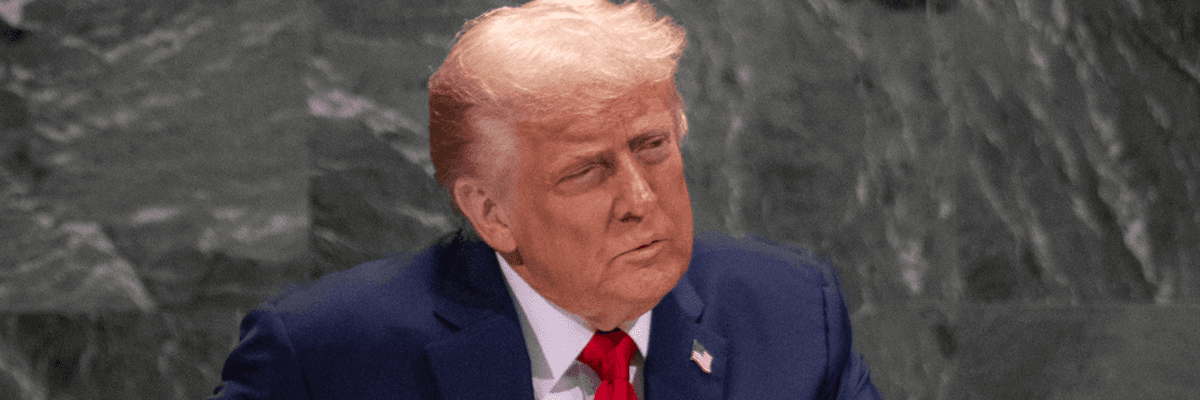
This week, I watched New York’s East River swell with armed speedboats as cars, ferries, and planes ground to a halt for President Donald Trump’s motorcade to the United Nations General Assembly’s 81st session. Stranded temporarily, I had plenty of time to consider Trump's winner-takes-all rejection of the United Nations.
And yet, as UNGA81 continues, this dismissive bluster aims to hide the global ripple effects of a crumbling world order. Organisation for Economic Co-operation and Development oil inventories are at their lowest in decades as the US and Israel continue strikes on Iran, and as Russia continues to wage its war on Ukraine. The real costs continue to fall on those with the least cushion, including the 50 million people the World Food Program says will be pushed into acute hunger. While only 15% of the world’s population lives in what we call the Global North, that 15% continues to drive the greatest of climate and economic catastrophes imposed on the Global Majority.
Last year, the United Nations General Assembly felt like a descent into surrealism. This year, the world order is fully under attack. In the face of health and climate crises and unilateral wars, we can’t afford to ignore internationalism or to quietly retreat from institutions meant to buffer those most at risk.
Trump may have usurped the podium at UNGA to malign multilateralism, but we're doing the work beyond the podium.
This does not mean wholesale protection of multilateralism as we know it. From foundation leaders to UN officials to civil society, we hear calls for "reimagining" the UN and global governance. Indeed, we cannot build a future fit for purpose for us all if we don’t bring the lifelines we need—from the International Criminal Court to the Paris Agreement.
That is what makes this week so critical. UNGA takes place in the shadow of elections in Russia that are anything but free or fair and heading into midterms in the United States that, while free, rest under the pressure cooker of strong and clear cross-border efforts to attack open societies. If internationalism is to survive, we have to make the case for multilateral cooperation and global funding. Internationalism is the only way we can see ourselves through the crises that we’re facing.
Crises from the Covid-19 pandemic to the risks of unregulated AI have shown us that if we go at it alone or try to address just one country or one policy at a time, we will invariably fail all. We cannot withstand the polycrises we face if we don’t consider ourselves intrinsically linked to movements around the world. And philanthropy's purpose is precisely to fund what markets won't.
We—those who seek to protect human dignity and rights—are not alone. Autocratic leaders, who bask in impunity and lambast institutions like the UN, have a secret: They are the ultimate internationalists, under the guise of nationalism.
The irony is that autocratic forces have mobilized with one another, carefully, strategically, and across borders, over the last 20 years. They have trained each other, learned how to keep and barter power, and worked with the very same billionaires to mobilize breathtaking amounts of money to dismantle and destroy progressive policies and strip away our basic civil and political rights. "Make America Great Again" and "Russia United" are playing by the same authoritarian playbook to keep the opposition in check.
They have another secret: They need us, too. Leaders like Trump and Israeli Prime Minister Benjamin Netanyahu are still showing up to UNGA81 (albeit in a flurry). They still care enough to ridicule allies, to bully others into foreign aid budget cuts their citizens oppose, and to push back wherever they could be held to account, whether by the International Criminal Court or reports by the UN High Commissioner for Human Rights. Indeed, 10 countries—including the US, Russia, Israel, and North Korea—opposed an extended four-year mandate for the UN High Commissioner for Human Rights, Volker Türk.
These debates are not symbolic. They are signals that descent into isolationism and away from multilateralism is not a foregone conclusion. They point to where the fight is—and the spaces we must not cede. And, lest we lose sight of the larger lesson, the possibilities indeed, in a new world order: 144 countries voted in favor of extending High Commissioner Türk’s mandate.
So, how can we lead internationalism into its next era with conflicts multiplying, the Sustainable Development Goalss off track, and AI reshaping global governance? How can we protect human dignity and human rights for all people? By getting more creative in shaping our shared future—without wholesale retreat from the institutions that bring us together. Just this week, Canada invited the United Kingdom to join the economic alliance it is negotiating with the European Union, days after the commission floated a first-ever associate status. This year, countries committed to moving us away from fossil fuels came together despite China, Russia, and the US to implement just transitions. The Global Alliance for Human Rights is a perfect example of adaptation—convened by the Office of the United Nations High Commissioner for Human Rights (OHCHR), the alliance is a multi-stakeholder, cross-regional mobilization that connects people across sectors and generations, without any single person, organization, or country that is responsible for the lion’s share.
As many of us gather this week—itself a signal—from UNGA to Climate Week, the Clinton Global Initiative to the Devex Impact House, it is time to reimagine what kind of leadership can carry internationalism through its most consequential transition in decades. At Human Rights Funders Network, we believe that better preparedness means building infrastructure for coordination, improving funding flows, and connecting diverse sectors, so movements can survive today’s crises and thrive tomorrow. And we plan to make the case for development and multilateralism to a new United States and policymakers worldwide. We are two years away from the 80th anniversary of the UN Declaration of Human Rights. What we do, say, and create in the next two years will determine whether we are celebrating a new era of our shared humanity or if we have ceded to the divisions some would have us believe are inevitable.
The US war on Iran has shown how quickly one region's crisis becomes everyone's. Leaders who treat their constituencies as separate are ignoring what the past seven months have made plain. Trump may have usurped the podium at UNGA to malign multilateralism, but we're doing the work beyond the podium—at coffeetables, halls, and on the streets—to ensure the very best of the internationalism system is protected.
Dear Common Dreams reader, It’s been nearly 30 years since I co-founded Common Dreams with my late wife, Lina Newhouser. We had the radical notion that journalism should serve the public good, not corporate profits. It was clear to us from the outset what it would take to build such a project. No paid advertisements. No corporate sponsors. No millionaire publisher telling us what to think or do. Many people said we wouldn't last a year, but we proved those doubters wrong. Together with a tremendous team of journalists and dedicated staff, we built an independent media outlet free from the constraints of profits and corporate control. Our mission has always been simple: To inform. To inspire. To ignite change for the common good. Building Common Dreams was not easy. Our survival was never guaranteed. When you take on the most powerful forces—Wall Street greed, fossil fuel industry destruction, Big Tech lobbyists, and uber-rich oligarchs who have spent billions upon billions rigging the economy and democracy in their favor—the only bulwark you have is supporters who believe in your work. But here’s the urgent message from me today. It's never been this bad out there. And it's never been this hard to keep us going. At the very moment Common Dreams is most needed, the threats we face are intensifying. We need your support now more than ever. We don't accept corporate advertising and never will. We don't have a paywall because we don't think people should be blocked from critical news based on their ability to pay. Everything we do is funded by the donations of readers like you. When everyone does the little they can afford, we are strong. But if that support retreats or dries up, so do we. Will you donate now to make sure Common Dreams not only survives but thrives? —Craig Brown, Co-founder |
This week, I watched New York’s East River swell with armed speedboats as cars, ferries, and planes ground to a halt for President Donald Trump’s motorcade to the United Nations General Assembly’s 81st session. Stranded temporarily, I had plenty of time to consider Trump's winner-takes-all rejection of the United Nations.
And yet, as UNGA81 continues, this dismissive bluster aims to hide the global ripple effects of a crumbling world order. Organisation for Economic Co-operation and Development oil inventories are at their lowest in decades as the US and Israel continue strikes on Iran, and as Russia continues to wage its war on Ukraine. The real costs continue to fall on those with the least cushion, including the 50 million people the World Food Program says will be pushed into acute hunger. While only 15% of the world’s population lives in what we call the Global North, that 15% continues to drive the greatest of climate and economic catastrophes imposed on the Global Majority.
Last year, the United Nations General Assembly felt like a descent into surrealism. This year, the world order is fully under attack. In the face of health and climate crises and unilateral wars, we can’t afford to ignore internationalism or to quietly retreat from institutions meant to buffer those most at risk.
Trump may have usurped the podium at UNGA to malign multilateralism, but we're doing the work beyond the podium.
This does not mean wholesale protection of multilateralism as we know it. From foundation leaders to UN officials to civil society, we hear calls for "reimagining" the UN and global governance. Indeed, we cannot build a future fit for purpose for us all if we don’t bring the lifelines we need—from the International Criminal Court to the Paris Agreement.
That is what makes this week so critical. UNGA takes place in the shadow of elections in Russia that are anything but free or fair and heading into midterms in the United States that, while free, rest under the pressure cooker of strong and clear cross-border efforts to attack open societies. If internationalism is to survive, we have to make the case for multilateral cooperation and global funding. Internationalism is the only way we can see ourselves through the crises that we’re facing.
Crises from the Covid-19 pandemic to the risks of unregulated AI have shown us that if we go at it alone or try to address just one country or one policy at a time, we will invariably fail all. We cannot withstand the polycrises we face if we don’t consider ourselves intrinsically linked to movements around the world. And philanthropy's purpose is precisely to fund what markets won't.
We—those who seek to protect human dignity and rights—are not alone. Autocratic leaders, who bask in impunity and lambast institutions like the UN, have a secret: They are the ultimate internationalists, under the guise of nationalism.
The irony is that autocratic forces have mobilized with one another, carefully, strategically, and across borders, over the last 20 years. They have trained each other, learned how to keep and barter power, and worked with the very same billionaires to mobilize breathtaking amounts of money to dismantle and destroy progressive policies and strip away our basic civil and political rights. "Make America Great Again" and "Russia United" are playing by the same authoritarian playbook to keep the opposition in check.
They have another secret: They need us, too. Leaders like Trump and Israeli Prime Minister Benjamin Netanyahu are still showing up to UNGA81 (albeit in a flurry). They still care enough to ridicule allies, to bully others into foreign aid budget cuts their citizens oppose, and to push back wherever they could be held to account, whether by the International Criminal Court or reports by the UN High Commissioner for Human Rights. Indeed, 10 countries—including the US, Russia, Israel, and North Korea—opposed an extended four-year mandate for the UN High Commissioner for Human Rights, Volker Türk.
These debates are not symbolic. They are signals that descent into isolationism and away from multilateralism is not a foregone conclusion. They point to where the fight is—and the spaces we must not cede. And, lest we lose sight of the larger lesson, the possibilities indeed, in a new world order: 144 countries voted in favor of extending High Commissioner Türk’s mandate.
So, how can we lead internationalism into its next era with conflicts multiplying, the Sustainable Development Goalss off track, and AI reshaping global governance? How can we protect human dignity and human rights for all people? By getting more creative in shaping our shared future—without wholesale retreat from the institutions that bring us together. Just this week, Canada invited the United Kingdom to join the economic alliance it is negotiating with the European Union, days after the commission floated a first-ever associate status. This year, countries committed to moving us away from fossil fuels came together despite China, Russia, and the US to implement just transitions. The Global Alliance for Human Rights is a perfect example of adaptation—convened by the Office of the United Nations High Commissioner for Human Rights (OHCHR), the alliance is a multi-stakeholder, cross-regional mobilization that connects people across sectors and generations, without any single person, organization, or country that is responsible for the lion’s share.
As many of us gather this week—itself a signal—from UNGA to Climate Week, the Clinton Global Initiative to the Devex Impact House, it is time to reimagine what kind of leadership can carry internationalism through its most consequential transition in decades. At Human Rights Funders Network, we believe that better preparedness means building infrastructure for coordination, improving funding flows, and connecting diverse sectors, so movements can survive today’s crises and thrive tomorrow. And we plan to make the case for development and multilateralism to a new United States and policymakers worldwide. We are two years away from the 80th anniversary of the UN Declaration of Human Rights. What we do, say, and create in the next two years will determine whether we are celebrating a new era of our shared humanity or if we have ceded to the divisions some would have us believe are inevitable.
The US war on Iran has shown how quickly one region's crisis becomes everyone's. Leaders who treat their constituencies as separate are ignoring what the past seven months have made plain. Trump may have usurped the podium at UNGA to malign multilateralism, but we're doing the work beyond the podium—at coffeetables, halls, and on the streets—to ensure the very best of the internationalism system is protected.
This week, I watched New York’s East River swell with armed speedboats as cars, ferries, and planes ground to a halt for President Donald Trump’s motorcade to the United Nations General Assembly’s 81st session. Stranded temporarily, I had plenty of time to consider Trump's winner-takes-all rejection of the United Nations.
And yet, as UNGA81 continues, this dismissive bluster aims to hide the global ripple effects of a crumbling world order. Organisation for Economic Co-operation and Development oil inventories are at their lowest in decades as the US and Israel continue strikes on Iran, and as Russia continues to wage its war on Ukraine. The real costs continue to fall on those with the least cushion, including the 50 million people the World Food Program says will be pushed into acute hunger. While only 15% of the world’s population lives in what we call the Global North, that 15% continues to drive the greatest of climate and economic catastrophes imposed on the Global Majority.
Last year, the United Nations General Assembly felt like a descent into surrealism. This year, the world order is fully under attack. In the face of health and climate crises and unilateral wars, we can’t afford to ignore internationalism or to quietly retreat from institutions meant to buffer those most at risk.
Trump may have usurped the podium at UNGA to malign multilateralism, but we're doing the work beyond the podium.
This does not mean wholesale protection of multilateralism as we know it. From foundation leaders to UN officials to civil society, we hear calls for "reimagining" the UN and global governance. Indeed, we cannot build a future fit for purpose for us all if we don’t bring the lifelines we need—from the International Criminal Court to the Paris Agreement.
That is what makes this week so critical. UNGA takes place in the shadow of elections in Russia that are anything but free or fair and heading into midterms in the United States that, while free, rest under the pressure cooker of strong and clear cross-border efforts to attack open societies. If internationalism is to survive, we have to make the case for multilateral cooperation and global funding. Internationalism is the only way we can see ourselves through the crises that we’re facing.
Crises from the Covid-19 pandemic to the risks of unregulated AI have shown us that if we go at it alone or try to address just one country or one policy at a time, we will invariably fail all. We cannot withstand the polycrises we face if we don’t consider ourselves intrinsically linked to movements around the world. And philanthropy's purpose is precisely to fund what markets won't.
We—those who seek to protect human dignity and rights—are not alone. Autocratic leaders, who bask in impunity and lambast institutions like the UN, have a secret: They are the ultimate internationalists, under the guise of nationalism.
The irony is that autocratic forces have mobilized with one another, carefully, strategically, and across borders, over the last 20 years. They have trained each other, learned how to keep and barter power, and worked with the very same billionaires to mobilize breathtaking amounts of money to dismantle and destroy progressive policies and strip away our basic civil and political rights. "Make America Great Again" and "Russia United" are playing by the same authoritarian playbook to keep the opposition in check.
They have another secret: They need us, too. Leaders like Trump and Israeli Prime Minister Benjamin Netanyahu are still showing up to UNGA81 (albeit in a flurry). They still care enough to ridicule allies, to bully others into foreign aid budget cuts their citizens oppose, and to push back wherever they could be held to account, whether by the International Criminal Court or reports by the UN High Commissioner for Human Rights. Indeed, 10 countries—including the US, Russia, Israel, and North Korea—opposed an extended four-year mandate for the UN High Commissioner for Human Rights, Volker Türk.
These debates are not symbolic. They are signals that descent into isolationism and away from multilateralism is not a foregone conclusion. They point to where the fight is—and the spaces we must not cede. And, lest we lose sight of the larger lesson, the possibilities indeed, in a new world order: 144 countries voted in favor of extending High Commissioner Türk’s mandate.
So, how can we lead internationalism into its next era with conflicts multiplying, the Sustainable Development Goalss off track, and AI reshaping global governance? How can we protect human dignity and human rights for all people? By getting more creative in shaping our shared future—without wholesale retreat from the institutions that bring us together. Just this week, Canada invited the United Kingdom to join the economic alliance it is negotiating with the European Union, days after the commission floated a first-ever associate status. This year, countries committed to moving us away from fossil fuels came together despite China, Russia, and the US to implement just transitions. The Global Alliance for Human Rights is a perfect example of adaptation—convened by the Office of the United Nations High Commissioner for Human Rights (OHCHR), the alliance is a multi-stakeholder, cross-regional mobilization that connects people across sectors and generations, without any single person, organization, or country that is responsible for the lion’s share.
As many of us gather this week—itself a signal—from UNGA to Climate Week, the Clinton Global Initiative to the Devex Impact House, it is time to reimagine what kind of leadership can carry internationalism through its most consequential transition in decades. At Human Rights Funders Network, we believe that better preparedness means building infrastructure for coordination, improving funding flows, and connecting diverse sectors, so movements can survive today’s crises and thrive tomorrow. And we plan to make the case for development and multilateralism to a new United States and policymakers worldwide. We are two years away from the 80th anniversary of the UN Declaration of Human Rights. What we do, say, and create in the next two years will determine whether we are celebrating a new era of our shared humanity or if we have ceded to the divisions some would have us believe are inevitable.
The US war on Iran has shown how quickly one region's crisis becomes everyone's. Leaders who treat their constituencies as separate are ignoring what the past seven months have made plain. Trump may have usurped the podium at UNGA to malign multilateralism, but we're doing the work beyond the podium—at coffeetables, halls, and on the streets—to ensure the very best of the internationalism system is protected.