SUBSCRIBE TO OUR FREE NEWSLETTER
Daily news & progressive opinion—funded by the people, not the corporations—delivered straight to your inbox.
5
#000000
#FFFFFF
To donate by check, phone, or other method, see our More Ways to Give page.
Daily news & progressive opinion—funded by the people, not the corporations—delivered straight to your inbox.
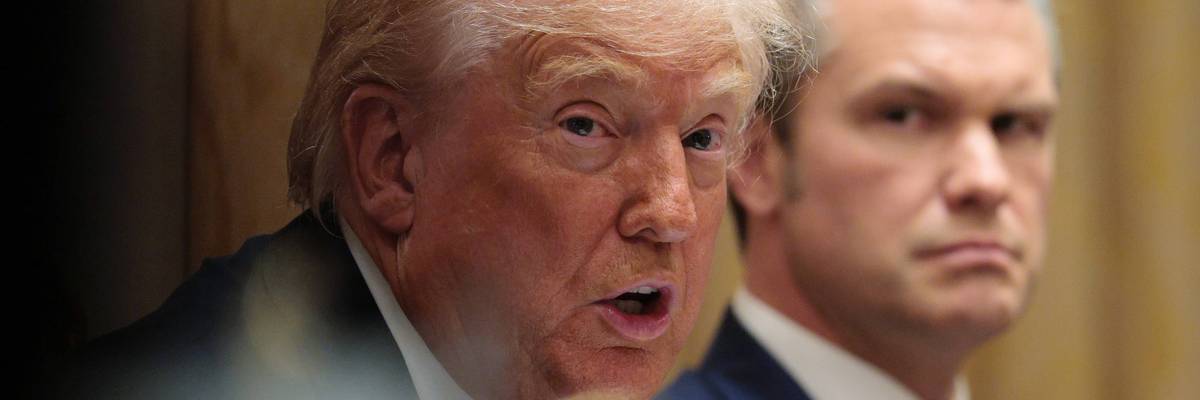
Secretary of Defense Pete Hegsethlooks on as USPresident Donald Trump speaks during a meeting of his Cabinet in the Cabinet Room of the White House on December 02, 2025 in Washington, DC.
Donald Trump's imperial ambitions and aggressive use of military power push the world toward a perilous future. At this moment in history, when the world actually needs cooperation among nations to confront existential environmental, technological and socioeconomic crises, diplomacy must promote international collaboration in achieving shared goals. Trump's administration, however, has completely abandoned diplomacy as a primary means of resolving international concerns and conflict. Military power is swiftly displacing it as the arbiter of competing interests. In a hostile and militarized international political environment “might makes right” is the operative principle. The consequence of policy based on this principle is international chaos and war.
The Trump administration's foreign policy sends multiple ominous signals to the world. Questions that would seem unthinkable little more than a year ago now are central concerns of the international community. Will the US retreat from the North Atlantic Treaty Organization (NATO)? Will the US actually attempt to destabilize the economy of its neighbor Canada? Will the US favor Russia over Ukraine? Is Greenland in imminent danger of a US invasion? Is destroying dozens of boats and killing scores of people onboard—all without evidence and due process—justified under international law? Are invasion of another nation and abduction of a head of state an assault on territorial sovereignty and the United Nations Charter? Will billion-dollar seats on a Board of Peace chaired by Trump and displacing UN peacekeeping authority improve the lives of Palestinians in Gaza? Will the US employ tariffs as a universal political tool despite their destabilizing consequences for global economic growth and market predictability?
The hubris and ruthlessness of a leader who forces such questions to the surface, particularly when that leader is the commander-in-chief of the world's most powerful military force, are more than menacing. These leadership character flaws are nevertheless amplified by Trump and Secretary of Defense Hegseth's bellicose and callous use of language concerning war. In discussing the sinking of Iran's naval force, for example, Trump recalled with obvious satisfaction that a general told him that he preferred destroying ships to capturing them “because it's more fun to sink them.” In remarks about Kharg Island, Iran's oil export hub in the Persian Gulf, Trump warned “I'll knock the hell out of it,” and he, too, would do it “just for fun.” Referring without evidence to alleged drug smuggling into the US on boats, he characterized the extrajudicial murders of the boats' occupants as “an act of kindness." He mocked Greenland's military defense as “two dog sleds." Trump offered this justification for invading Venezuela: “They took our oil rights...and we want it back." And, regarding Cuba, Trump declared, “I think I can do anything I want with it."
Further, Defense Secretary Pete Hegseth demands that he be called Secretary of War, chief of the Department of War. Hegseth obsessively refers to soldiers as warriors. He gushes over US exploits in the war with Iran. “What it takes to [wage war] with the precision that we do is world class. No one else can do it. And it's world class Americans... the engine of what makes our country great." His predatory instincts and disregard for human suffering are deeply alarming: “This was never meant to be a fair fight, and it is not a fair fight. We are punching them while they’re down, which is exactly how it should be.”
Elsewhere he describes the American military operation in Venezuela as “spectacularly executed,” claiming it “reestablish[ed] the deterrent effect of the US armed forces." Equally frightening as brandishing missiles and proclaiming that the greatness of America is its use of military force is Hegseth's predilection for religious crusade. In his 2020 book American Crusade echoes of 'holy war' ring sharply: “Do you enjoy Western civilization? Freedom? Equal justice? Thank a crusader,” he exhorts Americans. “ If not for the Crusades, there would have been no Protestant Reformation or Renaissance. There would be no Europe and no America."
In Hegseth's apocalyptic vision those who resist American military dominance are less than human. He casts Iranian leaders as vermin, “desperate and hiding, they've gone underground, cowering. That's what rats do.” His Old Testament wrath and venomous attitude toward Iranians with whom the US was in diplomatic discussion just three weeks ago suggests that he may be at least as dangerous as those he purports to be America's enemies.
In retrospect, regarding the current war with Iran, diplomacy appears to have been “a ruse,” according to Brett Bruen, a former official of the Obama State Department and National Security Council. His view is supported by comments of the Omani foreign minister Badr bin Hamad Al Busaidi who mediated the negotiations. Appearing on CBS “Face the Nation” just hours before the US-Israeli attack on Iran, he expressed confidence that “the peace deal is within our reach.” He further emphasized that an agreement could be achieved “if we just allow diplomacy the space it needs to get there. Because I don't think any alternative to diplomacy is going to solve this problem." Later in the interview Al Busaidi explained that there had been a breakthrough in the central issue of the negotiations: “the agreement that Iran will never, ever have nuclear material that will create a bomb.” He then clarified just what he meant. “I think that there is agreement now that this [the enriched uranium] will be down blended to the lowest level possible, to a neutral level, a natural level...and converted into fuel, and that fuel will be irreversible." Then, after the first attacks, the Omani foreign minister wrote on social media that “I am dismayed. Active and serious negotiations have yet again been undermined.”
The determined move away from diplomacy to war reflects the idea that weaker nations need to bend to the will of the United States if military invasion is to be avoided. Secretary of State Marco Rubio is influential in crafting this volatile and repressive brand of foreign policy. Edward Wong and Michael Crowley, veteran NY Times international news reporters who travel with Rubio, contend that a core aim of this is to create client states of authoritarian regimes. “It is regime compliance rather than regime change, a doctrine of destroy and deal." In addition to massive aerial invasion or introduction of ground troops, an overwhelming threat of imminent military invasion or limited military intervention may be enough to exact concessions. This doctrine forces nations into asymmetrical transactions, arrangements where the dominant party (US) dictates the terms. The military action against Venezuela, the abduction of its president and now the pressure to compel new leadership to facilitate favorable oil concessions illustrate how full-scale military invasion underway in Iran may not always be necessary to achieve Rubio's and Trump's desired results.
The Trump administration's campaign against immigrants in the US and international migration in general and its commitment to the defense and spread of Western values and civilization drive the ever-present specter of war. They are now both the national and international agenda of the United States. A militarized crusade, as discussed above, is an integral element of American foreign policy. These imperialist and autocratic designs are organic outgrowths of Trump's “America first” political objectives. Trump administration officials and right-wing ideologues court ultra-conservative, illiberal and fascist counterparts in Europe. These hyper-nationalistic, anti-immigrant forces are challenging and destabilizing liberal institutions throughout the continent. In this climate no one, not non-European nations nor traditional allies, can trust a US led by Trump.
The pronouncements and policies of his administration are ever poised for military conflict to advance distorted and politically deranged ideas. The US now is demonstrably the most dangerous nation in the world. Its destruction of Iran, its armed intervention in Venezuela, its threatening of neighbors and allies and its military backing of Israel in Gaza, Iraq, Lebanon and beyond are just the beginning of a future that will haunt the world and Americans for generations. To mitigate the horrendous suffering Trump's administration is inflicting abroad as well as at home, to turn back his pursuit of authoritarian power and to salvage the humanity of this nation, US voters must overwhelmingly reject Trump's political supporters seeking office in the 2026 elections.
Dear Common Dreams reader, It’s been nearly 30 years since I co-founded Common Dreams with my late wife, Lina Newhouser. We had the radical notion that journalism should serve the public good, not corporate profits. It was clear to us from the outset what it would take to build such a project. No paid advertisements. No corporate sponsors. No millionaire publisher telling us what to think or do. Many people said we wouldn't last a year, but we proved those doubters wrong. Together with a tremendous team of journalists and dedicated staff, we built an independent media outlet free from the constraints of profits and corporate control. Our mission has always been simple: To inform. To inspire. To ignite change for the common good. Building Common Dreams was not easy. Our survival was never guaranteed. When you take on the most powerful forces—Wall Street greed, fossil fuel industry destruction, Big Tech lobbyists, and uber-rich oligarchs who have spent billions upon billions rigging the economy and democracy in their favor—the only bulwark you have is supporters who believe in your work. But here’s the urgent message from me today. It's never been this bad out there. And it's never been this hard to keep us going. At the very moment Common Dreams is most needed, the threats we face are intensifying. We need your support now more than ever. We don't accept corporate advertising and never will. We don't have a paywall because we don't think people should be blocked from critical news based on their ability to pay. Everything we do is funded by the donations of readers like you. When everyone does the little they can afford, we are strong. But if that support retreats or dries up, so do we. Will you donate now to make sure Common Dreams not only survives but thrives? —Craig Brown, Co-founder |
Donald Trump's imperial ambitions and aggressive use of military power push the world toward a perilous future. At this moment in history, when the world actually needs cooperation among nations to confront existential environmental, technological and socioeconomic crises, diplomacy must promote international collaboration in achieving shared goals. Trump's administration, however, has completely abandoned diplomacy as a primary means of resolving international concerns and conflict. Military power is swiftly displacing it as the arbiter of competing interests. In a hostile and militarized international political environment “might makes right” is the operative principle. The consequence of policy based on this principle is international chaos and war.
The Trump administration's foreign policy sends multiple ominous signals to the world. Questions that would seem unthinkable little more than a year ago now are central concerns of the international community. Will the US retreat from the North Atlantic Treaty Organization (NATO)? Will the US actually attempt to destabilize the economy of its neighbor Canada? Will the US favor Russia over Ukraine? Is Greenland in imminent danger of a US invasion? Is destroying dozens of boats and killing scores of people onboard—all without evidence and due process—justified under international law? Are invasion of another nation and abduction of a head of state an assault on territorial sovereignty and the United Nations Charter? Will billion-dollar seats on a Board of Peace chaired by Trump and displacing UN peacekeeping authority improve the lives of Palestinians in Gaza? Will the US employ tariffs as a universal political tool despite their destabilizing consequences for global economic growth and market predictability?
The hubris and ruthlessness of a leader who forces such questions to the surface, particularly when that leader is the commander-in-chief of the world's most powerful military force, are more than menacing. These leadership character flaws are nevertheless amplified by Trump and Secretary of Defense Hegseth's bellicose and callous use of language concerning war. In discussing the sinking of Iran's naval force, for example, Trump recalled with obvious satisfaction that a general told him that he preferred destroying ships to capturing them “because it's more fun to sink them.” In remarks about Kharg Island, Iran's oil export hub in the Persian Gulf, Trump warned “I'll knock the hell out of it,” and he, too, would do it “just for fun.” Referring without evidence to alleged drug smuggling into the US on boats, he characterized the extrajudicial murders of the boats' occupants as “an act of kindness." He mocked Greenland's military defense as “two dog sleds." Trump offered this justification for invading Venezuela: “They took our oil rights...and we want it back." And, regarding Cuba, Trump declared, “I think I can do anything I want with it."
Further, Defense Secretary Pete Hegseth demands that he be called Secretary of War, chief of the Department of War. Hegseth obsessively refers to soldiers as warriors. He gushes over US exploits in the war with Iran. “What it takes to [wage war] with the precision that we do is world class. No one else can do it. And it's world class Americans... the engine of what makes our country great." His predatory instincts and disregard for human suffering are deeply alarming: “This was never meant to be a fair fight, and it is not a fair fight. We are punching them while they’re down, which is exactly how it should be.”
Elsewhere he describes the American military operation in Venezuela as “spectacularly executed,” claiming it “reestablish[ed] the deterrent effect of the US armed forces." Equally frightening as brandishing missiles and proclaiming that the greatness of America is its use of military force is Hegseth's predilection for religious crusade. In his 2020 book American Crusade echoes of 'holy war' ring sharply: “Do you enjoy Western civilization? Freedom? Equal justice? Thank a crusader,” he exhorts Americans. “ If not for the Crusades, there would have been no Protestant Reformation or Renaissance. There would be no Europe and no America."
In Hegseth's apocalyptic vision those who resist American military dominance are less than human. He casts Iranian leaders as vermin, “desperate and hiding, they've gone underground, cowering. That's what rats do.” His Old Testament wrath and venomous attitude toward Iranians with whom the US was in diplomatic discussion just three weeks ago suggests that he may be at least as dangerous as those he purports to be America's enemies.
In retrospect, regarding the current war with Iran, diplomacy appears to have been “a ruse,” according to Brett Bruen, a former official of the Obama State Department and National Security Council. His view is supported by comments of the Omani foreign minister Badr bin Hamad Al Busaidi who mediated the negotiations. Appearing on CBS “Face the Nation” just hours before the US-Israeli attack on Iran, he expressed confidence that “the peace deal is within our reach.” He further emphasized that an agreement could be achieved “if we just allow diplomacy the space it needs to get there. Because I don't think any alternative to diplomacy is going to solve this problem." Later in the interview Al Busaidi explained that there had been a breakthrough in the central issue of the negotiations: “the agreement that Iran will never, ever have nuclear material that will create a bomb.” He then clarified just what he meant. “I think that there is agreement now that this [the enriched uranium] will be down blended to the lowest level possible, to a neutral level, a natural level...and converted into fuel, and that fuel will be irreversible." Then, after the first attacks, the Omani foreign minister wrote on social media that “I am dismayed. Active and serious negotiations have yet again been undermined.”
The determined move away from diplomacy to war reflects the idea that weaker nations need to bend to the will of the United States if military invasion is to be avoided. Secretary of State Marco Rubio is influential in crafting this volatile and repressive brand of foreign policy. Edward Wong and Michael Crowley, veteran NY Times international news reporters who travel with Rubio, contend that a core aim of this is to create client states of authoritarian regimes. “It is regime compliance rather than regime change, a doctrine of destroy and deal." In addition to massive aerial invasion or introduction of ground troops, an overwhelming threat of imminent military invasion or limited military intervention may be enough to exact concessions. This doctrine forces nations into asymmetrical transactions, arrangements where the dominant party (US) dictates the terms. The military action against Venezuela, the abduction of its president and now the pressure to compel new leadership to facilitate favorable oil concessions illustrate how full-scale military invasion underway in Iran may not always be necessary to achieve Rubio's and Trump's desired results.
The Trump administration's campaign against immigrants in the US and international migration in general and its commitment to the defense and spread of Western values and civilization drive the ever-present specter of war. They are now both the national and international agenda of the United States. A militarized crusade, as discussed above, is an integral element of American foreign policy. These imperialist and autocratic designs are organic outgrowths of Trump's “America first” political objectives. Trump administration officials and right-wing ideologues court ultra-conservative, illiberal and fascist counterparts in Europe. These hyper-nationalistic, anti-immigrant forces are challenging and destabilizing liberal institutions throughout the continent. In this climate no one, not non-European nations nor traditional allies, can trust a US led by Trump.
The pronouncements and policies of his administration are ever poised for military conflict to advance distorted and politically deranged ideas. The US now is demonstrably the most dangerous nation in the world. Its destruction of Iran, its armed intervention in Venezuela, its threatening of neighbors and allies and its military backing of Israel in Gaza, Iraq, Lebanon and beyond are just the beginning of a future that will haunt the world and Americans for generations. To mitigate the horrendous suffering Trump's administration is inflicting abroad as well as at home, to turn back his pursuit of authoritarian power and to salvage the humanity of this nation, US voters must overwhelmingly reject Trump's political supporters seeking office in the 2026 elections.
Donald Trump's imperial ambitions and aggressive use of military power push the world toward a perilous future. At this moment in history, when the world actually needs cooperation among nations to confront existential environmental, technological and socioeconomic crises, diplomacy must promote international collaboration in achieving shared goals. Trump's administration, however, has completely abandoned diplomacy as a primary means of resolving international concerns and conflict. Military power is swiftly displacing it as the arbiter of competing interests. In a hostile and militarized international political environment “might makes right” is the operative principle. The consequence of policy based on this principle is international chaos and war.
The Trump administration's foreign policy sends multiple ominous signals to the world. Questions that would seem unthinkable little more than a year ago now are central concerns of the international community. Will the US retreat from the North Atlantic Treaty Organization (NATO)? Will the US actually attempt to destabilize the economy of its neighbor Canada? Will the US favor Russia over Ukraine? Is Greenland in imminent danger of a US invasion? Is destroying dozens of boats and killing scores of people onboard—all without evidence and due process—justified under international law? Are invasion of another nation and abduction of a head of state an assault on territorial sovereignty and the United Nations Charter? Will billion-dollar seats on a Board of Peace chaired by Trump and displacing UN peacekeeping authority improve the lives of Palestinians in Gaza? Will the US employ tariffs as a universal political tool despite their destabilizing consequences for global economic growth and market predictability?
The hubris and ruthlessness of a leader who forces such questions to the surface, particularly when that leader is the commander-in-chief of the world's most powerful military force, are more than menacing. These leadership character flaws are nevertheless amplified by Trump and Secretary of Defense Hegseth's bellicose and callous use of language concerning war. In discussing the sinking of Iran's naval force, for example, Trump recalled with obvious satisfaction that a general told him that he preferred destroying ships to capturing them “because it's more fun to sink them.” In remarks about Kharg Island, Iran's oil export hub in the Persian Gulf, Trump warned “I'll knock the hell out of it,” and he, too, would do it “just for fun.” Referring without evidence to alleged drug smuggling into the US on boats, he characterized the extrajudicial murders of the boats' occupants as “an act of kindness." He mocked Greenland's military defense as “two dog sleds." Trump offered this justification for invading Venezuela: “They took our oil rights...and we want it back." And, regarding Cuba, Trump declared, “I think I can do anything I want with it."
Further, Defense Secretary Pete Hegseth demands that he be called Secretary of War, chief of the Department of War. Hegseth obsessively refers to soldiers as warriors. He gushes over US exploits in the war with Iran. “What it takes to [wage war] with the precision that we do is world class. No one else can do it. And it's world class Americans... the engine of what makes our country great." His predatory instincts and disregard for human suffering are deeply alarming: “This was never meant to be a fair fight, and it is not a fair fight. We are punching them while they’re down, which is exactly how it should be.”
Elsewhere he describes the American military operation in Venezuela as “spectacularly executed,” claiming it “reestablish[ed] the deterrent effect of the US armed forces." Equally frightening as brandishing missiles and proclaiming that the greatness of America is its use of military force is Hegseth's predilection for religious crusade. In his 2020 book American Crusade echoes of 'holy war' ring sharply: “Do you enjoy Western civilization? Freedom? Equal justice? Thank a crusader,” he exhorts Americans. “ If not for the Crusades, there would have been no Protestant Reformation or Renaissance. There would be no Europe and no America."
In Hegseth's apocalyptic vision those who resist American military dominance are less than human. He casts Iranian leaders as vermin, “desperate and hiding, they've gone underground, cowering. That's what rats do.” His Old Testament wrath and venomous attitude toward Iranians with whom the US was in diplomatic discussion just three weeks ago suggests that he may be at least as dangerous as those he purports to be America's enemies.
In retrospect, regarding the current war with Iran, diplomacy appears to have been “a ruse,” according to Brett Bruen, a former official of the Obama State Department and National Security Council. His view is supported by comments of the Omani foreign minister Badr bin Hamad Al Busaidi who mediated the negotiations. Appearing on CBS “Face the Nation” just hours before the US-Israeli attack on Iran, he expressed confidence that “the peace deal is within our reach.” He further emphasized that an agreement could be achieved “if we just allow diplomacy the space it needs to get there. Because I don't think any alternative to diplomacy is going to solve this problem." Later in the interview Al Busaidi explained that there had been a breakthrough in the central issue of the negotiations: “the agreement that Iran will never, ever have nuclear material that will create a bomb.” He then clarified just what he meant. “I think that there is agreement now that this [the enriched uranium] will be down blended to the lowest level possible, to a neutral level, a natural level...and converted into fuel, and that fuel will be irreversible." Then, after the first attacks, the Omani foreign minister wrote on social media that “I am dismayed. Active and serious negotiations have yet again been undermined.”
The determined move away from diplomacy to war reflects the idea that weaker nations need to bend to the will of the United States if military invasion is to be avoided. Secretary of State Marco Rubio is influential in crafting this volatile and repressive brand of foreign policy. Edward Wong and Michael Crowley, veteran NY Times international news reporters who travel with Rubio, contend that a core aim of this is to create client states of authoritarian regimes. “It is regime compliance rather than regime change, a doctrine of destroy and deal." In addition to massive aerial invasion or introduction of ground troops, an overwhelming threat of imminent military invasion or limited military intervention may be enough to exact concessions. This doctrine forces nations into asymmetrical transactions, arrangements where the dominant party (US) dictates the terms. The military action against Venezuela, the abduction of its president and now the pressure to compel new leadership to facilitate favorable oil concessions illustrate how full-scale military invasion underway in Iran may not always be necessary to achieve Rubio's and Trump's desired results.
The Trump administration's campaign against immigrants in the US and international migration in general and its commitment to the defense and spread of Western values and civilization drive the ever-present specter of war. They are now both the national and international agenda of the United States. A militarized crusade, as discussed above, is an integral element of American foreign policy. These imperialist and autocratic designs are organic outgrowths of Trump's “America first” political objectives. Trump administration officials and right-wing ideologues court ultra-conservative, illiberal and fascist counterparts in Europe. These hyper-nationalistic, anti-immigrant forces are challenging and destabilizing liberal institutions throughout the continent. In this climate no one, not non-European nations nor traditional allies, can trust a US led by Trump.
The pronouncements and policies of his administration are ever poised for military conflict to advance distorted and politically deranged ideas. The US now is demonstrably the most dangerous nation in the world. Its destruction of Iran, its armed intervention in Venezuela, its threatening of neighbors and allies and its military backing of Israel in Gaza, Iraq, Lebanon and beyond are just the beginning of a future that will haunt the world and Americans for generations. To mitigate the horrendous suffering Trump's administration is inflicting abroad as well as at home, to turn back his pursuit of authoritarian power and to salvage the humanity of this nation, US voters must overwhelmingly reject Trump's political supporters seeking office in the 2026 elections.