SUBSCRIBE TO OUR FREE NEWSLETTER
Daily news & progressive opinion—funded by the people, not the corporations—delivered straight to your inbox.
5
#000000
#FFFFFF
To donate by check, phone, or other method, see our More Ways to Give page.
Daily news & progressive opinion—funded by the people, not the corporations—delivered straight to your inbox.
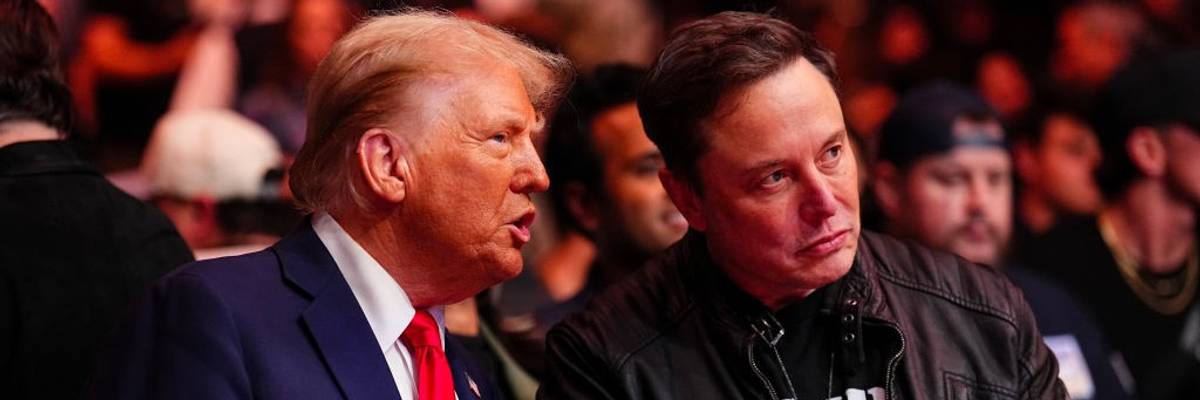
President-elect Donald Trump and Elon Musk talk ringside during the UFC 309 event at Madison Square Garden on November 16, 2024 in New York City.
It appears that Trump has entered into a power-sharing agreement with Musk and several other wealthy individuals including Vivek Ramaswamy, Robert F. Kennedy Jr., and David Sacks.
Democracy decays into oligarchy when a few individuals accumulate most of the political power.
The reelection of Donald Trump has accelerated the decline of the United States into oligarchy. Trump has had billionaire donors for each of his presidential campaigns, but in 2024 the role of these wealthy donors expanded. Donors such as Elon Musk made gigantic contributions to Trump’s campaign; in return for this they are taking an active role in the Trump White House. Perhaps, this time around, Trump turned the oval office into a time-share.
On December 19, Elon Musk led the call for House Republicans to repudiate a continuing resolution they had just negotiated to keep the federal government running through the end of the year. Perhaps Musk’s charter includes coordination with Congress.
When Elon Musk and Vivek Ramaswamy speak of increasing government efficiency, they usually start with services for the unfortunate.
It appears that Trump has entered into a power-sharing agreement with Musk and several other wealthy individuals including Vivek Ramaswamy, Robert F. Kennedy Jr., and David Sacks. However this arrangement works, it’s likely that the Trump administration will cater to billionaires—Sen. Bernie Sanders (I-Vt.) observed that the 13 billionaires chosen by Trump to serve in his administration have a combined wealth of at least $383 billion.
What do these billionaires want? The oligarchs and billionaires want lower taxes and reduced government regulations. Of course, each billionaire has a particular set of interests; for example, David Sacks, Trump’s “AI and crypto czar,” is a venture capitalist with heavy investment in AI and crypto. Sadly. most of the oligarchs are climate-change deniers.
The oligarchs want more wealth. Robert Reich observes:
Since [1980], the median wage of the bottom 90% has stagnated. The share of the nation’s wealth owned by the richest 400 Americans has quadrupled (from less than 1% to 3.5%) while the share owned by the entire bottom half of America has dropped to 1.3%… The richest 1% of Americans now has more wealth than the bottom 90% combined.
The oligarchs share a fiscally conservative agenda. They intend to shrink the size of the federal government. The particulars vary but the oligarchs are not concerned with the size of the defense budget; their cost-cutting focus is on programs that service the poor and disadvantaged—such as Medicaid. When Elon Musk and Vivek Ramaswamy speak of increasing government efficiency, they usually start with services for the unfortunate.
What are the practical consequences of this shift to oligarchy? It’s unsettling to be in a political situation where we do not understand who is in charge at the White House. We don’t know how power-sharing will work. The relationship between Trump and Congress has been fraught. The shift to oligarchy will make this relationship even more difficult.
Will the oligarchs fix the economy? Trump was elected because he promised to fix the economy. Most Americans believed he would drive down inflation; they thought Trump would reduce the cost of food, housing, and household and medical expenses. Since November 5, Trump has given no indication of how he plans to do this. Perhaps he has lost interest.
During the presidential campaign, Trump said his inflation-fighting agenda would rely upon tariffs, but it’s likely that the oligarchs will influence how Trump’s tariff strategy plays out. Musk has huge business interests in China, and it’s unlikely that he would support a tariff policy that would hurt his relationships with the country.
Trump has appointed a “czar” for immigration (Tom Homan), energy (Doug Burgum), and AI & Crypto (Sacks). Trump has not appointed a czar for inflation. With much fanfare, Trump has appointed a commission on “government efficiency;” they’ve already started meeting. Trump has not appointed to a commission to curb inflation.
After January 20, Trump will own inflation and the economy. Trump’s immigration “purge” will drive up the cost of food. Trump’s tariffs will drive up the cost of household expenses.
Trump’s trying to ignore inflation. Or turn it over to an oligarch co-president. Stay tuned.
Dear Common Dreams reader, It’s been nearly 30 years since I co-founded Common Dreams with my late wife, Lina Newhouser. We had the radical notion that journalism should serve the public good, not corporate profits. It was clear to us from the outset what it would take to build such a project. No paid advertisements. No corporate sponsors. No millionaire publisher telling us what to think or do. Many people said we wouldn't last a year, but we proved those doubters wrong. Together with a tremendous team of journalists and dedicated staff, we built an independent media outlet free from the constraints of profits and corporate control. Our mission has always been simple: To inform. To inspire. To ignite change for the common good. Building Common Dreams was not easy. Our survival was never guaranteed. When you take on the most powerful forces—Wall Street greed, fossil fuel industry destruction, Big Tech lobbyists, and uber-rich oligarchs who have spent billions upon billions rigging the economy and democracy in their favor—the only bulwark you have is supporters who believe in your work. But here’s the urgent message from me today. It's never been this bad out there. And it's never been this hard to keep us going. At the very moment Common Dreams is most needed, the threats we face are intensifying. We need your support now more than ever. We don't accept corporate advertising and never will. We don't have a paywall because we don't think people should be blocked from critical news based on their ability to pay. Everything we do is funded by the donations of readers like you. When everyone does the little they can afford, we are strong. But if that support retreats or dries up, so do we. Will you donate now to make sure Common Dreams not only survives but thrives? —Craig Brown, Co-founder |
Democracy decays into oligarchy when a few individuals accumulate most of the political power.
The reelection of Donald Trump has accelerated the decline of the United States into oligarchy. Trump has had billionaire donors for each of his presidential campaigns, but in 2024 the role of these wealthy donors expanded. Donors such as Elon Musk made gigantic contributions to Trump’s campaign; in return for this they are taking an active role in the Trump White House. Perhaps, this time around, Trump turned the oval office into a time-share.
On December 19, Elon Musk led the call for House Republicans to repudiate a continuing resolution they had just negotiated to keep the federal government running through the end of the year. Perhaps Musk’s charter includes coordination with Congress.
When Elon Musk and Vivek Ramaswamy speak of increasing government efficiency, they usually start with services for the unfortunate.
It appears that Trump has entered into a power-sharing agreement with Musk and several other wealthy individuals including Vivek Ramaswamy, Robert F. Kennedy Jr., and David Sacks. However this arrangement works, it’s likely that the Trump administration will cater to billionaires—Sen. Bernie Sanders (I-Vt.) observed that the 13 billionaires chosen by Trump to serve in his administration have a combined wealth of at least $383 billion.
What do these billionaires want? The oligarchs and billionaires want lower taxes and reduced government regulations. Of course, each billionaire has a particular set of interests; for example, David Sacks, Trump’s “AI and crypto czar,” is a venture capitalist with heavy investment in AI and crypto. Sadly. most of the oligarchs are climate-change deniers.
The oligarchs want more wealth. Robert Reich observes:
Since [1980], the median wage of the bottom 90% has stagnated. The share of the nation’s wealth owned by the richest 400 Americans has quadrupled (from less than 1% to 3.5%) while the share owned by the entire bottom half of America has dropped to 1.3%… The richest 1% of Americans now has more wealth than the bottom 90% combined.
The oligarchs share a fiscally conservative agenda. They intend to shrink the size of the federal government. The particulars vary but the oligarchs are not concerned with the size of the defense budget; their cost-cutting focus is on programs that service the poor and disadvantaged—such as Medicaid. When Elon Musk and Vivek Ramaswamy speak of increasing government efficiency, they usually start with services for the unfortunate.
What are the practical consequences of this shift to oligarchy? It’s unsettling to be in a political situation where we do not understand who is in charge at the White House. We don’t know how power-sharing will work. The relationship between Trump and Congress has been fraught. The shift to oligarchy will make this relationship even more difficult.
Will the oligarchs fix the economy? Trump was elected because he promised to fix the economy. Most Americans believed he would drive down inflation; they thought Trump would reduce the cost of food, housing, and household and medical expenses. Since November 5, Trump has given no indication of how he plans to do this. Perhaps he has lost interest.
During the presidential campaign, Trump said his inflation-fighting agenda would rely upon tariffs, but it’s likely that the oligarchs will influence how Trump’s tariff strategy plays out. Musk has huge business interests in China, and it’s unlikely that he would support a tariff policy that would hurt his relationships with the country.
Trump has appointed a “czar” for immigration (Tom Homan), energy (Doug Burgum), and AI & Crypto (Sacks). Trump has not appointed a czar for inflation. With much fanfare, Trump has appointed a commission on “government efficiency;” they’ve already started meeting. Trump has not appointed to a commission to curb inflation.
After January 20, Trump will own inflation and the economy. Trump’s immigration “purge” will drive up the cost of food. Trump’s tariffs will drive up the cost of household expenses.
Trump’s trying to ignore inflation. Or turn it over to an oligarch co-president. Stay tuned.
Democracy decays into oligarchy when a few individuals accumulate most of the political power.
The reelection of Donald Trump has accelerated the decline of the United States into oligarchy. Trump has had billionaire donors for each of his presidential campaigns, but in 2024 the role of these wealthy donors expanded. Donors such as Elon Musk made gigantic contributions to Trump’s campaign; in return for this they are taking an active role in the Trump White House. Perhaps, this time around, Trump turned the oval office into a time-share.
On December 19, Elon Musk led the call for House Republicans to repudiate a continuing resolution they had just negotiated to keep the federal government running through the end of the year. Perhaps Musk’s charter includes coordination with Congress.
When Elon Musk and Vivek Ramaswamy speak of increasing government efficiency, they usually start with services for the unfortunate.
It appears that Trump has entered into a power-sharing agreement with Musk and several other wealthy individuals including Vivek Ramaswamy, Robert F. Kennedy Jr., and David Sacks. However this arrangement works, it’s likely that the Trump administration will cater to billionaires—Sen. Bernie Sanders (I-Vt.) observed that the 13 billionaires chosen by Trump to serve in his administration have a combined wealth of at least $383 billion.
What do these billionaires want? The oligarchs and billionaires want lower taxes and reduced government regulations. Of course, each billionaire has a particular set of interests; for example, David Sacks, Trump’s “AI and crypto czar,” is a venture capitalist with heavy investment in AI and crypto. Sadly. most of the oligarchs are climate-change deniers.
The oligarchs want more wealth. Robert Reich observes:
Since [1980], the median wage of the bottom 90% has stagnated. The share of the nation’s wealth owned by the richest 400 Americans has quadrupled (from less than 1% to 3.5%) while the share owned by the entire bottom half of America has dropped to 1.3%… The richest 1% of Americans now has more wealth than the bottom 90% combined.
The oligarchs share a fiscally conservative agenda. They intend to shrink the size of the federal government. The particulars vary but the oligarchs are not concerned with the size of the defense budget; their cost-cutting focus is on programs that service the poor and disadvantaged—such as Medicaid. When Elon Musk and Vivek Ramaswamy speak of increasing government efficiency, they usually start with services for the unfortunate.
What are the practical consequences of this shift to oligarchy? It’s unsettling to be in a political situation where we do not understand who is in charge at the White House. We don’t know how power-sharing will work. The relationship between Trump and Congress has been fraught. The shift to oligarchy will make this relationship even more difficult.
Will the oligarchs fix the economy? Trump was elected because he promised to fix the economy. Most Americans believed he would drive down inflation; they thought Trump would reduce the cost of food, housing, and household and medical expenses. Since November 5, Trump has given no indication of how he plans to do this. Perhaps he has lost interest.
During the presidential campaign, Trump said his inflation-fighting agenda would rely upon tariffs, but it’s likely that the oligarchs will influence how Trump’s tariff strategy plays out. Musk has huge business interests in China, and it’s unlikely that he would support a tariff policy that would hurt his relationships with the country.
Trump has appointed a “czar” for immigration (Tom Homan), energy (Doug Burgum), and AI & Crypto (Sacks). Trump has not appointed a czar for inflation. With much fanfare, Trump has appointed a commission on “government efficiency;” they’ve already started meeting. Trump has not appointed to a commission to curb inflation.
After January 20, Trump will own inflation and the economy. Trump’s immigration “purge” will drive up the cost of food. Trump’s tariffs will drive up the cost of household expenses.
Trump’s trying to ignore inflation. Or turn it over to an oligarch co-president. Stay tuned.