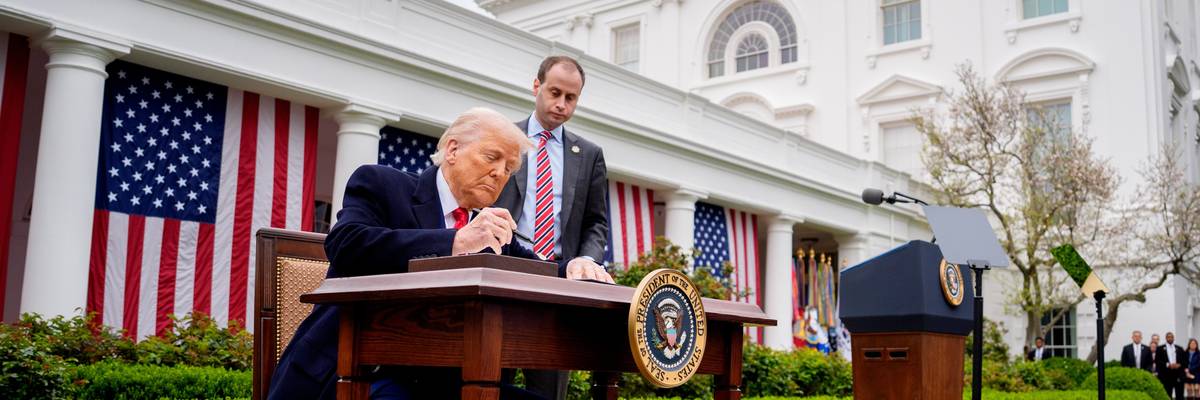
U.S. President Donald Trump, accompanied by White House Staff Secretary Will Scharf, signs executive orders imposing tariffs on imported goods during a "Make America Wealthy Again" trade announcement event in the Rose Garden at the White House on April 2, 2025 in Washington, D.C.
Trump Is Wielding Tariffs to Help Billionaires, But They Can Be a Tool for Fair Trade, Too
Rather than reflexively dismiss tariffs altogether, those of us who care about sweatshop labor, plastic pollution, climate change, and other destructive by-products of tariff-free trade can still use them to demand a fairer economy.
President Donald Trump has said “tariff” is “the most beautiful word in the dictionary.” He claims tariffs will restore American trade supremacy, bring lost jobs back to the United States, and most bizarrely, replace income taxes.
Tariffs can be a useful tool to regulate global trade in the interest of jobs, wages, labor rights, the environment, and consumers—if applied correctly.
But Trump’s chaotic, overly broad tariffs are only likely to hurt working people. They won’t ensure labor rights or protect the environment. They won’t even return jobs to the U.S., if his first term tariffs are any indication.
Tariffs on oil imports, for example, if done correctly, can foot the bill to repair the climate destruction that fossil fuel companies profit from, and incentivize phasing out oil and gas altogether.
Because new tariffs require congressional approval, Trump manufactured a crisis about the flow of drugs and undocumented immigrants across U.S. borders in order to use executive power to unilaterally impose tariffs. He insists that foreign governments and companies pay these tariffs—and that imposing them on goods from Canada, Mexico, and China will solve all of the U.S.’ economic problems.
Tariffs aren’t the same as income taxes. When applied to goods being imported from, say, Canada, tariffs aren’t paid by either the Canadian manufacturer or the Canadian government. They’re paid by the U.S. importer to the U.S. government. So a company like Walmart would pay a fee in order to be able to import specific goods from Canada.
Importers will often pass increased tariffs on to consumers, resulting in higher prices. But as Hillary Haden of the Trade Justice Education Fund explained to me in an interview, that’s not a given. Sometimes tariffs are absorbed by the importer as the cost of doing business.
Unsurprisingly, the stock market is leery of tariffs, as are investors and free market champions, who’ve pushed for decades to demolish trade barriers via such initiatives as the World Trade Organization (WTO). Indeed, China has already filed a lawsuit against Trump’s tariffs at the WTO.
With the world’s free-trade-based economy teetering on a knife’s edge, Democrats are attempting to undo Trump’s haphazard tariffs, especially against our neighbors, Mexico and Canada. After all, it was a Democratic president—Bill Clinton—who signed the North American Free Trade Agreement (NAFTA) in 1992, turning all three member nations into a tariff-free zone. (In 2020, Trump signed the U.S.-Mexico-Canada agreement, replacing NAFTA.)
There’s good reason to criticize Trump’s blanket tariffs. But rather than reflexively dismiss tariffs altogether, those of us who care about sweatshop labor, plastic pollution, climate change, and other destructive by-products of tariff-free trade can still use them to demand a fairer economy.
In 1999, hundreds of thousands of activists, including union members and environmentalists, marched against the WTO in Seattle. The “Battle of Seattle,” as it came to be known, was the high point of the so-called anti-globalization movement, which sought to prioritize human rights, workers’ rights, conservation, and other considerations before corporate profits.
It was the pursuit of a “fair-trade” economy over a free-trade one.
So it’s ironic that President Trump is wielding tariffs as a central pillar of his pro-billionaire economic agenda—and his liberal opposition is championing free trade. Neither pro-billionaire trade nor unregulated trade is in the interests of working people.
Tariffs on oil imports, for example, if done correctly, can foot the bill to repair the climate destruction that fossil fuel companies profit from, and incentivize phasing out oil and gas altogether.
Similarly, tariffs on products manufactured with slave labor or underpaid labor can level the playing field for manufacturers who pay their workers a fair, living wage and ensure safe working conditions.
Rather than reflexively opposing tariffs because it is Trump’s latest fixation, we ought to demand a protectionist economy that can apply tariffs carefully, strategically, and thoughtfully in order to undo the damage of free market capitalism.
We are at a crossroads
This country and this world are at a monumental crossroads. In a few short weeks, US voters will have an opportunity to beat back the forces of fascism and confront the billionaires who are rigging the economy, our media system, and our democracy, making it increasingly impossible for ordinary people to get by. We’re not just talking about the election. We’re talking about what must be done once these fascist elements are vanquished from power. We need a bolder set of solutions than what either major party has so far been willing to offer and a working-class movement ready to fight like hell for it. Trump didn't emerge from nowhere. The conditions that fueled MAGA authoritarianism were created by decades of radical neoliberal economic policies and a corrupt political system dominated by corporate interests. They slashed taxes on the super-rich, promising that the benefits would trickle down. They said giveaways to the corporate titans would make life more affordable for the rest of us. It was all bullshit. And when a bitter, betrayed populace searches for someone to blame, right-wing demagogues have little trouble finding scapegoats. People know when they're being lied to, but you won't hear any of this from the corporate media. Only independent journalism—powered and funded by people who believe in building a better world—can deliver truly trustworthy daily news. Our Fall Campaign is underway, and we need your help. To power our newsroom through the rest of the year, we need to raise $125,000 by midnight on October 31. So if you share our vision, please contribute whatever you can to sustain our work. |
President Donald Trump has said “tariff” is “the most beautiful word in the dictionary.” He claims tariffs will restore American trade supremacy, bring lost jobs back to the United States, and most bizarrely, replace income taxes.
Tariffs can be a useful tool to regulate global trade in the interest of jobs, wages, labor rights, the environment, and consumers—if applied correctly.
But Trump’s chaotic, overly broad tariffs are only likely to hurt working people. They won’t ensure labor rights or protect the environment. They won’t even return jobs to the U.S., if his first term tariffs are any indication.
Tariffs on oil imports, for example, if done correctly, can foot the bill to repair the climate destruction that fossil fuel companies profit from, and incentivize phasing out oil and gas altogether.
Because new tariffs require congressional approval, Trump manufactured a crisis about the flow of drugs and undocumented immigrants across U.S. borders in order to use executive power to unilaterally impose tariffs. He insists that foreign governments and companies pay these tariffs—and that imposing them on goods from Canada, Mexico, and China will solve all of the U.S.’ economic problems.
Tariffs aren’t the same as income taxes. When applied to goods being imported from, say, Canada, tariffs aren’t paid by either the Canadian manufacturer or the Canadian government. They’re paid by the U.S. importer to the U.S. government. So a company like Walmart would pay a fee in order to be able to import specific goods from Canada.
Importers will often pass increased tariffs on to consumers, resulting in higher prices. But as Hillary Haden of the Trade Justice Education Fund explained to me in an interview, that’s not a given. Sometimes tariffs are absorbed by the importer as the cost of doing business.
Unsurprisingly, the stock market is leery of tariffs, as are investors and free market champions, who’ve pushed for decades to demolish trade barriers via such initiatives as the World Trade Organization (WTO). Indeed, China has already filed a lawsuit against Trump’s tariffs at the WTO.
With the world’s free-trade-based economy teetering on a knife’s edge, Democrats are attempting to undo Trump’s haphazard tariffs, especially against our neighbors, Mexico and Canada. After all, it was a Democratic president—Bill Clinton—who signed the North American Free Trade Agreement (NAFTA) in 1992, turning all three member nations into a tariff-free zone. (In 2020, Trump signed the U.S.-Mexico-Canada agreement, replacing NAFTA.)
There’s good reason to criticize Trump’s blanket tariffs. But rather than reflexively dismiss tariffs altogether, those of us who care about sweatshop labor, plastic pollution, climate change, and other destructive by-products of tariff-free trade can still use them to demand a fairer economy.
In 1999, hundreds of thousands of activists, including union members and environmentalists, marched against the WTO in Seattle. The “Battle of Seattle,” as it came to be known, was the high point of the so-called anti-globalization movement, which sought to prioritize human rights, workers’ rights, conservation, and other considerations before corporate profits.
It was the pursuit of a “fair-trade” economy over a free-trade one.
So it’s ironic that President Trump is wielding tariffs as a central pillar of his pro-billionaire economic agenda—and his liberal opposition is championing free trade. Neither pro-billionaire trade nor unregulated trade is in the interests of working people.
Tariffs on oil imports, for example, if done correctly, can foot the bill to repair the climate destruction that fossil fuel companies profit from, and incentivize phasing out oil and gas altogether.
Similarly, tariffs on products manufactured with slave labor or underpaid labor can level the playing field for manufacturers who pay their workers a fair, living wage and ensure safe working conditions.
Rather than reflexively opposing tariffs because it is Trump’s latest fixation, we ought to demand a protectionist economy that can apply tariffs carefully, strategically, and thoughtfully in order to undo the damage of free market capitalism.
- Trump Follows Through With High Tariffs on Canada, Mexico, and China ›
- Top Economist Has Winning Idea for Trump's Trade War: Tariffs for US Oligarchs ›
- Trump Is Turning the White House Into a Billionaire Time-Share ›
- Trump Tariffs Show GOP Aims to Make Working Class Fund 'Payday for Billionaires and Giant Corporations' ›