SUBSCRIBE TO OUR FREE NEWSLETTER
Daily news & progressive opinion—funded by the people, not the corporations—delivered straight to your inbox.
5
#000000
#FFFFFF
To donate by check, phone, or other method, see our More Ways to Give page.
Daily news & progressive opinion—funded by the people, not the corporations—delivered straight to your inbox.
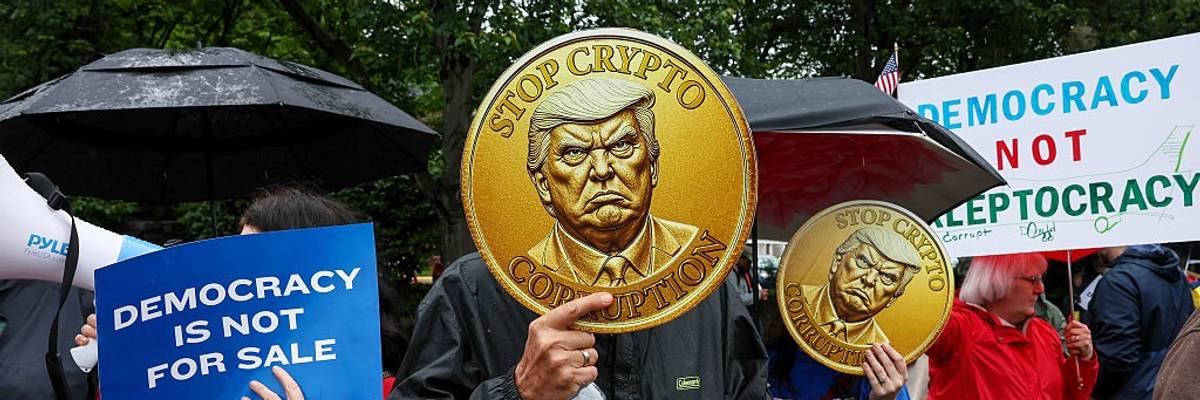
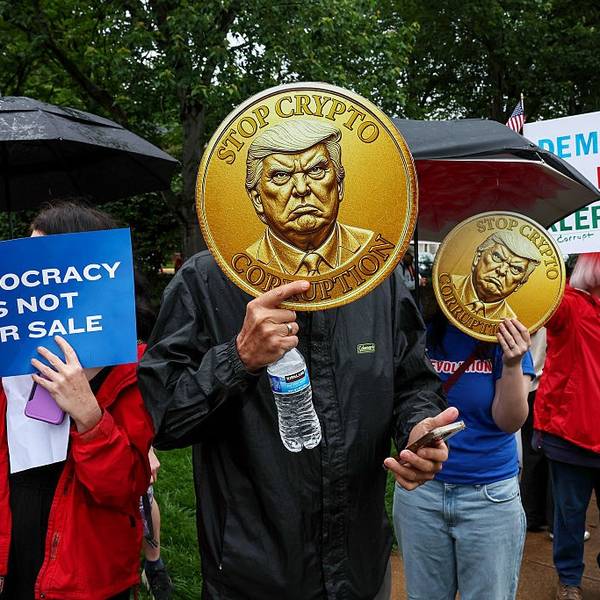
Demonstrators hold up mock cryptocurrency during the "America is Not for Sale" rally against President Donald Trump's crypto dealings at the Trump National Golf Club on May 22, 2025, in Washington, DC.
"Your family gets higher energy prices and cuts to healthcare. His family gets billions," said Rep. Greg Casar.
In what Public Citizen called "the greatest corruption in presidential history," US President Donald Trump and his family added $5 billion in cash to their fortunes this Labor Day as his new cryptocurrency was opened to the public market.
The currency, known as WLFI, is owned by World Liberty Financial, a company founded by the president's sons, Donald Trump, Jr., and Eric Trump. A Trump business entity owns 60% of the company and is entitled to 75% of the revenue from coin sales.
As the Wall Street Journal reported Monday:
The trading debut was most likely the biggest financial success for the president's family since the inauguration...
WLFI is likely now the Trumps' most valuable asset, exceeding their decades-old property portfolio. While the president's family has continued to pursue property deals around the world since taking office, the fast-moving crypto business has had the biggest early impact.
Crypto is now the dominant source of Trump's wealth. As an investigation by the anti-corruption group Accountable.US found last month, "President Trump's net worth could roughly be $15.9 billion, with about $11.6 billion in uncounted crypto assets," meaning that the digital currencies now make up 73% of his total net worth.
In addition to the tokens owned by World Liberty Financial, it found that two Trump-affiliated companies owned 80% of the $TRUMP meme coin as of May and had collected over $324 million in fees since Trump took office in January.
Meanwhile, Trump Media, which owns his online platform Truth Social, bought $2 billion worth of Bitcoin in July and reserved another $300 million in Bitcoin options.
As America's self-proclaimed "first crypto president," Trump has sought to curb regulations against the volatile financial assets.
In July, Trump signed the GENIUS Act, which purports to establish the US's first regulatory framework for crypto. However, critics noted that the law designated so-called "stablecoins," of which Trump owns many, as "commodities" rather than "securities," allowing them to face much looser oversight.
Though the bill passed with support from over 100 Democrats, Rep. Maxine Waters (Calif.), the ranking Democrat on the House Financial Services Committee, warned that the bill "legitimizes Trump actively building the most corrupt self-dealing crypto environment this country has ever seen."
Rep. Ayanna Pressley (D-Mass.) described Trump's latest $5 billion windfall as "blatantly corrupt and a brazen abuse of power."
"The current occupant of the White House," she said, "is putting personal profit above the people, using his power to illegally line the pockets of his family and billionaire friends while hanging everyday families out to dry by ripping away their healthcare, food assistance, raising the cost of consumer goods, gutting the Consumer Financial Protection Bureau, and more."
While cryptocurrency is often billed as an asset available to everyone that levels the playing field of the finance world, in practice, its ownership is largely concentrated among the wealthiest Americans. According to a Harris poll published in April, nearly half of all crypto owners have a yearly income of over $150,000, putting them in the wealthiest 10% of the country.
"Your family gets higher energy prices and cuts to healthcare. [Trump's] family gets billions," said Rep. Greg Casar (D-Texas), the chair of the Congressional Progressive Caucus. "Corruption, plain and simple."
Sen. Patty Murray (D-Wash), a strong advocate for crypto regulation, said that such blatant profiting from the presidency makes Trump "easily the most corrupt president in our country's history," and emphasized that "Republicans in Congress are not lifting a single finger to exercise basic oversight."
According to data from OpenSecrets, just three crypto industry-backed political action committees (PACs) poured over $133 million into the 2024 election. Though they spent the majority of that money supporting Republicans, nearly 40% of it went to Democrats.
But although all this money helped to buy what Coinbase CEO Brian Armstrong called "America's most pro-crypto Congress ever," according to Reuters, just 3% of legislators in the US House of Representatives and Senate own these assets themselves, including Sens. Dave McCormick (R-Pa.) and Tim Sheehy (R-Mon.), as well as Reps. Nick Begich (R-Ark.) and Mike Collins (R-Ga.).
But Trump's profiteering far exceeds the crypto holdings of every congressperson put together.
"We have only seen the tip of the iceberg when it comes to the damage that this corruption will inflict on the American people," said Bartlett Naylor, a financial reform advocate with Public Citizen. "The impact of attempts by the Trump family and others to buy and sell politics and politicians will continue to ricochet."
Dear Common Dreams reader, It’s been nearly 30 years since I co-founded Common Dreams with my late wife, Lina Newhouser. We had the radical notion that journalism should serve the public good, not corporate profits. It was clear to us from the outset what it would take to build such a project. No paid advertisements. No corporate sponsors. No millionaire publisher telling us what to think or do. Many people said we wouldn't last a year, but we proved those doubters wrong. Together with a tremendous team of journalists and dedicated staff, we built an independent media outlet free from the constraints of profits and corporate control. Our mission has always been simple: To inform. To inspire. To ignite change for the common good. Building Common Dreams was not easy. Our survival was never guaranteed. When you take on the most powerful forces—Wall Street greed, fossil fuel industry destruction, Big Tech lobbyists, and uber-rich oligarchs who have spent billions upon billions rigging the economy and democracy in their favor—the only bulwark you have is supporters who believe in your work. But here’s the urgent message from me today. It's never been this bad out there. And it's never been this hard to keep us going. At the very moment Common Dreams is most needed, the threats we face are intensifying. We need your support now more than ever. We don't accept corporate advertising and never will. We don't have a paywall because we don't think people should be blocked from critical news based on their ability to pay. Everything we do is funded by the donations of readers like you. When everyone does the little they can afford, we are strong. But if that support retreats or dries up, so do we. Will you donate now to make sure Common Dreams not only survives but thrives? —Craig Brown, Co-founder |
In what Public Citizen called "the greatest corruption in presidential history," US President Donald Trump and his family added $5 billion in cash to their fortunes this Labor Day as his new cryptocurrency was opened to the public market.
The currency, known as WLFI, is owned by World Liberty Financial, a company founded by the president's sons, Donald Trump, Jr., and Eric Trump. A Trump business entity owns 60% of the company and is entitled to 75% of the revenue from coin sales.
As the Wall Street Journal reported Monday:
The trading debut was most likely the biggest financial success for the president's family since the inauguration...
WLFI is likely now the Trumps' most valuable asset, exceeding their decades-old property portfolio. While the president's family has continued to pursue property deals around the world since taking office, the fast-moving crypto business has had the biggest early impact.
Crypto is now the dominant source of Trump's wealth. As an investigation by the anti-corruption group Accountable.US found last month, "President Trump's net worth could roughly be $15.9 billion, with about $11.6 billion in uncounted crypto assets," meaning that the digital currencies now make up 73% of his total net worth.
In addition to the tokens owned by World Liberty Financial, it found that two Trump-affiliated companies owned 80% of the $TRUMP meme coin as of May and had collected over $324 million in fees since Trump took office in January.
Meanwhile, Trump Media, which owns his online platform Truth Social, bought $2 billion worth of Bitcoin in July and reserved another $300 million in Bitcoin options.
As America's self-proclaimed "first crypto president," Trump has sought to curb regulations against the volatile financial assets.
In July, Trump signed the GENIUS Act, which purports to establish the US's first regulatory framework for crypto. However, critics noted that the law designated so-called "stablecoins," of which Trump owns many, as "commodities" rather than "securities," allowing them to face much looser oversight.
Though the bill passed with support from over 100 Democrats, Rep. Maxine Waters (Calif.), the ranking Democrat on the House Financial Services Committee, warned that the bill "legitimizes Trump actively building the most corrupt self-dealing crypto environment this country has ever seen."
Rep. Ayanna Pressley (D-Mass.) described Trump's latest $5 billion windfall as "blatantly corrupt and a brazen abuse of power."
"The current occupant of the White House," she said, "is putting personal profit above the people, using his power to illegally line the pockets of his family and billionaire friends while hanging everyday families out to dry by ripping away their healthcare, food assistance, raising the cost of consumer goods, gutting the Consumer Financial Protection Bureau, and more."
While cryptocurrency is often billed as an asset available to everyone that levels the playing field of the finance world, in practice, its ownership is largely concentrated among the wealthiest Americans. According to a Harris poll published in April, nearly half of all crypto owners have a yearly income of over $150,000, putting them in the wealthiest 10% of the country.
"Your family gets higher energy prices and cuts to healthcare. [Trump's] family gets billions," said Rep. Greg Casar (D-Texas), the chair of the Congressional Progressive Caucus. "Corruption, plain and simple."
Sen. Patty Murray (D-Wash), a strong advocate for crypto regulation, said that such blatant profiting from the presidency makes Trump "easily the most corrupt president in our country's history," and emphasized that "Republicans in Congress are not lifting a single finger to exercise basic oversight."
According to data from OpenSecrets, just three crypto industry-backed political action committees (PACs) poured over $133 million into the 2024 election. Though they spent the majority of that money supporting Republicans, nearly 40% of it went to Democrats.
But although all this money helped to buy what Coinbase CEO Brian Armstrong called "America's most pro-crypto Congress ever," according to Reuters, just 3% of legislators in the US House of Representatives and Senate own these assets themselves, including Sens. Dave McCormick (R-Pa.) and Tim Sheehy (R-Mon.), as well as Reps. Nick Begich (R-Ark.) and Mike Collins (R-Ga.).
But Trump's profiteering far exceeds the crypto holdings of every congressperson put together.
"We have only seen the tip of the iceberg when it comes to the damage that this corruption will inflict on the American people," said Bartlett Naylor, a financial reform advocate with Public Citizen. "The impact of attempts by the Trump family and others to buy and sell politics and politicians will continue to ricochet."
In what Public Citizen called "the greatest corruption in presidential history," US President Donald Trump and his family added $5 billion in cash to their fortunes this Labor Day as his new cryptocurrency was opened to the public market.
The currency, known as WLFI, is owned by World Liberty Financial, a company founded by the president's sons, Donald Trump, Jr., and Eric Trump. A Trump business entity owns 60% of the company and is entitled to 75% of the revenue from coin sales.
As the Wall Street Journal reported Monday:
The trading debut was most likely the biggest financial success for the president's family since the inauguration...
WLFI is likely now the Trumps' most valuable asset, exceeding their decades-old property portfolio. While the president's family has continued to pursue property deals around the world since taking office, the fast-moving crypto business has had the biggest early impact.
Crypto is now the dominant source of Trump's wealth. As an investigation by the anti-corruption group Accountable.US found last month, "President Trump's net worth could roughly be $15.9 billion, with about $11.6 billion in uncounted crypto assets," meaning that the digital currencies now make up 73% of his total net worth.
In addition to the tokens owned by World Liberty Financial, it found that two Trump-affiliated companies owned 80% of the $TRUMP meme coin as of May and had collected over $324 million in fees since Trump took office in January.
Meanwhile, Trump Media, which owns his online platform Truth Social, bought $2 billion worth of Bitcoin in July and reserved another $300 million in Bitcoin options.
As America's self-proclaimed "first crypto president," Trump has sought to curb regulations against the volatile financial assets.
In July, Trump signed the GENIUS Act, which purports to establish the US's first regulatory framework for crypto. However, critics noted that the law designated so-called "stablecoins," of which Trump owns many, as "commodities" rather than "securities," allowing them to face much looser oversight.
Though the bill passed with support from over 100 Democrats, Rep. Maxine Waters (Calif.), the ranking Democrat on the House Financial Services Committee, warned that the bill "legitimizes Trump actively building the most corrupt self-dealing crypto environment this country has ever seen."
Rep. Ayanna Pressley (D-Mass.) described Trump's latest $5 billion windfall as "blatantly corrupt and a brazen abuse of power."
"The current occupant of the White House," she said, "is putting personal profit above the people, using his power to illegally line the pockets of his family and billionaire friends while hanging everyday families out to dry by ripping away their healthcare, food assistance, raising the cost of consumer goods, gutting the Consumer Financial Protection Bureau, and more."
While cryptocurrency is often billed as an asset available to everyone that levels the playing field of the finance world, in practice, its ownership is largely concentrated among the wealthiest Americans. According to a Harris poll published in April, nearly half of all crypto owners have a yearly income of over $150,000, putting them in the wealthiest 10% of the country.
"Your family gets higher energy prices and cuts to healthcare. [Trump's] family gets billions," said Rep. Greg Casar (D-Texas), the chair of the Congressional Progressive Caucus. "Corruption, plain and simple."
Sen. Patty Murray (D-Wash), a strong advocate for crypto regulation, said that such blatant profiting from the presidency makes Trump "easily the most corrupt president in our country's history," and emphasized that "Republicans in Congress are not lifting a single finger to exercise basic oversight."
According to data from OpenSecrets, just three crypto industry-backed political action committees (PACs) poured over $133 million into the 2024 election. Though they spent the majority of that money supporting Republicans, nearly 40% of it went to Democrats.
But although all this money helped to buy what Coinbase CEO Brian Armstrong called "America's most pro-crypto Congress ever," according to Reuters, just 3% of legislators in the US House of Representatives and Senate own these assets themselves, including Sens. Dave McCormick (R-Pa.) and Tim Sheehy (R-Mon.), as well as Reps. Nick Begich (R-Ark.) and Mike Collins (R-Ga.).
But Trump's profiteering far exceeds the crypto holdings of every congressperson put together.
"We have only seen the tip of the iceberg when it comes to the damage that this corruption will inflict on the American people," said Bartlett Naylor, a financial reform advocate with Public Citizen. "The impact of attempts by the Trump family and others to buy and sell politics and politicians will continue to ricochet."