SUBSCRIBE TO OUR FREE NEWSLETTER
Daily news & progressive opinion—funded by the people, not the corporations—delivered straight to your inbox.
5
#000000
#FFFFFF
To donate by check, phone, or other method, see our More Ways to Give page.
Daily news & progressive opinion—funded by the people, not the corporations—delivered straight to your inbox.
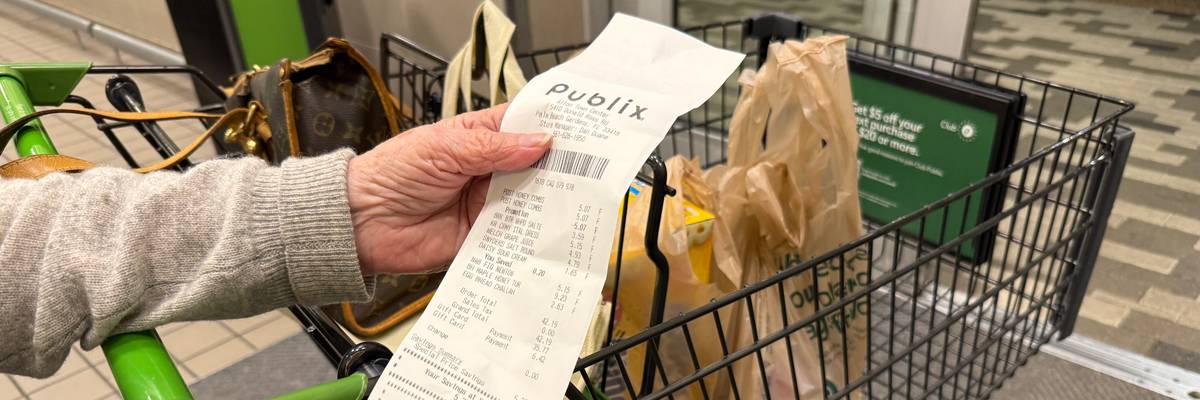
A shopper reviews her receipt after shopping at a Florida Publix supermarket on February 3, 2026.
"Big businesses that get refunds need to get the money back to their customers; ‘everyday low prices’ is not the way to do it," said US Sen. Ed Markey.
The Trump administration on Monday launched a portal designed to facilitate refunds on around $166 billion taken in from tariffs that the US Supreme Court struck down as unconstitutional earlier this year.
But only businesses that directly paid President Donald Trump's sweeping import taxes are eligible for relief—not the millions of Americans who paid higher prices as a result of the illegal tariffs. As The New York Times observed, "The extent to which consumers realize any gain hinges on whether businesses share the proceeds, something that few have publicly committed to do."
US Sen. Ed Markey (D-Mass.), the top Democrat on the Senate Small Business and Entrepreneurship Committee, said in a statement Monday that big corporations that passed tariff costs onto consumers are set to "benefit the most" from the Trump administration's refund system, given that they are better-equipped to deal with the complicated application process and potential issues with the newly created portal.
Markey faulted the administration for its "shortsighted decision to not issue automatic refunds," instead choosing a convoluted application system that's expected to face issues due to massive demand. The Associated Press noted that "companies must submit declarations listing the goods on which they collectively put billions of dollars toward the import taxes the court subsequently struck down."
"If [Customs and Border Protection] approves a claim, it will take 60 to 90 days for a refund to be issued," the outlet observed. "The government expects to process refunds in phases, however, focusing first on more recent tariff payments. Any number of technical factors and procedural issues could delay an importer’s application, so any reimbursements businesses plan to make to customers likely would trickle down slowly."
"Big businesses must help ease the ongoing affordability crisis by passing on any refund savings they receive to customers and small businesses."
Democrats on the congressional Joint Economic Committee (JEC) estimated that, prior to the US Supreme Court's ruling in February, Trump's tariffs had cost US families over $1,700 each. Overall, American consumers paid more than $231 billion in tariff costs from February 2025 to January 2026, according to the JEC.
Markey said Monday that “American small businesses and families deserve to get their money back with interest."
"Big businesses that get refunds need to get the money back to their customers; ‘everyday low prices’ is not the way to do it," the senator said. "There must be no further delay or complicated hoops to jump through. CBP must ensure quick and easy refunds without further documentation. Big businesses must help ease the ongoing affordability crisis by passing on any refund savings they receive to customers and small businesses who paid them rather than waiting around for a rebate that may never come.”
Unlikely to receive relief from the Trump administration, some consumers harmed by tariffs are taking legal action against corporations that jacked up prices.
The American Prospect reported Monday that "while companies are pursuing tariff refunds and the Trump administration is levying new global tariffs to replace what was struck down, some consumers are filing their own lawsuits seeking relief for higher prices paid because of tariffs."
"Lawsuits have been filed against at least five corporations that plaintiffs say raised prices to pay for tariffs—costs set to be refunded to companies," the Prospect noted. "The proposed class action suits target Costco, EssilorLuxottica (the maker of Ray-Ban sunglasses), activewear company Fabletics, UPS, and FedEx."
Dear Common Dreams reader, It’s been nearly 30 years since I co-founded Common Dreams with my late wife, Lina Newhouser. We had the radical notion that journalism should serve the public good, not corporate profits. It was clear to us from the outset what it would take to build such a project. No paid advertisements. No corporate sponsors. No millionaire publisher telling us what to think or do. Many people said we wouldn't last a year, but we proved those doubters wrong. Together with a tremendous team of journalists and dedicated staff, we built an independent media outlet free from the constraints of profits and corporate control. Our mission has always been simple: To inform. To inspire. To ignite change for the common good. Building Common Dreams was not easy. Our survival was never guaranteed. When you take on the most powerful forces—Wall Street greed, fossil fuel industry destruction, Big Tech lobbyists, and uber-rich oligarchs who have spent billions upon billions rigging the economy and democracy in their favor—the only bulwark you have is supporters who believe in your work. But here’s the urgent message from me today. It's never been this bad out there. And it's never been this hard to keep us going. At the very moment Common Dreams is most needed, the threats we face are intensifying. We need your support now more than ever. We don't accept corporate advertising and never will. We don't have a paywall because we don't think people should be blocked from critical news based on their ability to pay. Everything we do is funded by the donations of readers like you. When everyone does the little they can afford, we are strong. But if that support retreats or dries up, so do we. Will you donate now to make sure Common Dreams not only survives but thrives? —Craig Brown, Co-founder |
The Trump administration on Monday launched a portal designed to facilitate refunds on around $166 billion taken in from tariffs that the US Supreme Court struck down as unconstitutional earlier this year.
But only businesses that directly paid President Donald Trump's sweeping import taxes are eligible for relief—not the millions of Americans who paid higher prices as a result of the illegal tariffs. As The New York Times observed, "The extent to which consumers realize any gain hinges on whether businesses share the proceeds, something that few have publicly committed to do."
US Sen. Ed Markey (D-Mass.), the top Democrat on the Senate Small Business and Entrepreneurship Committee, said in a statement Monday that big corporations that passed tariff costs onto consumers are set to "benefit the most" from the Trump administration's refund system, given that they are better-equipped to deal with the complicated application process and potential issues with the newly created portal.
Markey faulted the administration for its "shortsighted decision to not issue automatic refunds," instead choosing a convoluted application system that's expected to face issues due to massive demand. The Associated Press noted that "companies must submit declarations listing the goods on which they collectively put billions of dollars toward the import taxes the court subsequently struck down."
"If [Customs and Border Protection] approves a claim, it will take 60 to 90 days for a refund to be issued," the outlet observed. "The government expects to process refunds in phases, however, focusing first on more recent tariff payments. Any number of technical factors and procedural issues could delay an importer’s application, so any reimbursements businesses plan to make to customers likely would trickle down slowly."
"Big businesses must help ease the ongoing affordability crisis by passing on any refund savings they receive to customers and small businesses."
Democrats on the congressional Joint Economic Committee (JEC) estimated that, prior to the US Supreme Court's ruling in February, Trump's tariffs had cost US families over $1,700 each. Overall, American consumers paid more than $231 billion in tariff costs from February 2025 to January 2026, according to the JEC.
Markey said Monday that “American small businesses and families deserve to get their money back with interest."
"Big businesses that get refunds need to get the money back to their customers; ‘everyday low prices’ is not the way to do it," the senator said. "There must be no further delay or complicated hoops to jump through. CBP must ensure quick and easy refunds without further documentation. Big businesses must help ease the ongoing affordability crisis by passing on any refund savings they receive to customers and small businesses who paid them rather than waiting around for a rebate that may never come.”
Unlikely to receive relief from the Trump administration, some consumers harmed by tariffs are taking legal action against corporations that jacked up prices.
The American Prospect reported Monday that "while companies are pursuing tariff refunds and the Trump administration is levying new global tariffs to replace what was struck down, some consumers are filing their own lawsuits seeking relief for higher prices paid because of tariffs."
"Lawsuits have been filed against at least five corporations that plaintiffs say raised prices to pay for tariffs—costs set to be refunded to companies," the Prospect noted. "The proposed class action suits target Costco, EssilorLuxottica (the maker of Ray-Ban sunglasses), activewear company Fabletics, UPS, and FedEx."
The Trump administration on Monday launched a portal designed to facilitate refunds on around $166 billion taken in from tariffs that the US Supreme Court struck down as unconstitutional earlier this year.
But only businesses that directly paid President Donald Trump's sweeping import taxes are eligible for relief—not the millions of Americans who paid higher prices as a result of the illegal tariffs. As The New York Times observed, "The extent to which consumers realize any gain hinges on whether businesses share the proceeds, something that few have publicly committed to do."
US Sen. Ed Markey (D-Mass.), the top Democrat on the Senate Small Business and Entrepreneurship Committee, said in a statement Monday that big corporations that passed tariff costs onto consumers are set to "benefit the most" from the Trump administration's refund system, given that they are better-equipped to deal with the complicated application process and potential issues with the newly created portal.
Markey faulted the administration for its "shortsighted decision to not issue automatic refunds," instead choosing a convoluted application system that's expected to face issues due to massive demand. The Associated Press noted that "companies must submit declarations listing the goods on which they collectively put billions of dollars toward the import taxes the court subsequently struck down."
"If [Customs and Border Protection] approves a claim, it will take 60 to 90 days for a refund to be issued," the outlet observed. "The government expects to process refunds in phases, however, focusing first on more recent tariff payments. Any number of technical factors and procedural issues could delay an importer’s application, so any reimbursements businesses plan to make to customers likely would trickle down slowly."
"Big businesses must help ease the ongoing affordability crisis by passing on any refund savings they receive to customers and small businesses."
Democrats on the congressional Joint Economic Committee (JEC) estimated that, prior to the US Supreme Court's ruling in February, Trump's tariffs had cost US families over $1,700 each. Overall, American consumers paid more than $231 billion in tariff costs from February 2025 to January 2026, according to the JEC.
Markey said Monday that “American small businesses and families deserve to get their money back with interest."
"Big businesses that get refunds need to get the money back to their customers; ‘everyday low prices’ is not the way to do it," the senator said. "There must be no further delay or complicated hoops to jump through. CBP must ensure quick and easy refunds without further documentation. Big businesses must help ease the ongoing affordability crisis by passing on any refund savings they receive to customers and small businesses who paid them rather than waiting around for a rebate that may never come.”
Unlikely to receive relief from the Trump administration, some consumers harmed by tariffs are taking legal action against corporations that jacked up prices.
The American Prospect reported Monday that "while companies are pursuing tariff refunds and the Trump administration is levying new global tariffs to replace what was struck down, some consumers are filing their own lawsuits seeking relief for higher prices paid because of tariffs."
"Lawsuits have been filed against at least five corporations that plaintiffs say raised prices to pay for tariffs—costs set to be refunded to companies," the Prospect noted. "The proposed class action suits target Costco, EssilorLuxottica (the maker of Ray-Ban sunglasses), activewear company Fabletics, UPS, and FedEx."