SUBSCRIBE TO OUR FREE NEWSLETTER
Daily news & progressive opinion—funded by the people, not the corporations—delivered straight to your inbox.
5
#000000
#FFFFFF
To donate by check, phone, or other method, see our More Ways to Give page.
Daily news & progressive opinion—funded by the people, not the corporations—delivered straight to your inbox.
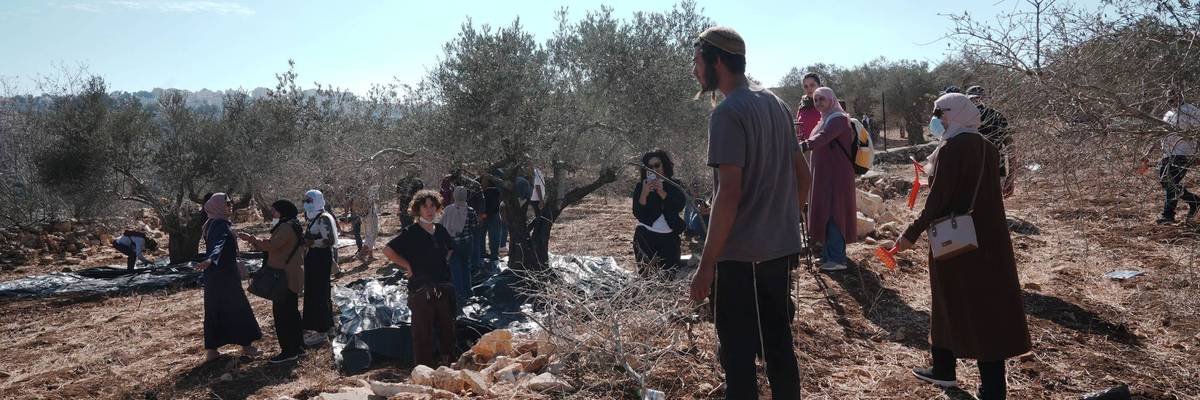
Jewish settlers argue with Palestinian farmers harvesting olives and activists supporting them and try to stop a group of people picking olives in Ramallah, West Bank on October 29, 2025.
Israeli Prime Minister Benjamin Netanyahu is a war criminal, but he is not the problem; he has overseen the genocide in Gaza, but he inherited a social and political order structured around Palestinian dispossession and erasure.
Israel has killed more than 1,300 Palestinians in Gaza since the so-called “ceasefire” took effect a year ago, more than the number of Israelis killed on October 7, 2023. The supposedly unlimited “right” to genocidal retaliation invoked ever since has left at least 74,000 dead.
This quotidian slaughter is not new. For years, it was normalized under the euphemism of “mowing the grass,” as Israel repeatedly brought its impunity and overwhelming military superiority to bear against a defenseless, besieged population: in 2008, 2012, 2014, 2018, and 2021.
As a result, a generation of Palestinians in Gaza has been condemned to life and death under the deadly gaze of an Israeli panopticon. Even before the latest escalation, they endured the constant hum of drones overhead; the repeated reduction of homes and entire neighborhoods to rubble; and the mourning of shattered lives, families, and futures. Each time, Israel invoked “self-defense.” Yet the staggering asymmetry of the violence told a different story.
Changing this unconscionable status quo requires confronting the history that produced it, challenging not only the notion that one individual is responsible, but the deeper myth that Zionism simply “went wrong.”
In Gaza, the fiction of “collateral damage” has reached its most grotesque inversion. The term has long been deployed to assuage Western consciences, casting our own violence as regrettable but invariably legitimate, while violence committed by others remains categorically inexcusable, even barbaric. Yet the purpose of such overwhelming force is clear: to make the price of resisting an illegal occupation unbearable, while American weapons and diplomatic protection ensure that Israel bears remarkably little of the cost.
And Gaza is but one front. Across Israel and the occupied territories, a system of apartheid is enforced through law, military rule, and state-backed settler violence. Beyond Palestine, Israel has repeatedly bombed its neighbors, terrorizing the region in the name of “counterterrorism.” As Palestinian Ambassador Majed Bamya captured this fundamental double standard before the United Nations Security Council: “Is there an international law for them, and an international law for us? Do they have the right to kill, and the only right we have is to die?”
The horrors of Gaza, and the scale of Western complicity, have begun to rupture the indifference that has long emboldened Israel’s unchecked exercise of military power. Public opinion is shifting, even as political elites struggle to contain it. This has often come at the expense of basic democratic principles, laying bare the contradictions at the heart of Western “liberalism.” Yet even some of Israel’s sharpest critics in mainstream US politics, such as Sen. Bernie Sanders (I-Vt.), have repeatedly and mistakenly located the problem in “Netanyahu’s extremist government.”
Israeli Prime Minister Benjamin Netanyahu is a war criminal. But he is not the problem. He did not invent the occupation or build apartheid alone. He has overseen the genocide in Gaza, but he inherited a social and political order structured around Palestinian dispossession and erasure. He may be forced out in coming elections. But the ideological forces that made him possible will remain. Changing this unconscionable status quo requires confronting the history that produced it, challenging not only the notion that one individual is responsible, but the deeper myth that Zionism simply “went wrong.”
From its origins in the late 19th century, Zionism was shaped by a colonial imagination that rendered Palestinians largely invisible, treating a country inhabited by an overwhelming Arab majority for at least 1,200 years as though it were terra nullius. Or, in the words of a popular Christian Zionist slogan of the day, “a land without a people for a people without a land.” But the Zionist ambition to create a Jewish homeland in a territory with a small Jewish minority raised an unavoidable question: What was to be done with the people already living there? The contradiction between Zionist territorial and demographic ambitions and Palestinian presence would shape the ensuing century of dispossession, conquest, and conflict.
It is in this sense that, as Patrick Wolfe famously observed, “The question of genocide is never far from discussions of settler colonialism.” Unlike traditional colonialism, which generally sought to dominate territories for the economic benefit of a distant metropole, settler colonialism seeks total societal transformation, remaking the conquered territory into a permanent home of a new settler state. “Territoriality,” or control over the land, is its “irreducible element,” and its underlying logic is not primarily one of exploitation but that of elimination. Settler colonialism, in short, “destroys to replace,” making invasion “not an event but a structure.”
“Every native population in the world,” Jabotinsky observed, “resists colonists as long as it has the slightest hope of being able to rid itself of the danger of being colonized.” That, he acknowledged, “is what the Arabs in Palestine are doing.”
In response to this characterization, Zionists often adopt the language of decolonization, recasting Zionism as the national liberation movement of an Indigenous people. It is true that Jews have a deep historical and religious connection to the land. It is true that Zionism was conceived as a national movement. And it is also true that virulent, increasingly eliminationist antisemitism across Europe made Jewish life increasingly untenable. But none of these facts negates Zionism’s colonial structure.
Nor did its founding ideologues necessarily disguise that reality. The “founding father” of political Zionism, Theodor Herzl, appealed to Cecil Rhodes for support for his movement precisely because it was “something colonial.” He further envisioned the prospective Jewish state as “a portion of a rampart of Europe against Asia, an outpost of civilization as opposed to barbarism.” Aptly named institutions, including the Jewish Colonization Association and the Jewish Colonial Trust, formed part of the movement’s political and financial infrastructure.
That colonial orientation helped Zionism secure the patronage of the British Empire. With the 1917 Balfour Declaration and British Mandate, London threw its imperial weight behind the creation of a Jewish “national home” for a largely European diasporic population. The national aspirations of the existing majority Palestinian population, indeed, even its existence as a people with political rights of its own, were denied outright. Britain’s support reflected not simply sympathy for Jewish self-determination, but a combination of geopolitics, antisemitism, and Christian philosemitism.
As historian Rashid Khalidi has argued, Britain thus enabled the Jewish community in Palestine to develop the institutional capacity of a proto-state while systematically subverting Palestinian nation-building efforts. When Palestinians revolted against this colonial order from 1936 to 1939, British forces, aided by Zionist militias, brutally suppressed the uprising. By its end, Khalidi notes, some “10% of the adult male population was killed, wounded, imprisoned, or exiled.”
Zionist leaders understood the roots of Palestinian resistance perfectly well. Ze’ev Jabotinsky, the ideological pioneer of Revisionist Zionism, from which much of the Israeli right traces its lineage, embraced territorial maximalism. Yet he was not ignorant to Palestinian aspirations. “Every native population in the world,” Jabotinsky observed, “resists colonists as long as it has the slightest hope of being able to rid itself of the danger of being colonized.” That, he acknowledged, “is what the Arabs in Palestine are doing.”
David Ben-Gurion, the mainstream leader of the pre-state Jewish community and Israel’s future first prime minister, similarly recognized the roots of the conflict. “Let us not ignore the truth among ourselves,” he remarked. “Politically we are the aggressors and they defend themselves.”
After World War II, a financially exhausted Britain, facing mounting anti-colonial pressures from India to Egypt and escalating anti-British violence by Zionist paramilitaries, abandoned Palestine and handed the problem to the newly established United Nations. The UN promised to serve as a new experiment in democratic internationalism, yet it remained profoundly shaped by the colonial order that it had inherited. Most colonized peoples still lacked representation when, in 1947, the General Assembly adopted Resolution 181, calling for the partition of Palestine into a Jewish state and an Arab territory.
This blunt instrument, deployed disastrously in Palestine and elsewhere, treated pluralism itself as a “problem” to be solved. Rooted in the colonial logic of divide and rule and a European conception of ethnonational citizenship, it cast the solution to communal conflict as demographic engineering: the pursuit of homogenization and the construction of “racially specific landscapes.”
Palestinians rejected partition. The Zionist leadership accepted it. But that familiar fact obscures the extraordinary concession Palestinians were being asked to make. Despite constituting some two-thirds of the population, they were expected to accept the creation of a Jewish state on more than half of the country, including some of its most densely populated and economically valuable regions.
As historian Walid Khalidi observed, this was hardly a choice at all. Instead, the Palestinian Arabs, he wrote, “were dubbed the aggressor for not meekly submitting to the dismemberment of their country.” Compounding this sense of injustice was the conviction among many Palestinians that they were, in effect, being asked to pay reparations for Europe’s crimes, crimes in which they had played no part.
In the war that followed, Zionist forces carried out expulsions and massacres that drove 750,000 Palestinians from their homes. As a result, the majority that were living within the territory that became Israel were forcibly displaced. Whether this came from a single, centrally directed policy remains historically disputed. But as Benny Morris has observed, soldiers did not require explicit instructions to understand the possibilities war had created. By 1948, “transfer was in the air.”
The Nakba transformed the human geography of Palestine. Israel emerged with a Jewish majority and control of 78% of historic Palestine, while the Palestinians who remained within its borders were reduced to a minority and subjected to the violence of military rule. The new state then set about making the wartime transformation permanent, above all by ensuring that those who had been expelled could not return.
In 1950, Israel enacted two laws that helped consolidate this new order. The Law of Return granted Jews in the diaspora citizenship in Israel, while the Absentees’ Property Law facilitated the state seizure of the land and homes belonging to Palestinians. Much of this property was subsequently redistributed to new Jewish immigrants and Holocaust survivors. Many moved into homes from which Palestinians had only recently been forcibly displaced, leaving behind their possessions and family photographs still hanging on the walls.
The imperative of maintaining Jewish political supremacy meant that the millions of Palestinians now brought under Israeli control could not be incorporated as equal citizens
While these catastrophes differed enormously in scope, scale, and character, the dissonance was nonetheless profound: Jews driven from expropriated homes in Europe were resettled in homes from which Palestinians had been expelled in the pursuit of another ethnonational project. Though largely repressed, the parallel did not go entirely unremarked. Israeli poet Avot Yeshurun captured this historical entanglement, writing that, in this sense, “the Holocaust of the Jews of Europe and the Holocaust of the Arabs of the Land of Israel are one Holocaust of the Jewish People.”
Nor did Palestinians simply accept their newfound condition of exile. Refugees repeatedly crossed the newly imposed borders, keys in hand, to return to their homes or tend their fields. Israeli forces responded with lethal force, killing thousands of Palestinians from 1949-1956, most unarmed. Resistance soon developed, which Israel regularly invoked to justify raids, reprisals, and collective punishment against Palestinian communities across their borders.
Violence, dispossession, and exile transformed the Palestinian refugee camps of neighboring states into crucibles of revolutionary nationalism. From this political ferment emerged political and militant organizations such as Fatah, the Palestine Liberation Organization, and the Popular Front for the Liberation of Palestine.
Then came the 1967 War. In six days, Israel seized the West Bank and East Jerusalem from Jordan, Gaza and the Sinai Peninsula from Egypt, and the Golan Heights from Syria. The Sinai would later be returned to Egypt under a land-for-peace agreement. Elsewhere, the conquest of territories associated with the biblical Land of Israel, was celebrated by many Israelis as nothing short of a “miracle,” unleashed a messianic fervor that invigorated the Israeli right.
Religiously and politically motivated settlers began moving into the occupied territories, creating irreversible “facts on the ground” that bound the land ever more tightly to Israel while intentionally foreclosing the possibility of future territorial compromise. At the same time, the imperative of maintaining Jewish political supremacy meant that the millions of Palestinians now brought under Israeli control could not be incorporated as equal citizens. Instead, they remained subjects of an occupying power, governed separately and unequally.
The settlement project, initially driven by religious ideologues and later expanded with the help of the state through subsidies and other economic incentives, steadily carved Palestinian territory into disconnected enclaves, divided by settlements, bypass roads, checkpoints, walls, and the military infrastructure that followed to sustain and protect them.
At the same time, Israel worked to suppress Palestinian political organization and national identity. Palestinian political organizations and political activity and expression were outlawed or severely repressed. Newspapers and publications were subjected to censorship. Flying the Palestinian flag was prohibited, and even artwork incorporating its colors could invite repression.
As this history has sought to demonstrate, Israel is an anachronistic settler-colonial project. What is required, then, is a belated decolonization.
Occupation reached deep into Palestinian life. A growing permit regime governed construction, movement, and access to land and resources. Wells and irrigation systems also required Israeli approval. Palestinians faced restrictions on activities ranging from fishing in their own waters to cultivating their own land. These restrictions were enforced not only by soldiers and settlers but through a Kafkaesque bureaucracy that made domination a feature of daily life.
By 1987, two decades of domination and humiliation erupted into the First Intifada, a spontaneous, decentralized, and overwhelmingly unarmed uprising. Palestinian engaged in civil disobedience. Israel responded with brutal force. Tens of thousands of Palestinians passed through Israeli prisons, while soldiers were ordered to break the bones of protesters, killing more than 1,000 Palestinians, including 240 children.
The violent repression of the Intifada created the conditions in which groups like Hamas emerged, much as Hezbollah had arisen in response to Israel’s 1982 invasion of Lebanon. Yet the uprising also demonstrated that permanent occupation could not continue without stimulating resistance, helping open the political process that culminated in the Oslo Accords starting in 1993.
Oslo, flawed from the outset and failing to confront many of the conflict’s fundamental questions, collided with powerful forces determined to prevent a negotiated settlement. In 1994, Israeli settler Baruch Goldstein entered Hebron’s Ibrahimi Mosque and massacred 29 worshipers (National Security Minister Itamar Ben-Gvir displayed a prominent photo of him in his living room for decades). This incident became a catalyst for Hamas’s turn toward suicide bombings, feeding an escalating cycle of violence that steadily eroded the political ground beneath Oslo.
Then, in 1995, an Israeli settler, Yigal Amir, assassinated prime minister Yitzhak Rabin. Amir was an extremist in his methods. But the belief that Israel was an inviolable trust of the Jewish people that animated him was hardly confined to the political fringe. Likud, led by Benjamin Netanyahu, has long rejected Palestinian statehood. Its 1977 party platform declared that “the right of the Jewish people to the land of Israel is eternal and indisputable” and “between the Sea and the Jordan there will only be Israeli sovereignty.”
Rabin’s was one of the most consequential assassinations in modern history. It dealt a devastating blow to a fragile, imperfect peace process and helped clear Netanyahu’s path to power. Netanyahu himself had participated in the incendiary political campaign against Oslo that portrayed Rabin as a traitor for negotiating with Palestinians.
In the decades since, Netanyahu’s cultivation of the ultranationalist and Jewish-supremacist forces that define Israel’s political mainstream has helped him maintain an extraordinary grip on power. Meanwhile, Western leaders sustain the fiction of a two-state solution, invoking it with ritualistic devotion even as successive Israeli governments expand apartheid, imprison prominent Palestinian leaders, kill with impunity, and reject Palestinian rights and sovereignty outright.
As this history has sought to demonstrate, Israel is an anachronistic settler-colonial project. What is required, then, is a belated decolonization. First and foremost, this means an immediate end to the genocide. But it also demands justice: the renunciation of Jewish supremacy, reparations for historical dispossession, accountability for past and present crimes, and the upholding of the right of return for Palestinian refugees.
That can only happen through the dismantling of the political and legal structures that make one people’s rights and freedom contingent on the denial of those same rights and freedoms to others. In short, it necessitates an end to Zionism as it has long been practiced as an exclusivist political project and the realization of a free Palestine, confronting the one-state reality as it is and pressing for its transformation into a genuine democratic state for all its citizens.
Dear Common Dreams reader, It’s been nearly 30 years since I co-founded Common Dreams with my late wife, Lina Newhouser. We had the radical notion that journalism should serve the public good, not corporate profits. It was clear to us from the outset what it would take to build such a project. No paid advertisements. No corporate sponsors. No millionaire publisher telling us what to think or do. Many people said we wouldn't last a year, but we proved those doubters wrong. Together with a tremendous team of journalists and dedicated staff, we built an independent media outlet free from the constraints of profits and corporate control. Our mission has always been simple: To inform. To inspire. To ignite change for the common good. Building Common Dreams was not easy. Our survival was never guaranteed. When you take on the most powerful forces—Wall Street greed, fossil fuel industry destruction, Big Tech lobbyists, and uber-rich oligarchs who have spent billions upon billions rigging the economy and democracy in their favor—the only bulwark you have is supporters who believe in your work. But here’s the urgent message from me today. It's never been this bad out there. And it's never been this hard to keep us going. At the very moment Common Dreams is most needed, the threats we face are intensifying. We need your support now more than ever. We don't accept corporate advertising and never will. We don't have a paywall because we don't think people should be blocked from critical news based on their ability to pay. Everything we do is funded by the donations of readers like you. When everyone does the little they can afford, we are strong. But if that support retreats or dries up, so do we. Will you donate now to make sure Common Dreams not only survives but thrives? —Craig Brown, Co-founder |
Israel has killed more than 1,300 Palestinians in Gaza since the so-called “ceasefire” took effect a year ago, more than the number of Israelis killed on October 7, 2023. The supposedly unlimited “right” to genocidal retaliation invoked ever since has left at least 74,000 dead.
This quotidian slaughter is not new. For years, it was normalized under the euphemism of “mowing the grass,” as Israel repeatedly brought its impunity and overwhelming military superiority to bear against a defenseless, besieged population: in 2008, 2012, 2014, 2018, and 2021.
As a result, a generation of Palestinians in Gaza has been condemned to life and death under the deadly gaze of an Israeli panopticon. Even before the latest escalation, they endured the constant hum of drones overhead; the repeated reduction of homes and entire neighborhoods to rubble; and the mourning of shattered lives, families, and futures. Each time, Israel invoked “self-defense.” Yet the staggering asymmetry of the violence told a different story.
Changing this unconscionable status quo requires confronting the history that produced it, challenging not only the notion that one individual is responsible, but the deeper myth that Zionism simply “went wrong.”
In Gaza, the fiction of “collateral damage” has reached its most grotesque inversion. The term has long been deployed to assuage Western consciences, casting our own violence as regrettable but invariably legitimate, while violence committed by others remains categorically inexcusable, even barbaric. Yet the purpose of such overwhelming force is clear: to make the price of resisting an illegal occupation unbearable, while American weapons and diplomatic protection ensure that Israel bears remarkably little of the cost.
And Gaza is but one front. Across Israel and the occupied territories, a system of apartheid is enforced through law, military rule, and state-backed settler violence. Beyond Palestine, Israel has repeatedly bombed its neighbors, terrorizing the region in the name of “counterterrorism.” As Palestinian Ambassador Majed Bamya captured this fundamental double standard before the United Nations Security Council: “Is there an international law for them, and an international law for us? Do they have the right to kill, and the only right we have is to die?”
The horrors of Gaza, and the scale of Western complicity, have begun to rupture the indifference that has long emboldened Israel’s unchecked exercise of military power. Public opinion is shifting, even as political elites struggle to contain it. This has often come at the expense of basic democratic principles, laying bare the contradictions at the heart of Western “liberalism.” Yet even some of Israel’s sharpest critics in mainstream US politics, such as Sen. Bernie Sanders (I-Vt.), have repeatedly and mistakenly located the problem in “Netanyahu’s extremist government.”
Israeli Prime Minister Benjamin Netanyahu is a war criminal. But he is not the problem. He did not invent the occupation or build apartheid alone. He has overseen the genocide in Gaza, but he inherited a social and political order structured around Palestinian dispossession and erasure. He may be forced out in coming elections. But the ideological forces that made him possible will remain. Changing this unconscionable status quo requires confronting the history that produced it, challenging not only the notion that one individual is responsible, but the deeper myth that Zionism simply “went wrong.”
From its origins in the late 19th century, Zionism was shaped by a colonial imagination that rendered Palestinians largely invisible, treating a country inhabited by an overwhelming Arab majority for at least 1,200 years as though it were terra nullius. Or, in the words of a popular Christian Zionist slogan of the day, “a land without a people for a people without a land.” But the Zionist ambition to create a Jewish homeland in a territory with a small Jewish minority raised an unavoidable question: What was to be done with the people already living there? The contradiction between Zionist territorial and demographic ambitions and Palestinian presence would shape the ensuing century of dispossession, conquest, and conflict.
It is in this sense that, as Patrick Wolfe famously observed, “The question of genocide is never far from discussions of settler colonialism.” Unlike traditional colonialism, which generally sought to dominate territories for the economic benefit of a distant metropole, settler colonialism seeks total societal transformation, remaking the conquered territory into a permanent home of a new settler state. “Territoriality,” or control over the land, is its “irreducible element,” and its underlying logic is not primarily one of exploitation but that of elimination. Settler colonialism, in short, “destroys to replace,” making invasion “not an event but a structure.”
“Every native population in the world,” Jabotinsky observed, “resists colonists as long as it has the slightest hope of being able to rid itself of the danger of being colonized.” That, he acknowledged, “is what the Arabs in Palestine are doing.”
In response to this characterization, Zionists often adopt the language of decolonization, recasting Zionism as the national liberation movement of an Indigenous people. It is true that Jews have a deep historical and religious connection to the land. It is true that Zionism was conceived as a national movement. And it is also true that virulent, increasingly eliminationist antisemitism across Europe made Jewish life increasingly untenable. But none of these facts negates Zionism’s colonial structure.
Nor did its founding ideologues necessarily disguise that reality. The “founding father” of political Zionism, Theodor Herzl, appealed to Cecil Rhodes for support for his movement precisely because it was “something colonial.” He further envisioned the prospective Jewish state as “a portion of a rampart of Europe against Asia, an outpost of civilization as opposed to barbarism.” Aptly named institutions, including the Jewish Colonization Association and the Jewish Colonial Trust, formed part of the movement’s political and financial infrastructure.
That colonial orientation helped Zionism secure the patronage of the British Empire. With the 1917 Balfour Declaration and British Mandate, London threw its imperial weight behind the creation of a Jewish “national home” for a largely European diasporic population. The national aspirations of the existing majority Palestinian population, indeed, even its existence as a people with political rights of its own, were denied outright. Britain’s support reflected not simply sympathy for Jewish self-determination, but a combination of geopolitics, antisemitism, and Christian philosemitism.
As historian Rashid Khalidi has argued, Britain thus enabled the Jewish community in Palestine to develop the institutional capacity of a proto-state while systematically subverting Palestinian nation-building efforts. When Palestinians revolted against this colonial order from 1936 to 1939, British forces, aided by Zionist militias, brutally suppressed the uprising. By its end, Khalidi notes, some “10% of the adult male population was killed, wounded, imprisoned, or exiled.”
Zionist leaders understood the roots of Palestinian resistance perfectly well. Ze’ev Jabotinsky, the ideological pioneer of Revisionist Zionism, from which much of the Israeli right traces its lineage, embraced territorial maximalism. Yet he was not ignorant to Palestinian aspirations. “Every native population in the world,” Jabotinsky observed, “resists colonists as long as it has the slightest hope of being able to rid itself of the danger of being colonized.” That, he acknowledged, “is what the Arabs in Palestine are doing.”
David Ben-Gurion, the mainstream leader of the pre-state Jewish community and Israel’s future first prime minister, similarly recognized the roots of the conflict. “Let us not ignore the truth among ourselves,” he remarked. “Politically we are the aggressors and they defend themselves.”
After World War II, a financially exhausted Britain, facing mounting anti-colonial pressures from India to Egypt and escalating anti-British violence by Zionist paramilitaries, abandoned Palestine and handed the problem to the newly established United Nations. The UN promised to serve as a new experiment in democratic internationalism, yet it remained profoundly shaped by the colonial order that it had inherited. Most colonized peoples still lacked representation when, in 1947, the General Assembly adopted Resolution 181, calling for the partition of Palestine into a Jewish state and an Arab territory.
This blunt instrument, deployed disastrously in Palestine and elsewhere, treated pluralism itself as a “problem” to be solved. Rooted in the colonial logic of divide and rule and a European conception of ethnonational citizenship, it cast the solution to communal conflict as demographic engineering: the pursuit of homogenization and the construction of “racially specific landscapes.”
Palestinians rejected partition. The Zionist leadership accepted it. But that familiar fact obscures the extraordinary concession Palestinians were being asked to make. Despite constituting some two-thirds of the population, they were expected to accept the creation of a Jewish state on more than half of the country, including some of its most densely populated and economically valuable regions.
As historian Walid Khalidi observed, this was hardly a choice at all. Instead, the Palestinian Arabs, he wrote, “were dubbed the aggressor for not meekly submitting to the dismemberment of their country.” Compounding this sense of injustice was the conviction among many Palestinians that they were, in effect, being asked to pay reparations for Europe’s crimes, crimes in which they had played no part.
In the war that followed, Zionist forces carried out expulsions and massacres that drove 750,000 Palestinians from their homes. As a result, the majority that were living within the territory that became Israel were forcibly displaced. Whether this came from a single, centrally directed policy remains historically disputed. But as Benny Morris has observed, soldiers did not require explicit instructions to understand the possibilities war had created. By 1948, “transfer was in the air.”
The Nakba transformed the human geography of Palestine. Israel emerged with a Jewish majority and control of 78% of historic Palestine, while the Palestinians who remained within its borders were reduced to a minority and subjected to the violence of military rule. The new state then set about making the wartime transformation permanent, above all by ensuring that those who had been expelled could not return.
In 1950, Israel enacted two laws that helped consolidate this new order. The Law of Return granted Jews in the diaspora citizenship in Israel, while the Absentees’ Property Law facilitated the state seizure of the land and homes belonging to Palestinians. Much of this property was subsequently redistributed to new Jewish immigrants and Holocaust survivors. Many moved into homes from which Palestinians had only recently been forcibly displaced, leaving behind their possessions and family photographs still hanging on the walls.
The imperative of maintaining Jewish political supremacy meant that the millions of Palestinians now brought under Israeli control could not be incorporated as equal citizens
While these catastrophes differed enormously in scope, scale, and character, the dissonance was nonetheless profound: Jews driven from expropriated homes in Europe were resettled in homes from which Palestinians had been expelled in the pursuit of another ethnonational project. Though largely repressed, the parallel did not go entirely unremarked. Israeli poet Avot Yeshurun captured this historical entanglement, writing that, in this sense, “the Holocaust of the Jews of Europe and the Holocaust of the Arabs of the Land of Israel are one Holocaust of the Jewish People.”
Nor did Palestinians simply accept their newfound condition of exile. Refugees repeatedly crossed the newly imposed borders, keys in hand, to return to their homes or tend their fields. Israeli forces responded with lethal force, killing thousands of Palestinians from 1949-1956, most unarmed. Resistance soon developed, which Israel regularly invoked to justify raids, reprisals, and collective punishment against Palestinian communities across their borders.
Violence, dispossession, and exile transformed the Palestinian refugee camps of neighboring states into crucibles of revolutionary nationalism. From this political ferment emerged political and militant organizations such as Fatah, the Palestine Liberation Organization, and the Popular Front for the Liberation of Palestine.
Then came the 1967 War. In six days, Israel seized the West Bank and East Jerusalem from Jordan, Gaza and the Sinai Peninsula from Egypt, and the Golan Heights from Syria. The Sinai would later be returned to Egypt under a land-for-peace agreement. Elsewhere, the conquest of territories associated with the biblical Land of Israel, was celebrated by many Israelis as nothing short of a “miracle,” unleashed a messianic fervor that invigorated the Israeli right.
Religiously and politically motivated settlers began moving into the occupied territories, creating irreversible “facts on the ground” that bound the land ever more tightly to Israel while intentionally foreclosing the possibility of future territorial compromise. At the same time, the imperative of maintaining Jewish political supremacy meant that the millions of Palestinians now brought under Israeli control could not be incorporated as equal citizens. Instead, they remained subjects of an occupying power, governed separately and unequally.
The settlement project, initially driven by religious ideologues and later expanded with the help of the state through subsidies and other economic incentives, steadily carved Palestinian territory into disconnected enclaves, divided by settlements, bypass roads, checkpoints, walls, and the military infrastructure that followed to sustain and protect them.
At the same time, Israel worked to suppress Palestinian political organization and national identity. Palestinian political organizations and political activity and expression were outlawed or severely repressed. Newspapers and publications were subjected to censorship. Flying the Palestinian flag was prohibited, and even artwork incorporating its colors could invite repression.
As this history has sought to demonstrate, Israel is an anachronistic settler-colonial project. What is required, then, is a belated decolonization.
Occupation reached deep into Palestinian life. A growing permit regime governed construction, movement, and access to land and resources. Wells and irrigation systems also required Israeli approval. Palestinians faced restrictions on activities ranging from fishing in their own waters to cultivating their own land. These restrictions were enforced not only by soldiers and settlers but through a Kafkaesque bureaucracy that made domination a feature of daily life.
By 1987, two decades of domination and humiliation erupted into the First Intifada, a spontaneous, decentralized, and overwhelmingly unarmed uprising. Palestinian engaged in civil disobedience. Israel responded with brutal force. Tens of thousands of Palestinians passed through Israeli prisons, while soldiers were ordered to break the bones of protesters, killing more than 1,000 Palestinians, including 240 children.
The violent repression of the Intifada created the conditions in which groups like Hamas emerged, much as Hezbollah had arisen in response to Israel’s 1982 invasion of Lebanon. Yet the uprising also demonstrated that permanent occupation could not continue without stimulating resistance, helping open the political process that culminated in the Oslo Accords starting in 1993.
Oslo, flawed from the outset and failing to confront many of the conflict’s fundamental questions, collided with powerful forces determined to prevent a negotiated settlement. In 1994, Israeli settler Baruch Goldstein entered Hebron’s Ibrahimi Mosque and massacred 29 worshipers (National Security Minister Itamar Ben-Gvir displayed a prominent photo of him in his living room for decades). This incident became a catalyst for Hamas’s turn toward suicide bombings, feeding an escalating cycle of violence that steadily eroded the political ground beneath Oslo.
Then, in 1995, an Israeli settler, Yigal Amir, assassinated prime minister Yitzhak Rabin. Amir was an extremist in his methods. But the belief that Israel was an inviolable trust of the Jewish people that animated him was hardly confined to the political fringe. Likud, led by Benjamin Netanyahu, has long rejected Palestinian statehood. Its 1977 party platform declared that “the right of the Jewish people to the land of Israel is eternal and indisputable” and “between the Sea and the Jordan there will only be Israeli sovereignty.”
Rabin’s was one of the most consequential assassinations in modern history. It dealt a devastating blow to a fragile, imperfect peace process and helped clear Netanyahu’s path to power. Netanyahu himself had participated in the incendiary political campaign against Oslo that portrayed Rabin as a traitor for negotiating with Palestinians.
In the decades since, Netanyahu’s cultivation of the ultranationalist and Jewish-supremacist forces that define Israel’s political mainstream has helped him maintain an extraordinary grip on power. Meanwhile, Western leaders sustain the fiction of a two-state solution, invoking it with ritualistic devotion even as successive Israeli governments expand apartheid, imprison prominent Palestinian leaders, kill with impunity, and reject Palestinian rights and sovereignty outright.
As this history has sought to demonstrate, Israel is an anachronistic settler-colonial project. What is required, then, is a belated decolonization. First and foremost, this means an immediate end to the genocide. But it also demands justice: the renunciation of Jewish supremacy, reparations for historical dispossession, accountability for past and present crimes, and the upholding of the right of return for Palestinian refugees.
That can only happen through the dismantling of the political and legal structures that make one people’s rights and freedom contingent on the denial of those same rights and freedoms to others. In short, it necessitates an end to Zionism as it has long been practiced as an exclusivist political project and the realization of a free Palestine, confronting the one-state reality as it is and pressing for its transformation into a genuine democratic state for all its citizens.
Israel has killed more than 1,300 Palestinians in Gaza since the so-called “ceasefire” took effect a year ago, more than the number of Israelis killed on October 7, 2023. The supposedly unlimited “right” to genocidal retaliation invoked ever since has left at least 74,000 dead.
This quotidian slaughter is not new. For years, it was normalized under the euphemism of “mowing the grass,” as Israel repeatedly brought its impunity and overwhelming military superiority to bear against a defenseless, besieged population: in 2008, 2012, 2014, 2018, and 2021.
As a result, a generation of Palestinians in Gaza has been condemned to life and death under the deadly gaze of an Israeli panopticon. Even before the latest escalation, they endured the constant hum of drones overhead; the repeated reduction of homes and entire neighborhoods to rubble; and the mourning of shattered lives, families, and futures. Each time, Israel invoked “self-defense.” Yet the staggering asymmetry of the violence told a different story.
Changing this unconscionable status quo requires confronting the history that produced it, challenging not only the notion that one individual is responsible, but the deeper myth that Zionism simply “went wrong.”
In Gaza, the fiction of “collateral damage” has reached its most grotesque inversion. The term has long been deployed to assuage Western consciences, casting our own violence as regrettable but invariably legitimate, while violence committed by others remains categorically inexcusable, even barbaric. Yet the purpose of such overwhelming force is clear: to make the price of resisting an illegal occupation unbearable, while American weapons and diplomatic protection ensure that Israel bears remarkably little of the cost.
And Gaza is but one front. Across Israel and the occupied territories, a system of apartheid is enforced through law, military rule, and state-backed settler violence. Beyond Palestine, Israel has repeatedly bombed its neighbors, terrorizing the region in the name of “counterterrorism.” As Palestinian Ambassador Majed Bamya captured this fundamental double standard before the United Nations Security Council: “Is there an international law for them, and an international law for us? Do they have the right to kill, and the only right we have is to die?”
The horrors of Gaza, and the scale of Western complicity, have begun to rupture the indifference that has long emboldened Israel’s unchecked exercise of military power. Public opinion is shifting, even as political elites struggle to contain it. This has often come at the expense of basic democratic principles, laying bare the contradictions at the heart of Western “liberalism.” Yet even some of Israel’s sharpest critics in mainstream US politics, such as Sen. Bernie Sanders (I-Vt.), have repeatedly and mistakenly located the problem in “Netanyahu’s extremist government.”
Israeli Prime Minister Benjamin Netanyahu is a war criminal. But he is not the problem. He did not invent the occupation or build apartheid alone. He has overseen the genocide in Gaza, but he inherited a social and political order structured around Palestinian dispossession and erasure. He may be forced out in coming elections. But the ideological forces that made him possible will remain. Changing this unconscionable status quo requires confronting the history that produced it, challenging not only the notion that one individual is responsible, but the deeper myth that Zionism simply “went wrong.”
From its origins in the late 19th century, Zionism was shaped by a colonial imagination that rendered Palestinians largely invisible, treating a country inhabited by an overwhelming Arab majority for at least 1,200 years as though it were terra nullius. Or, in the words of a popular Christian Zionist slogan of the day, “a land without a people for a people without a land.” But the Zionist ambition to create a Jewish homeland in a territory with a small Jewish minority raised an unavoidable question: What was to be done with the people already living there? The contradiction between Zionist territorial and demographic ambitions and Palestinian presence would shape the ensuing century of dispossession, conquest, and conflict.
It is in this sense that, as Patrick Wolfe famously observed, “The question of genocide is never far from discussions of settler colonialism.” Unlike traditional colonialism, which generally sought to dominate territories for the economic benefit of a distant metropole, settler colonialism seeks total societal transformation, remaking the conquered territory into a permanent home of a new settler state. “Territoriality,” or control over the land, is its “irreducible element,” and its underlying logic is not primarily one of exploitation but that of elimination. Settler colonialism, in short, “destroys to replace,” making invasion “not an event but a structure.”
“Every native population in the world,” Jabotinsky observed, “resists colonists as long as it has the slightest hope of being able to rid itself of the danger of being colonized.” That, he acknowledged, “is what the Arabs in Palestine are doing.”
In response to this characterization, Zionists often adopt the language of decolonization, recasting Zionism as the national liberation movement of an Indigenous people. It is true that Jews have a deep historical and religious connection to the land. It is true that Zionism was conceived as a national movement. And it is also true that virulent, increasingly eliminationist antisemitism across Europe made Jewish life increasingly untenable. But none of these facts negates Zionism’s colonial structure.
Nor did its founding ideologues necessarily disguise that reality. The “founding father” of political Zionism, Theodor Herzl, appealed to Cecil Rhodes for support for his movement precisely because it was “something colonial.” He further envisioned the prospective Jewish state as “a portion of a rampart of Europe against Asia, an outpost of civilization as opposed to barbarism.” Aptly named institutions, including the Jewish Colonization Association and the Jewish Colonial Trust, formed part of the movement’s political and financial infrastructure.
That colonial orientation helped Zionism secure the patronage of the British Empire. With the 1917 Balfour Declaration and British Mandate, London threw its imperial weight behind the creation of a Jewish “national home” for a largely European diasporic population. The national aspirations of the existing majority Palestinian population, indeed, even its existence as a people with political rights of its own, were denied outright. Britain’s support reflected not simply sympathy for Jewish self-determination, but a combination of geopolitics, antisemitism, and Christian philosemitism.
As historian Rashid Khalidi has argued, Britain thus enabled the Jewish community in Palestine to develop the institutional capacity of a proto-state while systematically subverting Palestinian nation-building efforts. When Palestinians revolted against this colonial order from 1936 to 1939, British forces, aided by Zionist militias, brutally suppressed the uprising. By its end, Khalidi notes, some “10% of the adult male population was killed, wounded, imprisoned, or exiled.”
Zionist leaders understood the roots of Palestinian resistance perfectly well. Ze’ev Jabotinsky, the ideological pioneer of Revisionist Zionism, from which much of the Israeli right traces its lineage, embraced territorial maximalism. Yet he was not ignorant to Palestinian aspirations. “Every native population in the world,” Jabotinsky observed, “resists colonists as long as it has the slightest hope of being able to rid itself of the danger of being colonized.” That, he acknowledged, “is what the Arabs in Palestine are doing.”
David Ben-Gurion, the mainstream leader of the pre-state Jewish community and Israel’s future first prime minister, similarly recognized the roots of the conflict. “Let us not ignore the truth among ourselves,” he remarked. “Politically we are the aggressors and they defend themselves.”
After World War II, a financially exhausted Britain, facing mounting anti-colonial pressures from India to Egypt and escalating anti-British violence by Zionist paramilitaries, abandoned Palestine and handed the problem to the newly established United Nations. The UN promised to serve as a new experiment in democratic internationalism, yet it remained profoundly shaped by the colonial order that it had inherited. Most colonized peoples still lacked representation when, in 1947, the General Assembly adopted Resolution 181, calling for the partition of Palestine into a Jewish state and an Arab territory.
This blunt instrument, deployed disastrously in Palestine and elsewhere, treated pluralism itself as a “problem” to be solved. Rooted in the colonial logic of divide and rule and a European conception of ethnonational citizenship, it cast the solution to communal conflict as demographic engineering: the pursuit of homogenization and the construction of “racially specific landscapes.”
Palestinians rejected partition. The Zionist leadership accepted it. But that familiar fact obscures the extraordinary concession Palestinians were being asked to make. Despite constituting some two-thirds of the population, they were expected to accept the creation of a Jewish state on more than half of the country, including some of its most densely populated and economically valuable regions.
As historian Walid Khalidi observed, this was hardly a choice at all. Instead, the Palestinian Arabs, he wrote, “were dubbed the aggressor for not meekly submitting to the dismemberment of their country.” Compounding this sense of injustice was the conviction among many Palestinians that they were, in effect, being asked to pay reparations for Europe’s crimes, crimes in which they had played no part.
In the war that followed, Zionist forces carried out expulsions and massacres that drove 750,000 Palestinians from their homes. As a result, the majority that were living within the territory that became Israel were forcibly displaced. Whether this came from a single, centrally directed policy remains historically disputed. But as Benny Morris has observed, soldiers did not require explicit instructions to understand the possibilities war had created. By 1948, “transfer was in the air.”
The Nakba transformed the human geography of Palestine. Israel emerged with a Jewish majority and control of 78% of historic Palestine, while the Palestinians who remained within its borders were reduced to a minority and subjected to the violence of military rule. The new state then set about making the wartime transformation permanent, above all by ensuring that those who had been expelled could not return.
In 1950, Israel enacted two laws that helped consolidate this new order. The Law of Return granted Jews in the diaspora citizenship in Israel, while the Absentees’ Property Law facilitated the state seizure of the land and homes belonging to Palestinians. Much of this property was subsequently redistributed to new Jewish immigrants and Holocaust survivors. Many moved into homes from which Palestinians had only recently been forcibly displaced, leaving behind their possessions and family photographs still hanging on the walls.
The imperative of maintaining Jewish political supremacy meant that the millions of Palestinians now brought under Israeli control could not be incorporated as equal citizens
While these catastrophes differed enormously in scope, scale, and character, the dissonance was nonetheless profound: Jews driven from expropriated homes in Europe were resettled in homes from which Palestinians had been expelled in the pursuit of another ethnonational project. Though largely repressed, the parallel did not go entirely unremarked. Israeli poet Avot Yeshurun captured this historical entanglement, writing that, in this sense, “the Holocaust of the Jews of Europe and the Holocaust of the Arabs of the Land of Israel are one Holocaust of the Jewish People.”
Nor did Palestinians simply accept their newfound condition of exile. Refugees repeatedly crossed the newly imposed borders, keys in hand, to return to their homes or tend their fields. Israeli forces responded with lethal force, killing thousands of Palestinians from 1949-1956, most unarmed. Resistance soon developed, which Israel regularly invoked to justify raids, reprisals, and collective punishment against Palestinian communities across their borders.
Violence, dispossession, and exile transformed the Palestinian refugee camps of neighboring states into crucibles of revolutionary nationalism. From this political ferment emerged political and militant organizations such as Fatah, the Palestine Liberation Organization, and the Popular Front for the Liberation of Palestine.
Then came the 1967 War. In six days, Israel seized the West Bank and East Jerusalem from Jordan, Gaza and the Sinai Peninsula from Egypt, and the Golan Heights from Syria. The Sinai would later be returned to Egypt under a land-for-peace agreement. Elsewhere, the conquest of territories associated with the biblical Land of Israel, was celebrated by many Israelis as nothing short of a “miracle,” unleashed a messianic fervor that invigorated the Israeli right.
Religiously and politically motivated settlers began moving into the occupied territories, creating irreversible “facts on the ground” that bound the land ever more tightly to Israel while intentionally foreclosing the possibility of future territorial compromise. At the same time, the imperative of maintaining Jewish political supremacy meant that the millions of Palestinians now brought under Israeli control could not be incorporated as equal citizens. Instead, they remained subjects of an occupying power, governed separately and unequally.
The settlement project, initially driven by religious ideologues and later expanded with the help of the state through subsidies and other economic incentives, steadily carved Palestinian territory into disconnected enclaves, divided by settlements, bypass roads, checkpoints, walls, and the military infrastructure that followed to sustain and protect them.
At the same time, Israel worked to suppress Palestinian political organization and national identity. Palestinian political organizations and political activity and expression were outlawed or severely repressed. Newspapers and publications were subjected to censorship. Flying the Palestinian flag was prohibited, and even artwork incorporating its colors could invite repression.
As this history has sought to demonstrate, Israel is an anachronistic settler-colonial project. What is required, then, is a belated decolonization.
Occupation reached deep into Palestinian life. A growing permit regime governed construction, movement, and access to land and resources. Wells and irrigation systems also required Israeli approval. Palestinians faced restrictions on activities ranging from fishing in their own waters to cultivating their own land. These restrictions were enforced not only by soldiers and settlers but through a Kafkaesque bureaucracy that made domination a feature of daily life.
By 1987, two decades of domination and humiliation erupted into the First Intifada, a spontaneous, decentralized, and overwhelmingly unarmed uprising. Palestinian engaged in civil disobedience. Israel responded with brutal force. Tens of thousands of Palestinians passed through Israeli prisons, while soldiers were ordered to break the bones of protesters, killing more than 1,000 Palestinians, including 240 children.
The violent repression of the Intifada created the conditions in which groups like Hamas emerged, much as Hezbollah had arisen in response to Israel’s 1982 invasion of Lebanon. Yet the uprising also demonstrated that permanent occupation could not continue without stimulating resistance, helping open the political process that culminated in the Oslo Accords starting in 1993.
Oslo, flawed from the outset and failing to confront many of the conflict’s fundamental questions, collided with powerful forces determined to prevent a negotiated settlement. In 1994, Israeli settler Baruch Goldstein entered Hebron’s Ibrahimi Mosque and massacred 29 worshipers (National Security Minister Itamar Ben-Gvir displayed a prominent photo of him in his living room for decades). This incident became a catalyst for Hamas’s turn toward suicide bombings, feeding an escalating cycle of violence that steadily eroded the political ground beneath Oslo.
Then, in 1995, an Israeli settler, Yigal Amir, assassinated prime minister Yitzhak Rabin. Amir was an extremist in his methods. But the belief that Israel was an inviolable trust of the Jewish people that animated him was hardly confined to the political fringe. Likud, led by Benjamin Netanyahu, has long rejected Palestinian statehood. Its 1977 party platform declared that “the right of the Jewish people to the land of Israel is eternal and indisputable” and “between the Sea and the Jordan there will only be Israeli sovereignty.”
Rabin’s was one of the most consequential assassinations in modern history. It dealt a devastating blow to a fragile, imperfect peace process and helped clear Netanyahu’s path to power. Netanyahu himself had participated in the incendiary political campaign against Oslo that portrayed Rabin as a traitor for negotiating with Palestinians.
In the decades since, Netanyahu’s cultivation of the ultranationalist and Jewish-supremacist forces that define Israel’s political mainstream has helped him maintain an extraordinary grip on power. Meanwhile, Western leaders sustain the fiction of a two-state solution, invoking it with ritualistic devotion even as successive Israeli governments expand apartheid, imprison prominent Palestinian leaders, kill with impunity, and reject Palestinian rights and sovereignty outright.
As this history has sought to demonstrate, Israel is an anachronistic settler-colonial project. What is required, then, is a belated decolonization. First and foremost, this means an immediate end to the genocide. But it also demands justice: the renunciation of Jewish supremacy, reparations for historical dispossession, accountability for past and present crimes, and the upholding of the right of return for Palestinian refugees.
That can only happen through the dismantling of the political and legal structures that make one people’s rights and freedom contingent on the denial of those same rights and freedoms to others. In short, it necessitates an end to Zionism as it has long been practiced as an exclusivist political project and the realization of a free Palestine, confronting the one-state reality as it is and pressing for its transformation into a genuine democratic state for all its citizens.