
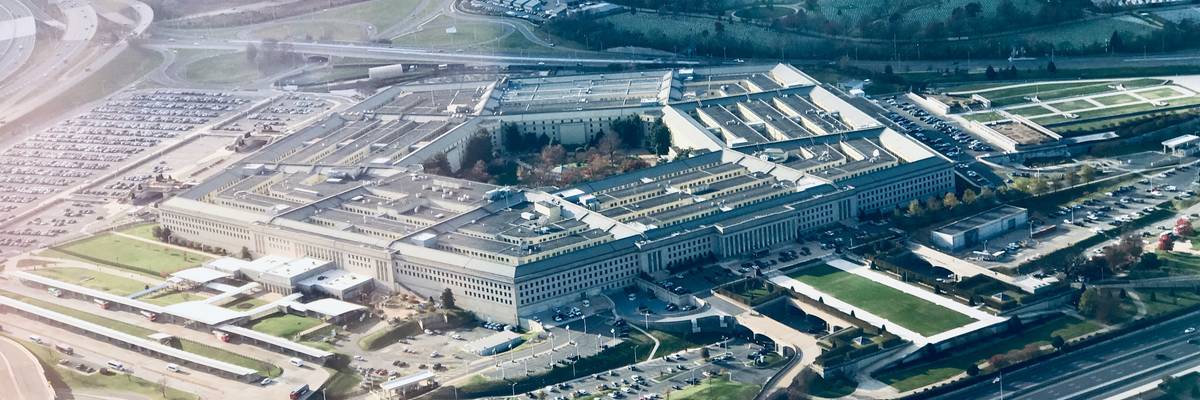
An aerial view shows the Department of Defense, the cornerstone of United States defense.
Why Does the Pentagon Seem to Be Spending More for Less?
One has to wonder how on Earth the Pentagon needs more money to not fight wars than it did to fight two of them at the same time.
As US Congress returns from its summer recess, Washington’s attention is turning toward a possible government shutdown.
While much of the focus will be on a showdown between Senate Democrats and President Donald Trump, a subplot is brewing as the House and Senate, led by Republicans but supported by far too many Democrats, fight over how big the Pentagon’s budget should be. The House voted to give Trump his requested trillion dollar budget, while the Senate is demanding $22 billion more.
To justify this historic largesse, both Trump and Congress give the same reason: peace through strength. Harkening back to Ronald Reagan’s Cold War military spending spree, today its invocation often boils down to one simple idea: Give the Pentagon more money. But, since Reagan’s famed buildup actually cost much less, it's worth asking if the problem really is a lack of funds
Four decades ago, the newest aircraft carrier in the fleet was the USS Theodore Roosevelt. It was a remarkable acquisition project coming in a full 16 months early and more than $80 million under budget. Today, the latest carrier, the USS Gerald Ford, was billions of dollars over budget and years behind schedule. And even after adjusting for inflation, the Ford class carriers are also much more expensive than the Nimitz class they are replacing, and costs may keep going up. And those costs come before even asking if the ships are actually matched to the military’s current needs, let alone for the decades ahead they’ll be in use.
Sadly, this cost explosion and questionable alignment with modern warfare are far from unique to carriers. A quick Google search for the F-35, Littoral Combat Ship, Sentinel ICBM, or any number of other recent boondoggles tells the same story. Today, nearly every Pentagon acquisition program is a mess, coming in late, over budget, and significantly more expensive than the weapons and platforms being replaced.
This collapse into dysfunction of the Pentagon’s procurement system cannot be ascribed to a lack of funding. Despite a genuine drop in spending following the end of the Cold War, the Pentagon is now nearly two and a half decades into an unprecedented era of massive budgets. More money hasn’t solved this problem, and there’s zero reason to think even more will do anything but make it worse.
Before going further, it’s worth examining two of the most common justifications for why costs have skyrocketed: technology and personnel.
There’s a decent chance you’re reading this on a smartphone like the iPhone, a remarkable encapsulation of just how dramatically technology has increased in power and decreased in costs over the past 40 years. In 1985, the CRAY-2 was the world’s most powerful super computer. It cost between $35-50 million (adjusted for inflation) and weighed nearly 3 tons. Instead, that iPhone in your hand weighs a few ounces, costs around $1,000, and is thousands of times more powerful. Oh, and it also makes phone calls, plays music, takes photos and videos, lets you surf the internet, and much more.
When you put it all together, Washington has some tough questions to ask about the Pentagon’s budget, and one of those questions should not be, “Can we add $22 billion more?”
Put another way, you have far more computing power in your pocket than the entire US military did four decades ago, and you didn’t even need a multi-billion-dollar spending spree to get it. Yet somehow, every time someone tries to explain why the Pentagon needs a trillion dollars today, the inevitable answer is the role of advanced technology in today’s military. Is technology more ubiquitous and more complex? Unquestionably. It is also outrageously more powerful and cheaper today than it was 40 years ago. Reagan’s military wasn’t sailing tall ships and using an abacus. They bought most of those supercomputers and utilized some of the most sophisticated technology of the time.
Yet somehow, while the rest of us have cheap supercomputers in our pocket, the Pentagon’s spending more than ever.
Of course, the Pentagon doesn’t just buy things; it is the largest employer in the United States, and, so the justification for more money goes, those people cost more today than they used to. Let’s start with acknowledging two facts: Military personnel have seen real and meaningful increases in their pay and benefits over the past 40 years; and also their compensation, particularly among the lower ranks, remains woefully low and should be raised further.
But what’s also true is that the size of the armed forces under Trump is significantly smaller than those under Reagan. In 1985, there were 2.15 million active-duty personnel with another 1.1 million civilians supporting them. Today, those numbers are more than one-third smaller. So, while one can justify some budget pressure by the increasing costs per person due to better pay and benefits, any honest math would have to also account for significant cost savings of a smaller workforce both in and out of uniform. Today, we’re simply paying more for a far smaller military and civilian workforce than 40 years ago. Since in Washington, “more” is never enough, we’re left to wonder what happened to the savings of a smaller workforce utilizing ever cheaper technology?
It’s worth adding into the equation what the military is actually doing. There is no doubt that a wartime military costs more than one at peace. At the center of today’s calls for a larger budget is thus, the so-called “return of great power competition,” with the US-China rivalry at its core. Add in a resurgent and aggressive Russia, ongoing crises in the Middle East, and other challenges like North Korea, and the Pentagon’s boosters say the threat environment is simply far more complex and involved than 40 years ago.
Accepting that logic, however, requires one to dramatically downplay the complexity of the Cold War, which of course was only “cold” if you leave out conflicts like Afghanistan, Central America, and the Iraq-Iran War. There was also US support for brutal dictators like Mobutu, Pinochet, and Suharto and their armed forces. Today’s threat environment is no doubt complex, but Reagan hardly oversaw a time of cheap, global peace.
Trump’s trillion-dollar budget is also coming in far larger than those of the recent past when the US was actively fighting wars in Iraq and Afghanistan, with as many as 200,000 uniformed personnel deployed in theater simultaneously. While the US undoubtedly maintains a not-insignificant operational tempo across the Middle East and North Africa today, it is a far cry from those peak war years.
One has to wonder how on Earth the Pentagon needs more money to not fight wars than it did to fight two of them at the same time.
When you put it all together, Washington has some tough questions to ask about the Pentagon’s budget, and one of those questions should not be, “Can we add $22 billion more?” How will more money fix a completely broken acquisition process? What happened to savings from cheaper technology and a smaller military? And why exactly are the military’s missions of the future so much more expensive than the past? Ultimately, if we want our nation to experience either peace or strength, it's going to take answering those, and other, questions, not just an ever larger fortune for the Pentagon.
We are at a crossroads
This country and this world are at a monumental crossroads. In a few short weeks, US voters will have an opportunity to beat back the forces of fascism and confront the billionaires who are rigging the economy, our media system, and our democracy, making it increasingly impossible for ordinary people to get by. We’re not just talking about the election. We’re talking about what must be done once these fascist elements are vanquished from power. We need a bolder set of solutions than what either major party has so far been willing to offer and a working-class movement ready to fight like hell for it. Trump didn't emerge from nowhere. The conditions that fueled MAGA authoritarianism were created by decades of radical neoliberal economic policies and a corrupt political system dominated by corporate interests. They slashed taxes on the super-rich, promising that the benefits would trickle down. They said giveaways to the corporate titans would make life more affordable for the rest of us. It was all bullshit. And when a bitter, betrayed populace searches for someone to blame, right-wing demagogues have little trouble finding scapegoats. People know when they're being lied to, but you won't hear any of this from the corporate media. Only independent journalism—powered and funded by people who believe in building a better world—can deliver truly trustworthy daily news. Our Fall Campaign is underway, and we need your help. To power our newsroom through the rest of the year, we need to raise $125,000 by midnight on October 31. So if you share our vision, please contribute whatever you can to sustain our work. |
As US Congress returns from its summer recess, Washington’s attention is turning toward a possible government shutdown.
While much of the focus will be on a showdown between Senate Democrats and President Donald Trump, a subplot is brewing as the House and Senate, led by Republicans but supported by far too many Democrats, fight over how big the Pentagon’s budget should be. The House voted to give Trump his requested trillion dollar budget, while the Senate is demanding $22 billion more.
To justify this historic largesse, both Trump and Congress give the same reason: peace through strength. Harkening back to Ronald Reagan’s Cold War military spending spree, today its invocation often boils down to one simple idea: Give the Pentagon more money. But, since Reagan’s famed buildup actually cost much less, it's worth asking if the problem really is a lack of funds
Four decades ago, the newest aircraft carrier in the fleet was the USS Theodore Roosevelt. It was a remarkable acquisition project coming in a full 16 months early and more than $80 million under budget. Today, the latest carrier, the USS Gerald Ford, was billions of dollars over budget and years behind schedule. And even after adjusting for inflation, the Ford class carriers are also much more expensive than the Nimitz class they are replacing, and costs may keep going up. And those costs come before even asking if the ships are actually matched to the military’s current needs, let alone for the decades ahead they’ll be in use.
Sadly, this cost explosion and questionable alignment with modern warfare are far from unique to carriers. A quick Google search for the F-35, Littoral Combat Ship, Sentinel ICBM, or any number of other recent boondoggles tells the same story. Today, nearly every Pentagon acquisition program is a mess, coming in late, over budget, and significantly more expensive than the weapons and platforms being replaced.
This collapse into dysfunction of the Pentagon’s procurement system cannot be ascribed to a lack of funding. Despite a genuine drop in spending following the end of the Cold War, the Pentagon is now nearly two and a half decades into an unprecedented era of massive budgets. More money hasn’t solved this problem, and there’s zero reason to think even more will do anything but make it worse.
Before going further, it’s worth examining two of the most common justifications for why costs have skyrocketed: technology and personnel.
There’s a decent chance you’re reading this on a smartphone like the iPhone, a remarkable encapsulation of just how dramatically technology has increased in power and decreased in costs over the past 40 years. In 1985, the CRAY-2 was the world’s most powerful super computer. It cost between $35-50 million (adjusted for inflation) and weighed nearly 3 tons. Instead, that iPhone in your hand weighs a few ounces, costs around $1,000, and is thousands of times more powerful. Oh, and it also makes phone calls, plays music, takes photos and videos, lets you surf the internet, and much more.
When you put it all together, Washington has some tough questions to ask about the Pentagon’s budget, and one of those questions should not be, “Can we add $22 billion more?”
Put another way, you have far more computing power in your pocket than the entire US military did four decades ago, and you didn’t even need a multi-billion-dollar spending spree to get it. Yet somehow, every time someone tries to explain why the Pentagon needs a trillion dollars today, the inevitable answer is the role of advanced technology in today’s military. Is technology more ubiquitous and more complex? Unquestionably. It is also outrageously more powerful and cheaper today than it was 40 years ago. Reagan’s military wasn’t sailing tall ships and using an abacus. They bought most of those supercomputers and utilized some of the most sophisticated technology of the time.
Yet somehow, while the rest of us have cheap supercomputers in our pocket, the Pentagon’s spending more than ever.
Of course, the Pentagon doesn’t just buy things; it is the largest employer in the United States, and, so the justification for more money goes, those people cost more today than they used to. Let’s start with acknowledging two facts: Military personnel have seen real and meaningful increases in their pay and benefits over the past 40 years; and also their compensation, particularly among the lower ranks, remains woefully low and should be raised further.
But what’s also true is that the size of the armed forces under Trump is significantly smaller than those under Reagan. In 1985, there were 2.15 million active-duty personnel with another 1.1 million civilians supporting them. Today, those numbers are more than one-third smaller. So, while one can justify some budget pressure by the increasing costs per person due to better pay and benefits, any honest math would have to also account for significant cost savings of a smaller workforce both in and out of uniform. Today, we’re simply paying more for a far smaller military and civilian workforce than 40 years ago. Since in Washington, “more” is never enough, we’re left to wonder what happened to the savings of a smaller workforce utilizing ever cheaper technology?
It’s worth adding into the equation what the military is actually doing. There is no doubt that a wartime military costs more than one at peace. At the center of today’s calls for a larger budget is thus, the so-called “return of great power competition,” with the US-China rivalry at its core. Add in a resurgent and aggressive Russia, ongoing crises in the Middle East, and other challenges like North Korea, and the Pentagon’s boosters say the threat environment is simply far more complex and involved than 40 years ago.
Accepting that logic, however, requires one to dramatically downplay the complexity of the Cold War, which of course was only “cold” if you leave out conflicts like Afghanistan, Central America, and the Iraq-Iran War. There was also US support for brutal dictators like Mobutu, Pinochet, and Suharto and their armed forces. Today’s threat environment is no doubt complex, but Reagan hardly oversaw a time of cheap, global peace.
Trump’s trillion-dollar budget is also coming in far larger than those of the recent past when the US was actively fighting wars in Iraq and Afghanistan, with as many as 200,000 uniformed personnel deployed in theater simultaneously. While the US undoubtedly maintains a not-insignificant operational tempo across the Middle East and North Africa today, it is a far cry from those peak war years.
One has to wonder how on Earth the Pentagon needs more money to not fight wars than it did to fight two of them at the same time.
When you put it all together, Washington has some tough questions to ask about the Pentagon’s budget, and one of those questions should not be, “Can we add $22 billion more?” How will more money fix a completely broken acquisition process? What happened to savings from cheaper technology and a smaller military? And why exactly are the military’s missions of the future so much more expensive than the past? Ultimately, if we want our nation to experience either peace or strength, it's going to take answering those, and other, questions, not just an ever larger fortune for the Pentagon.
- Egg Prices and the Pentagon Budget: A Tax Day Lament ›
- The American Way of War Is a Budget-Breaker ›
- Trump Walks Back Call to Cut Military Spending—Not Surprising, But a Huge Mistake ›
- Trump Is Making the Pentagon an Even Bigger Budget Buster, Purging Programs People Need ›
- Pentagon Projected to Hand $407 Billion to Private Military Contractors This Fiscal Year ›
- Nearly $1 Trillion in Military Spending Makes Us Less Safe, Not More ›
- Opinion | Stop Feeding the Blob: It's Time to Finally Heed Ike's Warning and Dismantle the MIC | Common Dreams ›