SUBSCRIBE TO OUR FREE NEWSLETTER
Daily news & progressive opinion—funded by the people, not the corporations—delivered straight to your inbox.
5
#000000
#FFFFFF
To donate by check, phone, or other method, see our More Ways to Give page.
Daily news & progressive opinion—funded by the people, not the corporations—delivered straight to your inbox.
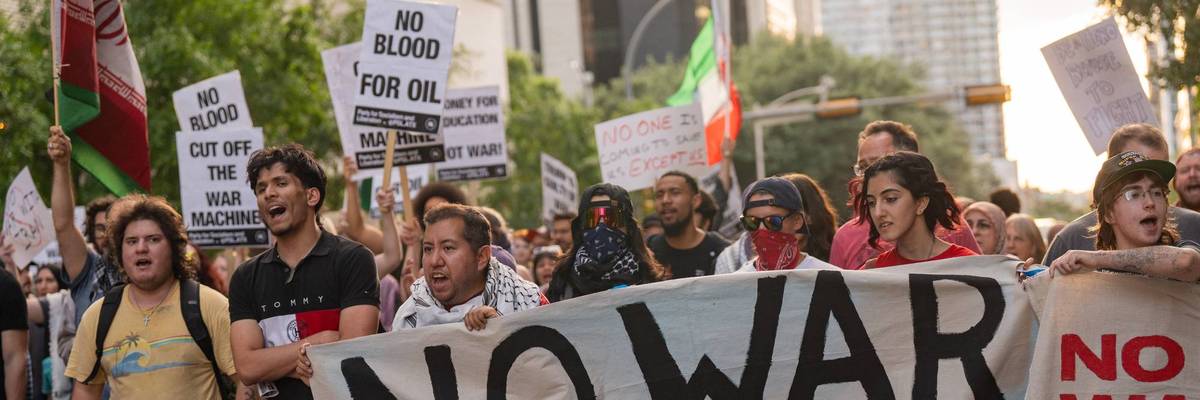
Protesters march to show opposition to the war in Iran in Austin, Texas, on April 8, 2026.
"This is a self-inflicted wound, it's a choice, and it can be undone."
A group of experts says that President Donald Trump's illegal war with Iran, which has been massively expensive and has made Americans less safe, shows the need for a radical overhaul of US foreign policy.
Scholars at the Political Economy Research Institute (PERI) at the University of Massachusetts on Wednesday are holding a webinar to present ideas for reducing the US military footprint and using the savings to invest in programs that will directly benefit working-class Americans.
In a video posted on social media ahead of the webinar, PERI experts advocated for making major changes to US foreign policy, which they argued has left the country overstretched.
"The Iran War costs us billions while making us less safe," says a message accompanying the video on PERI’s social media account. "By reining in military spending and taxing the wealthy to pay their fair share, we can fund critical services like universal preschool, infrastructure investments, and Medicare for All."
The Iran War costs us billions while making us less safe.
By reining in military spending and taxing the wealthy to pay their fair share, we can fund critical services like universal preschool, infrastructure investments, and medicare for all. pic.twitter.com/daOFLyWHEr
— PERI (@PERIatUMass) September 30, 2026
Lindsay Koshgarian, program director of the National Priorities Project (NPP), made the case that the US can no longer enforce a policy of "maintaining dominance over the entire world."
"We have endless wars in the Middle East, a war of choice with Iran at the moment," said Koshgarian. "Clearly, something is broken about our foreign policy. It's extremely costly and, in fact, it actually makes us less safe."
Koshgarian then outlined her plan for what she described as "a smaller, safer military" that would slash US presence overseas and generate between $200 billion to $500 billion of savings per year.
Heidi Peltier, senior researcher at the Watson School of International and Public Affairs at Brown University, pointed to Trump's request for an "astronomical" $1.5 trillion military budget to argue that America's priorities have become completely warped.
"The money is there," Peltier said. "The question really is, what are our priorities?"
Peltier's research aims to "demilitarize" federal spending by reducing the annual US Department of Defense budget by 10%, which would free up $100 billion more to spend on domestic priorities.
Aaron Medlin, professor of international studies at Boston College, pointed to the ways Trump's illegal war had made the price of energy more expensive and was inflicting economic pain on working-class Americans.
Medlin said that his work focuses on raising taxes on the wealthy by taxing income generated from owning assets at the same rate as income generated from working, while also imposing a minimum tax on fortunes over $100 million, and small levies on stock, bond, and derivatives trades.
In total, Medlin estimates that the proposed tax package would raise more than $2 trillion annually.
"The United States is just becoming unaffordable for a huge share of Americans," he said. "This is a self-inflicted wound, it's a choice, and it can be undone."
The experts' proposals for reducing the US military footprint and taxing extreme wealth came on the same day that petroleum industry analyst Patrick De Haan estimated that Americans have now spent over $75 billion more on gasoline since the start of the Iran War.
When higher gas prices are combined with rising rates for diesel, the Costs of War Project at Brown's Watson Institute estimates that Americans have spent an extra $121.7 billion.
Dear Common Dreams reader, It’s been nearly 30 years since I co-founded Common Dreams with my late wife, Lina Newhouser. We had the radical notion that journalism should serve the public good, not corporate profits. It was clear to us from the outset what it would take to build such a project. No paid advertisements. No corporate sponsors. No millionaire publisher telling us what to think or do. Many people said we wouldn't last a year, but we proved those doubters wrong. Together with a tremendous team of journalists and dedicated staff, we built an independent media outlet free from the constraints of profits and corporate control. Our mission has always been simple: To inform. To inspire. To ignite change for the common good. Building Common Dreams was not easy. Our survival was never guaranteed. When you take on the most powerful forces—Wall Street greed, fossil fuel industry destruction, Big Tech lobbyists, and uber-rich oligarchs who have spent billions upon billions rigging the economy and democracy in their favor—the only bulwark you have is supporters who believe in your work. But here’s the urgent message from me today. It's never been this bad out there. And it's never been this hard to keep us going. At the very moment Common Dreams is most needed, the threats we face are intensifying. We need your support now more than ever. We don't accept corporate advertising and never will. We don't have a paywall because we don't think people should be blocked from critical news based on their ability to pay. Everything we do is funded by the donations of readers like you. When everyone does the little they can afford, we are strong. But if that support retreats or dries up, so do we. Will you donate now to make sure Common Dreams not only survives but thrives? —Craig Brown, Co-founder |
A group of experts says that President Donald Trump's illegal war with Iran, which has been massively expensive and has made Americans less safe, shows the need for a radical overhaul of US foreign policy.
Scholars at the Political Economy Research Institute (PERI) at the University of Massachusetts on Wednesday are holding a webinar to present ideas for reducing the US military footprint and using the savings to invest in programs that will directly benefit working-class Americans.
In a video posted on social media ahead of the webinar, PERI experts advocated for making major changes to US foreign policy, which they argued has left the country overstretched.
"The Iran War costs us billions while making us less safe," says a message accompanying the video on PERI’s social media account. "By reining in military spending and taxing the wealthy to pay their fair share, we can fund critical services like universal preschool, infrastructure investments, and Medicare for All."
The Iran War costs us billions while making us less safe.
By reining in military spending and taxing the wealthy to pay their fair share, we can fund critical services like universal preschool, infrastructure investments, and medicare for all. pic.twitter.com/daOFLyWHEr
— PERI (@PERIatUMass) September 30, 2026
Lindsay Koshgarian, program director of the National Priorities Project (NPP), made the case that the US can no longer enforce a policy of "maintaining dominance over the entire world."
"We have endless wars in the Middle East, a war of choice with Iran at the moment," said Koshgarian. "Clearly, something is broken about our foreign policy. It's extremely costly and, in fact, it actually makes us less safe."
Koshgarian then outlined her plan for what she described as "a smaller, safer military" that would slash US presence overseas and generate between $200 billion to $500 billion of savings per year.
Heidi Peltier, senior researcher at the Watson School of International and Public Affairs at Brown University, pointed to Trump's request for an "astronomical" $1.5 trillion military budget to argue that America's priorities have become completely warped.
"The money is there," Peltier said. "The question really is, what are our priorities?"
Peltier's research aims to "demilitarize" federal spending by reducing the annual US Department of Defense budget by 10%, which would free up $100 billion more to spend on domestic priorities.
Aaron Medlin, professor of international studies at Boston College, pointed to the ways Trump's illegal war had made the price of energy more expensive and was inflicting economic pain on working-class Americans.
Medlin said that his work focuses on raising taxes on the wealthy by taxing income generated from owning assets at the same rate as income generated from working, while also imposing a minimum tax on fortunes over $100 million, and small levies on stock, bond, and derivatives trades.
In total, Medlin estimates that the proposed tax package would raise more than $2 trillion annually.
"The United States is just becoming unaffordable for a huge share of Americans," he said. "This is a self-inflicted wound, it's a choice, and it can be undone."
The experts' proposals for reducing the US military footprint and taxing extreme wealth came on the same day that petroleum industry analyst Patrick De Haan estimated that Americans have now spent over $75 billion more on gasoline since the start of the Iran War.
When higher gas prices are combined with rising rates for diesel, the Costs of War Project at Brown's Watson Institute estimates that Americans have spent an extra $121.7 billion.
A group of experts says that President Donald Trump's illegal war with Iran, which has been massively expensive and has made Americans less safe, shows the need for a radical overhaul of US foreign policy.
Scholars at the Political Economy Research Institute (PERI) at the University of Massachusetts on Wednesday are holding a webinar to present ideas for reducing the US military footprint and using the savings to invest in programs that will directly benefit working-class Americans.
In a video posted on social media ahead of the webinar, PERI experts advocated for making major changes to US foreign policy, which they argued has left the country overstretched.
"The Iran War costs us billions while making us less safe," says a message accompanying the video on PERI’s social media account. "By reining in military spending and taxing the wealthy to pay their fair share, we can fund critical services like universal preschool, infrastructure investments, and Medicare for All."
The Iran War costs us billions while making us less safe.
By reining in military spending and taxing the wealthy to pay their fair share, we can fund critical services like universal preschool, infrastructure investments, and medicare for all. pic.twitter.com/daOFLyWHEr
— PERI (@PERIatUMass) September 30, 2026
Lindsay Koshgarian, program director of the National Priorities Project (NPP), made the case that the US can no longer enforce a policy of "maintaining dominance over the entire world."
"We have endless wars in the Middle East, a war of choice with Iran at the moment," said Koshgarian. "Clearly, something is broken about our foreign policy. It's extremely costly and, in fact, it actually makes us less safe."
Koshgarian then outlined her plan for what she described as "a smaller, safer military" that would slash US presence overseas and generate between $200 billion to $500 billion of savings per year.
Heidi Peltier, senior researcher at the Watson School of International and Public Affairs at Brown University, pointed to Trump's request for an "astronomical" $1.5 trillion military budget to argue that America's priorities have become completely warped.
"The money is there," Peltier said. "The question really is, what are our priorities?"
Peltier's research aims to "demilitarize" federal spending by reducing the annual US Department of Defense budget by 10%, which would free up $100 billion more to spend on domestic priorities.
Aaron Medlin, professor of international studies at Boston College, pointed to the ways Trump's illegal war had made the price of energy more expensive and was inflicting economic pain on working-class Americans.
Medlin said that his work focuses on raising taxes on the wealthy by taxing income generated from owning assets at the same rate as income generated from working, while also imposing a minimum tax on fortunes over $100 million, and small levies on stock, bond, and derivatives trades.
In total, Medlin estimates that the proposed tax package would raise more than $2 trillion annually.
"The United States is just becoming unaffordable for a huge share of Americans," he said. "This is a self-inflicted wound, it's a choice, and it can be undone."
The experts' proposals for reducing the US military footprint and taxing extreme wealth came on the same day that petroleum industry analyst Patrick De Haan estimated that Americans have now spent over $75 billion more on gasoline since the start of the Iran War.
When higher gas prices are combined with rising rates for diesel, the Costs of War Project at Brown's Watson Institute estimates that Americans have spent an extra $121.7 billion.