SUBSCRIBE TO OUR FREE NEWSLETTER
Daily news & progressive opinion—funded by the people, not the corporations—delivered straight to your inbox.
5
#000000
#FFFFFF
To donate by check, phone, or other method, see our More Ways to Give page.
Daily news & progressive opinion—funded by the people, not the corporations—delivered straight to your inbox.
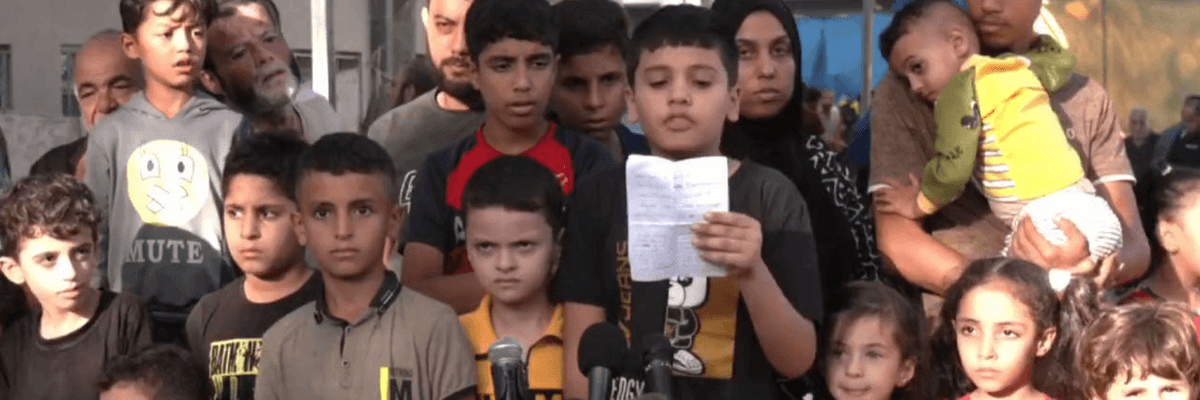
What heart refuses to protect and even worse, intentionally targets “the child” along with the people and institutions that provide the care and protection necessary to sustain the child’s life?
"Whereas mankind owes to the child the best it has to give…"—United Nations Declaration on the Rights of the Child, 1959
There were Iraqi children before Gaza, before Hind. Before Iran and the Minab School bombing. Iraqi children dying by the thousands, as many as 500,000 as a result of US-supported UN economic sanctions and wars in Iraq. Governments expressed “concern.” International scholars and lawyers called it a genocide. Former Secretary of State under Bill Clinton, Madeleine Albright, called it a price worth paying.
Who are we; what universe is this where one writes again and again in support of children, of “the child” as if they were some political cause. It’s the new abnormal, where everyday brings news of children suffering, injured and dying, in Iraq, in Ukraine, and Sudan. In Gaza and the Occupied West Bank, in Iran and Lebanon to name a few.
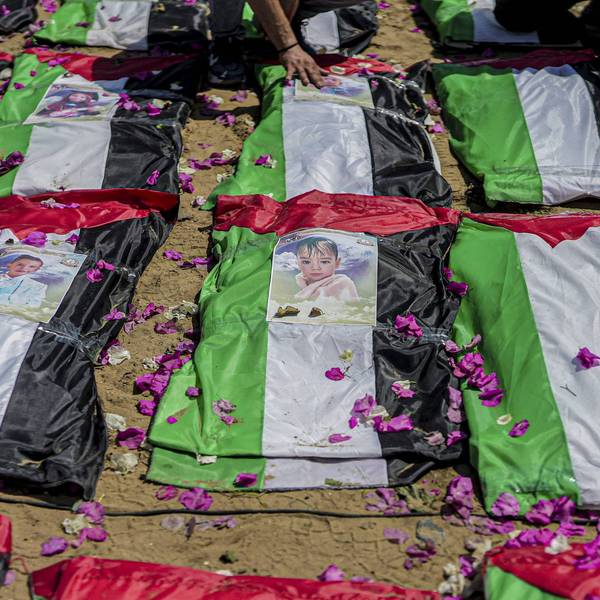
The child is trapped in a car, shot dead; they are buried under the rubble of their bombed-out house, of their school or the hospital where they have just been born. They’re wounded, missing eyes, arms, and legs; missing parents and siblings, aunts and uncles.They’re missing all the little as well as the significant “stuff” that is, that should be, a child's life. They’re sick and there are no doctors or medicines; they’re hungry and there’s no food or clean water. There’s no school, no mosque, no church, and no more neighborhood. Out of a house, in a tent or on the street, forcibly moved from here to there. What sort of world is this, what kind of culture. What heart refuses to protect and even worse, intentionally targets “the child” along with the people and institutions that provide the care and protection necessary to sustain the child’s life?
We know, everyone knows this is not the world “fit for Children” promised by global leaders at the UN some 30 years ago, yet it continues.
While instinct—some call it maternal—helps insure the future of a species, caring about and for one’s own offspring doesn’t necessarily translate to caring about all children. This enormous responsibility has been taken up by governments and international organizations; children need guaranteed special protections because they are “…innocent, vulnerable, and dependent.” The Convention on the Rights of the Child (CRC, 1990), the most widely endorsed human rights document in history, committed world leaders to giving children the “first call” on human and financial resources and know-how to address critical issues such as: poverty, education, child and maternal health, and protection during armed conflicts. With great fanfare, they reaffirmed these aspirations, calling for a world “fit” for children in 2002 at the UN Special Session on Children, the largest ever gathering for a UN Special Session.
The disconnect of words to actions and to the actual situation for children in 2002, as the Special Session convened, was not lost on those of us who cared about Iraq and Iraqi children. An estimated half million had died. The alarming increase in birth defects and childhood cancers was stressing a medical system under siege. The overall health of Iraqi children as measured by the Under 5 Mortality Rate (U5MR) “…the single most significant indicator of the state of a nation’s children…” had declined by 160% in the decade since the CRC. It was the largest decline in well-being by far for children in any country in the world. And this, like the overall destruction of Iraq and Iraqi society was brought on by war and sustained by the severe US-supported UN economic sanctions imposed by the very agency pledging to take responsibility for the world’s children.
International law failed to protect Iraqi children; it has failed Palestinian children for decades despite their well-documented fragility under Israeli occupation. And now, we watch as the already precarious “child” in Gaza and the Occupied West Bank suffers unimaginable atrocities.“Atrocity in the ordinary sense of the term, as evoking simply the shock and horror that most would feel in the face of such enormous and gratuitous human damage; a circumstance in which we would be hard-pressed not to disparage the justifications” (Joy Gordon, Invisible War: The United States and the Iraq Sanctions, 2010).
UN and human rights organizations wring their hands and issue condemnations. Some do not call this a genocide. The majority that might help to end this catastrophe has stood by—including women, mothers, and global health and human rights organizations—and watched the occupation and genocide kill and maim thousands and thousands of Palestinian children and their extended families. Watched as the very country is rendered uninhabitable. Stood silently by as the very ones seeking to protect Palestinian children are treated and prosecuted as terrorists.
The moving promises of UN declarations and their aspirations on behalf of children have come to nothing. We’re being subjected to a form of global violence Joy Gordon warned about, that of "a single nation," or in today’s world, two nations—the US and Israel—"hijacking an institution of international governance, substituting their own agenda in place of the interests and will of the international community.” This should not stand.
According to the Ministry of Health, 73,386 Palestinians—including 21,000 children—were killed in the Gaza Strip and another 174,256 were injured between October 7, 2023 and August 9, 2026. This includes 1,258 fatalities and 4,295 injuries between the announcement of a ceasefire agreement on October 10, 2025 and August 9, 2026. We know, everyone knows this is not the world “fit for Children” promised by global leaders at the UN some 30 years ago, yet it continues. I’m at a loss. What can be said that hasn’t been said, or written that hasn’t been written. What poem or investigative article, what personal narrative could possibly bring an end to this carnage.
In 1915 Henry James declared, “The war has used up words, they have weakened, they have deteriorated…” Dr. Salma Al-Hadad, head of the pediatric oncology unit at Children’s Welfare Teaching Hospital in Baghdad since 1992, shared his view. After years of interviews revealing the struggles to save increasing numbers of patients with increasingly difficult cancers without even the most basic medicines and technology, she went silent. “The very hard times I’ve experienced over these years,” she wrote sometime in a mid-2000 email, “have rendered me silent. I find no comment.”
The moral universe owes a deep debt to the people of Palestine who have not gone silent, or ceased to document the atrocities against them. They pay for this every day with their lives, and in many cases the lives of other family members. I urge myself on. We have to repay that debt by breaking the silence even when we feel there is nothing more to say. Silence cannot be an option for those who are suffering under the weight of the atrocities being committed against children.
"All people,” wrote Leo Tolstoy, “live, Not by reason of any care they have for themselves, But by the love for them that is in other people.” If we truly care about “the child,” we have to increase our efforts on their behalf.
Dear Common Dreams reader, It’s been nearly 30 years since I co-founded Common Dreams with my late wife, Lina Newhouser. We had the radical notion that journalism should serve the public good, not corporate profits. It was clear to us from the outset what it would take to build such a project. No paid advertisements. No corporate sponsors. No millionaire publisher telling us what to think or do. Many people said we wouldn't last a year, but we proved those doubters wrong. Together with a tremendous team of journalists and dedicated staff, we built an independent media outlet free from the constraints of profits and corporate control. Our mission has always been simple: To inform. To inspire. To ignite change for the common good. Building Common Dreams was not easy. Our survival was never guaranteed. When you take on the most powerful forces—Wall Street greed, fossil fuel industry destruction, Big Tech lobbyists, and uber-rich oligarchs who have spent billions upon billions rigging the economy and democracy in their favor—the only bulwark you have is supporters who believe in your work. But here’s the urgent message from me today. It's never been this bad out there. And it's never been this hard to keep us going. At the very moment Common Dreams is most needed, the threats we face are intensifying. We need your support now more than ever. We don't accept corporate advertising and never will. We don't have a paywall because we don't think people should be blocked from critical news based on their ability to pay. Everything we do is funded by the donations of readers like you. When everyone does the little they can afford, we are strong. But if that support retreats or dries up, so do we. Will you donate now to make sure Common Dreams not only survives but thrives? —Craig Brown, Co-founder |
"Whereas mankind owes to the child the best it has to give…"—United Nations Declaration on the Rights of the Child, 1959
There were Iraqi children before Gaza, before Hind. Before Iran and the Minab School bombing. Iraqi children dying by the thousands, as many as 500,000 as a result of US-supported UN economic sanctions and wars in Iraq. Governments expressed “concern.” International scholars and lawyers called it a genocide. Former Secretary of State under Bill Clinton, Madeleine Albright, called it a price worth paying.
Who are we; what universe is this where one writes again and again in support of children, of “the child” as if they were some political cause. It’s the new abnormal, where everyday brings news of children suffering, injured and dying, in Iraq, in Ukraine, and Sudan. In Gaza and the Occupied West Bank, in Iran and Lebanon to name a few.
The child is trapped in a car, shot dead; they are buried under the rubble of their bombed-out house, of their school or the hospital where they have just been born. They’re wounded, missing eyes, arms, and legs; missing parents and siblings, aunts and uncles.They’re missing all the little as well as the significant “stuff” that is, that should be, a child's life. They’re sick and there are no doctors or medicines; they’re hungry and there’s no food or clean water. There’s no school, no mosque, no church, and no more neighborhood. Out of a house, in a tent or on the street, forcibly moved from here to there. What sort of world is this, what kind of culture. What heart refuses to protect and even worse, intentionally targets “the child” along with the people and institutions that provide the care and protection necessary to sustain the child’s life?
We know, everyone knows this is not the world “fit for Children” promised by global leaders at the UN some 30 years ago, yet it continues.
While instinct—some call it maternal—helps insure the future of a species, caring about and for one’s own offspring doesn’t necessarily translate to caring about all children. This enormous responsibility has been taken up by governments and international organizations; children need guaranteed special protections because they are “…innocent, vulnerable, and dependent.” The Convention on the Rights of the Child (CRC, 1990), the most widely endorsed human rights document in history, committed world leaders to giving children the “first call” on human and financial resources and know-how to address critical issues such as: poverty, education, child and maternal health, and protection during armed conflicts. With great fanfare, they reaffirmed these aspirations, calling for a world “fit” for children in 2002 at the UN Special Session on Children, the largest ever gathering for a UN Special Session.
The disconnect of words to actions and to the actual situation for children in 2002, as the Special Session convened, was not lost on those of us who cared about Iraq and Iraqi children. An estimated half million had died. The alarming increase in birth defects and childhood cancers was stressing a medical system under siege. The overall health of Iraqi children as measured by the Under 5 Mortality Rate (U5MR) “…the single most significant indicator of the state of a nation’s children…” had declined by 160% in the decade since the CRC. It was the largest decline in well-being by far for children in any country in the world. And this, like the overall destruction of Iraq and Iraqi society was brought on by war and sustained by the severe US-supported UN economic sanctions imposed by the very agency pledging to take responsibility for the world’s children.
International law failed to protect Iraqi children; it has failed Palestinian children for decades despite their well-documented fragility under Israeli occupation. And now, we watch as the already precarious “child” in Gaza and the Occupied West Bank suffers unimaginable atrocities.“Atrocity in the ordinary sense of the term, as evoking simply the shock and horror that most would feel in the face of such enormous and gratuitous human damage; a circumstance in which we would be hard-pressed not to disparage the justifications” (Joy Gordon, Invisible War: The United States and the Iraq Sanctions, 2010).
UN and human rights organizations wring their hands and issue condemnations. Some do not call this a genocide. The majority that might help to end this catastrophe has stood by—including women, mothers, and global health and human rights organizations—and watched the occupation and genocide kill and maim thousands and thousands of Palestinian children and their extended families. Watched as the very country is rendered uninhabitable. Stood silently by as the very ones seeking to protect Palestinian children are treated and prosecuted as terrorists.
The moving promises of UN declarations and their aspirations on behalf of children have come to nothing. We’re being subjected to a form of global violence Joy Gordon warned about, that of "a single nation," or in today’s world, two nations—the US and Israel—"hijacking an institution of international governance, substituting their own agenda in place of the interests and will of the international community.” This should not stand.
According to the Ministry of Health, 73,386 Palestinians—including 21,000 children—were killed in the Gaza Strip and another 174,256 were injured between October 7, 2023 and August 9, 2026. This includes 1,258 fatalities and 4,295 injuries between the announcement of a ceasefire agreement on October 10, 2025 and August 9, 2026. We know, everyone knows this is not the world “fit for Children” promised by global leaders at the UN some 30 years ago, yet it continues. I’m at a loss. What can be said that hasn’t been said, or written that hasn’t been written. What poem or investigative article, what personal narrative could possibly bring an end to this carnage.
In 1915 Henry James declared, “The war has used up words, they have weakened, they have deteriorated…” Dr. Salma Al-Hadad, head of the pediatric oncology unit at Children’s Welfare Teaching Hospital in Baghdad since 1992, shared his view. After years of interviews revealing the struggles to save increasing numbers of patients with increasingly difficult cancers without even the most basic medicines and technology, she went silent. “The very hard times I’ve experienced over these years,” she wrote sometime in a mid-2000 email, “have rendered me silent. I find no comment.”
The moral universe owes a deep debt to the people of Palestine who have not gone silent, or ceased to document the atrocities against them. They pay for this every day with their lives, and in many cases the lives of other family members. I urge myself on. We have to repay that debt by breaking the silence even when we feel there is nothing more to say. Silence cannot be an option for those who are suffering under the weight of the atrocities being committed against children.
"All people,” wrote Leo Tolstoy, “live, Not by reason of any care they have for themselves, But by the love for them that is in other people.” If we truly care about “the child,” we have to increase our efforts on their behalf.
"Whereas mankind owes to the child the best it has to give…"—United Nations Declaration on the Rights of the Child, 1959
There were Iraqi children before Gaza, before Hind. Before Iran and the Minab School bombing. Iraqi children dying by the thousands, as many as 500,000 as a result of US-supported UN economic sanctions and wars in Iraq. Governments expressed “concern.” International scholars and lawyers called it a genocide. Former Secretary of State under Bill Clinton, Madeleine Albright, called it a price worth paying.
Who are we; what universe is this where one writes again and again in support of children, of “the child” as if they were some political cause. It’s the new abnormal, where everyday brings news of children suffering, injured and dying, in Iraq, in Ukraine, and Sudan. In Gaza and the Occupied West Bank, in Iran and Lebanon to name a few.
The child is trapped in a car, shot dead; they are buried under the rubble of their bombed-out house, of their school or the hospital where they have just been born. They’re wounded, missing eyes, arms, and legs; missing parents and siblings, aunts and uncles.They’re missing all the little as well as the significant “stuff” that is, that should be, a child's life. They’re sick and there are no doctors or medicines; they’re hungry and there’s no food or clean water. There’s no school, no mosque, no church, and no more neighborhood. Out of a house, in a tent or on the street, forcibly moved from here to there. What sort of world is this, what kind of culture. What heart refuses to protect and even worse, intentionally targets “the child” along with the people and institutions that provide the care and protection necessary to sustain the child’s life?
We know, everyone knows this is not the world “fit for Children” promised by global leaders at the UN some 30 years ago, yet it continues.
While instinct—some call it maternal—helps insure the future of a species, caring about and for one’s own offspring doesn’t necessarily translate to caring about all children. This enormous responsibility has been taken up by governments and international organizations; children need guaranteed special protections because they are “…innocent, vulnerable, and dependent.” The Convention on the Rights of the Child (CRC, 1990), the most widely endorsed human rights document in history, committed world leaders to giving children the “first call” on human and financial resources and know-how to address critical issues such as: poverty, education, child and maternal health, and protection during armed conflicts. With great fanfare, they reaffirmed these aspirations, calling for a world “fit” for children in 2002 at the UN Special Session on Children, the largest ever gathering for a UN Special Session.
The disconnect of words to actions and to the actual situation for children in 2002, as the Special Session convened, was not lost on those of us who cared about Iraq and Iraqi children. An estimated half million had died. The alarming increase in birth defects and childhood cancers was stressing a medical system under siege. The overall health of Iraqi children as measured by the Under 5 Mortality Rate (U5MR) “…the single most significant indicator of the state of a nation’s children…” had declined by 160% in the decade since the CRC. It was the largest decline in well-being by far for children in any country in the world. And this, like the overall destruction of Iraq and Iraqi society was brought on by war and sustained by the severe US-supported UN economic sanctions imposed by the very agency pledging to take responsibility for the world’s children.
International law failed to protect Iraqi children; it has failed Palestinian children for decades despite their well-documented fragility under Israeli occupation. And now, we watch as the already precarious “child” in Gaza and the Occupied West Bank suffers unimaginable atrocities.“Atrocity in the ordinary sense of the term, as evoking simply the shock and horror that most would feel in the face of such enormous and gratuitous human damage; a circumstance in which we would be hard-pressed not to disparage the justifications” (Joy Gordon, Invisible War: The United States and the Iraq Sanctions, 2010).
UN and human rights organizations wring their hands and issue condemnations. Some do not call this a genocide. The majority that might help to end this catastrophe has stood by—including women, mothers, and global health and human rights organizations—and watched the occupation and genocide kill and maim thousands and thousands of Palestinian children and their extended families. Watched as the very country is rendered uninhabitable. Stood silently by as the very ones seeking to protect Palestinian children are treated and prosecuted as terrorists.
The moving promises of UN declarations and their aspirations on behalf of children have come to nothing. We’re being subjected to a form of global violence Joy Gordon warned about, that of "a single nation," or in today’s world, two nations—the US and Israel—"hijacking an institution of international governance, substituting their own agenda in place of the interests and will of the international community.” This should not stand.
According to the Ministry of Health, 73,386 Palestinians—including 21,000 children—were killed in the Gaza Strip and another 174,256 were injured between October 7, 2023 and August 9, 2026. This includes 1,258 fatalities and 4,295 injuries between the announcement of a ceasefire agreement on October 10, 2025 and August 9, 2026. We know, everyone knows this is not the world “fit for Children” promised by global leaders at the UN some 30 years ago, yet it continues. I’m at a loss. What can be said that hasn’t been said, or written that hasn’t been written. What poem or investigative article, what personal narrative could possibly bring an end to this carnage.
In 1915 Henry James declared, “The war has used up words, they have weakened, they have deteriorated…” Dr. Salma Al-Hadad, head of the pediatric oncology unit at Children’s Welfare Teaching Hospital in Baghdad since 1992, shared his view. After years of interviews revealing the struggles to save increasing numbers of patients with increasingly difficult cancers without even the most basic medicines and technology, she went silent. “The very hard times I’ve experienced over these years,” she wrote sometime in a mid-2000 email, “have rendered me silent. I find no comment.”
The moral universe owes a deep debt to the people of Palestine who have not gone silent, or ceased to document the atrocities against them. They pay for this every day with their lives, and in many cases the lives of other family members. I urge myself on. We have to repay that debt by breaking the silence even when we feel there is nothing more to say. Silence cannot be an option for those who are suffering under the weight of the atrocities being committed against children.
"All people,” wrote Leo Tolstoy, “live, Not by reason of any care they have for themselves, But by the love for them that is in other people.” If we truly care about “the child,” we have to increase our efforts on their behalf.