SUBSCRIBE TO OUR FREE NEWSLETTER
Daily news & progressive opinion—funded by the people, not the corporations—delivered straight to your inbox.
5
#000000
#FFFFFF
To donate by check, phone, or other method, see our More Ways to Give page.
Daily news & progressive opinion—funded by the people, not the corporations—delivered straight to your inbox.
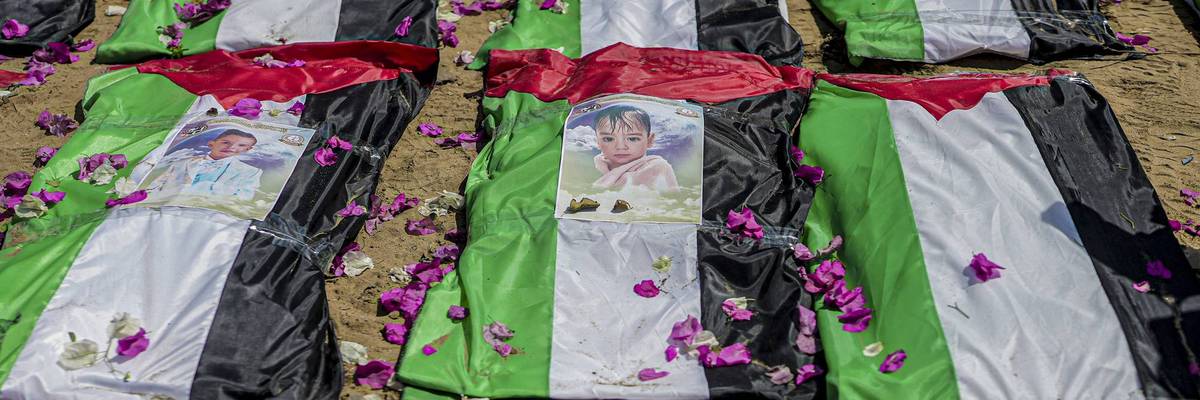
Photographs rest on bodies wrapped in Palestinian flags during a mass funeral in Gaza City on August 4, 2026.
"A ceasefire that leaves an average of one child dead each and every day is failing children," said one United Nations official.
"The world calls it a ceasefire, but families in Gaza are still burying their children."
That was one United Nations spokesperson's assessment of the ongoing US-backed Israeli assault on Gaza on Thursday, which marked the 300th day since a ceasefire deal was reached between Israel and Hamas—a period during which at least 300 Palestinian children have been killed, the UN reported.
"A ceasefire that leaves an average of one child dead each and every day is failing children," said Edouard Beigbeder, regional director for the Middle East and North Africa for the UN Children's Fund (UNICEF). "With hundreds more children injured, many severely, children in Gaza are still waiting for the end to the violence they were promised."
Louise Wateridge, a spokesperson for UNICEF, noted that in the first three days of August, at least four children were killed across Gaza, and surviving children have been left with "painfully simple" and urgent questions for Israeli officials who had agreed last October to cease hostilities, reopen border crossings, and ensure 600 aid trucks entered Gaza per day to get much-needed food and essentials to Palestinians who had been facing a near-total blockade.
Wateridge said Palestinian children need to know: "When will the killings stop? When will food and medicine reach me at the level needed? When will hospitals reopen? And when will clean water flow again?"
300 children gone in 300 days.
300 days of the ceasefire in #Gaza has seen at least 300 children killed.
"The world calls it a ceasefire, but families in Gaza are still burying their children."
- @UNICEF's Louise Wateridge pic.twitter.com/1rmJz3YExW
— United Nations Geneva (@UNGeneva) August 6, 2026
Reports of the mass casualties of children come as Israel and President Donald Trump's Board of Peace raise doubts about whether Israel will accept a deal stipulating the disarmament of Hamas and Israel's withdrawal from the exclave.
UN officials on Thursday expressed hope that the next steps of the peace plan can move forward to save children and other civilians across Gaza.
"Children have heard promises before. This time, agreements must translate into action," said Beigbeder.
The UN Office for the Coordination of Humanitarian Affairs (OCHA) said Thursday that continued airstrikes have damaged civilian infrastructure, including healthcare facilities and medical supplies.
UNICEF warned that children are continue to face acute malnutrition almost a year after Israel agreed to allow humanitarian aid into Gaza, as well as suffering from disease and a lack of sanitation.
An attack on a medical storage facility next to Al-Aqsa Hospital in Deir al-Balah last week destroyed supplies that had been delivered by the UN, said the World Health Organization.
The UN is working to help "exhausted and hungry mothers" arriving at health centers with their malnourished children, and are fighting to save newborns born prematurely or with health issues, with extremely limited resources.
“There’s not enough incubators and in some cases [health workers are] saying they see two or even three babies sharing a single machine,” said Wateridge. “In Gaza, children only days old are already fighting to stay alive, born into partially functioning hospitals lacking equipment and medicine. This is what the world has chosen to tolerate. The killing must stop, aid has to enter at scale and children must be protected.”
According to OCHA, at least 1,209 people have been killed and 3,943 have been injured since the ceasefire deal was reached last October.
Dear Common Dreams reader, It’s been nearly 30 years since I co-founded Common Dreams with my late wife, Lina Newhouser. We had the radical notion that journalism should serve the public good, not corporate profits. It was clear to us from the outset what it would take to build such a project. No paid advertisements. No corporate sponsors. No millionaire publisher telling us what to think or do. Many people said we wouldn't last a year, but we proved those doubters wrong. Together with a tremendous team of journalists and dedicated staff, we built an independent media outlet free from the constraints of profits and corporate control. Our mission has always been simple: To inform. To inspire. To ignite change for the common good. Building Common Dreams was not easy. Our survival was never guaranteed. When you take on the most powerful forces—Wall Street greed, fossil fuel industry destruction, Big Tech lobbyists, and uber-rich oligarchs who have spent billions upon billions rigging the economy and democracy in their favor—the only bulwark you have is supporters who believe in your work. But here’s the urgent message from me today. It's never been this bad out there. And it's never been this hard to keep us going. At the very moment Common Dreams is most needed, the threats we face are intensifying. We need your support now more than ever. We don't accept corporate advertising and never will. We don't have a paywall because we don't think people should be blocked from critical news based on their ability to pay. Everything we do is funded by the donations of readers like you. When everyone does the little they can afford, we are strong. But if that support retreats or dries up, so do we. Will you donate now to make sure Common Dreams not only survives but thrives? —Craig Brown, Co-founder |
"The world calls it a ceasefire, but families in Gaza are still burying their children."
That was one United Nations spokesperson's assessment of the ongoing US-backed Israeli assault on Gaza on Thursday, which marked the 300th day since a ceasefire deal was reached between Israel and Hamas—a period during which at least 300 Palestinian children have been killed, the UN reported.
"A ceasefire that leaves an average of one child dead each and every day is failing children," said Edouard Beigbeder, regional director for the Middle East and North Africa for the UN Children's Fund (UNICEF). "With hundreds more children injured, many severely, children in Gaza are still waiting for the end to the violence they were promised."
Louise Wateridge, a spokesperson for UNICEF, noted that in the first three days of August, at least four children were killed across Gaza, and surviving children have been left with "painfully simple" and urgent questions for Israeli officials who had agreed last October to cease hostilities, reopen border crossings, and ensure 600 aid trucks entered Gaza per day to get much-needed food and essentials to Palestinians who had been facing a near-total blockade.
Wateridge said Palestinian children need to know: "When will the killings stop? When will food and medicine reach me at the level needed? When will hospitals reopen? And when will clean water flow again?"
300 children gone in 300 days.
300 days of the ceasefire in #Gaza has seen at least 300 children killed.
"The world calls it a ceasefire, but families in Gaza are still burying their children."
- @UNICEF's Louise Wateridge pic.twitter.com/1rmJz3YExW
— United Nations Geneva (@UNGeneva) August 6, 2026
Reports of the mass casualties of children come as Israel and President Donald Trump's Board of Peace raise doubts about whether Israel will accept a deal stipulating the disarmament of Hamas and Israel's withdrawal from the exclave.
UN officials on Thursday expressed hope that the next steps of the peace plan can move forward to save children and other civilians across Gaza.
"Children have heard promises before. This time, agreements must translate into action," said Beigbeder.
The UN Office for the Coordination of Humanitarian Affairs (OCHA) said Thursday that continued airstrikes have damaged civilian infrastructure, including healthcare facilities and medical supplies.
UNICEF warned that children are continue to face acute malnutrition almost a year after Israel agreed to allow humanitarian aid into Gaza, as well as suffering from disease and a lack of sanitation.
An attack on a medical storage facility next to Al-Aqsa Hospital in Deir al-Balah last week destroyed supplies that had been delivered by the UN, said the World Health Organization.
The UN is working to help "exhausted and hungry mothers" arriving at health centers with their malnourished children, and are fighting to save newborns born prematurely or with health issues, with extremely limited resources.
“There’s not enough incubators and in some cases [health workers are] saying they see two or even three babies sharing a single machine,” said Wateridge. “In Gaza, children only days old are already fighting to stay alive, born into partially functioning hospitals lacking equipment and medicine. This is what the world has chosen to tolerate. The killing must stop, aid has to enter at scale and children must be protected.”
According to OCHA, at least 1,209 people have been killed and 3,943 have been injured since the ceasefire deal was reached last October.
"The world calls it a ceasefire, but families in Gaza are still burying their children."
That was one United Nations spokesperson's assessment of the ongoing US-backed Israeli assault on Gaza on Thursday, which marked the 300th day since a ceasefire deal was reached between Israel and Hamas—a period during which at least 300 Palestinian children have been killed, the UN reported.
"A ceasefire that leaves an average of one child dead each and every day is failing children," said Edouard Beigbeder, regional director for the Middle East and North Africa for the UN Children's Fund (UNICEF). "With hundreds more children injured, many severely, children in Gaza are still waiting for the end to the violence they were promised."
Louise Wateridge, a spokesperson for UNICEF, noted that in the first three days of August, at least four children were killed across Gaza, and surviving children have been left with "painfully simple" and urgent questions for Israeli officials who had agreed last October to cease hostilities, reopen border crossings, and ensure 600 aid trucks entered Gaza per day to get much-needed food and essentials to Palestinians who had been facing a near-total blockade.
Wateridge said Palestinian children need to know: "When will the killings stop? When will food and medicine reach me at the level needed? When will hospitals reopen? And when will clean water flow again?"
300 children gone in 300 days.
300 days of the ceasefire in #Gaza has seen at least 300 children killed.
"The world calls it a ceasefire, but families in Gaza are still burying their children."
- @UNICEF's Louise Wateridge pic.twitter.com/1rmJz3YExW
— United Nations Geneva (@UNGeneva) August 6, 2026
Reports of the mass casualties of children come as Israel and President Donald Trump's Board of Peace raise doubts about whether Israel will accept a deal stipulating the disarmament of Hamas and Israel's withdrawal from the exclave.
UN officials on Thursday expressed hope that the next steps of the peace plan can move forward to save children and other civilians across Gaza.
"Children have heard promises before. This time, agreements must translate into action," said Beigbeder.
The UN Office for the Coordination of Humanitarian Affairs (OCHA) said Thursday that continued airstrikes have damaged civilian infrastructure, including healthcare facilities and medical supplies.
UNICEF warned that children are continue to face acute malnutrition almost a year after Israel agreed to allow humanitarian aid into Gaza, as well as suffering from disease and a lack of sanitation.
An attack on a medical storage facility next to Al-Aqsa Hospital in Deir al-Balah last week destroyed supplies that had been delivered by the UN, said the World Health Organization.
The UN is working to help "exhausted and hungry mothers" arriving at health centers with their malnourished children, and are fighting to save newborns born prematurely or with health issues, with extremely limited resources.
“There’s not enough incubators and in some cases [health workers are] saying they see two or even three babies sharing a single machine,” said Wateridge. “In Gaza, children only days old are already fighting to stay alive, born into partially functioning hospitals lacking equipment and medicine. This is what the world has chosen to tolerate. The killing must stop, aid has to enter at scale and children must be protected.”
According to OCHA, at least 1,209 people have been killed and 3,943 have been injured since the ceasefire deal was reached last October.