SUBSCRIBE TO OUR FREE NEWSLETTER
Daily news & progressive opinion—funded by the people, not the corporations—delivered straight to your inbox.
5
#000000
#FFFFFF
To donate by check, phone, or other method, see our More Ways to Give page.
Daily news & progressive opinion—funded by the people, not the corporations—delivered straight to your inbox.
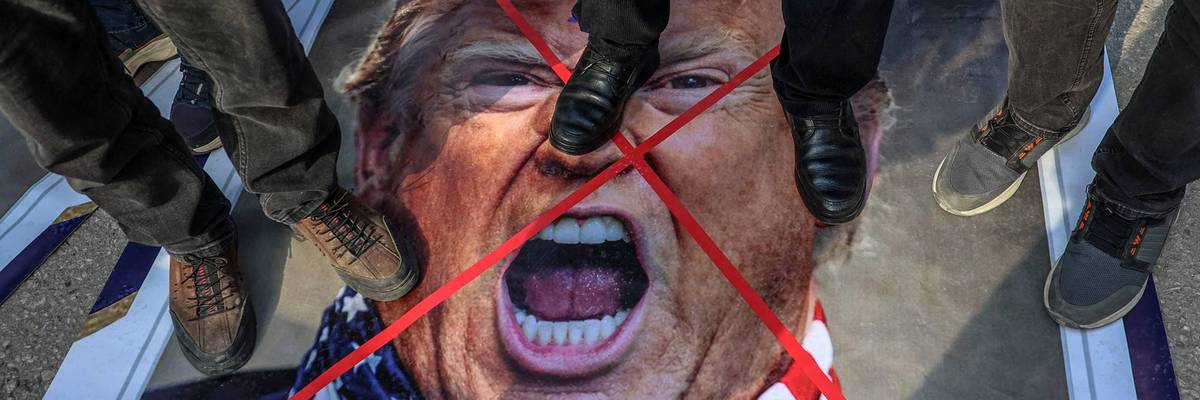
Protestors stand on an image depicting US President Donald Trump during a gathering to protest against the US and Israel attack of Iran and the killing of the Supreme leader in front of the US Embassy in Ankara on March 1, 2026.
Washington’s present predicament cannot be explained solely through depleted arsenals, poor military planning, Trump’s impulsiveness, or Netanyahu’s manipulation. Nor can it be understood simply as the result of underestimating Iran.
The US government continues to double down, even as its stubbornness costs it dearly—not only in material terms, but also in geopolitical influence. Washington is rapidly losing power and status in the Middle East, a decline that could produce a wider domino effect, reverberating around the world.
The latest expression of this hubris came from US Treasury Secretary Scott Bessent. Speaking at a G20 gathering of finance ministers in Asheville, North Carolina on September 1, Bessent declared that within two years, the Strait of Hormuz would become “a worthless piece of water,” as oil would instead be transported through overland pipelines.
Bessent is now promoting a new narrative that shifts the emphasis from the military war to an economic one. In an August 23 article for the Financial Times, he announced that “an economic D-Day is coming for Iran,” threatening countries that continue to trade with Tehran with severe economic consequences.
This sounds less like a serious foreign-policy strategy than an admission of Washington’s inability to alter the course of the ongoing war.
The deeper failure lies in Washington’s attempt to impose an outdated model of regional domination on a Middle East—and a world—that has fundamentally changed.
Two dominant schools of thought have emerged to explain how Washington found itself in this position.
The first, promoted largely by sections of the US media, former officials, and retired military commanders, argues that the war on Iran was a mistake from the outset and that Washington lacked the military and logistical preparedness necessary to wage it.
The second explanation places Iran at the center. It argues that Washington fundamentally underestimated Iran’s military capabilities, political resilience, and regional reach, treating the country as though it were another Venezuela that could be subdued through sanctions, threats, and limited military pressure.
Both explanations contain elements of truth. Neither, however, provides the deeper, less defensive, and more historically grounded understanding required to explain the scale of the present American failure.
John J. Mearsheimer, the prominent American political scientist and international relations scholar, has been among the boldest critics of the US war.
“Trump is trapped and has no way out,” Mearsheimer said on July 15, reiterating an argument he had advanced repeatedly since the beginning of the war. “All of this is to say that the decision to attack Iran on 28 February 2026 is one of the greatest blunders in the history of US foreign policy,” he added.
Mearsheimer, like Jeffrey Sachs, Scott Ritter, and other critical American voices, often—and understandably—analyzes these “great blunders” from a US-centered perspective. For millions of people in the Middle East, however, this collective analysis is not an intellectual or strategic exercise. It describes their everyday reality. They have lived through these catastrophic miscalculations and paid the human cost of US intransigence, militarism, and political failure.
The history of US foreign policy in the Middle East offers countless examples of this destructive pattern. Washington’s support for Israel—the region’s greatest destabilizing force—remains the most enduring example.
Palestinians, Lebanese, Syrians, and other peoples of the region require no new strategic framework to reach a conclusion similar to Mearsheimer’s. They have experienced the consequences of US power directly: wars, invasions, occupations, sanctions, political interference, and unconditional support for Israel.
The United States also established a disastrous record through its invasion and occupation of Iraq. It succeeded in overthrowing Saddam Hussein’s government in 2003, but failed catastrophically to govern the country, stabilize it, or restructure the Middle East according to the "vision" it had proclaimed.
The outcome was not a new American order, but the devastation of Iraq, prolonged instability, and the rise of political forces Washington had neither anticipated nor controlled.
Washington’s Western allies were also drawn into what became known as the Iraq quagmire, paying considerable political, military and financial costs for a war whose premises proved false and whose consequences remain unresolved.
Naturally, those former partners have little appetite for participating in a much larger and potentially more destructive war against Iran for an indefinite period—particularly when the crisis is being managed by Donald Trump and Benjamin Netanyahu, two deeply unpopular, impulsive, and widely distrusted leaders.
But the Middle East has changed. Regional states now possess greater political agency, more diversified alliances, and far more at stake than they did in 2003. They are no longer operating within a regional order in which Washington represents the only meaningful center of global power.
Chinese President Xi Jinping’s recent visit to Egypt provides one of numerous examples. “We must uphold the principle that the people of the Middle East are the masters of their own affairs,” Xi said during his September 2 meeting with Egyptian President Abdel Fattah el-Sisi. He also urged countries to oppose “external interference” and strengthen regional dialogue on peace and security.
Like Egypt, other regional powers are similarly diversifying their partnerships rather than relying exclusively on Washington.
Key Middle Eastern leaders understand that a prolonged war against Iran would not remain confined to Iran. It could destabilize the entire region, devastate economies and infrastructure, threaten vital energy routes and generate interconnected wars whose consequences could endure for decades.
This brings us to Israel. Historically the cornerstone of US strategy in the region, Israel is itself considerably weaker. It is militarily overstretched, politically fragmented, socially divided, and unable to decisively conclude any of the wars it has opened, despite Netanyahu’s repeated declarations of victory.
Washington’s present predicament, therefore, cannot be explained solely through depleted arsenals, poor military planning, Trump’s impulsiveness, or Netanyahu’s manipulation. Nor can it be understood simply as the result of underestimating Iran.
The deeper failure lies in Washington’s attempt to impose an outdated model of regional domination on a Middle East—and a world—that has fundamentally changed.
Dear Common Dreams reader, It’s been nearly 30 years since I co-founded Common Dreams with my late wife, Lina Newhouser. We had the radical notion that journalism should serve the public good, not corporate profits. It was clear to us from the outset what it would take to build such a project. No paid advertisements. No corporate sponsors. No millionaire publisher telling us what to think or do. Many people said we wouldn't last a year, but we proved those doubters wrong. Together with a tremendous team of journalists and dedicated staff, we built an independent media outlet free from the constraints of profits and corporate control. Our mission has always been simple: To inform. To inspire. To ignite change for the common good. Building Common Dreams was not easy. Our survival was never guaranteed. When you take on the most powerful forces—Wall Street greed, fossil fuel industry destruction, Big Tech lobbyists, and uber-rich oligarchs who have spent billions upon billions rigging the economy and democracy in their favor—the only bulwark you have is supporters who believe in your work. But here’s the urgent message from me today. It's never been this bad out there. And it's never been this hard to keep us going. At the very moment Common Dreams is most needed, the threats we face are intensifying. We need your support now more than ever. We don't accept corporate advertising and never will. We don't have a paywall because we don't think people should be blocked from critical news based on their ability to pay. Everything we do is funded by the donations of readers like you. When everyone does the little they can afford, we are strong. But if that support retreats or dries up, so do we. Will you donate now to make sure Common Dreams not only survives but thrives? —Craig Brown, Co-founder |
The US government continues to double down, even as its stubbornness costs it dearly—not only in material terms, but also in geopolitical influence. Washington is rapidly losing power and status in the Middle East, a decline that could produce a wider domino effect, reverberating around the world.
The latest expression of this hubris came from US Treasury Secretary Scott Bessent. Speaking at a G20 gathering of finance ministers in Asheville, North Carolina on September 1, Bessent declared that within two years, the Strait of Hormuz would become “a worthless piece of water,” as oil would instead be transported through overland pipelines.
Bessent is now promoting a new narrative that shifts the emphasis from the military war to an economic one. In an August 23 article for the Financial Times, he announced that “an economic D-Day is coming for Iran,” threatening countries that continue to trade with Tehran with severe economic consequences.
This sounds less like a serious foreign-policy strategy than an admission of Washington’s inability to alter the course of the ongoing war.
The deeper failure lies in Washington’s attempt to impose an outdated model of regional domination on a Middle East—and a world—that has fundamentally changed.
Two dominant schools of thought have emerged to explain how Washington found itself in this position.
The first, promoted largely by sections of the US media, former officials, and retired military commanders, argues that the war on Iran was a mistake from the outset and that Washington lacked the military and logistical preparedness necessary to wage it.
The second explanation places Iran at the center. It argues that Washington fundamentally underestimated Iran’s military capabilities, political resilience, and regional reach, treating the country as though it were another Venezuela that could be subdued through sanctions, threats, and limited military pressure.
Both explanations contain elements of truth. Neither, however, provides the deeper, less defensive, and more historically grounded understanding required to explain the scale of the present American failure.
John J. Mearsheimer, the prominent American political scientist and international relations scholar, has been among the boldest critics of the US war.
“Trump is trapped and has no way out,” Mearsheimer said on July 15, reiterating an argument he had advanced repeatedly since the beginning of the war. “All of this is to say that the decision to attack Iran on 28 February 2026 is one of the greatest blunders in the history of US foreign policy,” he added.
Mearsheimer, like Jeffrey Sachs, Scott Ritter, and other critical American voices, often—and understandably—analyzes these “great blunders” from a US-centered perspective. For millions of people in the Middle East, however, this collective analysis is not an intellectual or strategic exercise. It describes their everyday reality. They have lived through these catastrophic miscalculations and paid the human cost of US intransigence, militarism, and political failure.
The history of US foreign policy in the Middle East offers countless examples of this destructive pattern. Washington’s support for Israel—the region’s greatest destabilizing force—remains the most enduring example.
Palestinians, Lebanese, Syrians, and other peoples of the region require no new strategic framework to reach a conclusion similar to Mearsheimer’s. They have experienced the consequences of US power directly: wars, invasions, occupations, sanctions, political interference, and unconditional support for Israel.
The United States also established a disastrous record through its invasion and occupation of Iraq. It succeeded in overthrowing Saddam Hussein’s government in 2003, but failed catastrophically to govern the country, stabilize it, or restructure the Middle East according to the "vision" it had proclaimed.
The outcome was not a new American order, but the devastation of Iraq, prolonged instability, and the rise of political forces Washington had neither anticipated nor controlled.
Washington’s Western allies were also drawn into what became known as the Iraq quagmire, paying considerable political, military and financial costs for a war whose premises proved false and whose consequences remain unresolved.
Naturally, those former partners have little appetite for participating in a much larger and potentially more destructive war against Iran for an indefinite period—particularly when the crisis is being managed by Donald Trump and Benjamin Netanyahu, two deeply unpopular, impulsive, and widely distrusted leaders.
But the Middle East has changed. Regional states now possess greater political agency, more diversified alliances, and far more at stake than they did in 2003. They are no longer operating within a regional order in which Washington represents the only meaningful center of global power.
Chinese President Xi Jinping’s recent visit to Egypt provides one of numerous examples. “We must uphold the principle that the people of the Middle East are the masters of their own affairs,” Xi said during his September 2 meeting with Egyptian President Abdel Fattah el-Sisi. He also urged countries to oppose “external interference” and strengthen regional dialogue on peace and security.
Like Egypt, other regional powers are similarly diversifying their partnerships rather than relying exclusively on Washington.
Key Middle Eastern leaders understand that a prolonged war against Iran would not remain confined to Iran. It could destabilize the entire region, devastate economies and infrastructure, threaten vital energy routes and generate interconnected wars whose consequences could endure for decades.
This brings us to Israel. Historically the cornerstone of US strategy in the region, Israel is itself considerably weaker. It is militarily overstretched, politically fragmented, socially divided, and unable to decisively conclude any of the wars it has opened, despite Netanyahu’s repeated declarations of victory.
Washington’s present predicament, therefore, cannot be explained solely through depleted arsenals, poor military planning, Trump’s impulsiveness, or Netanyahu’s manipulation. Nor can it be understood simply as the result of underestimating Iran.
The deeper failure lies in Washington’s attempt to impose an outdated model of regional domination on a Middle East—and a world—that has fundamentally changed.
The US government continues to double down, even as its stubbornness costs it dearly—not only in material terms, but also in geopolitical influence. Washington is rapidly losing power and status in the Middle East, a decline that could produce a wider domino effect, reverberating around the world.
The latest expression of this hubris came from US Treasury Secretary Scott Bessent. Speaking at a G20 gathering of finance ministers in Asheville, North Carolina on September 1, Bessent declared that within two years, the Strait of Hormuz would become “a worthless piece of water,” as oil would instead be transported through overland pipelines.
Bessent is now promoting a new narrative that shifts the emphasis from the military war to an economic one. In an August 23 article for the Financial Times, he announced that “an economic D-Day is coming for Iran,” threatening countries that continue to trade with Tehran with severe economic consequences.
This sounds less like a serious foreign-policy strategy than an admission of Washington’s inability to alter the course of the ongoing war.
The deeper failure lies in Washington’s attempt to impose an outdated model of regional domination on a Middle East—and a world—that has fundamentally changed.
Two dominant schools of thought have emerged to explain how Washington found itself in this position.
The first, promoted largely by sections of the US media, former officials, and retired military commanders, argues that the war on Iran was a mistake from the outset and that Washington lacked the military and logistical preparedness necessary to wage it.
The second explanation places Iran at the center. It argues that Washington fundamentally underestimated Iran’s military capabilities, political resilience, and regional reach, treating the country as though it were another Venezuela that could be subdued through sanctions, threats, and limited military pressure.
Both explanations contain elements of truth. Neither, however, provides the deeper, less defensive, and more historically grounded understanding required to explain the scale of the present American failure.
John J. Mearsheimer, the prominent American political scientist and international relations scholar, has been among the boldest critics of the US war.
“Trump is trapped and has no way out,” Mearsheimer said on July 15, reiterating an argument he had advanced repeatedly since the beginning of the war. “All of this is to say that the decision to attack Iran on 28 February 2026 is one of the greatest blunders in the history of US foreign policy,” he added.
Mearsheimer, like Jeffrey Sachs, Scott Ritter, and other critical American voices, often—and understandably—analyzes these “great blunders” from a US-centered perspective. For millions of people in the Middle East, however, this collective analysis is not an intellectual or strategic exercise. It describes their everyday reality. They have lived through these catastrophic miscalculations and paid the human cost of US intransigence, militarism, and political failure.
The history of US foreign policy in the Middle East offers countless examples of this destructive pattern. Washington’s support for Israel—the region’s greatest destabilizing force—remains the most enduring example.
Palestinians, Lebanese, Syrians, and other peoples of the region require no new strategic framework to reach a conclusion similar to Mearsheimer’s. They have experienced the consequences of US power directly: wars, invasions, occupations, sanctions, political interference, and unconditional support for Israel.
The United States also established a disastrous record through its invasion and occupation of Iraq. It succeeded in overthrowing Saddam Hussein’s government in 2003, but failed catastrophically to govern the country, stabilize it, or restructure the Middle East according to the "vision" it had proclaimed.
The outcome was not a new American order, but the devastation of Iraq, prolonged instability, and the rise of political forces Washington had neither anticipated nor controlled.
Washington’s Western allies were also drawn into what became known as the Iraq quagmire, paying considerable political, military and financial costs for a war whose premises proved false and whose consequences remain unresolved.
Naturally, those former partners have little appetite for participating in a much larger and potentially more destructive war against Iran for an indefinite period—particularly when the crisis is being managed by Donald Trump and Benjamin Netanyahu, two deeply unpopular, impulsive, and widely distrusted leaders.
But the Middle East has changed. Regional states now possess greater political agency, more diversified alliances, and far more at stake than they did in 2003. They are no longer operating within a regional order in which Washington represents the only meaningful center of global power.
Chinese President Xi Jinping’s recent visit to Egypt provides one of numerous examples. “We must uphold the principle that the people of the Middle East are the masters of their own affairs,” Xi said during his September 2 meeting with Egyptian President Abdel Fattah el-Sisi. He also urged countries to oppose “external interference” and strengthen regional dialogue on peace and security.
Like Egypt, other regional powers are similarly diversifying their partnerships rather than relying exclusively on Washington.
Key Middle Eastern leaders understand that a prolonged war against Iran would not remain confined to Iran. It could destabilize the entire region, devastate economies and infrastructure, threaten vital energy routes and generate interconnected wars whose consequences could endure for decades.
This brings us to Israel. Historically the cornerstone of US strategy in the region, Israel is itself considerably weaker. It is militarily overstretched, politically fragmented, socially divided, and unable to decisively conclude any of the wars it has opened, despite Netanyahu’s repeated declarations of victory.
Washington’s present predicament, therefore, cannot be explained solely through depleted arsenals, poor military planning, Trump’s impulsiveness, or Netanyahu’s manipulation. Nor can it be understood simply as the result of underestimating Iran.
The deeper failure lies in Washington’s attempt to impose an outdated model of regional domination on a Middle East—and a world—that has fundamentally changed.