SUBSCRIBE TO OUR FREE NEWSLETTER
Daily news & progressive opinion—funded by the people, not the corporations—delivered straight to your inbox.
5
#000000
#FFFFFF
To donate by check, phone, or other method, see our More Ways to Give page.
Daily news & progressive opinion—funded by the people, not the corporations—delivered straight to your inbox.
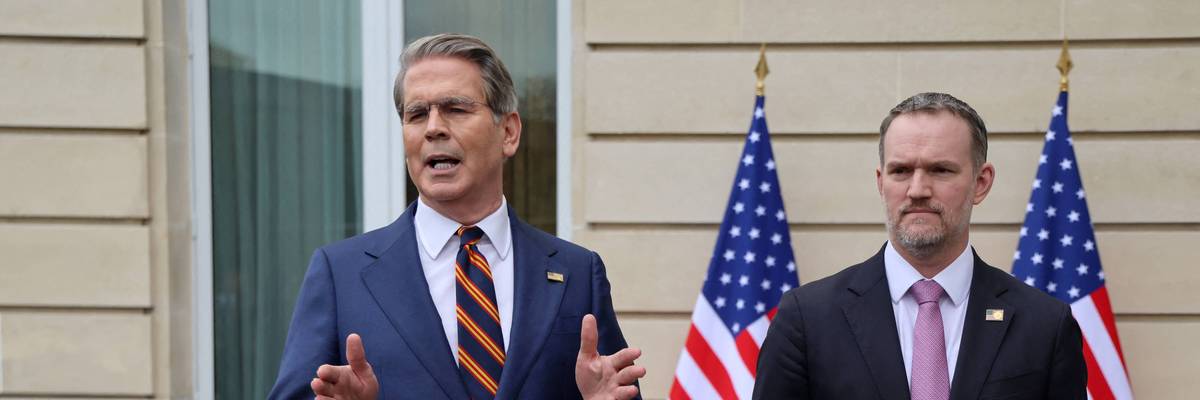
US Treasury Secretary Scott Bessent addresses journalists in Paris on March 16, 2026.
"Is this a victory or an admission of America's failure!?" asked Iran's deputy foreign minister.
Top Iranian officials on Monday ridiculed the Trump administration's threats of total economic warfare against the Middle East country, calling the US Treasury Department's proposed "financial offensive" an act of desperation as the costly conflict drags on with no end in sight.
"Is this a victory or an admission of America's failure!?" Kazem Gharibabadi, Iran's deputy foreign minister, wrote on social media after US Treasury Secretary Scott Bessent laid out the Trump administration's planned economic assault in a Sunday op-ed for the Financial Times titled, "An Economic D-Day Is Coming for Iran."
In a social media post promoting his op-ed, Bessent declared that US President Donald Trump has "dismantled Iran’s military capabilities, destroyed nearly 100% of its military factories, and buried its nuclear program."
"We are now entering the endgame," Bessent added. "At dawn begins an economic D-Day—the single greatest financial offensive ever marshaled against an adversary."
Gharibabadi responded that Bessent's "narrative doesn't add up."
"You say Iran's military capability has been 'dismantled,' 100% of its military factories 'destroyed,' and its nuclear program 'buried'; but for this very Iran, the 'largest financial assault in history' and the mobilization of 'all US institutions and authorities' have been necessary!" Gharibabadi wrote.
Iran's top diplomat, Abbas Araghchi, similarly dismissed the Trump administration's vow to intensify its economic warfare against Iran, saying it is "bound to fail."
"We have seen this movie before," said Araghchi. "Same bull. Different bullies."
Bessent is expected to unveil the details of the economic measures in a press conference on Monday, initiating a new phase of a war that the US and Israel launched in late February.
Analysts said the renewed threats of all-out economic warfare are reminiscent of the "maximum pressure" campaign that the first Trump administration launched against Iran after shredding the Obama-era nuclear accord, setting the stage for the current war.
"The United States can certainly inflict a significant amount of pain on the Iranians," Trita Parsi, executive vice president of the Quincy Institute for Responsible Statecraft, told CNN over the weekend. "But to bring them to some sort of a breaking point that would cause them to surrender, I find extremely unlikely. I think we should remind ourselves: We've been here before. This is what the maximum pressure sanctions were supposed to do eight years ago."
"If this ends up becoming successful in terms of putting a lot of pressure on the Iranians," Parsi added, "then the most likely outcome is that they will counter-escalate, and their counter-escalation could be striking countries in the region."
Esmail Baghaei, a spokesperson for Iran's foreign ministry, warned during a press conference on Monday that "any collusion with the United States in this plan will certainly have consequences."
Dear Common Dreams reader, It’s been nearly 30 years since I co-founded Common Dreams with my late wife, Lina Newhouser. We had the radical notion that journalism should serve the public good, not corporate profits. It was clear to us from the outset what it would take to build such a project. No paid advertisements. No corporate sponsors. No millionaire publisher telling us what to think or do. Many people said we wouldn't last a year, but we proved those doubters wrong. Together with a tremendous team of journalists and dedicated staff, we built an independent media outlet free from the constraints of profits and corporate control. Our mission has always been simple: To inform. To inspire. To ignite change for the common good. Building Common Dreams was not easy. Our survival was never guaranteed. When you take on the most powerful forces—Wall Street greed, fossil fuel industry destruction, Big Tech lobbyists, and uber-rich oligarchs who have spent billions upon billions rigging the economy and democracy in their favor—the only bulwark you have is supporters who believe in your work. But here’s the urgent message from me today. It's never been this bad out there. And it's never been this hard to keep us going. At the very moment Common Dreams is most needed, the threats we face are intensifying. We need your support now more than ever. We don't accept corporate advertising and never will. We don't have a paywall because we don't think people should be blocked from critical news based on their ability to pay. Everything we do is funded by the donations of readers like you. When everyone does the little they can afford, we are strong. But if that support retreats or dries up, so do we. Will you donate now to make sure Common Dreams not only survives but thrives? —Craig Brown, Co-founder |
Top Iranian officials on Monday ridiculed the Trump administration's threats of total economic warfare against the Middle East country, calling the US Treasury Department's proposed "financial offensive" an act of desperation as the costly conflict drags on with no end in sight.
"Is this a victory or an admission of America's failure!?" Kazem Gharibabadi, Iran's deputy foreign minister, wrote on social media after US Treasury Secretary Scott Bessent laid out the Trump administration's planned economic assault in a Sunday op-ed for the Financial Times titled, "An Economic D-Day Is Coming for Iran."
In a social media post promoting his op-ed, Bessent declared that US President Donald Trump has "dismantled Iran’s military capabilities, destroyed nearly 100% of its military factories, and buried its nuclear program."
"We are now entering the endgame," Bessent added. "At dawn begins an economic D-Day—the single greatest financial offensive ever marshaled against an adversary."
Gharibabadi responded that Bessent's "narrative doesn't add up."
"You say Iran's military capability has been 'dismantled,' 100% of its military factories 'destroyed,' and its nuclear program 'buried'; but for this very Iran, the 'largest financial assault in history' and the mobilization of 'all US institutions and authorities' have been necessary!" Gharibabadi wrote.
Iran's top diplomat, Abbas Araghchi, similarly dismissed the Trump administration's vow to intensify its economic warfare against Iran, saying it is "bound to fail."
"We have seen this movie before," said Araghchi. "Same bull. Different bullies."
Bessent is expected to unveil the details of the economic measures in a press conference on Monday, initiating a new phase of a war that the US and Israel launched in late February.
Analysts said the renewed threats of all-out economic warfare are reminiscent of the "maximum pressure" campaign that the first Trump administration launched against Iran after shredding the Obama-era nuclear accord, setting the stage for the current war.
"The United States can certainly inflict a significant amount of pain on the Iranians," Trita Parsi, executive vice president of the Quincy Institute for Responsible Statecraft, told CNN over the weekend. "But to bring them to some sort of a breaking point that would cause them to surrender, I find extremely unlikely. I think we should remind ourselves: We've been here before. This is what the maximum pressure sanctions were supposed to do eight years ago."
"If this ends up becoming successful in terms of putting a lot of pressure on the Iranians," Parsi added, "then the most likely outcome is that they will counter-escalate, and their counter-escalation could be striking countries in the region."
Esmail Baghaei, a spokesperson for Iran's foreign ministry, warned during a press conference on Monday that "any collusion with the United States in this plan will certainly have consequences."
Top Iranian officials on Monday ridiculed the Trump administration's threats of total economic warfare against the Middle East country, calling the US Treasury Department's proposed "financial offensive" an act of desperation as the costly conflict drags on with no end in sight.
"Is this a victory or an admission of America's failure!?" Kazem Gharibabadi, Iran's deputy foreign minister, wrote on social media after US Treasury Secretary Scott Bessent laid out the Trump administration's planned economic assault in a Sunday op-ed for the Financial Times titled, "An Economic D-Day Is Coming for Iran."
In a social media post promoting his op-ed, Bessent declared that US President Donald Trump has "dismantled Iran’s military capabilities, destroyed nearly 100% of its military factories, and buried its nuclear program."
"We are now entering the endgame," Bessent added. "At dawn begins an economic D-Day—the single greatest financial offensive ever marshaled against an adversary."
Gharibabadi responded that Bessent's "narrative doesn't add up."
"You say Iran's military capability has been 'dismantled,' 100% of its military factories 'destroyed,' and its nuclear program 'buried'; but for this very Iran, the 'largest financial assault in history' and the mobilization of 'all US institutions and authorities' have been necessary!" Gharibabadi wrote.
Iran's top diplomat, Abbas Araghchi, similarly dismissed the Trump administration's vow to intensify its economic warfare against Iran, saying it is "bound to fail."
"We have seen this movie before," said Araghchi. "Same bull. Different bullies."
Bessent is expected to unveil the details of the economic measures in a press conference on Monday, initiating a new phase of a war that the US and Israel launched in late February.
Analysts said the renewed threats of all-out economic warfare are reminiscent of the "maximum pressure" campaign that the first Trump administration launched against Iran after shredding the Obama-era nuclear accord, setting the stage for the current war.
"The United States can certainly inflict a significant amount of pain on the Iranians," Trita Parsi, executive vice president of the Quincy Institute for Responsible Statecraft, told CNN over the weekend. "But to bring them to some sort of a breaking point that would cause them to surrender, I find extremely unlikely. I think we should remind ourselves: We've been here before. This is what the maximum pressure sanctions were supposed to do eight years ago."
"If this ends up becoming successful in terms of putting a lot of pressure on the Iranians," Parsi added, "then the most likely outcome is that they will counter-escalate, and their counter-escalation could be striking countries in the region."
Esmail Baghaei, a spokesperson for Iran's foreign ministry, warned during a press conference on Monday that "any collusion with the United States in this plan will certainly have consequences."