SUBSCRIBE TO OUR FREE NEWSLETTER
Daily news & progressive opinion—funded by the people, not the corporations—delivered straight to your inbox.
5
#000000
#FFFFFF
To donate by check, phone, or other method, see our More Ways to Give page.
Daily news & progressive opinion—funded by the people, not the corporations—delivered straight to your inbox.
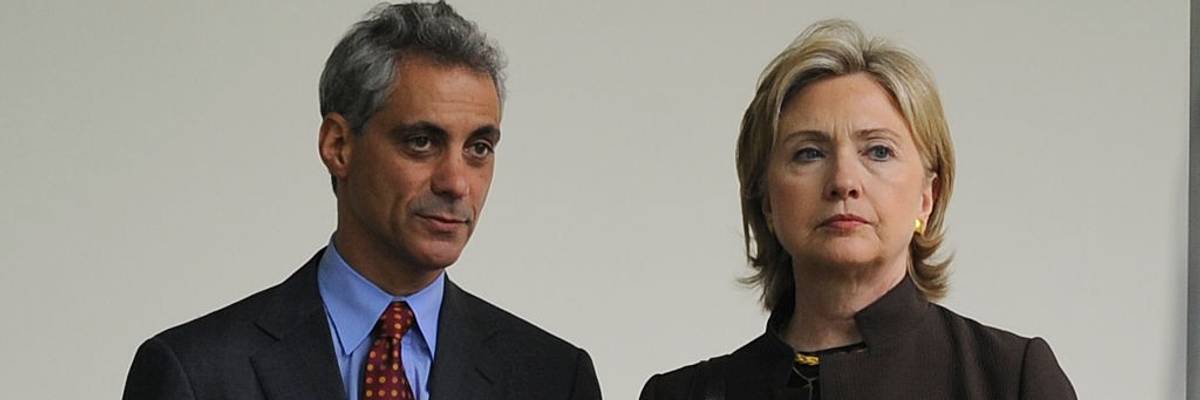
Former Secretary of State Hillary Clinton and former Chief of Staff Rahm Emanuel, pictured on the colonnade during a Rose Garden Press Conference with President Barack Obama on July 16, 2009.
For the Democrats to become a truly populist party, an entirely new wave of working-class candidates must come to the fore. But that won't just happen. A movement must be built and harnessed.
Donald Trump’s victory is causing James Carville, the outspoken raging Cajun who was Bill Clinton’s campaign manager in 1992, to call for the Democratic Party to go all in on a populist agenda. He wrote recently in the New York Times,
“Go big, go populist, stick to economic progress, and force them [Republicans] to oppose what they cannot be for. In unison.”
Is Carville really agreeing with the Center for Working Class Politics, which in October published the results of their YouGov survey, “Populism Wins Pennsylvania?” That report found that:
“… working-class Pennsylvanians responded most favorably to populist messages and messages that emphasized progressive economic policies. What’s more, we found little evidence that focusing on economic populism risks decreasing voter enthusiasm among core Democratic constituencies outside the working class.”
Ezra Klein, another Democratic Party influencer, picked up on that survey just before the election in November, but then dismissed it as an outlier: “Surveys like that should be treated with some skepticism”, he wrote. “The Harris team is running plenty of its own polls and focus groups and message tests.”
But the results of elections matter, and there is now a chorus of Democratic Party nouveau populists, including Rahm Emanuel, Bill Clinton’s close advisor, who went on to earn tens of millions on Wall Street.
It’s time to take a deep breath and recall how these recently minted populists helped to create the very conditions that crushed the working class. As former Senator Sherrod Brown discovered in Ohio, to this day, workers still blame the Democrats for NAFTA, the 1994 trade deal that Clinton, Carville, and Emanuel pushed that ended up costing millions of U.S. jobs.
It’s time to take a deep breath and recall how these recently minted populists helped to create the very conditions that crushed the working class.
Emanual seems these days to have become a closet Sanders supporter, claiming that Obama was way too soft on the bankers who crashed the economy in 2008:
Not only was no one held accountable, but the same bankers who engineered the crisis were aggrieved at the suggestion of diminished bonuses and government intervention. It was a mistake not to apply Old Testament justice to the bankers during the Obama administration, as some called for at the time.
Some did, at the time, but Emanuel did not. Buy hey, people do change, don’t they? Why shouldn’t we believe that the old Democrats can become real populists?
Let’s start with an understanding of how that Harris polling could have been so wrong. Why did their results cause them to shy away from the kind of strong populism that the Center for Working Class Politics found attracted the most working-class support in Pennsylvania? A state Harris had to win.
I don’t know the Harris pollsters personally, but I do know how the Center for Working Class Politics operates. They are meticulous. They know that their polls will be ripped apart by establishment academics and party gatekeepers, so they can’t make mistakes. They can’t let their own personal beliefs tilt the survey towards what they’d like to believe is true. Their goal is to ask the questions others aren’t asking, to better reflect the opinions of people of all types about working class values and beliefs.
Not so with the pollsters who cashed in on the Harris campaign. They know what their client wants to hear (and is capable of hearing). And it’s not that a strong anti-Wall Street message sells, and therefore that she should mercilessly attack what Sanders calls “the billionaire class.” After all, Harris made a public point of holding a Wall Street fundraiser in the middle of her campaign, and her staff made clear that Wall Street helped to shape her agenda. Her brother-in-law, Tony West, was special adviser to her election campaign, and has deep ties to Wall Street through Uber and Pepsico.
It’s not that Democratic Party pollsters cooked the books. They just knew to ask questions that hovered within the corporate Democratic comfort zone. They didn’t ask the strongest populist questions because they didn’t think those results would be welcomed within the campaign.
I once saw this process in action. I was watching a focus group through a one-way mirror. The topic was healthcare in the leadup to Obamacare, but it was stunning to see how the discussion was shaped by the types of questions the facilitators asked. They limited them to various types of health insurance and avoided more radical reforms of the healthcare system.
At one point a younger Black man expressed his frustration: “Why all this talk about insurance? I’m interested in health care and getting access to it.” He was thanked for his comment and then ignored, while I yelled at the mirror, “Talk about Medicare for All!” It didn’t happen because the group paying for the focus group, as well as the pollster, didn’t think Medicare for All was feasible, and therefore refused to discuss it.
Today, the Democratic elites not only run away from Medicare for All, but they refuse to acknowledge their financial ties to Wall Street. They are more than comfortable, however, accepting large consulting and speaking fees from what should be the targets of their populism. This goes back to Bill and Hillary Clintons’ tone-deaf acceptance of $153 million in speaking fees, including 39 speeches from the very banks that crashed the economy in 2008. During Hillary Clinton’s 2016 campaign she collected $1.8 million for eight speeches to Wall Street banks.
For the Democrats to become a populist party, an entirely new wave of working-class candidates must come to the fore. And for that to happened, we need a working-class movement that forms outside of the two parties and demands economic justice for all...
It's not hard to understand. The Wall Street barons who pay the speaking fees are the same kind of people who went to Yale with Hillary and Bill. They’re all from the same newly minted class of highly successful strivers. If there were any working-class roots in their backgrounds, they withered long ago. Nearly all Democratic Party elites are swathed within this moneyed class. During their leadership of the Vietnam War in the 1960s, author David Halberstam called them “the best and the brightest.” Now they are just the richest. In this milieu, light years away from the working class, getting $225,000 per speech seems like a trifle.
But let’s try to be fair. Can’t the party change its stripes now that Democratic influencers are talking populism in the wake of Trump’s victory?
Unfortunately, I don’t think their talk is credible. It’s doubtful that Carville, Klein, and Emanuel are capable of offering a sustained anti-Wall Street message. They are different from Bernie Sanders, and not just because of their word choices. It’s about their entire careers, the things that made them who they are, their entire way of being. Sanders has been an overt social democrat all his adult life. It’s obvious that he means what he says. He says it over and over again. He really couldn’t care less what Wall Street thinks about him.
As for the nouveau populists, I’m waiting for Carville to say, “Look I was dead wrong when I helped Bill Clinton undermine unions through NAFTA.” Or for Emanuel to confess that “I was wrong to take millions in Wall Street fees while workers were losing their jobs through mergers, leveraged buyouts, and stock buybacks.” Or for Ezra Klein to admit in print that the Center for Worker Class Politics, “were right about populism. The Harris pollsters were wrong, and I was at fault for dismissing their solid work.”
Or maybe the Democrats could finally show some outrage about Wall Street-induced mass layoffs that are destroying the livelihoods of working people. (For more information, please see Wall Street’s War on Workers.)
For the Democrats to become a populist party, an entirely new wave of working-class candidates must come to the fore. And for that to happened, we need a working-class movement that forms outside of the two parties and demands economic justice for all, as the original American populists, the Peoples Party, did in the 1880s. Today, that might look like a sustained, organized version of Occupy Wall Street, which fights against mass layoffs caused by Wall Street’s greed and for a $20 federal minimum wage.
Meanwhile, get ready for more faux populism from Democratic Party elites while Wall Street feasts on the riches Trump showers upon them.
Dear Common Dreams reader, It’s been nearly 30 years since I co-founded Common Dreams with my late wife, Lina Newhouser. We had the radical notion that journalism should serve the public good, not corporate profits. It was clear to us from the outset what it would take to build such a project. No paid advertisements. No corporate sponsors. No millionaire publisher telling us what to think or do. Many people said we wouldn't last a year, but we proved those doubters wrong. Together with a tremendous team of journalists and dedicated staff, we built an independent media outlet free from the constraints of profits and corporate control. Our mission has always been simple: To inform. To inspire. To ignite change for the common good. Building Common Dreams was not easy. Our survival was never guaranteed. When you take on the most powerful forces—Wall Street greed, fossil fuel industry destruction, Big Tech lobbyists, and uber-rich oligarchs who have spent billions upon billions rigging the economy and democracy in their favor—the only bulwark you have is supporters who believe in your work. But here’s the urgent message from me today. It's never been this bad out there. And it's never been this hard to keep us going. At the very moment Common Dreams is most needed, the threats we face are intensifying. We need your support now more than ever. We don't accept corporate advertising and never will. We don't have a paywall because we don't think people should be blocked from critical news based on their ability to pay. Everything we do is funded by the donations of readers like you. When everyone does the little they can afford, we are strong. But if that support retreats or dries up, so do we. Will you donate now to make sure Common Dreams not only survives but thrives? —Craig Brown, Co-founder |
Les Leopold is the executive director of the Labor Institute and author of the new book, “The Billionaires Have Two Parties, We Need a Party of Our Own” (2026). His previous books include: “Wall Street’s War on Workers: How Mass Layoffs and Greed Are Destroying the Working Class and What to Do About It" (2024); "Runaway Inequality: An Activist's Guide to Economic Justice" (2015); and “The Man Who Hated Work and Loved Labor: The Life and Times of Tony Mazzocchi” (2007). Read more of his work on his substack here.
Donald Trump’s victory is causing James Carville, the outspoken raging Cajun who was Bill Clinton’s campaign manager in 1992, to call for the Democratic Party to go all in on a populist agenda. He wrote recently in the New York Times,
“Go big, go populist, stick to economic progress, and force them [Republicans] to oppose what they cannot be for. In unison.”
Is Carville really agreeing with the Center for Working Class Politics, which in October published the results of their YouGov survey, “Populism Wins Pennsylvania?” That report found that:
“… working-class Pennsylvanians responded most favorably to populist messages and messages that emphasized progressive economic policies. What’s more, we found little evidence that focusing on economic populism risks decreasing voter enthusiasm among core Democratic constituencies outside the working class.”
Ezra Klein, another Democratic Party influencer, picked up on that survey just before the election in November, but then dismissed it as an outlier: “Surveys like that should be treated with some skepticism”, he wrote. “The Harris team is running plenty of its own polls and focus groups and message tests.”
But the results of elections matter, and there is now a chorus of Democratic Party nouveau populists, including Rahm Emanuel, Bill Clinton’s close advisor, who went on to earn tens of millions on Wall Street.
It’s time to take a deep breath and recall how these recently minted populists helped to create the very conditions that crushed the working class. As former Senator Sherrod Brown discovered in Ohio, to this day, workers still blame the Democrats for NAFTA, the 1994 trade deal that Clinton, Carville, and Emanuel pushed that ended up costing millions of U.S. jobs.
It’s time to take a deep breath and recall how these recently minted populists helped to create the very conditions that crushed the working class.
Emanual seems these days to have become a closet Sanders supporter, claiming that Obama was way too soft on the bankers who crashed the economy in 2008:
Not only was no one held accountable, but the same bankers who engineered the crisis were aggrieved at the suggestion of diminished bonuses and government intervention. It was a mistake not to apply Old Testament justice to the bankers during the Obama administration, as some called for at the time.
Some did, at the time, but Emanuel did not. Buy hey, people do change, don’t they? Why shouldn’t we believe that the old Democrats can become real populists?
Let’s start with an understanding of how that Harris polling could have been so wrong. Why did their results cause them to shy away from the kind of strong populism that the Center for Working Class Politics found attracted the most working-class support in Pennsylvania? A state Harris had to win.
I don’t know the Harris pollsters personally, but I do know how the Center for Working Class Politics operates. They are meticulous. They know that their polls will be ripped apart by establishment academics and party gatekeepers, so they can’t make mistakes. They can’t let their own personal beliefs tilt the survey towards what they’d like to believe is true. Their goal is to ask the questions others aren’t asking, to better reflect the opinions of people of all types about working class values and beliefs.
Not so with the pollsters who cashed in on the Harris campaign. They know what their client wants to hear (and is capable of hearing). And it’s not that a strong anti-Wall Street message sells, and therefore that she should mercilessly attack what Sanders calls “the billionaire class.” After all, Harris made a public point of holding a Wall Street fundraiser in the middle of her campaign, and her staff made clear that Wall Street helped to shape her agenda. Her brother-in-law, Tony West, was special adviser to her election campaign, and has deep ties to Wall Street through Uber and Pepsico.
It’s not that Democratic Party pollsters cooked the books. They just knew to ask questions that hovered within the corporate Democratic comfort zone. They didn’t ask the strongest populist questions because they didn’t think those results would be welcomed within the campaign.
I once saw this process in action. I was watching a focus group through a one-way mirror. The topic was healthcare in the leadup to Obamacare, but it was stunning to see how the discussion was shaped by the types of questions the facilitators asked. They limited them to various types of health insurance and avoided more radical reforms of the healthcare system.
At one point a younger Black man expressed his frustration: “Why all this talk about insurance? I’m interested in health care and getting access to it.” He was thanked for his comment and then ignored, while I yelled at the mirror, “Talk about Medicare for All!” It didn’t happen because the group paying for the focus group, as well as the pollster, didn’t think Medicare for All was feasible, and therefore refused to discuss it.
Today, the Democratic elites not only run away from Medicare for All, but they refuse to acknowledge their financial ties to Wall Street. They are more than comfortable, however, accepting large consulting and speaking fees from what should be the targets of their populism. This goes back to Bill and Hillary Clintons’ tone-deaf acceptance of $153 million in speaking fees, including 39 speeches from the very banks that crashed the economy in 2008. During Hillary Clinton’s 2016 campaign she collected $1.8 million for eight speeches to Wall Street banks.
For the Democrats to become a populist party, an entirely new wave of working-class candidates must come to the fore. And for that to happened, we need a working-class movement that forms outside of the two parties and demands economic justice for all...
It's not hard to understand. The Wall Street barons who pay the speaking fees are the same kind of people who went to Yale with Hillary and Bill. They’re all from the same newly minted class of highly successful strivers. If there were any working-class roots in their backgrounds, they withered long ago. Nearly all Democratic Party elites are swathed within this moneyed class. During their leadership of the Vietnam War in the 1960s, author David Halberstam called them “the best and the brightest.” Now they are just the richest. In this milieu, light years away from the working class, getting $225,000 per speech seems like a trifle.
But let’s try to be fair. Can’t the party change its stripes now that Democratic influencers are talking populism in the wake of Trump’s victory?
Unfortunately, I don’t think their talk is credible. It’s doubtful that Carville, Klein, and Emanuel are capable of offering a sustained anti-Wall Street message. They are different from Bernie Sanders, and not just because of their word choices. It’s about their entire careers, the things that made them who they are, their entire way of being. Sanders has been an overt social democrat all his adult life. It’s obvious that he means what he says. He says it over and over again. He really couldn’t care less what Wall Street thinks about him.
As for the nouveau populists, I’m waiting for Carville to say, “Look I was dead wrong when I helped Bill Clinton undermine unions through NAFTA.” Or for Emanuel to confess that “I was wrong to take millions in Wall Street fees while workers were losing their jobs through mergers, leveraged buyouts, and stock buybacks.” Or for Ezra Klein to admit in print that the Center for Worker Class Politics, “were right about populism. The Harris pollsters were wrong, and I was at fault for dismissing their solid work.”
Or maybe the Democrats could finally show some outrage about Wall Street-induced mass layoffs that are destroying the livelihoods of working people. (For more information, please see Wall Street’s War on Workers.)
For the Democrats to become a populist party, an entirely new wave of working-class candidates must come to the fore. And for that to happened, we need a working-class movement that forms outside of the two parties and demands economic justice for all, as the original American populists, the Peoples Party, did in the 1880s. Today, that might look like a sustained, organized version of Occupy Wall Street, which fights against mass layoffs caused by Wall Street’s greed and for a $20 federal minimum wage.
Meanwhile, get ready for more faux populism from Democratic Party elites while Wall Street feasts on the riches Trump showers upon them.
Les Leopold is the executive director of the Labor Institute and author of the new book, “The Billionaires Have Two Parties, We Need a Party of Our Own” (2026). His previous books include: “Wall Street’s War on Workers: How Mass Layoffs and Greed Are Destroying the Working Class and What to Do About It" (2024); "Runaway Inequality: An Activist's Guide to Economic Justice" (2015); and “The Man Who Hated Work and Loved Labor: The Life and Times of Tony Mazzocchi” (2007). Read more of his work on his substack here.
Donald Trump’s victory is causing James Carville, the outspoken raging Cajun who was Bill Clinton’s campaign manager in 1992, to call for the Democratic Party to go all in on a populist agenda. He wrote recently in the New York Times,
“Go big, go populist, stick to economic progress, and force them [Republicans] to oppose what they cannot be for. In unison.”
Is Carville really agreeing with the Center for Working Class Politics, which in October published the results of their YouGov survey, “Populism Wins Pennsylvania?” That report found that:
“… working-class Pennsylvanians responded most favorably to populist messages and messages that emphasized progressive economic policies. What’s more, we found little evidence that focusing on economic populism risks decreasing voter enthusiasm among core Democratic constituencies outside the working class.”
Ezra Klein, another Democratic Party influencer, picked up on that survey just before the election in November, but then dismissed it as an outlier: “Surveys like that should be treated with some skepticism”, he wrote. “The Harris team is running plenty of its own polls and focus groups and message tests.”
But the results of elections matter, and there is now a chorus of Democratic Party nouveau populists, including Rahm Emanuel, Bill Clinton’s close advisor, who went on to earn tens of millions on Wall Street.
It’s time to take a deep breath and recall how these recently minted populists helped to create the very conditions that crushed the working class. As former Senator Sherrod Brown discovered in Ohio, to this day, workers still blame the Democrats for NAFTA, the 1994 trade deal that Clinton, Carville, and Emanuel pushed that ended up costing millions of U.S. jobs.
It’s time to take a deep breath and recall how these recently minted populists helped to create the very conditions that crushed the working class.
Emanual seems these days to have become a closet Sanders supporter, claiming that Obama was way too soft on the bankers who crashed the economy in 2008:
Not only was no one held accountable, but the same bankers who engineered the crisis were aggrieved at the suggestion of diminished bonuses and government intervention. It was a mistake not to apply Old Testament justice to the bankers during the Obama administration, as some called for at the time.
Some did, at the time, but Emanuel did not. Buy hey, people do change, don’t they? Why shouldn’t we believe that the old Democrats can become real populists?
Let’s start with an understanding of how that Harris polling could have been so wrong. Why did their results cause them to shy away from the kind of strong populism that the Center for Working Class Politics found attracted the most working-class support in Pennsylvania? A state Harris had to win.
I don’t know the Harris pollsters personally, but I do know how the Center for Working Class Politics operates. They are meticulous. They know that their polls will be ripped apart by establishment academics and party gatekeepers, so they can’t make mistakes. They can’t let their own personal beliefs tilt the survey towards what they’d like to believe is true. Their goal is to ask the questions others aren’t asking, to better reflect the opinions of people of all types about working class values and beliefs.
Not so with the pollsters who cashed in on the Harris campaign. They know what their client wants to hear (and is capable of hearing). And it’s not that a strong anti-Wall Street message sells, and therefore that she should mercilessly attack what Sanders calls “the billionaire class.” After all, Harris made a public point of holding a Wall Street fundraiser in the middle of her campaign, and her staff made clear that Wall Street helped to shape her agenda. Her brother-in-law, Tony West, was special adviser to her election campaign, and has deep ties to Wall Street through Uber and Pepsico.
It’s not that Democratic Party pollsters cooked the books. They just knew to ask questions that hovered within the corporate Democratic comfort zone. They didn’t ask the strongest populist questions because they didn’t think those results would be welcomed within the campaign.
I once saw this process in action. I was watching a focus group through a one-way mirror. The topic was healthcare in the leadup to Obamacare, but it was stunning to see how the discussion was shaped by the types of questions the facilitators asked. They limited them to various types of health insurance and avoided more radical reforms of the healthcare system.
At one point a younger Black man expressed his frustration: “Why all this talk about insurance? I’m interested in health care and getting access to it.” He was thanked for his comment and then ignored, while I yelled at the mirror, “Talk about Medicare for All!” It didn’t happen because the group paying for the focus group, as well as the pollster, didn’t think Medicare for All was feasible, and therefore refused to discuss it.
Today, the Democratic elites not only run away from Medicare for All, but they refuse to acknowledge their financial ties to Wall Street. They are more than comfortable, however, accepting large consulting and speaking fees from what should be the targets of their populism. This goes back to Bill and Hillary Clintons’ tone-deaf acceptance of $153 million in speaking fees, including 39 speeches from the very banks that crashed the economy in 2008. During Hillary Clinton’s 2016 campaign she collected $1.8 million for eight speeches to Wall Street banks.
For the Democrats to become a populist party, an entirely new wave of working-class candidates must come to the fore. And for that to happened, we need a working-class movement that forms outside of the two parties and demands economic justice for all...
It's not hard to understand. The Wall Street barons who pay the speaking fees are the same kind of people who went to Yale with Hillary and Bill. They’re all from the same newly minted class of highly successful strivers. If there were any working-class roots in their backgrounds, they withered long ago. Nearly all Democratic Party elites are swathed within this moneyed class. During their leadership of the Vietnam War in the 1960s, author David Halberstam called them “the best and the brightest.” Now they are just the richest. In this milieu, light years away from the working class, getting $225,000 per speech seems like a trifle.
But let’s try to be fair. Can’t the party change its stripes now that Democratic influencers are talking populism in the wake of Trump’s victory?
Unfortunately, I don’t think their talk is credible. It’s doubtful that Carville, Klein, and Emanuel are capable of offering a sustained anti-Wall Street message. They are different from Bernie Sanders, and not just because of their word choices. It’s about their entire careers, the things that made them who they are, their entire way of being. Sanders has been an overt social democrat all his adult life. It’s obvious that he means what he says. He says it over and over again. He really couldn’t care less what Wall Street thinks about him.
As for the nouveau populists, I’m waiting for Carville to say, “Look I was dead wrong when I helped Bill Clinton undermine unions through NAFTA.” Or for Emanuel to confess that “I was wrong to take millions in Wall Street fees while workers were losing their jobs through mergers, leveraged buyouts, and stock buybacks.” Or for Ezra Klein to admit in print that the Center for Worker Class Politics, “were right about populism. The Harris pollsters were wrong, and I was at fault for dismissing their solid work.”
Or maybe the Democrats could finally show some outrage about Wall Street-induced mass layoffs that are destroying the livelihoods of working people. (For more information, please see Wall Street’s War on Workers.)
For the Democrats to become a populist party, an entirely new wave of working-class candidates must come to the fore. And for that to happened, we need a working-class movement that forms outside of the two parties and demands economic justice for all, as the original American populists, the Peoples Party, did in the 1880s. Today, that might look like a sustained, organized version of Occupy Wall Street, which fights against mass layoffs caused by Wall Street’s greed and for a $20 federal minimum wage.
Meanwhile, get ready for more faux populism from Democratic Party elites while Wall Street feasts on the riches Trump showers upon them.