SUBSCRIBE TO OUR FREE NEWSLETTER
Daily news & progressive opinion—funded by the people, not the corporations—delivered straight to your inbox.
5
#000000
#FFFFFF
To donate by check, phone, or other method, see our More Ways to Give page.
Daily news & progressive opinion—funded by the people, not the corporations—delivered straight to your inbox.
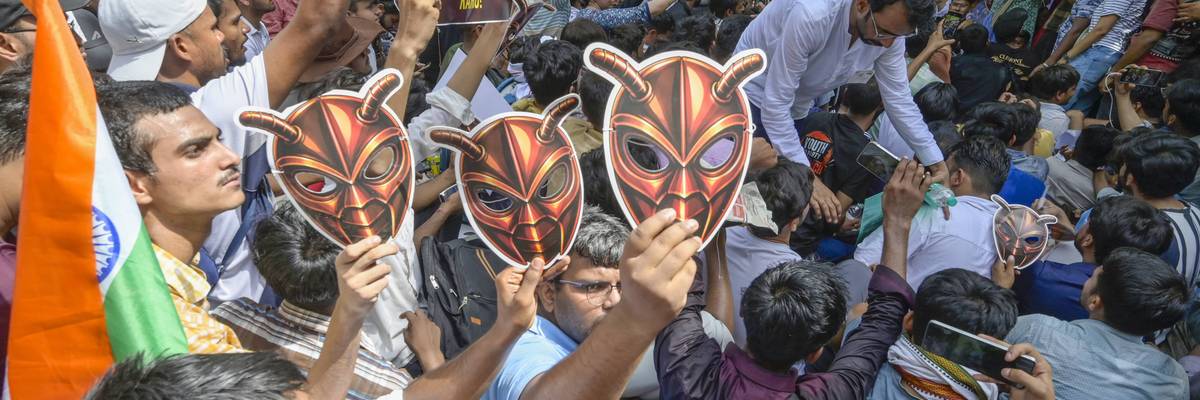
A Cockroach Janta Party (CJP) supporter holds a cockroach mask during a protest over alleged irregularities in the country's major examinations on June 6, 2026 in New Delhi, India.
How a leaked high-stakes exam exposed capitalism’s broken promise—and why standardized testing keeps igniting struggle.
They called them cockroaches.
It was meant to reduce them—to make millions of young people seem small enough to squish and contemptible enough that no one would mourn their extermination.
But instead of crushing them, the insult only made them multiply.
Every blow from a police lathi—a long, heavy club used by Indian police—brought more bodies into the streets. Every attempt to scatter them revealed how many there were. What authorities dismissed as an infestation became an uprising powerful enough to drive India’s education minister from office and deliver one of the sharpest popular rebukes yet to Prime Minister Narendra Modi’s rule.
When the questions themselves go up for sale, it is not only the examination that is compromised. The promise collapses with it.
At the center of the revolt was a test that promised merit and delivered betrayal.
India’s National Eligibility-cum-Entrance Test, or NEET, determines admission to undergraduate medical programs. More than 2 million young people took the examination, often after their families had sacrificed for years to pay for specialized coaching. The test presents itself as an impartial judge: Everyone receives the same questions, the same clock, and the same numerical verdict.
Then the questions were leaked and reportedly sold in advance.
Young people told to outstudy one another discovered that some contestants might simply have purchased the finish line. The test promised an even starting line, but the marketplace had filled some lanes with hurdles and cleared others for the wealthy.
Their fury grew into weeks of mass protest that forced Education Minister Dharmendra Pradhan to resign on July 25, 2026.
The movement took its name from a remark by Chief Justice Surya Kant comparing unemployed young people to “cockroaches” and “parasites.” Abhijeet Dipke, a Dalit activist from one of India’s historically oppressed caste communities, seized the slur and sent it crawling back toward those in power. “What if all cockroaches came together?” he asked online.
From that question emerged the Cockroach Janta Party (CJP)—a name that mocked Modi’s ruling Bharatiya Janata Party, or BJP.
The great Indian writer and activist Arundhati Roy celebrated the CJP members as “young roaches riding in on the rain,” as protesters poured into Delhi beneath the monsoon skies. Their numbers were formidable, but so was their irreverence. When police aimed water cannons at them, young people dared the officers to turn them on—then danced in the spray. The state brought water cannons into the streets to produce fear. The protesters transformed the streets into a stage and danced in the spray.
In a Democracy Now! interview, Roy described a movement alive with “mockery and humor,” “dancing,” and “singing”—a rebellion defined by “exuberance.” Protesters joked that fleeing police lathi attacks was helping them maintain their running streaks on Strava, a fitness-tracking app. They turned footage of the chases into video-game parodies and posted mock influencer-style “get ready with me” videos and “fit checks” featuring helmets, goggles, and homemade protective gear. One demonstrator held a placard declaring, “Every joke is a tiny revolution.”
That creative humor—an intelligence no standardized test could measure—was not an escape from struggle, but rather one of the movement’s weapons. They met contempt with laughter, intimidation with choreography, and isolation with an expanding circle of solidarity.
The uprising forced Modi to announce a national task force to overhaul the examination system, while the government proposed stronger penalties for exam fraud. The Cockroach Janta Party also secured commitments to compensate families of students who died by suicide amid the crisis and withdraw criminal cases against protesters.
While no single event explains a suicide, movement leaders linked the deaths to the despair produced by a system that made one examination appear capable of determining an entire life—then revealed that the exam could be bought.
Near the main protest site in New Delhi, students erupted in celebration. Dipke reportedly fell to his knees, raised his fist, and declared, “We have done it.” He called the result “a victory for the people of India” and “a defeat for the dictator.”
But the government did not accept defeat quietly. The movement called off its demonstrations after officials agreed to its central demands, including withdrawing criminal cases against protesters.
Within days, however, the Cockroach Janta Party reported that students and protesters were again being detained and arrested in several states. Movement leaders accused the government of violating the agreement and threatened to return to the streets.
The government subsequently announced that most Delhi protesters would face no further action. But organizers warned that closing proceedings was not the same as formally withdrawing the cases—and that the movement would resume if the government again broke its promises.
The government had retreated—but only far enough to gather itself for another attack. After officials agreed to withdraw cases against protesters and promised that no punitive action would follow, authorities began detaining and arresting students across several states, with Muslim and Dalit participants reportedly among those singled out. At least 100 people were arrested, many on stringent non-bailable charges, as the movement accused the government of backtracking on its agreement. By then, however, the students had done more than expose an examination leak. They had opened a crack in the façade of the system itself.
Why would a compromised examination provoke an uprising powerful enough to force out a cabinet minister—and frighten the government into trying to seal that crack through repression? Because a high-stakes test is never merely a collection of questions. It is a promise about how society works. It tells young people that wealth, caste, language, and power do not matter—that the future belongs to whoever studies hard.
When the questions themselves go up for sale, it is not only the examination that is compromised. The promise collapses with it.
Whether in India or across the world in the United States, standardized testing is one of capitalism’s most effective laundering machines. It takes a dirty hierarchy built through unequal access to wealth and education, scrubs away its history, and returns the result stamped with a single word: merit.
Every high-stakes testing system tells young people some version of the same story: Work hard, follow the rules, outstudy everyone else, and a high score will make the future yours.
For the millions of students taking NEET in India, that promise carries enormous weight. The examination is presented as the great objective referee, capable of determining who deserves entry into medical school. It supposedly does not care about a student’s family income, caste, gender, language, region, or access to private coaching. Everyone receives the same questions, the same time limit, and a score that appears to settle who is prepared to advance.
But a society does not become equal merely because it administers the same test to people who have been given profoundly unequal lives.
These scandals expose corruption, but they also reveal a deeper fiction: that a standardized examination can transform unequal access to wealth, schooling, language, and preparation into a neutral ranking of merit.
Some NEET applicants attend well-funded schools and spend years in expensive private coaching programs. Others learn in overcrowded classrooms, study in regional languages, work after school, care for siblings, or worry about whether their families can afford another year of preparation. “Everywhere you look, you can see the desperation of young people in this country,” Shree Kumar Verma, a 19-year-old NEET student studying in Kota—the center of India’s exam-coaching industry—told The Guardian. “Being at Kota is either going to bring you success or totally break you down; it’s all or nothing here.” Some students enter the testing center trained specifically to defeat NEET. Others arrive carrying every burden that caste, poverty, geography, and educational inequality have already placed on their backs.
Standardized tests convert these unequal conditions into a clean numerical hierarchy and then present the result as a neutral measure of individual merit. This is the central function of what I call the testocracy: a social class of elites that uses standardized testing to make inequality appear earned.
The NEET leak laid bare the crudest form of class privilege: Students with enough money or the right connections could allegedly purchase the questions outright. It was corruption in a form no one could mistake.
The scandal has a close parallel in the United States. In 2019, federal prosecutors exposed Operation Varsity Blues, a sprawling college admissions scheme in which wealthy parents paid consultant William “Rick” Singer to fraudulently secure places for their children at selective universities. Some arranged for stand-ins to take the SAT or ACT or paid corrupt proctors to change answers after the exams. Others bribed college coaches to designate their children as recruited athletes, sometimes fabricating athletic résumés and staging photographs of students participating in sports they did not actually play.
The scandal provoked outrage because wealthy families had purchased test scores and admissions outcomes outright. But affluent families routinely buy educational advantages that remain perfectly legal: elite schools, private tutoring, test preparation, admissions consultants, and access to universities that favor donors and children of alumni.
The comparison with NEET is striking. In both scandals, public outrage erupts when wealth abandons even the pretense of fairness and simply buys access to education and opportunity.
These scandals expose corruption, but they also reveal a deeper fiction: that a standardized examination can transform unequal access to wealth, schooling, language, and preparation into a neutral ranking of merit.
The camouflage of inherited advantage as individual merit is not an accidental flaw. It is rooted in the white supremacist, colonial, and eugenic history of standardized testing—a system designed to translate racial and imperial hierarchies into the seemingly neutral language of scores.
British colonial rule imposed a standardized examination system on India, reorganizing education around centralized curricula, externally controlled tests, and official credentials. Historian Jana Tschurenev describes the resulting culture as centered on “memorisation, examination, and technocratic management.” British authorities expanded schooling not to achieve equality, but to prepare most colonized people for subordinate positions while opening a narrow path to government employment and elite credentials.
A decisive turn came with Thomas Babington Macaulay’s 1835 Minute on Indian Education. Macaulay admitted that he knew neither Sanskrit nor Arabic, yet declared that “a single shelf of a good European library was worth the whole native literature of India and Arabia.” His contempt expressed the racist logic of British policy, which treated European knowledge as universal and Indian intellectual traditions as inferior. Whatever opportunities English education later offered some people excluded by India’s caste hierarchies, the colonial policy itself was designed to elevate the language and culture of the rulers. Mastery of that culture became increasingly essential to credentials, employment, and social advancement.
Wood’s Despatch of 1854 further centralized the system. The universities established in Calcutta, Bombay, and Madras in 1857 were modeled after the University of London and operated largely as examining and affiliating institutions, prescribing curricula, administering tests, and conferring degrees. Teaching became organized around examinations controlled by colonial authorities.
The Indian Civil Service (ICS) examination made the colonial function of testing especially clear. Indians could formally compete to enter the elite administrative corps that governed their country, but the examination was held only in London and structured around subjects associated with elite British schooling. British officials argued that the examination should secure candidates trained in the “highest and best form of English education”—a principle they said would be sacrificed if the test were also offered in India.
The effective exclusion of most Indian candidates became an early nationalist cause. At its founding meeting in 1885, the Indian National Congress demanded that the exam also be offered in India. The dispute exposed the contradiction of colonial meritocracy: Britain proclaimed an open competition while designing it to reward those with the wealth to travel to Britain and the greatest access to the colonizer’s language, schools, and culture.
A related system of race and class sorting developed in the United States, and the use of standardized tests gave that hierarchy the appearance of objective measurement. As Rethinking Schools has written:
Standardized tests first entered the public schools in the 1920s, pushed by eugenicists whose pseudoscience promoted the "natural superiority" of wealthy, white, US-born males. High-stakes standardized tests have disguised class and race privilege as merit ever since.
Beginning during World War I, psychologists administered the Army Alpha and Beta intelligence tests to more than 1.7 million military recruits. The tests sorted soldiers and were then used to make sweeping claims about the intelligence of entire racial and national groups.
Eugenicist psychologist Carl Brigham drew on the Army test results in his 1923 book, A Study of American Intelligence, to promote the supposed superiority of “Nordic” people and the inferiority of Black people and immigrants from Southern and Eastern Europe. Warning that “the decline of American intelligence” would accelerate “owing to the presence here of the negro,” he called for public action to prevent what he described as racial deterioration. Three years later, Brigham helped develop the Scholastic Aptitude Test (SAT), turning a system shaped by military classification and eugenics into a gatekeeper for higher education.
By the 1920s, standardized tests were also sorting millions of children into academic, remedial, and vocational tracks. They disproportionately directed white and affluent students toward universities and professional careers while steering Black, immigrant, working-class, and disabled children toward lower-paid positions in a racially stratified economy. Testing was essential for reproducing hierarchy and making it appear deserved.
Black intellectuals organized an early counterattack against this racist testing regime. Reflecting on the rapid spread of psychological testing after World War I, W.E.B. Du Bois wrote:
It was not until I was long out of school and indeed after the [First] World War that there came the hurried use of the new technique of psychological tests, which were quickly adjusted so as to put black folk absolutely beyond the possibility of civilization.
Du Bois was part of a larger movement of Black scholars challenging the tests’ methods, assumptions, and political uses. In 1924, educator Horace Mann Bond systematically dismantled Brigham’s claims, exposing the supposed science behind intelligence testing as an instrument of “propaganda and encouragement for prejudice.” Bond urged Black intellectuals to understand how the tests were constructed and used so they could resist efforts to portray Black people as incapable of exercising the full rights of citizenship.
Du Bois and Bond understood that the tests converted the consequences of segregation, poverty, and unequal schooling into supposed evidence of Black inferiority. The state denied Black children equal resources, measured the predictable results, and then used their scores to restrict access to advanced education and professional work.
The colonial testing system in India and the eugenic testing system in the United States were not identical. But both converted the language, culture, and advantages of dominant groups into supposedly universal measures of merit.
The openly colonial and eugenic language eventually became less acceptable, but the sorting machinery survived. “Racial fitness” became “aptitude.” Assertions of British and white superiority became supposedly universal “standards.” Claims about racial differences in intelligence became claims about an “achievement gap.” This year marks the SAT’s 100th anniversary—a century after its creation by eugenicists, it is still used to rank and sort young people for unequal opportunities.
High-stakes tests become politically explosive because they ask young people to place their faith in a promise our economic and political system cannot keep.
Capitalism produces enough wealth to house, feed, clothe, and educate everyone, but concentrates that wealth at the top. Education is celebrated as the “great equalizer,” yet schools operate within—and help reproduce—this unequal order. Education may help some individuals move within the hierarchy, but it cannot abolish a hierarchy the economy depends on. Standardized tests manage this contradiction by ranking young people, rationing scarce opportunities and presenting the results as merit rather than economic design.
When a test carrying the weight of a young person’s future is exposed as corrupt, arbitrary, or rigged, the promise of meritocracy can collapse into rebellion. In India, a leaked medical entrance examination sent masses of young people into the streets. In the United States, resistance to high-stakes testing grew into what organizers called the Education Spring. Though these movements confronted different systems, both revealed how supposedly neutral exams ration opportunity, discipline educators, and disguise inequality.
The protesters unlearned the lesson the testocracy had taught them. They had been told to view millions of other students as competitors standing between them and their futures. In struggle, they discovered one another as comrades.
I learned something about resisting the testocracy at Garfield High School in Seattle. In January 2013, teachers voted to refuse to administer the district-mandated Measures of Academic Progress test, known as the MAP. We were not opposed to assessing students. We opposed a test disconnected from much of our curriculum, costly in time and resources, and increasingly used to rank teachers rather than improve learning.
When the district threatened us with a 10-day suspension without pay, students and parents joined the struggle. Families opted out, students urged classmates to refuse the exam, and educators at other schools joined the boycott. By the end of the school year, the boycott forced the district to end the required use of the MAP in Seattle high schools.
The boycott became one of the brightest sparks of the Education Spring, the largest revolt against standardized testing in US history. The uprising carried the critique of Occupy Wall Street into public schools. Occupy had exposed how the wealthiest 1% manipulated political and economic institutions; the Education Spring challenged the use of testing, austerity, and privatization to reorganize education around corporate interests.
Across the country, hundreds of thousands of families opted out of state exams; students organized walkouts; and educators challenged testing mandates through resolutions, rallies, and boycotts. In New York alone, more than 200,000 students refused the state’s Common Core exams in 2015. The Garfield teachers did not create this movement alone, but our refusal helped spread a dangerous question: What if we simply stop cooperating?
The Education Spring and the NEET revolt both erupted because high-stakes tests compress vast social conflicts into a single score. An exam can determine whether a student graduates, enters medical school, receives a scholarship, or is shut out of a profession. It can also rank schools, punish educators, and justify closures. Resistance has since helped push a growing number of states to abandon standardized exams as high school graduation requirements.
Standardized tests become detonators because they promise fairness while making life-altering decisions among people never given equal opportunities. When that promise collapses—through leaked questions, racial disparities, corporate profiteering, or educationally useless exams—the test reveals itself as more than an assessment. It becomes a symbol of the system deciding who advances and who is left behind.
The testocracy tells young people they must defeat one another for access to a scarce future. Resistance begins when they recognize that the real obstacle is not the person sitting beside them, but the system forcing them to compete for what should be a right.
The Cockroach Movement did more than expose a corrupted examination. It exposed a society that tells young people their futures depend on defeating one another while the wealthy purchase every imaginable advantage—and sometimes the answers themselves.
A fairer NEET would matter. But no perfectly guarded test can make an unequal society just. India remains scarred by poverty, caste oppression, concentrated wealth, and repression. The United States is likewise defined by mass poverty amid extraordinary wealth, racial inequality, and attacks on dissent.
A fairer competition for scarcity does not end scarcity. A cleaner testocracy remains a testocracy.
The cockroaches have come together. The rest of us must decide whether we will keep competing for our assigned places in an unjust world—or join them in creating one in which every child has the chance to flourish.
But struggle is the greatest teacher. Young people who entered the streets demanding a fair exam learned that the corruption ran deeper than a leaked test. They learned how wealth and power shape the institutions governing their lives—and that institutions presented as immovable can be forced to retreat.
The Cockroach Movement did not end that repression. But it showed that even a government accustomed to surviving mass dissent can be forced to concede.
Most important, the protesters unlearned the lesson the testocracy had taught them. They had been told to view millions of other students as competitors standing between them and their futures. In struggle, they discovered one another as comrades. Their power did not come from defeating the student beside them, but from uniting in solidarity.
The government called them cockroaches because it believed they were small, disposable, and easy to crush. But cockroaches are legendary survivors, said to be capable of outliving even a nuclear apocalypse. These young people came through the monsoon rain, danced beneath the water cannons, and transformed an insult into a warning: The powerful may build the machinery of destruction, but those they despise may yet survive them.
Power wants the isolated student hunched over a standardized test, stomach knotted and nerves frayed, believing every failure belongs to them alone. It fears the moment that student looks up, sees millions carrying the same burden, and realizes that the failure belongs to the system.
The cockroaches have come together. The rest of us must decide whether we will keep competing for our assigned places in an unjust world—or join them in creating one in which every child has the chance to flourish.
That is the test our movements must pass.
Dear Common Dreams reader, It’s been nearly 30 years since I co-founded Common Dreams with my late wife, Lina Newhouser. We had the radical notion that journalism should serve the public good, not corporate profits. It was clear to us from the outset what it would take to build such a project. No paid advertisements. No corporate sponsors. No millionaire publisher telling us what to think or do. Many people said we wouldn't last a year, but we proved those doubters wrong. Together with a tremendous team of journalists and dedicated staff, we built an independent media outlet free from the constraints of profits and corporate control. Our mission has always been simple: To inform. To inspire. To ignite change for the common good. Building Common Dreams was not easy. Our survival was never guaranteed. When you take on the most powerful forces—Wall Street greed, fossil fuel industry destruction, Big Tech lobbyists, and uber-rich oligarchs who have spent billions upon billions rigging the economy and democracy in their favor—the only bulwark you have is supporters who believe in your work. But here’s the urgent message from me today. It's never been this bad out there. And it's never been this hard to keep us going. At the very moment Common Dreams is most needed, the threats we face are intensifying. We need your support now more than ever. We don't accept corporate advertising and never will. We don't have a paywall because we don't think people should be blocked from critical news based on their ability to pay. Everything we do is funded by the donations of readers like you. When everyone does the little they can afford, we are strong. But if that support retreats or dries up, so do we. Will you donate now to make sure Common Dreams not only survives but thrives? —Craig Brown, Co-founder |
They called them cockroaches.
It was meant to reduce them—to make millions of young people seem small enough to squish and contemptible enough that no one would mourn their extermination.
But instead of crushing them, the insult only made them multiply.
Every blow from a police lathi—a long, heavy club used by Indian police—brought more bodies into the streets. Every attempt to scatter them revealed how many there were. What authorities dismissed as an infestation became an uprising powerful enough to drive India’s education minister from office and deliver one of the sharpest popular rebukes yet to Prime Minister Narendra Modi’s rule.
When the questions themselves go up for sale, it is not only the examination that is compromised. The promise collapses with it.
At the center of the revolt was a test that promised merit and delivered betrayal.
India’s National Eligibility-cum-Entrance Test, or NEET, determines admission to undergraduate medical programs. More than 2 million young people took the examination, often after their families had sacrificed for years to pay for specialized coaching. The test presents itself as an impartial judge: Everyone receives the same questions, the same clock, and the same numerical verdict.
Then the questions were leaked and reportedly sold in advance.
Young people told to outstudy one another discovered that some contestants might simply have purchased the finish line. The test promised an even starting line, but the marketplace had filled some lanes with hurdles and cleared others for the wealthy.
Their fury grew into weeks of mass protest that forced Education Minister Dharmendra Pradhan to resign on July 25, 2026.
The movement took its name from a remark by Chief Justice Surya Kant comparing unemployed young people to “cockroaches” and “parasites.” Abhijeet Dipke, a Dalit activist from one of India’s historically oppressed caste communities, seized the slur and sent it crawling back toward those in power. “What if all cockroaches came together?” he asked online.
From that question emerged the Cockroach Janta Party (CJP)—a name that mocked Modi’s ruling Bharatiya Janata Party, or BJP.
The great Indian writer and activist Arundhati Roy celebrated the CJP members as “young roaches riding in on the rain,” as protesters poured into Delhi beneath the monsoon skies. Their numbers were formidable, but so was their irreverence. When police aimed water cannons at them, young people dared the officers to turn them on—then danced in the spray. The state brought water cannons into the streets to produce fear. The protesters transformed the streets into a stage and danced in the spray.
In a Democracy Now! interview, Roy described a movement alive with “mockery and humor,” “dancing,” and “singing”—a rebellion defined by “exuberance.” Protesters joked that fleeing police lathi attacks was helping them maintain their running streaks on Strava, a fitness-tracking app. They turned footage of the chases into video-game parodies and posted mock influencer-style “get ready with me” videos and “fit checks” featuring helmets, goggles, and homemade protective gear. One demonstrator held a placard declaring, “Every joke is a tiny revolution.”
That creative humor—an intelligence no standardized test could measure—was not an escape from struggle, but rather one of the movement’s weapons. They met contempt with laughter, intimidation with choreography, and isolation with an expanding circle of solidarity.
The uprising forced Modi to announce a national task force to overhaul the examination system, while the government proposed stronger penalties for exam fraud. The Cockroach Janta Party also secured commitments to compensate families of students who died by suicide amid the crisis and withdraw criminal cases against protesters.
While no single event explains a suicide, movement leaders linked the deaths to the despair produced by a system that made one examination appear capable of determining an entire life—then revealed that the exam could be bought.
Near the main protest site in New Delhi, students erupted in celebration. Dipke reportedly fell to his knees, raised his fist, and declared, “We have done it.” He called the result “a victory for the people of India” and “a defeat for the dictator.”
But the government did not accept defeat quietly. The movement called off its demonstrations after officials agreed to its central demands, including withdrawing criminal cases against protesters.
Within days, however, the Cockroach Janta Party reported that students and protesters were again being detained and arrested in several states. Movement leaders accused the government of violating the agreement and threatened to return to the streets.
The government subsequently announced that most Delhi protesters would face no further action. But organizers warned that closing proceedings was not the same as formally withdrawing the cases—and that the movement would resume if the government again broke its promises.
The government had retreated—but only far enough to gather itself for another attack. After officials agreed to withdraw cases against protesters and promised that no punitive action would follow, authorities began detaining and arresting students across several states, with Muslim and Dalit participants reportedly among those singled out. At least 100 people were arrested, many on stringent non-bailable charges, as the movement accused the government of backtracking on its agreement. By then, however, the students had done more than expose an examination leak. They had opened a crack in the façade of the system itself.
Why would a compromised examination provoke an uprising powerful enough to force out a cabinet minister—and frighten the government into trying to seal that crack through repression? Because a high-stakes test is never merely a collection of questions. It is a promise about how society works. It tells young people that wealth, caste, language, and power do not matter—that the future belongs to whoever studies hard.
When the questions themselves go up for sale, it is not only the examination that is compromised. The promise collapses with it.
Whether in India or across the world in the United States, standardized testing is one of capitalism’s most effective laundering machines. It takes a dirty hierarchy built through unequal access to wealth and education, scrubs away its history, and returns the result stamped with a single word: merit.
Every high-stakes testing system tells young people some version of the same story: Work hard, follow the rules, outstudy everyone else, and a high score will make the future yours.
For the millions of students taking NEET in India, that promise carries enormous weight. The examination is presented as the great objective referee, capable of determining who deserves entry into medical school. It supposedly does not care about a student’s family income, caste, gender, language, region, or access to private coaching. Everyone receives the same questions, the same time limit, and a score that appears to settle who is prepared to advance.
But a society does not become equal merely because it administers the same test to people who have been given profoundly unequal lives.
These scandals expose corruption, but they also reveal a deeper fiction: that a standardized examination can transform unequal access to wealth, schooling, language, and preparation into a neutral ranking of merit.
Some NEET applicants attend well-funded schools and spend years in expensive private coaching programs. Others learn in overcrowded classrooms, study in regional languages, work after school, care for siblings, or worry about whether their families can afford another year of preparation. “Everywhere you look, you can see the desperation of young people in this country,” Shree Kumar Verma, a 19-year-old NEET student studying in Kota—the center of India’s exam-coaching industry—told The Guardian. “Being at Kota is either going to bring you success or totally break you down; it’s all or nothing here.” Some students enter the testing center trained specifically to defeat NEET. Others arrive carrying every burden that caste, poverty, geography, and educational inequality have already placed on their backs.
Standardized tests convert these unequal conditions into a clean numerical hierarchy and then present the result as a neutral measure of individual merit. This is the central function of what I call the testocracy: a social class of elites that uses standardized testing to make inequality appear earned.
The NEET leak laid bare the crudest form of class privilege: Students with enough money or the right connections could allegedly purchase the questions outright. It was corruption in a form no one could mistake.
The scandal has a close parallel in the United States. In 2019, federal prosecutors exposed Operation Varsity Blues, a sprawling college admissions scheme in which wealthy parents paid consultant William “Rick” Singer to fraudulently secure places for their children at selective universities. Some arranged for stand-ins to take the SAT or ACT or paid corrupt proctors to change answers after the exams. Others bribed college coaches to designate their children as recruited athletes, sometimes fabricating athletic résumés and staging photographs of students participating in sports they did not actually play.
The scandal provoked outrage because wealthy families had purchased test scores and admissions outcomes outright. But affluent families routinely buy educational advantages that remain perfectly legal: elite schools, private tutoring, test preparation, admissions consultants, and access to universities that favor donors and children of alumni.
The comparison with NEET is striking. In both scandals, public outrage erupts when wealth abandons even the pretense of fairness and simply buys access to education and opportunity.
These scandals expose corruption, but they also reveal a deeper fiction: that a standardized examination can transform unequal access to wealth, schooling, language, and preparation into a neutral ranking of merit.
The camouflage of inherited advantage as individual merit is not an accidental flaw. It is rooted in the white supremacist, colonial, and eugenic history of standardized testing—a system designed to translate racial and imperial hierarchies into the seemingly neutral language of scores.
British colonial rule imposed a standardized examination system on India, reorganizing education around centralized curricula, externally controlled tests, and official credentials. Historian Jana Tschurenev describes the resulting culture as centered on “memorisation, examination, and technocratic management.” British authorities expanded schooling not to achieve equality, but to prepare most colonized people for subordinate positions while opening a narrow path to government employment and elite credentials.
A decisive turn came with Thomas Babington Macaulay’s 1835 Minute on Indian Education. Macaulay admitted that he knew neither Sanskrit nor Arabic, yet declared that “a single shelf of a good European library was worth the whole native literature of India and Arabia.” His contempt expressed the racist logic of British policy, which treated European knowledge as universal and Indian intellectual traditions as inferior. Whatever opportunities English education later offered some people excluded by India’s caste hierarchies, the colonial policy itself was designed to elevate the language and culture of the rulers. Mastery of that culture became increasingly essential to credentials, employment, and social advancement.
Wood’s Despatch of 1854 further centralized the system. The universities established in Calcutta, Bombay, and Madras in 1857 were modeled after the University of London and operated largely as examining and affiliating institutions, prescribing curricula, administering tests, and conferring degrees. Teaching became organized around examinations controlled by colonial authorities.
The Indian Civil Service (ICS) examination made the colonial function of testing especially clear. Indians could formally compete to enter the elite administrative corps that governed their country, but the examination was held only in London and structured around subjects associated with elite British schooling. British officials argued that the examination should secure candidates trained in the “highest and best form of English education”—a principle they said would be sacrificed if the test were also offered in India.
The effective exclusion of most Indian candidates became an early nationalist cause. At its founding meeting in 1885, the Indian National Congress demanded that the exam also be offered in India. The dispute exposed the contradiction of colonial meritocracy: Britain proclaimed an open competition while designing it to reward those with the wealth to travel to Britain and the greatest access to the colonizer’s language, schools, and culture.
A related system of race and class sorting developed in the United States, and the use of standardized tests gave that hierarchy the appearance of objective measurement. As Rethinking Schools has written:
Standardized tests first entered the public schools in the 1920s, pushed by eugenicists whose pseudoscience promoted the "natural superiority" of wealthy, white, US-born males. High-stakes standardized tests have disguised class and race privilege as merit ever since.
Beginning during World War I, psychologists administered the Army Alpha and Beta intelligence tests to more than 1.7 million military recruits. The tests sorted soldiers and were then used to make sweeping claims about the intelligence of entire racial and national groups.
Eugenicist psychologist Carl Brigham drew on the Army test results in his 1923 book, A Study of American Intelligence, to promote the supposed superiority of “Nordic” people and the inferiority of Black people and immigrants from Southern and Eastern Europe. Warning that “the decline of American intelligence” would accelerate “owing to the presence here of the negro,” he called for public action to prevent what he described as racial deterioration. Three years later, Brigham helped develop the Scholastic Aptitude Test (SAT), turning a system shaped by military classification and eugenics into a gatekeeper for higher education.
By the 1920s, standardized tests were also sorting millions of children into academic, remedial, and vocational tracks. They disproportionately directed white and affluent students toward universities and professional careers while steering Black, immigrant, working-class, and disabled children toward lower-paid positions in a racially stratified economy. Testing was essential for reproducing hierarchy and making it appear deserved.
Black intellectuals organized an early counterattack against this racist testing regime. Reflecting on the rapid spread of psychological testing after World War I, W.E.B. Du Bois wrote:
It was not until I was long out of school and indeed after the [First] World War that there came the hurried use of the new technique of psychological tests, which were quickly adjusted so as to put black folk absolutely beyond the possibility of civilization.
Du Bois was part of a larger movement of Black scholars challenging the tests’ methods, assumptions, and political uses. In 1924, educator Horace Mann Bond systematically dismantled Brigham’s claims, exposing the supposed science behind intelligence testing as an instrument of “propaganda and encouragement for prejudice.” Bond urged Black intellectuals to understand how the tests were constructed and used so they could resist efforts to portray Black people as incapable of exercising the full rights of citizenship.
Du Bois and Bond understood that the tests converted the consequences of segregation, poverty, and unequal schooling into supposed evidence of Black inferiority. The state denied Black children equal resources, measured the predictable results, and then used their scores to restrict access to advanced education and professional work.
The colonial testing system in India and the eugenic testing system in the United States were not identical. But both converted the language, culture, and advantages of dominant groups into supposedly universal measures of merit.
The openly colonial and eugenic language eventually became less acceptable, but the sorting machinery survived. “Racial fitness” became “aptitude.” Assertions of British and white superiority became supposedly universal “standards.” Claims about racial differences in intelligence became claims about an “achievement gap.” This year marks the SAT’s 100th anniversary—a century after its creation by eugenicists, it is still used to rank and sort young people for unequal opportunities.
High-stakes tests become politically explosive because they ask young people to place their faith in a promise our economic and political system cannot keep.
Capitalism produces enough wealth to house, feed, clothe, and educate everyone, but concentrates that wealth at the top. Education is celebrated as the “great equalizer,” yet schools operate within—and help reproduce—this unequal order. Education may help some individuals move within the hierarchy, but it cannot abolish a hierarchy the economy depends on. Standardized tests manage this contradiction by ranking young people, rationing scarce opportunities and presenting the results as merit rather than economic design.
When a test carrying the weight of a young person’s future is exposed as corrupt, arbitrary, or rigged, the promise of meritocracy can collapse into rebellion. In India, a leaked medical entrance examination sent masses of young people into the streets. In the United States, resistance to high-stakes testing grew into what organizers called the Education Spring. Though these movements confronted different systems, both revealed how supposedly neutral exams ration opportunity, discipline educators, and disguise inequality.
The protesters unlearned the lesson the testocracy had taught them. They had been told to view millions of other students as competitors standing between them and their futures. In struggle, they discovered one another as comrades.
I learned something about resisting the testocracy at Garfield High School in Seattle. In January 2013, teachers voted to refuse to administer the district-mandated Measures of Academic Progress test, known as the MAP. We were not opposed to assessing students. We opposed a test disconnected from much of our curriculum, costly in time and resources, and increasingly used to rank teachers rather than improve learning.
When the district threatened us with a 10-day suspension without pay, students and parents joined the struggle. Families opted out, students urged classmates to refuse the exam, and educators at other schools joined the boycott. By the end of the school year, the boycott forced the district to end the required use of the MAP in Seattle high schools.
The boycott became one of the brightest sparks of the Education Spring, the largest revolt against standardized testing in US history. The uprising carried the critique of Occupy Wall Street into public schools. Occupy had exposed how the wealthiest 1% manipulated political and economic institutions; the Education Spring challenged the use of testing, austerity, and privatization to reorganize education around corporate interests.
Across the country, hundreds of thousands of families opted out of state exams; students organized walkouts; and educators challenged testing mandates through resolutions, rallies, and boycotts. In New York alone, more than 200,000 students refused the state’s Common Core exams in 2015. The Garfield teachers did not create this movement alone, but our refusal helped spread a dangerous question: What if we simply stop cooperating?
The Education Spring and the NEET revolt both erupted because high-stakes tests compress vast social conflicts into a single score. An exam can determine whether a student graduates, enters medical school, receives a scholarship, or is shut out of a profession. It can also rank schools, punish educators, and justify closures. Resistance has since helped push a growing number of states to abandon standardized exams as high school graduation requirements.
Standardized tests become detonators because they promise fairness while making life-altering decisions among people never given equal opportunities. When that promise collapses—through leaked questions, racial disparities, corporate profiteering, or educationally useless exams—the test reveals itself as more than an assessment. It becomes a symbol of the system deciding who advances and who is left behind.
The testocracy tells young people they must defeat one another for access to a scarce future. Resistance begins when they recognize that the real obstacle is not the person sitting beside them, but the system forcing them to compete for what should be a right.
The Cockroach Movement did more than expose a corrupted examination. It exposed a society that tells young people their futures depend on defeating one another while the wealthy purchase every imaginable advantage—and sometimes the answers themselves.
A fairer NEET would matter. But no perfectly guarded test can make an unequal society just. India remains scarred by poverty, caste oppression, concentrated wealth, and repression. The United States is likewise defined by mass poverty amid extraordinary wealth, racial inequality, and attacks on dissent.
A fairer competition for scarcity does not end scarcity. A cleaner testocracy remains a testocracy.
The cockroaches have come together. The rest of us must decide whether we will keep competing for our assigned places in an unjust world—or join them in creating one in which every child has the chance to flourish.
But struggle is the greatest teacher. Young people who entered the streets demanding a fair exam learned that the corruption ran deeper than a leaked test. They learned how wealth and power shape the institutions governing their lives—and that institutions presented as immovable can be forced to retreat.
The Cockroach Movement did not end that repression. But it showed that even a government accustomed to surviving mass dissent can be forced to concede.
Most important, the protesters unlearned the lesson the testocracy had taught them. They had been told to view millions of other students as competitors standing between them and their futures. In struggle, they discovered one another as comrades. Their power did not come from defeating the student beside them, but from uniting in solidarity.
The government called them cockroaches because it believed they were small, disposable, and easy to crush. But cockroaches are legendary survivors, said to be capable of outliving even a nuclear apocalypse. These young people came through the monsoon rain, danced beneath the water cannons, and transformed an insult into a warning: The powerful may build the machinery of destruction, but those they despise may yet survive them.
Power wants the isolated student hunched over a standardized test, stomach knotted and nerves frayed, believing every failure belongs to them alone. It fears the moment that student looks up, sees millions carrying the same burden, and realizes that the failure belongs to the system.
The cockroaches have come together. The rest of us must decide whether we will keep competing for our assigned places in an unjust world—or join them in creating one in which every child has the chance to flourish.
That is the test our movements must pass.
They called them cockroaches.
It was meant to reduce them—to make millions of young people seem small enough to squish and contemptible enough that no one would mourn their extermination.
But instead of crushing them, the insult only made them multiply.
Every blow from a police lathi—a long, heavy club used by Indian police—brought more bodies into the streets. Every attempt to scatter them revealed how many there were. What authorities dismissed as an infestation became an uprising powerful enough to drive India’s education minister from office and deliver one of the sharpest popular rebukes yet to Prime Minister Narendra Modi’s rule.
When the questions themselves go up for sale, it is not only the examination that is compromised. The promise collapses with it.
At the center of the revolt was a test that promised merit and delivered betrayal.
India’s National Eligibility-cum-Entrance Test, or NEET, determines admission to undergraduate medical programs. More than 2 million young people took the examination, often after their families had sacrificed for years to pay for specialized coaching. The test presents itself as an impartial judge: Everyone receives the same questions, the same clock, and the same numerical verdict.
Then the questions were leaked and reportedly sold in advance.
Young people told to outstudy one another discovered that some contestants might simply have purchased the finish line. The test promised an even starting line, but the marketplace had filled some lanes with hurdles and cleared others for the wealthy.
Their fury grew into weeks of mass protest that forced Education Minister Dharmendra Pradhan to resign on July 25, 2026.
The movement took its name from a remark by Chief Justice Surya Kant comparing unemployed young people to “cockroaches” and “parasites.” Abhijeet Dipke, a Dalit activist from one of India’s historically oppressed caste communities, seized the slur and sent it crawling back toward those in power. “What if all cockroaches came together?” he asked online.
From that question emerged the Cockroach Janta Party (CJP)—a name that mocked Modi’s ruling Bharatiya Janata Party, or BJP.
The great Indian writer and activist Arundhati Roy celebrated the CJP members as “young roaches riding in on the rain,” as protesters poured into Delhi beneath the monsoon skies. Their numbers were formidable, but so was their irreverence. When police aimed water cannons at them, young people dared the officers to turn them on—then danced in the spray. The state brought water cannons into the streets to produce fear. The protesters transformed the streets into a stage and danced in the spray.
In a Democracy Now! interview, Roy described a movement alive with “mockery and humor,” “dancing,” and “singing”—a rebellion defined by “exuberance.” Protesters joked that fleeing police lathi attacks was helping them maintain their running streaks on Strava, a fitness-tracking app. They turned footage of the chases into video-game parodies and posted mock influencer-style “get ready with me” videos and “fit checks” featuring helmets, goggles, and homemade protective gear. One demonstrator held a placard declaring, “Every joke is a tiny revolution.”
That creative humor—an intelligence no standardized test could measure—was not an escape from struggle, but rather one of the movement’s weapons. They met contempt with laughter, intimidation with choreography, and isolation with an expanding circle of solidarity.
The uprising forced Modi to announce a national task force to overhaul the examination system, while the government proposed stronger penalties for exam fraud. The Cockroach Janta Party also secured commitments to compensate families of students who died by suicide amid the crisis and withdraw criminal cases against protesters.
While no single event explains a suicide, movement leaders linked the deaths to the despair produced by a system that made one examination appear capable of determining an entire life—then revealed that the exam could be bought.
Near the main protest site in New Delhi, students erupted in celebration. Dipke reportedly fell to his knees, raised his fist, and declared, “We have done it.” He called the result “a victory for the people of India” and “a defeat for the dictator.”
But the government did not accept defeat quietly. The movement called off its demonstrations after officials agreed to its central demands, including withdrawing criminal cases against protesters.
Within days, however, the Cockroach Janta Party reported that students and protesters were again being detained and arrested in several states. Movement leaders accused the government of violating the agreement and threatened to return to the streets.
The government subsequently announced that most Delhi protesters would face no further action. But organizers warned that closing proceedings was not the same as formally withdrawing the cases—and that the movement would resume if the government again broke its promises.
The government had retreated—but only far enough to gather itself for another attack. After officials agreed to withdraw cases against protesters and promised that no punitive action would follow, authorities began detaining and arresting students across several states, with Muslim and Dalit participants reportedly among those singled out. At least 100 people were arrested, many on stringent non-bailable charges, as the movement accused the government of backtracking on its agreement. By then, however, the students had done more than expose an examination leak. They had opened a crack in the façade of the system itself.
Why would a compromised examination provoke an uprising powerful enough to force out a cabinet minister—and frighten the government into trying to seal that crack through repression? Because a high-stakes test is never merely a collection of questions. It is a promise about how society works. It tells young people that wealth, caste, language, and power do not matter—that the future belongs to whoever studies hard.
When the questions themselves go up for sale, it is not only the examination that is compromised. The promise collapses with it.
Whether in India or across the world in the United States, standardized testing is one of capitalism’s most effective laundering machines. It takes a dirty hierarchy built through unequal access to wealth and education, scrubs away its history, and returns the result stamped with a single word: merit.
Every high-stakes testing system tells young people some version of the same story: Work hard, follow the rules, outstudy everyone else, and a high score will make the future yours.
For the millions of students taking NEET in India, that promise carries enormous weight. The examination is presented as the great objective referee, capable of determining who deserves entry into medical school. It supposedly does not care about a student’s family income, caste, gender, language, region, or access to private coaching. Everyone receives the same questions, the same time limit, and a score that appears to settle who is prepared to advance.
But a society does not become equal merely because it administers the same test to people who have been given profoundly unequal lives.
These scandals expose corruption, but they also reveal a deeper fiction: that a standardized examination can transform unequal access to wealth, schooling, language, and preparation into a neutral ranking of merit.
Some NEET applicants attend well-funded schools and spend years in expensive private coaching programs. Others learn in overcrowded classrooms, study in regional languages, work after school, care for siblings, or worry about whether their families can afford another year of preparation. “Everywhere you look, you can see the desperation of young people in this country,” Shree Kumar Verma, a 19-year-old NEET student studying in Kota—the center of India’s exam-coaching industry—told The Guardian. “Being at Kota is either going to bring you success or totally break you down; it’s all or nothing here.” Some students enter the testing center trained specifically to defeat NEET. Others arrive carrying every burden that caste, poverty, geography, and educational inequality have already placed on their backs.
Standardized tests convert these unequal conditions into a clean numerical hierarchy and then present the result as a neutral measure of individual merit. This is the central function of what I call the testocracy: a social class of elites that uses standardized testing to make inequality appear earned.
The NEET leak laid bare the crudest form of class privilege: Students with enough money or the right connections could allegedly purchase the questions outright. It was corruption in a form no one could mistake.
The scandal has a close parallel in the United States. In 2019, federal prosecutors exposed Operation Varsity Blues, a sprawling college admissions scheme in which wealthy parents paid consultant William “Rick” Singer to fraudulently secure places for their children at selective universities. Some arranged for stand-ins to take the SAT or ACT or paid corrupt proctors to change answers after the exams. Others bribed college coaches to designate their children as recruited athletes, sometimes fabricating athletic résumés and staging photographs of students participating in sports they did not actually play.
The scandal provoked outrage because wealthy families had purchased test scores and admissions outcomes outright. But affluent families routinely buy educational advantages that remain perfectly legal: elite schools, private tutoring, test preparation, admissions consultants, and access to universities that favor donors and children of alumni.
The comparison with NEET is striking. In both scandals, public outrage erupts when wealth abandons even the pretense of fairness and simply buys access to education and opportunity.
These scandals expose corruption, but they also reveal a deeper fiction: that a standardized examination can transform unequal access to wealth, schooling, language, and preparation into a neutral ranking of merit.
The camouflage of inherited advantage as individual merit is not an accidental flaw. It is rooted in the white supremacist, colonial, and eugenic history of standardized testing—a system designed to translate racial and imperial hierarchies into the seemingly neutral language of scores.
British colonial rule imposed a standardized examination system on India, reorganizing education around centralized curricula, externally controlled tests, and official credentials. Historian Jana Tschurenev describes the resulting culture as centered on “memorisation, examination, and technocratic management.” British authorities expanded schooling not to achieve equality, but to prepare most colonized people for subordinate positions while opening a narrow path to government employment and elite credentials.
A decisive turn came with Thomas Babington Macaulay’s 1835 Minute on Indian Education. Macaulay admitted that he knew neither Sanskrit nor Arabic, yet declared that “a single shelf of a good European library was worth the whole native literature of India and Arabia.” His contempt expressed the racist logic of British policy, which treated European knowledge as universal and Indian intellectual traditions as inferior. Whatever opportunities English education later offered some people excluded by India’s caste hierarchies, the colonial policy itself was designed to elevate the language and culture of the rulers. Mastery of that culture became increasingly essential to credentials, employment, and social advancement.
Wood’s Despatch of 1854 further centralized the system. The universities established in Calcutta, Bombay, and Madras in 1857 were modeled after the University of London and operated largely as examining and affiliating institutions, prescribing curricula, administering tests, and conferring degrees. Teaching became organized around examinations controlled by colonial authorities.
The Indian Civil Service (ICS) examination made the colonial function of testing especially clear. Indians could formally compete to enter the elite administrative corps that governed their country, but the examination was held only in London and structured around subjects associated with elite British schooling. British officials argued that the examination should secure candidates trained in the “highest and best form of English education”—a principle they said would be sacrificed if the test were also offered in India.
The effective exclusion of most Indian candidates became an early nationalist cause. At its founding meeting in 1885, the Indian National Congress demanded that the exam also be offered in India. The dispute exposed the contradiction of colonial meritocracy: Britain proclaimed an open competition while designing it to reward those with the wealth to travel to Britain and the greatest access to the colonizer’s language, schools, and culture.
A related system of race and class sorting developed in the United States, and the use of standardized tests gave that hierarchy the appearance of objective measurement. As Rethinking Schools has written:
Standardized tests first entered the public schools in the 1920s, pushed by eugenicists whose pseudoscience promoted the "natural superiority" of wealthy, white, US-born males. High-stakes standardized tests have disguised class and race privilege as merit ever since.
Beginning during World War I, psychologists administered the Army Alpha and Beta intelligence tests to more than 1.7 million military recruits. The tests sorted soldiers and were then used to make sweeping claims about the intelligence of entire racial and national groups.
Eugenicist psychologist Carl Brigham drew on the Army test results in his 1923 book, A Study of American Intelligence, to promote the supposed superiority of “Nordic” people and the inferiority of Black people and immigrants from Southern and Eastern Europe. Warning that “the decline of American intelligence” would accelerate “owing to the presence here of the negro,” he called for public action to prevent what he described as racial deterioration. Three years later, Brigham helped develop the Scholastic Aptitude Test (SAT), turning a system shaped by military classification and eugenics into a gatekeeper for higher education.
By the 1920s, standardized tests were also sorting millions of children into academic, remedial, and vocational tracks. They disproportionately directed white and affluent students toward universities and professional careers while steering Black, immigrant, working-class, and disabled children toward lower-paid positions in a racially stratified economy. Testing was essential for reproducing hierarchy and making it appear deserved.
Black intellectuals organized an early counterattack against this racist testing regime. Reflecting on the rapid spread of psychological testing after World War I, W.E.B. Du Bois wrote:
It was not until I was long out of school and indeed after the [First] World War that there came the hurried use of the new technique of psychological tests, which were quickly adjusted so as to put black folk absolutely beyond the possibility of civilization.
Du Bois was part of a larger movement of Black scholars challenging the tests’ methods, assumptions, and political uses. In 1924, educator Horace Mann Bond systematically dismantled Brigham’s claims, exposing the supposed science behind intelligence testing as an instrument of “propaganda and encouragement for prejudice.” Bond urged Black intellectuals to understand how the tests were constructed and used so they could resist efforts to portray Black people as incapable of exercising the full rights of citizenship.
Du Bois and Bond understood that the tests converted the consequences of segregation, poverty, and unequal schooling into supposed evidence of Black inferiority. The state denied Black children equal resources, measured the predictable results, and then used their scores to restrict access to advanced education and professional work.
The colonial testing system in India and the eugenic testing system in the United States were not identical. But both converted the language, culture, and advantages of dominant groups into supposedly universal measures of merit.
The openly colonial and eugenic language eventually became less acceptable, but the sorting machinery survived. “Racial fitness” became “aptitude.” Assertions of British and white superiority became supposedly universal “standards.” Claims about racial differences in intelligence became claims about an “achievement gap.” This year marks the SAT’s 100th anniversary—a century after its creation by eugenicists, it is still used to rank and sort young people for unequal opportunities.
High-stakes tests become politically explosive because they ask young people to place their faith in a promise our economic and political system cannot keep.
Capitalism produces enough wealth to house, feed, clothe, and educate everyone, but concentrates that wealth at the top. Education is celebrated as the “great equalizer,” yet schools operate within—and help reproduce—this unequal order. Education may help some individuals move within the hierarchy, but it cannot abolish a hierarchy the economy depends on. Standardized tests manage this contradiction by ranking young people, rationing scarce opportunities and presenting the results as merit rather than economic design.
When a test carrying the weight of a young person’s future is exposed as corrupt, arbitrary, or rigged, the promise of meritocracy can collapse into rebellion. In India, a leaked medical entrance examination sent masses of young people into the streets. In the United States, resistance to high-stakes testing grew into what organizers called the Education Spring. Though these movements confronted different systems, both revealed how supposedly neutral exams ration opportunity, discipline educators, and disguise inequality.
The protesters unlearned the lesson the testocracy had taught them. They had been told to view millions of other students as competitors standing between them and their futures. In struggle, they discovered one another as comrades.
I learned something about resisting the testocracy at Garfield High School in Seattle. In January 2013, teachers voted to refuse to administer the district-mandated Measures of Academic Progress test, known as the MAP. We were not opposed to assessing students. We opposed a test disconnected from much of our curriculum, costly in time and resources, and increasingly used to rank teachers rather than improve learning.
When the district threatened us with a 10-day suspension without pay, students and parents joined the struggle. Families opted out, students urged classmates to refuse the exam, and educators at other schools joined the boycott. By the end of the school year, the boycott forced the district to end the required use of the MAP in Seattle high schools.
The boycott became one of the brightest sparks of the Education Spring, the largest revolt against standardized testing in US history. The uprising carried the critique of Occupy Wall Street into public schools. Occupy had exposed how the wealthiest 1% manipulated political and economic institutions; the Education Spring challenged the use of testing, austerity, and privatization to reorganize education around corporate interests.
Across the country, hundreds of thousands of families opted out of state exams; students organized walkouts; and educators challenged testing mandates through resolutions, rallies, and boycotts. In New York alone, more than 200,000 students refused the state’s Common Core exams in 2015. The Garfield teachers did not create this movement alone, but our refusal helped spread a dangerous question: What if we simply stop cooperating?
The Education Spring and the NEET revolt both erupted because high-stakes tests compress vast social conflicts into a single score. An exam can determine whether a student graduates, enters medical school, receives a scholarship, or is shut out of a profession. It can also rank schools, punish educators, and justify closures. Resistance has since helped push a growing number of states to abandon standardized exams as high school graduation requirements.
Standardized tests become detonators because they promise fairness while making life-altering decisions among people never given equal opportunities. When that promise collapses—through leaked questions, racial disparities, corporate profiteering, or educationally useless exams—the test reveals itself as more than an assessment. It becomes a symbol of the system deciding who advances and who is left behind.
The testocracy tells young people they must defeat one another for access to a scarce future. Resistance begins when they recognize that the real obstacle is not the person sitting beside them, but the system forcing them to compete for what should be a right.
The Cockroach Movement did more than expose a corrupted examination. It exposed a society that tells young people their futures depend on defeating one another while the wealthy purchase every imaginable advantage—and sometimes the answers themselves.
A fairer NEET would matter. But no perfectly guarded test can make an unequal society just. India remains scarred by poverty, caste oppression, concentrated wealth, and repression. The United States is likewise defined by mass poverty amid extraordinary wealth, racial inequality, and attacks on dissent.
A fairer competition for scarcity does not end scarcity. A cleaner testocracy remains a testocracy.
The cockroaches have come together. The rest of us must decide whether we will keep competing for our assigned places in an unjust world—or join them in creating one in which every child has the chance to flourish.
But struggle is the greatest teacher. Young people who entered the streets demanding a fair exam learned that the corruption ran deeper than a leaked test. They learned how wealth and power shape the institutions governing their lives—and that institutions presented as immovable can be forced to retreat.
The Cockroach Movement did not end that repression. But it showed that even a government accustomed to surviving mass dissent can be forced to concede.
Most important, the protesters unlearned the lesson the testocracy had taught them. They had been told to view millions of other students as competitors standing between them and their futures. In struggle, they discovered one another as comrades. Their power did not come from defeating the student beside them, but from uniting in solidarity.
The government called them cockroaches because it believed they were small, disposable, and easy to crush. But cockroaches are legendary survivors, said to be capable of outliving even a nuclear apocalypse. These young people came through the monsoon rain, danced beneath the water cannons, and transformed an insult into a warning: The powerful may build the machinery of destruction, but those they despise may yet survive them.
Power wants the isolated student hunched over a standardized test, stomach knotted and nerves frayed, believing every failure belongs to them alone. It fears the moment that student looks up, sees millions carrying the same burden, and realizes that the failure belongs to the system.
The cockroaches have come together. The rest of us must decide whether we will keep competing for our assigned places in an unjust world—or join them in creating one in which every child has the chance to flourish.
That is the test our movements must pass.