

SUBSCRIBE TO OUR FREE NEWSLETTER
Daily news & progressive opinion—funded by the people, not the corporations—delivered straight to your inbox.
5
#000000
#FFFFFF
To donate by check, phone, or other method, see our More Ways to Give page.
Daily news & progressive opinion—funded by the people, not the corporations—delivered straight to your inbox.
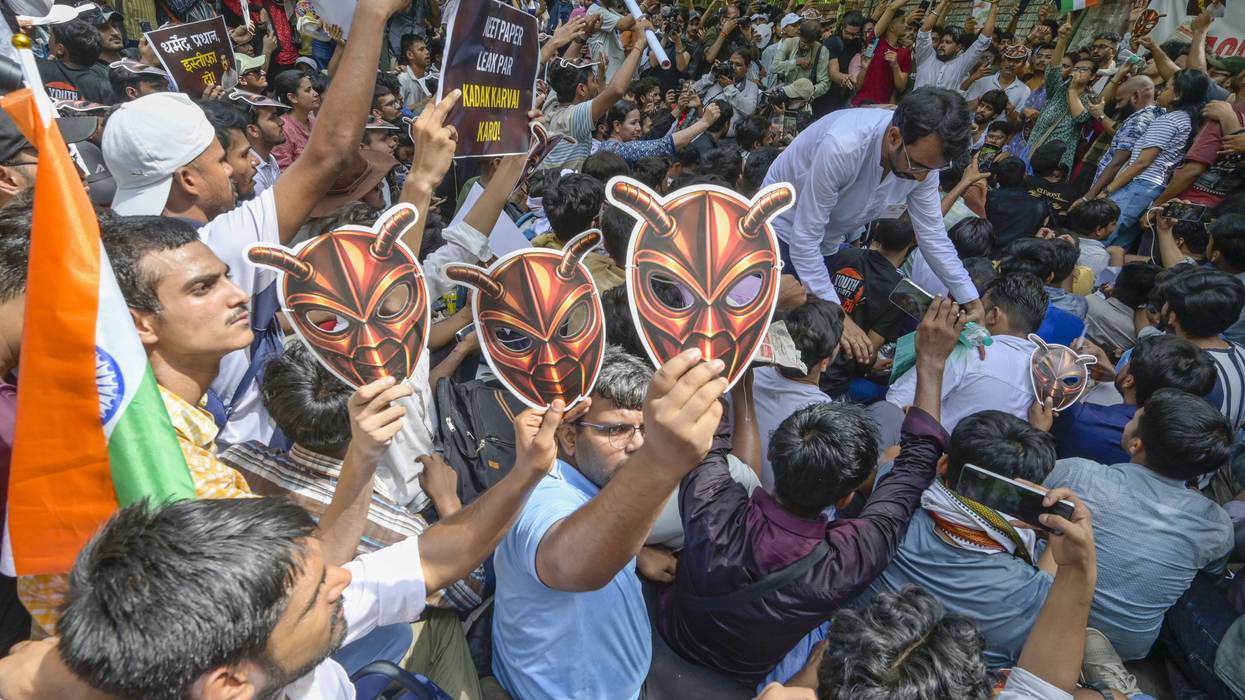
How a leaked high-stakes exam exposed capitalism’s broken promise—and why standardized testing keeps igniting struggle.
They called them cockroaches.
It was meant to reduce them—to make millions of young people seem small enough to squish and contemptible enough that no one would mourn their extermination.
But instead of crushing them, the insult only made them multiply.
Every blow from a police lathi—a long, heavy club used by Indian police—brought more bodies into the streets. Every attempt to scatter them revealed how many there were. What authorities dismissed as an infestation became an uprising powerful enough to drive India’s education minister from office and deliver one of the sharpest popular rebukes yet to Prime Minister Narendra Modi’s rule.
When the questions themselves go up for sale, it is not only the examination that is compromised. The promise collapses with it.
At the center of the revolt was a test that promised merit and delivered betrayal.
India’s National Eligibility-cum-Entrance Test, or NEET, determines admission to undergraduate medical programs. More than 2 million young people took the examination, often after their families had sacrificed for years to pay for specialized coaching. The test presents itself as an impartial judge: Everyone receives the same questions, the same clock, and the same numerical verdict.
Then the questions were leaked and reportedly sold in advance.
Young people told to outstudy one another discovered that some contestants might simply have purchased the finish line. The test promised an even starting line, but the marketplace had filled some lanes with hurdles and cleared others for the wealthy.
Their fury grew into weeks of mass protest that forced Education Minister Dharmendra Pradhan to resign on July 25, 2026.
The movement took its name from a remark by Chief Justice Surya Kant comparing unemployed young people to “cockroaches” and “parasites.” Abhijeet Dipke, a Dalit activist from one of India’s historically oppressed caste communities, seized the slur and sent it crawling back toward those in power. “What if all cockroaches came together?” he asked online.
From that question emerged the Cockroach Janta Party (CJP)—a name that mocked Modi’s ruling Bharatiya Janata Party, or BJP.
The great Indian writer and activist Arundhati Roy celebrated the CJP members as “young roaches riding in on the rain,” as protesters poured into Delhi beneath the monsoon skies. Their numbers were formidable, but so was their irreverence. When police aimed water cannons at them, young people dared the officers to turn them on—then danced in the spray. The state brought water cannons into the streets to produce fear. The protesters transformed the streets into a stage and danced in the spray.
In a Democracy Now! interview, Roy described a movement alive with “mockery and humor,” “dancing,” and “singing”—a rebellion defined by “exuberance.” Protesters joked that fleeing police lathi attacks was helping them maintain their running streaks on Strava, a fitness-tracking app. They turned footage of the chases into video-game parodies and posted mock influencer-style “get ready with me” videos and “fit checks” featuring helmets, goggles, and homemade protective gear. One demonstrator held a placard declaring, “Every joke is a tiny revolution.”
That creative humor—an intelligence no standardized test could measure—was not an escape from struggle, but rather one of the movement’s weapons. They met contempt with laughter, intimidation with choreography, and isolation with an expanding circle of solidarity.
The uprising forced Modi to announce a national task force to overhaul the examination system, while the government proposed stronger penalties for exam fraud. The Cockroach Janta Party also secured commitments to compensate families of students who died by suicide amid the crisis and withdraw criminal cases against protesters.
While no single event explains a suicide, movement leaders linked the deaths to the despair produced by a system that made one examination appear capable of determining an entire life—then revealed that the exam could be bought.
Near the main protest site in New Delhi, students erupted in celebration. Dipke reportedly fell to his knees, raised his fist, and declared, “We have done it.” He called the result “a victory for the people of India” and “a defeat for the dictator.”
But the government did not accept defeat quietly. The movement called off its demonstrations after officials agreed to its central demands, including withdrawing criminal cases against protesters.
Within days, however, the Cockroach Janta Party reported that students and protesters were again being detained and arrested in several states. Movement leaders accused the government of violating the agreement and threatened to return to the streets.
The government subsequently announced that most Delhi protesters would face no further action. But organizers warned that closing proceedings was not the same as formally withdrawing the cases—and that the movement would resume if the government again broke its promises.
The government had retreated—but only far enough to gather itself for another attack. After officials agreed to withdraw cases against protesters and promised that no punitive action would follow, authorities began detaining and arresting students across several states, with Muslim and Dalit participants reportedly among those singled out. At least 100 people were arrested, many on stringent non-bailable charges, as the movement accused the government of backtracking on its agreement. By then, however, the students had done more than expose an examination leak. They had opened a crack in the façade of the system itself.
Why would a compromised examination provoke an uprising powerful enough to force out a cabinet minister—and frighten the government into trying to seal that crack through repression? Because a high-stakes test is never merely a collection of questions. It is a promise about how society works. It tells young people that wealth, caste, language, and power do not matter—that the future belongs to whoever studies hard.
When the questions themselves go up for sale, it is not only the examination that is compromised. The promise collapses with it.
Whether in India or across the world in the United States, standardized testing is one of capitalism’s most effective laundering machines. It takes a dirty hierarchy built through unequal access to wealth and education, scrubs away its history, and returns the result stamped with a single word: merit.
Every high-stakes testing system tells young people some version of the same story: Work hard, follow the rules, outstudy everyone else, and a high score will make the future yours.
For the millions of students taking NEET in India, that promise carries enormous weight. The examination is presented as the great objective referee, capable of determining who deserves entry into medical school. It supposedly does not care about a student’s family income, caste, gender, language, region, or access to private coaching. Everyone receives the same questions, the same time limit, and a score that appears to settle who is prepared to advance.
But a society does not become equal merely because it administers the same test to people who have been given profoundly unequal lives.
These scandals expose corruption, but they also reveal a deeper fiction: that a standardized examination can transform unequal access to wealth, schooling, language, and preparation into a neutral ranking of merit.
Some NEET applicants attend well-funded schools and spend years in expensive private coaching programs. Others learn in overcrowded classrooms, study in regional languages, work after school, care for siblings, or worry about whether their families can afford another year of preparation. “Everywhere you look, you can see the desperation of young people in this country,” Shree Kumar Verma, a 19-year-old NEET student studying in Kota—the center of India’s exam-coaching industry—told The Guardian. “Being at Kota is either going to bring you success or totally break you down; it’s all or nothing here.” Some students enter the testing center trained specifically to defeat NEET. Others arrive carrying every burden that caste, poverty, geography, and educational inequality have already placed on their backs.
Standardized tests convert these unequal conditions into a clean numerical hierarchy and then present the result as a neutral measure of individual merit. This is the central function of what I call the testocracy: a social class of elites that uses standardized testing to make inequality appear earned.
The NEET leak laid bare the crudest form of class privilege: Students with enough money or the right connections could allegedly purchase the questions outright. It was corruption in a form no one could mistake.
The scandal has a close parallel in the United States. In 2019, federal prosecutors exposed Operation Varsity Blues, a sprawling college admissions scheme in which wealthy parents paid consultant William “Rick” Singer to fraudulently secure places for their children at selective universities. Some arranged for stand-ins to take the SAT or ACT or paid corrupt proctors to change answers after the exams. Others bribed college coaches to designate their children as recruited athletes, sometimes fabricating athletic résumés and staging photographs of students participating in sports they did not actually play.
The scandal provoked outrage because wealthy families had purchased test scores and admissions outcomes outright. But affluent families routinely buy educational advantages that remain perfectly legal: elite schools, private tutoring, test preparation, admissions consultants, and access to universities that favor donors and children of alumni.
The comparison with NEET is striking. In both scandals, public outrage erupts when wealth abandons even the pretense of fairness and simply buys access to education and opportunity.
These scandals expose corruption, but they also reveal a deeper fiction: that a standardized examination can transform unequal access to wealth, schooling, language, and preparation into a neutral ranking of merit.
The camouflage of inherited advantage as individual merit is not an accidental flaw. It is rooted in the white supremacist, colonial, and eugenic history of standardized testing—a system designed to translate racial and imperial hierarchies into the seemingly neutral language of scores.
British colonial rule imposed a standardized examination system on India, reorganizing education around centralized curricula, externally controlled tests, and official credentials. Historian Jana Tschurenev describes the resulting culture as centered on “memorisation, examination, and technocratic management.” British authorities expanded schooling not to achieve equality, but to prepare most colonized people for subordinate positions while opening a narrow path to government employment and elite credentials.
A decisive turn came with Thomas Babington Macaulay’s 1835 Minute on Indian Education. Macaulay admitted that he knew neither Sanskrit nor Arabic, yet declared that “a single shelf of a good European library was worth the whole native literature of India and Arabia.” His contempt expressed the racist logic of British policy, which treated European knowledge as universal and Indian intellectual traditions as inferior. Whatever opportunities English education later offered some people excluded by India’s caste hierarchies, the colonial policy itself was designed to elevate the language and culture of the rulers. Mastery of that culture became increasingly essential to credentials, employment, and social advancement.
Wood’s Despatch of 1854 further centralized the system. The universities established in Calcutta, Bombay, and Madras in 1857 were modeled after the University of London and operated largely as examining and affiliating institutions, prescribing curricula, administering tests, and conferring degrees. Teaching became organized around examinations controlled by colonial authorities.
The Indian Civil Service (ICS) examination made the colonial function of testing especially clear. Indians could formally compete to enter the elite administrative corps that governed their country, but the examination was held only in London and structured around subjects associated with elite British schooling. British officials argued that the examination should secure candidates trained in the “highest and best form of English education”—a principle they said would be sacrificed if the test were also offered in India.
The effective exclusion of most Indian candidates became an early nationalist cause. At its founding meeting in 1885, the Indian National Congress demanded that the exam also be offered in India. The dispute exposed the contradiction of colonial meritocracy: Britain proclaimed an open competition while designing it to reward those with the wealth to travel to Britain and the greatest access to the colonizer’s language, schools, and culture.
A related system of race and class sorting developed in the United States, and the use of standardized tests gave that hierarchy the appearance of objective measurement. As Rethinking Schools has written:
Standardized tests first entered the public schools in the 1920s, pushed by eugenicists whose pseudoscience promoted the "natural superiority" of wealthy, white, US-born males. High-stakes standardized tests have disguised class and race privilege as merit ever since.
Beginning during World War I, psychologists administered the Army Alpha and Beta intelligence tests to more than 1.7 million military recruits. The tests sorted soldiers and were then used to make sweeping claims about the intelligence of entire racial and national groups.
Eugenicist psychologist Carl Brigham drew on the Army test results in his 1923 book, A Study of American Intelligence, to promote the supposed superiority of “Nordic” people and the inferiority of Black people and immigrants from Southern and Eastern Europe. Warning that “the decline of American intelligence” would accelerate “owing to the presence here of the negro,” he called for public action to prevent what he described as racial deterioration. Three years later, Brigham helped develop the Scholastic Aptitude Test (SAT), turning a system shaped by military classification and eugenics into a gatekeeper for higher education.
By the 1920s, standardized tests were also sorting millions of children into academic, remedial, and vocational tracks. They disproportionately directed white and affluent students toward universities and professional careers while steering Black, immigrant, working-class, and disabled children toward lower-paid positions in a racially stratified economy. Testing was essential for reproducing hierarchy and making it appear deserved.
Black intellectuals organized an early counterattack against this racist testing regime. Reflecting on the rapid spread of psychological testing after World War I, W.E.B. Du Bois wrote:
It was not until I was long out of school and indeed after the [First] World War that there came the hurried use of the new technique of psychological tests, which were quickly adjusted so as to put black folk absolutely beyond the possibility of civilization.
Du Bois was part of a larger movement of Black scholars challenging the tests’ methods, assumptions, and political uses. In 1924, educator Horace Mann Bond systematically dismantled Brigham’s claims, exposing the supposed science behind intelligence testing as an instrument of “propaganda and encouragement for prejudice.” Bond urged Black intellectuals to understand how the tests were constructed and used so they could resist efforts to portray Black people as incapable of exercising the full rights of citizenship.
Du Bois and Bond understood that the tests converted the consequences of segregation, poverty, and unequal schooling into supposed evidence of Black inferiority. The state denied Black children equal resources, measured the predictable results, and then used their scores to restrict access to advanced education and professional work.
The colonial testing system in India and the eugenic testing system in the United States were not identical. But both converted the language, culture, and advantages of dominant groups into supposedly universal measures of merit.
The openly colonial and eugenic language eventually became less acceptable, but the sorting machinery survived. “Racial fitness” became “aptitude.” Assertions of British and white superiority became supposedly universal “standards.” Claims about racial differences in intelligence became claims about an “achievement gap.” This year marks the SAT’s 100th anniversary—a century after its creation by eugenicists, it is still used to rank and sort young people for unequal opportunities.
High-stakes tests become politically explosive because they ask young people to place their faith in a promise our economic and political system cannot keep.
Capitalism produces enough wealth to house, feed, clothe, and educate everyone, but concentrates that wealth at the top. Education is celebrated as the “great equalizer,” yet schools operate within—and help reproduce—this unequal order. Education may help some individuals move within the hierarchy, but it cannot abolish a hierarchy the economy depends on. Standardized tests manage this contradiction by ranking young people, rationing scarce opportunities and presenting the results as merit rather than economic design.
When a test carrying the weight of a young person’s future is exposed as corrupt, arbitrary, or rigged, the promise of meritocracy can collapse into rebellion. In India, a leaked medical entrance examination sent masses of young people into the streets. In the United States, resistance to high-stakes testing grew into what organizers called the Education Spring. Though these movements confronted different systems, both revealed how supposedly neutral exams ration opportunity, discipline educators, and disguise inequality.
The protesters unlearned the lesson the testocracy had taught them. They had been told to view millions of other students as competitors standing between them and their futures. In struggle, they discovered one another as comrades.
I learned something about resisting the testocracy at Garfield High School in Seattle. In January 2013, teachers voted to refuse to administer the district-mandated Measures of Academic Progress test, known as the MAP. We were not opposed to assessing students. We opposed a test disconnected from much of our curriculum, costly in time and resources, and increasingly used to rank teachers rather than improve learning.
When the district threatened us with a 10-day suspension without pay, students and parents joined the struggle. Families opted out, students urged classmates to refuse the exam, and educators at other schools joined the boycott. By the end of the school year, the boycott forced the district to end the required use of the MAP in Seattle high schools.
The boycott became one of the brightest sparks of the Education Spring, the largest revolt against standardized testing in US history. The uprising carried the critique of Occupy Wall Street into public schools. Occupy had exposed how the wealthiest 1% manipulated political and economic institutions; the Education Spring challenged the use of testing, austerity, and privatization to reorganize education around corporate interests.
Across the country, hundreds of thousands of families opted out of state exams; students organized walkouts; and educators challenged testing mandates through resolutions, rallies, and boycotts. In New York alone, more than 200,000 students refused the state’s Common Core exams in 2015. The Garfield teachers did not create this movement alone, but our refusal helped spread a dangerous question: What if we simply stop cooperating?
The Education Spring and the NEET revolt both erupted because high-stakes tests compress vast social conflicts into a single score. An exam can determine whether a student graduates, enters medical school, receives a scholarship, or is shut out of a profession. It can also rank schools, punish educators, and justify closures. Resistance has since helped push a growing number of states to abandon standardized exams as high school graduation requirements.
Standardized tests become detonators because they promise fairness while making life-altering decisions among people never given equal opportunities. When that promise collapses—through leaked questions, racial disparities, corporate profiteering, or educationally useless exams—the test reveals itself as more than an assessment. It becomes a symbol of the system deciding who advances and who is left behind.
The testocracy tells young people they must defeat one another for access to a scarce future. Resistance begins when they recognize that the real obstacle is not the person sitting beside them, but the system forcing them to compete for what should be a right.
The Cockroach Movement did more than expose a corrupted examination. It exposed a society that tells young people their futures depend on defeating one another while the wealthy purchase every imaginable advantage—and sometimes the answers themselves.
A fairer NEET would matter. But no perfectly guarded test can make an unequal society just. India remains scarred by poverty, caste oppression, concentrated wealth, and repression. The United States is likewise defined by mass poverty amid extraordinary wealth, racial inequality, and attacks on dissent.
A fairer competition for scarcity does not end scarcity. A cleaner testocracy remains a testocracy.
The cockroaches have come together. The rest of us must decide whether we will keep competing for our assigned places in an unjust world—or join them in creating one in which every child has the chance to flourish.
But struggle is the greatest teacher. Young people who entered the streets demanding a fair exam learned that the corruption ran deeper than a leaked test. They learned how wealth and power shape the institutions governing their lives—and that institutions presented as immovable can be forced to retreat.
The Cockroach Movement did not end that repression. But it showed that even a government accustomed to surviving mass dissent can be forced to concede.
Most important, the protesters unlearned the lesson the testocracy had taught them. They had been told to view millions of other students as competitors standing between them and their futures. In struggle, they discovered one another as comrades. Their power did not come from defeating the student beside them, but from uniting in solidarity.
The government called them cockroaches because it believed they were small, disposable, and easy to crush. But cockroaches are legendary survivors, said to be capable of outliving even a nuclear apocalypse. These young people came through the monsoon rain, danced beneath the water cannons, and transformed an insult into a warning: The powerful may build the machinery of destruction, but those they despise may yet survive them.
Power wants the isolated student hunched over a standardized test, stomach knotted and nerves frayed, believing every failure belongs to them alone. It fears the moment that student looks up, sees millions carrying the same burden, and realizes that the failure belongs to the system.
The cockroaches have come together. The rest of us must decide whether we will keep competing for our assigned places in an unjust world—or join them in creating one in which every child has the chance to flourish.
That is the test our movements must pass.
Standardized tests were supposed to be the magic remedy to fix our public schools.
They were supposed to make all students proficient in reading and math.
They were supposed to ensure all students were getting the proper resources.
They were supposed to ensure all teachers were doing their best for their students.
But after more than four decades, standardized tests have not fulfilled a single one of these promises.
In fact, all they've done is make things worse at public schools while creating a lucrative market for testing companies and school privatization concerns.
So why haven't we gotten rid of them?
To answer that question, we have to understand how we got here in the first place - where these kinds of assessments came from in the US and how they became the guiding policy of our public schools.
Standardized testing has been around in this country since the 1920s.
It was the product of the pseudoscientific eugenicist movement that tried to justify white supremacy with bad logic and biased premises.
Psychologists Robert Yerkes and Carl Brigham invented these assessments to justify privileging upper-class whites over lower class immigrants, Blacks and Hispanics. That was always the goal and they tailored their tests to find that result.
From the very start, it had serious consequences for public policy. The results were used to rationalize the forced sterilization of 60,000 to 70,000 people from groups with low test scores, thus preventing them from "polluting" the gene pool.
However, Brigham's greatest claim to fame was the creation of the Scholastic Assessment Test (SAT) to keep such undesirables out of higher education. These tests were not central to school curriculum and mainly used as gatekeepers with the SAT in particular still in wide use today.
The problem then - as now - is that standardized tests aren't very good assessments. They work okay for really simple things like rudimentary math. However, the more complex a skill you're assessing, the more inadequate the tests. For example, imagine just trying to have a conversation with someone where your only choices of reply were limited to four canned responses. That's a multiple-choice assessment. The result is a testing system that selects against the poor and minorities. At best, it reproduces the economic and racial disparities of society. At worst, it ensures those disparities will continue into the next generation.
That isn't to say the system went unchallenged. By the 1960s, the junk science and leaps of logic behind standardized testing were obvious and people began fighting back in court. Black plaintiffs began winning innumerable lawsuits against the testing industry.
Perhaps the most famous case is Hobson v. Hansen in 1967, which was filed on behalf of a group of Black students in Washington, DC. The court ruled that the policy of using tests to assign students to tracks was racially biased because the tests were standardized to a White, middleclass group.
Nevertheless, just as the tests were beginning to disappear, radical economists like Milton Friedman saw them as an opportunity to push their own personal agenda. More than anything, these extreme capitalists wanted to do away with almost all public services - especially public schools. They hoped the assessments could be repurposed to undermine these institutions and usher in an era of private education through measures like school vouchers.
So in the 1980s, the Reagan administration published "A Nation at Risk," a campfire tale about how America's public schools were failing. Thus, the authors argued we needed standardized testing to make American children competitive in a global marketplace.
However, the report, which examined test scores from the past 20 years, was misleading and full of statistical and mathematical errors.
For instance, it concluded that average student test scores had decreased but didn't take into account that scores had actually increased in every demographic group. It compared two decades worth of test scores, but failed to mention that more students took the test at the end of that period than at the beginning, and many of the newer students were disadvantaged. In other words, it compared test scores between an unrepresentative group at the beginning of the comparison with a more representative group at the end and concluded that these oranges were nothing like the apples they started with. Well, duh.
Most people weren't convinced by the disaster capitalism at work here, but the report marks a significant moment in the standardization movement. In fact, this is really where our modern era began.
Slowly governors and state legislators began drinking the Kool-aide and mandating standardized testing in schools along with corporate-written academic standards the tests were supposed to assess. It wasn't everywhere, but the model for test-and-punish was in place.
It took an additional two decades, until 2001, for President George W. Bush's No Child Left Behind (NCLB) legislation to require standardized testing in ALL public schools.
With bipartisan support, Bush tied federal funding of schools to standardized test performance and annual academic progress. And from then on, the die was cast. This policy has been upheld through both Republican and Democratic regimes.
In fact, standardized testing intensified under President Barack Obama and was continued with few changes by Donald Trump and even Joe Biden. Far from changing course, Biden broke a campaign promise to discontinue the tests. Once in office, he thought testing was so important that he forced schools to give the assessments during the Covid-19 pandemic when districts had trouble even keeping school buildings open.
And that brings us to today.
From the 1980s to 2022 we've had wide scale standardized testing in our schools. That's roughly 40 years where the entirety of what is done in public school has been organized around these assessments. They drive the curriculum and are the ultimate benchmark by which success or failure is judged. If this policy was ever going to work, it would have done so by now.
However, it has achieved NONE of its stated goals.
NCLB specifically stated that all children would be proficient in reading and math by 2014. That has not happened. Despite spending billions of dollars on remediation and completely reorganizing our schools around the assessments, test scores have remained mostly static or even decreased.
The law also justified its existence with claims to equity. Somehow taking resources away from districts with low test scores was supposed to increase funding at the neediest schools. Unsurprisingly this did not happen. All it did was further increase the funding gap between rich and poor schools and between wealthy and disadvantaged students.
NCLB also championed the idea that competing for test scores would result in better teachers. However, that didn't happen either. Instead, educators were forced to narrow the curriculum to cover mostly what was assessed, reduce creativity and critical thinking, and teachers who served poor and minority students were even punished for doing so.
If the purpose of standardized testing was all the things the law purported, then it was a decades long failure. It is the policy equivalent of slamming your head into a wall repeatedly and wondering why you aren't moving forward. (And where did this headache come from?)
If, however, the purpose of standardized testing was to fulfill Friedman's privatization dreams, then it was a resounding success. Public schools still persist, but they have been drained, weakened and in many ways subverted.
Look at the evidence.
Standardized testing has grown from a $423 million industry before 2001 to a multi-billion dollar one today. If we add in test prep, new text books, software, and consultancy, that figure easily tops the trillion dollar mark.
Huge corporations make the tests, grade the tests and then sell remediation materials when students fail. It's a huge scam.
But that's not the only business created by this policy. Test and punish opened entirely new markets that hadn't existed before. The emphasis on test scores and the "failing schools" narrative stoked unwarranted distrust in the public school system and a demand for more privatized alternatives.
Chief among these was charter schools.
The first charter school law was passed in 1991 in Minnesota. It allowed for the creation of new schools that would have special agreements (or charters) with states or districts to run without having to abide by all the usual regulations. Thus, the school could go without an elected board, pocket public money as private profit, etc. The bill was quickly copied and spread to legislatures across the country by the American Legislative Exchange Council (ALEC).
Today, there are charter schools in 43 states and the District of Columbia educating nearly three million students. Charter schools enroll about 6% of the students in the country.
However, charter schools are rife with fraud and malfeasance. For instance, more than a quarter of charter schools close within 5 years of opening. By year 15, roughly 50% of charter schools close. That's not a stable model of public education. It's a get rich quick scheme. And since these types of schools are free from the kinds of regulations, democratic governance and/or transparency that keeps authentic public schools in check, another charter school scandal pops up almost every day.
But let's not forget school vouchers. Before high stakes testing, the idea of using public money to pay for private or parochial schools was widely considered unconstitutional. Now about 4% of US students go to private and parochial schools some of which are funded with school vouchers. This is an option in 32 states and the District of Columbia, and more than 600,000 students participated in a voucher, scholarship tax credit or education savings account program last school year, according to EdChoice, a pro-voucher and school choice group.
There is little evidence that school vouchers actually improve student performance, however, and there's even evidence that students who receive vouchers to attend private schools may do worse on tests than they would have if they had stayed in authentic public schools.
Moreover, the cost of attending one of these private or parochial schools isn't completely covered by the voucher. On average, vouchers offer about $4,600 a year, according to American Federation for Children, which supports voucher programs. The average annual cost of tuition at a private K-12 school nationwide is $12,350, according to Educationdata.org, though that can be much more expensive in some states. In Connecticut, for example, the average tuition is almost $24,000. So vouchers only REDUCE the cost of attending private or parochial schools for a few kids while siphoning away tax dollars that should go to educating all kids.
In short, they're subsidies for wealthier kids at the expense of the middle class and disadvantaged.
Without standardized testing, it is impossible to imagine such an increase in privatization.
High stakes testing is a Trojan horse. It is a way to secretly undermine and weaken public schools so that testing corporations, charter schools and voucher schools can thrive.
Judged by its own metrics of success, standardized testing is an abject failure. Judged by the metric of business and school privatization it is a rousing success.
And that's why it has been so hard to discontinue.
This is corporate welfare at its finest, and the people getting rich off our tax dollars won't allow us to turn off the flow of funding without a fight.
On the right, policymakers are often boldly honest about their goals to bolster privatization over public schools. On the left, policymakers still cling to the failed measures of success testing has not been able to meet time-and-again.
However, both groups support the same system. They only give different reasons.
It is past time to wake up and smell the flowers.
If we want to ensure education dollars go to education and not profiteers, we need to end standardized testing.
& If we want to help students learn to the best of their abilities, we need to stop gaslighting them with faulty measures of success or failure.
If we want to allow teachers to do the best for their students, we need to stop holding them back with antiquated eugenicist shackles.
And if we truly want to save our public school system, we have to stop propping up privatization.
In short, we need to end standardized testing.
The sooner, the better.
Noted intellectual Noam Chomsky, author and activist Naomi Klein, and education historian Diane Ravitch are among those urging the U.S. Senate to reject President Barack Obama's pick for the next education secretary. They say the policies he's supported "have been ineffective and destructive to schools, educators, and most importantly students."
Their concerns are outlined in a letter published by the Washington Post on Thursday.
Obama's choice is John King, who's held the position of Acting Secretary of Education since the departure of Arne Duncan. King has already received an "astounding pass" from the Senate education committee last month, as Valerie Strauss wrote in an earlier story for the Post. At the hearings, he "was not asked one single direct question about the tumultuous 3 1/2 years he spent as the commissioner of education in New York state. Not by Republicans, and not by Democrats," she wrote.
King's critics have previously pointed out that he was a teacher for a mere three years, has been a fervent supporter of charter schools and high-stakes testing, displayed "autocratic behavior as state commissioner of education [which] spurred a massive parent opt-out from state testing," and was hit with the charge of being "responsible for more attacks on public educators than almost anyone else."
The new missive against his holding the position, which award-winning author Jonathan Kozol signed, Chicago Teachers Union President Karen Lewis, and the Network for Public Education, charges, "John King is the wrong candidate, and he will follow the failed strategies of Mr. Duncan."
It was penned in great part by 20-year-old Nikhil Goyal, author of the just published book, Schools on Trial: How Freedom and Creativity Can Fix Our Educational Malpractice.
Goyal told Salon that the letter is "yet another sign of the growing resistance in the United States against corporate, neoliberal reform -- school closures, standardized testing, and Common Core standards."
He also said,"[King's] agenda is just as terrible and oppressive as the former Secretary Arne Duncan," adding, "This country needs a secretary of education who will help bring some sanity into our classrooms, not a lackey of the corporate machine."
The letter is posted in full below:
To the U.S. Senate,
As educators, students, parents, and activists, we are writing to strongly urge you to reject the confirmation of John King, President Obama's nominee for the Secretary of Education. We believe he is the wrong choice for the position.
Research and evidence demonstrate that the education policies that John King has supported throughout his career, such as the Common Core standards, the collection of private student information, and high-stakes standardized testing, have been ineffective and destructive to schools, educators, and most importantly students.
As New York State Education Commissioner, he was an unapologetic supporter of the Common Core standards and inBloom. His policies failed. While test scores are flawed metrics, in 2013, just 31 percent of students in New York passed the English and math standardized tests, the first tests to be aligned to the Common Core and in three years the scores have barely budged. The achievement gap grew. Last year, over 200,000 students opted out of the tests.
Educators, parents, and students as well as the state teachers union and other public education advocacy groups called for King's resignation. His style is inflexible and he is quick to criticize the motives of those with whom he disagrees. He persistently refused to consider the desperate pleas of students and teachers who were reporting that the Common Core and value-added teacher evaluations were not working.
The American public deserves a Secretary of Education who will advocate for their interests, not those of the testing corporations who profit from the Common Core. We also deserve a Secretary who respects the importance of schools governed by communities, not by federal mandate.
Senators should not be misled by vague promises to do better as King offered at a recent hearing. John King is the wrong candidate and he will follow the failed strategies of Mr. Duncan. We strongly urge you to reject his nomination and recommend to President Obama that he nominate a candidate who will bring a progressive perspective to the department as it implements the Every Student Succeeds Act.
(Individuals)
Noam Chomsky, Institute Professor & Professor of Linguistics (Emeritus), MIT
Naomi Klein, Award-winning journalist and author
Diane Ravitch, Research Professor, New York University
Jonathan Kozol, National Book Award-winning author
Deborah Meier, Senior Scholar, New York University and 1987 MacArthur Fellow
Jill Stein, Green Party presidential candidate
Lucas Neff, Actor
Karen Lewis, President of the Chicago Teachers Union
Jeff Sharlet, Associate Professor of English, Dartmouth College
Keeanga-Yamahtta Taylor, Assistant Professor, Center for African American Studies, Princeton University
Carla Shedd, Assistant Professor of Sociology & African American Studies, Columbia University
Alfie Kohn, Acclaimed author on education
Nikhil Goyal, Author of the book Schools On Trial and Forbes 30 Under 30 honoree
Linda Nathan, Senior Lecturer, Boston University
Steve Cohen, Lecturer, Tufts University
Corey Robin, Professor of Political Science, Brooklyn College and the CUNY Graduate Center
Nancy Carlsson-Paige, Professor emerita, Lesley University
Mary Beth Tinker, Free speech activist
Andrew Hartman, Associate Professor, Illinois State University
Henry Giroux, Professor of English and Cultural Studies, McMaster University
Stephen Krashen, Professor Emeritus, University of Southern California
Peter McLaren, Distinguished Professor in Critical Studies, Chapman University
Mark Naison, Professor of History, Fordham University
Robert Buchanan, Undergraduate Faculty, Goddard College
Eva Swidler, Undergraduate Faculty, Goddard College
Lois Weiner, Professor of Education, New Jersey City University
Lawrence Brown, Assistant Professor, School of Community Health and Policy, Morgan State University
Jeanette Deutermann, Founder of Long Island Opt Out and parent
M. Zachary Mezera, Executive director of the Providence Student Union
Israel Munoz, Co-founder of the Chicago Student Union
Carol Burris, Executive Director of the Network for Public Education
Raynard Sanders, Radio host of The New Orleans Imperative
Howie Hawkins, 2014 Green Party candidate for NY Governor
Brian Jones, 2014 Green Party candidate for NY Lieutenant Governor
Benji Cohen, Doctoral history student, University of Virginia
Brian LeCloux, Wisconsin high school psychology teacher
Doug Henwood, Journalist and NYC public school parent
Liza Featherstone, amNY columnist, educator and NYC public school parent
Julian Vasquez Heilig, Professor of Education, California State University Sacramento
Wayne Au, Associate Professor of Education, University of Washington, Bothell
Jeff Bryant, Associate Fellow at Campaign for America's Future
Arnold Dodge, Associate Professor/Chair, Department of Educational Leadership and Administration, Long Island University Post
Anthony Cody, Author and educator
Lisa Edstrom, Brooklyn parent and educator
Rita Green, Alaska, Oregon, WA, Seattle/King County NAACP Education Chair
Nancy K. Cauthen, Sociologist
Jia Lee, Educator and 2016 UFT presidential candidate
Julie Cavanagh, Educator and 2013 MORE/UFT presidential candidate
Michael Klonsky, Executive Director at The Small Schools Workshop and educator
Monty Neill, Executive Director of the National Center for Fair & Open Testing (FairTest)
Jason Endacott, Assistant Professor of Secondary Social Studies Education, University of Arkansas
Chris Goering, Associate Professor, English Education, University of Arkansas
Lisa Rudley, Executive Director and Founding Member, NYS Allies for Public Education
Meg Norris, Founder/Director of Opt Out Georgia
Bianca Tanis, NYS Allies for Public Education
Katie Zahedi, NYS Allies for Public Education
(Organizations)
The Network for Public Education
New York State Allies for Public Education
Change the Stakes
New York City Opt Out
NYCpublic
Save Our Schools
Long Island Opt-Out
Parents Across Rhode Island
Opt Out Georgia
Time Out From Testing
Badass Teachers Association
Network for Public Education Action
Philly Neighborhood Networks
The Opt Out Florida Network
The North Country Alliance for Public Education
National Center for Fair & Open Testing (FairTest)
United Opt Out National
Half Hollow Hills Teachers' Association
Teaching, Not Testing: A New Narrative for Education
Citizens for Public Schools, Massachusetts
Rethinking Schools
Save
There's a dangerous myth being perpetrated that the American public has given up on public education.
Those making this claim point to the swelling enrollments of charter schools and the spread of school vouchers that allow parents to transfer their children out of the public school system at taxpayer expense. Indeed, giving parents more opportunities to "vote with their feet" and leave the public education system is chipping away at the population of students enrolled in public education. But does this mean support for public education is declining, and parents are happily transferring out of the system?
This week, thousands of teachers, parents, students, and community supporters of public education demonstrated nothing could be further from the truth in a series of "walk-in" protests in over 30 cities involving 900 schools.
Those big numbers come from the event sponsors themselves, the Alliance to Reclaim Our Schools, a national alliance of parent, youth and community organizations and labor groups that support public education. But numerous news stories in local press outlets and a lengthy Twitter stream of eyewitness accounts to the protests seem to prove those claims to be authentic.
It's hardly surprising these events brought out thousands of strong supporters for public schools. That's what they were intended to do. What's important, though, is to hear why the walk-ins are happening and what protestors are saying.
What's A "Walk-In?"
Walking into schools - as opposed to walking out - is a symbolic gesture of support for public education and an opportunity for concerned citizens and the media to see the conditions and challenges these schools face.
The walk-in concept originated in North Carolina and St. Paul, Minnesota, where teachers and students - unable or unwilling to walk out of schools - held walk-ins to voice their concerns, educate their communities, and galvanize support for public schools.
This week's events come at a time when, "The future of public education in the United States stands at a critical crossroad," according to a statement from AROS. The statement authors see "a web of billionaire advocates, national foundations, policy institutes, and local and federal decision-makers" working to "dismantle public education and promote a top-down, market-based approach to school reform."
But what do people on the ground see?
Why People Are Walking In
In Boston, the walk-in took place at City Hall where hundreds gathered outside to protest an estimated $50 million budget shortfall for the city's schools. "At the proposed level, district schools could lose teachers, after-school programs, and elective classes like languages and arts," according to a local news account. The crowd presented to the mayor a list of demands and a petition with more than 3,500 signatures, then proceeded to march to the State House to present their demands to the governor, too.
As part of the protest, ninth graders at one school, according to the Boston Globe, wrote a letter to the mayor complaining of the budget cuts and "asking that you come to our school and explain to our students why you are letting this happen."
School budget cuts were a point of contention in Chicago as well, where walk-in protests occurred at hundreds of schools across the city. "We're united as a community, "Chicago Teachers Union vice president Jesse Sharkey tells a local reporter. "The cuts are unacceptable."
Parents and students joined the teachers at many of the Chicago events, according to another local reporter, and voiced their disapproval of school budgets that have swollen class sizes and eliminated course offerings. "Not every school is able to get what they want for their students," one teacher explains. "I hope they get exactly what they're asking for," a parent chimes in.
At another Chicago rally, teacher Michelle Gunderson tells the reporter, "Schools are underfunded all over our country, especially in large urban districts."
"We need to create revenue for our neighborhood schools," a parent at the featured rally adds. "We don't need more charter schools."
Charter schools were also a point of protests in Los Angeles, where 20,000 were expected to turn out at events across the city, according to LA School Report. The target of the protestors' ire is a proposed plan to expand the city's already considerable supply of charter schools, which siphon money away from public schools.
"It's a zero-sum game for funding," another Los Angeles press outlet quotes American Federation President Randi Weingarten saying, "because of the attempts to create more and more and more charters at the expense of fixing local public schools."
A public school student tells the reporter her school "is something that we need to protect ... If we don't, it's going to fall into ruin and it's not going to be the same."
Signs and posters at one Los Angeles event, according to another local report, "focused on what students loved about their school - the teachers, the music." Participants in the protest fear these are the things being taken away from them in order to fund more charters.
Numerous walk-ins across Wisconsin protested funding cuts to schools while more resources are directed to charter schools and voucher programs. In Milwaukee, "Parents, educators and community leaders gathered at nearly 100 of Milwaukee's public schools," according to a local account. Protestors there spoke out against alleged "takeovers" of their public schools by charter school organizations and private schools funded by vouchers. In La Crosse, educators complained of the tough choices they have to make while charters and vouchers sap their resources without decreasing the costs of operating local schools. The result is loss of libraries, art and language programs, and support staff for students who need extra help.
In St. Paul, Minnesota, demonstrations in front of over 50 schools focused on funding demands teachers are making in upcoming contract negotiations. At rallies at more than 50 schools in Paterson, New Jersey, teachers, parents, and public officials spoke out against budget shortfalls and "private corporations [that] come in here and open schools that are not public." In Denver, protestors advocated for "smaller class sizes, deeper community partnerships to provide services for families, and greater accountability for charter schools." In San Diego, protesters wanted increased support for public schools and called for less emphasis on standardized testing. In Austin, walk-ins at three schools focused on funding for "community schools" that would offer increased health, emotional, and counseling supports for schools.
The common thread throughout these protests is pretty clear: lack of funding and support for public schools while resources are being directed elsewhere.
Who is responsible for that?
Who Has A Choice?
Views can differ on whether there is "a web" of collaborating groups - as AROS contends - directing education policy, and whether or not the intent is to "dismantle" public schools, but it's very clear the thousands of people involved in this week's walk-ins feel they have little choice in what's happening to their schools.
They did not choose to chronically underfund their schools and send public money somewhere else. Someone else chose to do that.
While some parents may find charter schools and vouchers can provide useful workarounds for them, that doesn't correct the chronic underfunding of the entire system and the unwillingness of political leaders to take that problem on. Participants in this week's walk-ins see the hard, bitter truth of that. Good for them.
The new Every Student Succeeds Act passed the Senate by an overwhelming vote. It will be law as soon as the President signs it, which he has said he will do. No Child Left Behind is history, a cruel law that set goals so far out of reach that it was certain to label every school in the nation a failure. Because of NCLB, data became more important than education. It was a boon for the standardized testing industry. It labeled and ranked schools by test scores and led to cheating, teaching to bad tests, gaming the system (by districts and states), and narrowing the curriculum. Thanks to this dreadful law, many schools abandoned or reduced time for the arts, physical education, recess, science, history, and foreign languages. NCLB was the platform for the even harsher, even more punitive, even more disastrous Race to the Top.
The fight for better education for all now shifts to the states. As Mercedes Schneider reports here, the 1,061 page act was released to the public on November 30. It is now December 9. Who read the entire act? We know from Kenneth Zeichner's reading of the section on teacher education that the new law opens the doors to alternative routes, in some cases enables institutions to award graduate degrees that have no faculty with graduate degrees (Relay, Match). We know from Mercedes Schneider's work thatTeach for America moles on the Congressional staff protected TFA. We know from the crowing of charter organizations that the bill protects them.
There is much we don't know. What we can say for certain is that the fight for the survival of public education and the teaching profession now shifts to the states. The battle to repel the monetization of education funds goes on. The struggle to allow teachers to teach goes on. The battle to prevent technology entrepreneurs from replacing teachers and mechanizing teaching goes on.
Now, as never before, our role as citizens and defenders of the common good is necessary. The Network for Public Education will continue to be in the forefront of the struggles ahead. Plan to join us at our annual meeting in Raleigh on April 16-17 to discuss how we can make our schools ready for all our children, not just a few. And how we can repel the privatization movement in its efforts to capture and profit from what belongs to all of us.
Days ago, the U.S. Department of Education announced a dramatic policy shift on standardized testing of public school students. Education Secretary Arne Duncan, echoed by President Obama, admitted that a Council of the Great City Schools study was right—there is too much reliance on standardized testing, hurting schoolchildren, teachers, and administrators. Therefore, the Education Department published a Testing Action Plan, which it claims will help states and school districts roll back over-testing, at least to some extent.
This about-face is astonishing because Arne Duncan is substantially responsible for our schools' overreliance on standardized tests. He made evaluating teachers based on student test scores a condition of federal Race to the Top funding and his Department's waivers from No Child Left Behind (NCLB). Duncan forced states to add standardized tests in subjects like social studies, science, languages, and physical education.
So, what will the Department of Education actually do? Will future policies match this new rhetoric? The only specific change is to support the two percent solution: schools should not spend more than two percent of classroom hours per year administering standardized tests. This idea is already enshrined in the U.S. Senate's proposed rewrite of the No Child Left Behind law.
But such a requirement would be nearly meaningless. According to the National Center for Education Statistics, the average school day lasts 6.64 hours, and the average number of school days is 180 per year. Do the easy math, and you'll find that two percent equals 23.9 hours of testing in a year.
Compare that to the number of hours that students sit for tests, according to the Council of Great City Schools. Remember, these are the hours that even testing advocates now say are far too many:
The two percent solution very marginally helps average 8th graders, but doesn't help anyone else. In fact, it allows schools to increase the amount of testing in 12 different grades.
But entirely besides that nearly meaningless requirement, it isn't the time spent taking tests that's the problem--it's the far greater time wasted on taking pre-tests and teaching-to-the-test and the narrowing of curricula to focus on tested subjects.
In fairness to the Department, we don't know what other substantive steps it will take. Part of the Testing Action Plan says:
By January 2016, the Department will provide clear guidance to all states and districts regarding what existing federal funds may be used for assessment audits and to support high-quality teaching and learning, and best practices for using testing as a learning tool.
And yet, the Testing Action Plan does not address some key issues. Here is what progressive advocates should demand:
* Prohibit Pre-Tests--In many high-poverty schools, teachers and students are forced to waste tremendous amounts of instructional time practicing for standardized tests. While the tests themselves might take 20 hours, the pre-tests (often given in four waves throughout the year) can take 20 school days. And all the test-taking skills taught and employed during these days are useless in real life. The Department should encourage them to stop it.
* Abolish teacher evaluations based on standardized test scores--Teachers in high-poverty schools are required to teach to the standardized tests; their jobs depend on it. Homework is often required to be in the style of test questions. In high-poverty schools, this requirement has destroyed much good teaching and caused many of the best teachers to quit. The Department can address this immediately by dropping it as a waiver requirement, letting states retract what they're doing.
* Prohibit schools from posting individual students' standardized test scores or test rankings where other students can see--Test shaming has become routine in many high-poverty schools. The practice is damaging, unprofessional, and simply outrageous.
* End the use of ranking and sanctioning schools based on test scores--If an overall evaluation finds a school to have serious problems, then districts and states must provide genuine assistance to meet the identified issues, not sanctions such as mass firings, closing or privatizing. The Department should use its waiver authority to end sanctions immediately.
* Prohibit schools from rewarding students for high scores or improved scores on standardized tests--Again, this practice is pervasive.
* Prohibit schools from teaching students in different ways or providing them with different classes based primarily on standardized test scores--Obviously there should be different levels of classes, but the practice of triaging students based on test scores and treating certain children differently because they are close to the cutoff for "proficiency" is unfair and hurtful to most of the students.
* Stop schools and school districts from narrowing their curricula to focus on tested subjects--Every school should be compelled to offer the full range of subjects appropriate to each grade level. In high-poverty schools, it's common for students to be taught very little about geography, history, social studies or science, and to have little or no band, chorus, art, or foreign languages. Similarly, prevent schools from overcrowding the untested subjects. In a high-poverty school, a social studies teacher might have 40 students enrolled in a class to allow for smaller class sizes in reading and math.
* Forbid charters from expelling or "counseling out" students because of low standardized test scores--Charters will deny it, but they often have higher test scores than neighborhood schools because they manage to keep out or get rid of lower scoring students.
It is too early to say whether Arne Duncan has surrendered. In a few months, we should better understand what the Department of Education will do. In the meantime, we should all keep up the pressure.
Several days before writing this blog post, I visited a 12th-grade class I have followed since the beginning of their 11th-grade year. I am a researcher studying how education policy affects teachers and students daily. The youth I work with are all immigrants and students of color learning English as a second language. I sat beside a student I didn't recognize and asked the teacher who he was. The teacher explained that the boy was simply in class to try to pass the NY Regents' exam- the test all high schoolers in New York state have to take to graduate from high school.
The boy had all the credits necessary for high school graduation but hadn't passed the Regents' exams in math and English. Without passing scores, youth do not receive a high school diploma, their only other option to study for the GED. Now in his fifth year in the high school, the teachers had created a specialized plan for the young man so he only had to attend math and English classes to prep for the Regents'. "He isn't going to graduate," the teacher whispered to me. The teacher continued, "he is going to age out of high school in January when he turns 21. He won't be able to get his scores up in time, his English is too weak. He has only been in the country for three years, and we think he may also have some special needs."
"Frankly, the situation has nothing to do with these youths' willingness to work hard and attempt the American Dream, and everything to do with how we treat people of color and immigrants in this country."
I asked the teacher what would happen to a young man of color and English Learner with no high school diploma in a neoliberal city like New York with a shrinking middle class. "I don't know," he said. "It breaks my heart. And guess who is going to have to tell him that he won't graduate? Me. The policy makers won't tell him. The people who are in the classroom with these kids have to deliver the news. After they moved here, got to class, did the work and learned English ... that they won't graduate. And then they evaluate me based on my students' test scores when my kids barely speak English ... it is not fair. The system is designed for these kids to fail."
Of the 22 young people in the class of students I have been studying for 14 months, 22 will attempt the English Language Arts Regents' exam for the 3rd time in January, having received non-passing scores on their first two attempts. Some of them, their teachers predict, will take the test seven or eight times. English Language Learners -- who are currently 14.4% of the student population in NYC- have the highest drop out rates of any student sub-group population in the city. Only 39.1% of ELLs graduate from high school according to data from 2013. Something is deeply wrong when we create a system that causes 60% of youth to leave high school without a diploma.
Kate Menken, a linguist and professor at CUNY has studied the Regents' at length, and determined that the exam is not a valid measure of academic content knowledge for youth learning English, given that the oft-idiomatic or culturally-specific English used on the test is challenging to someone newly learning the language. Consider this passage by Margaret Atwood from p. 5 of the Aug. 2015 Comprehensive English Exam:
Invitations to perform cascaded over us. All the best places wanted us, and all at once, for, as people said--though not to me--my voice would thrive only for a certain term. Then, as voices do, it would begin to shrivel. Finally it would drop off, and I would be left alone, denuded--a dead shrub, a footnote. It's begun to happen, the shrivelling.
Cascaded. Thrive only for a certain term. Denuded. Shrivelling.
I am a memoirist and poet, as well as a researcher. It behooves me, with a Ph.D., to use language in sophisticated and creative ways. But what are we trying to prove with 17 and 18-year old youth? What are we actually testing?
It would be easy enough to provide these youth with a different kind of test that more accurately assesses what they know and can do and is still rigorous and standards-based. My argument isn't to dumb down the tests, but provide them with reasonable tests where the majority can actually show off what they can do well and get credit for their hard work in high school. But we don't. Frankly, the situation has nothing to do with these youths' willingness to work hard and attempt the American Dream, and everything to do with how we treat people of color and immigrants in this country. If 60% of immigrant youth, who are also people of color, do not graduate in New York state then the white power elite is maintained.
The power elite is preserved because in a time of shrinking opportunities, a filter that eliminates large numbers of English learners from the mix gives white students an advantage. Let us be clear: the promises of the civil rights era have not come true. Both the workforce and schools remain segregated with a significant white power elite that is both about class and about race. Today, Blacks make up less than 4% of practicing physicians, and Latinos about 5%- similar percentages to 1960. Schools are not desegregated, and maintain the same rates of segregation since landmark Brown v. Board policy in 1954. Today, Black and Latino students tend to be in schools with a substantial majority of poor children, while white and Asian students typically attend middle class schools.
I think we should "call a spade a spade": standardized tests are a function of white supremacy and a method of racial profiling in schools.
Racial profiling is understood as the act of targeting particular groups of people because of their race. We usually think of the targeting as done by law enforcement, and racial profiling is usually thought of as traffic and pedestrian stops, raids on immigrant communities, and the ejection of Muslim Americans and South Asians on airlines and at airports.
Tests are a form of racial profiling because they provide a way for school districts and education reformers to frame black, brown and immigrant youth as "failing" and target the education services that these youth then receive. When a child's knowledge, worth and assets are reduced to a test score, assumptions can be made about that child's intelligence (and by extension the intelligence of the child's racial group). The low intelligence of people of color and immigrants is a regular trope in this country. The assumed superiority of the white brain means that we norm all "standards" (aka tests) to bizarre and out-of-touch expectations that only youth with an array of special services can pass.
Let's talk about those special services. Once youth of color get low scores on bad tests, they are framed as "failing" and targeted to receive an array of expensive for-profit services put into place at the expense of recess and social studies and fun and joy. Effectively, their educational opportunities are reduced to passing math and English. In fact, the National Center for Education Statistics (NCES), part of the U.S. Department of Education, released the findings of the first nationwide arts survey reporting an "equity gap" between the availability of arts instruction as well as the richness of course offerings for students in low-poverty schools compared to those in high-poverty schools, leading students who are economically disadvantaged not to get the enrichment experiences of affluent students.
Frame and target. Frame and target. This is at the center of racial profiling.
Standardized tests create test scores that target students of color by limiting the creative depth, intellectual wealth, and variety of their education. Producing test scores is an act of racial profiling. The alternative here is to opt young people out of tests, which means opting children out of this particular form of racial profiling. If they (the district, the power elite, the mayor, the education corporate reformers) do not have a young person's test score, then they cannot assign value or worth to that particular young person. Test refusal is refusing racial profiling and saying yes to dignity and anti-racist, humanizing schooling.
For more than 80 days, about 35 parents and children have been camping out in front of their neighborhood school in the U.S. Territory of Puerto Rico.
The Commonwealth government closed the Jose Melendez de Manati school along with more than 150 others over the last 5 years.
But the community is refusing to let them loot it.
They hope to force lawmakers to reopen the facility.
Department of Education officials have been repeatedly turned away by protesters holding placards with slogans like "This is my school and I want to defend it," and "There is no triumph without struggle, there is no struggle without sacrifice!"
Officials haven't even been able to shut off the water or electricity or even set foot inside the building.
The teachers union - the Federacion de Maestros de Puerto Rico (FMPR) - has called for a mass demonstration of parents, students and teachers on Sunday, Aug. 23. Protesters in the capital of San Juan will begin a march at 1 p.m. from Plaza Colon to La Fortaleza (the Governor's residence).
The Jose Melendez de Manati school, for instance, served students 92% of whom live in poverty.
Now that the building has been closed, parents say they can't afford the cost to transport their children to a new school miles away. And those schools that remain open have been forced to make drastic cuts to remain functional. Class sizes have ballooned to 35 students or more. Amenities like arts, music, health and physical education have typically been slashed.
Why?
The island territory is besieged by vulture capitalists encouraging damaging rewrites to the tax code while buying and selling Puerto Rican debt.
Hundreds of American private equity moguls and entrepreneurs are using the Commonwealth as a tax haven.
Since 2012, U.S. citizens who live on the island for at least 183 days a year pay minimal or no taxes, and unlike those living in Singapore or Bermuda, they get to keep their U.S. passports. After all, they're still living in the territorial U.S. These individuals pay no local or federal capital gains taxes and no local taxes on dividend interest for 20 years. Even someone working for a mainland company who resides on the island is exempt from paying U.S. federal taxes on his salary.
Worldwide, American companies keep 60 percent of their cash overseas and untaxed. That's about $1.7 trillion annually.
Microsoft, for instance, routes its domestic operations through Puerto Rican holdings to reduce taxes on its profits to 1.02 percent - a huge savings from the U.S. corporate tax rate of 35 percent! Over three years, Microsoft saved $4.5 billion in taxes on goods sold in the U.S. alone. That's a savings of $4 million a day!
Meanwhile, these corporate tax savings equal much less revenue for government entities - both inside and outside of Puerto Rico - to use for public goods such as schooling.
Public schools get their funding from tax revenues. Less tax money means less money to pay for children's educations. As the Puerto Rican government borrowed in an attempt to shore up budget deficits, the economy tanked.
But have no fear! In swooped Hedge Funds to buy up that debt and sell it for a profit.
When this still wasn't enough to prop up a system suffering from years of neglect, the Hedge Fund managers demanded more school closures, firing more teachers, etc.
Of course, this is only one interpretation of events.
If you ask Wall Street moguls, they'll blame the situation on declining student enrollment. And they have a point.
Some 450,000 people have left the island in the last decade as the economy suffered an 8-year depression.
There were 423,000 students in the Puerto Rican school system in 2013. That's expected to drop to 317,000 by 2020.
But is this the cause of the island's problems or a symptom?
Unfortunately, things look to get much worse before they'll get any better.
The government warns it may be out of money to pay its bills by as early as 2016. Over the next five years, it may have to close nearly 600 more schools - almost half of the remaining facilities!
Right on cue, Senate President Eduardo Bhatia is proposing corporate education reform methods to justify these draconian measures. This includes privatizing the school system, tying teacher evaluations to standardized test scores and increasing test-based accountability.
"Our interest is to promote transparency and flow of data through the implementation of a standardized measurement and accountability system for all agencies," Bhatia said, adding that the methodology has been successful in such cities as Chicago.
Despite such overwhelming opposition, protesters are taking the fight to the capitol. "Tax the Rich!" is a popular slogan on signs for Sunday's march.
"The foreign companies that pay no taxes or a less amount to evade paying their due in contributions - impose a tax on them now!"
This is just a beginning, she adds. Stronger actions will be coming.
In the meantime, those brave parents and children still refuse to give up their shuttered school.
They dream of a day when that empty building once again rings with the laughter of students and the instruction of teachers.
In a country being used by the wealthy to increase their already swollen bank statements, is that really so much to ask?
You can show your solidarity with these Puerto Rican protestors by spreading the word through social media. Post a picture of yourself with a sign saying you're with them in their fight. Tweet the Commonwealth Secretary of Education @Rafaelroman6. Use the hashtags #EducacionEnPR #SOSdocente.
School is out for the summer, and kids are overjoyed. But across the country, the future of public education is in serious jeopardy.
Where will public schools be in a year?
School is out for the summer, and kids are overjoyed. But across the country, the future of public education is in serious jeopardy.
Where will public schools be in a year?
Here is a quick primer on some of the key issues that relate to the fundamental question: Will America maintain or destroy that most basic democratic institution, the public school?
Are Public Schools "Failing"?
The idea that public schools have "failed" and that private market solutions are the answer to this problem is the heart of a campaign promoted by rightwing foundations, particularly the Bradley Foundation, over the last 30 years.
Recent cuts in school budgets by Bradley-supported politicians, including Wisconsin's Scott Walker, is creating more "failure."
As Wisconsin Public Education Network director Heather DuBois Bourenane observes, "The entire myth of the "failing school" depends on a refusal to acknowledge the ways that poverty impacts local communities, and how austerity policies and years of underfunding have led to the crises we see now."
New reports show that most states continue to put less money into public schools than they did before the recession, and about half put less money into schools that serve low-income students than schools that serve the wealthy.
"We can point to countless success stories of districts that adopted community schools models or established practices that help meet the needs of the whole child (with wrap-around services, peer tutoring, family-focused resources, etc.) Bourenane adds.
"Many of the schools labeled as "failing," in fact, can produce evidence of enormously successful programming and gains in student growth, but might not rank highly when standardized test scores are the primary criteria for success of their vulnerable student populations."
Opt-Out Meets #BlackLivesMatter
This year, the nationwide movement to opt out of standardized tests grew to become a massive phenomenon--especially on the East Coast. One in six students in New York refused to take standardized tests in 2015, The New York Times reports, "more than double and possibly triple the number who did so in 2014."
When large numbers of New York students were labeled "not proficient" on statewide tests--including kids in well funded suburban schools--a massive walkout ensued. Parents rebelled against a plan to tie teacher evaluations to test scores, and the threat of labeling schools as "failing" based on new, tougher standards.
Education Secretary Arne Duncan has derided parents whose kids opt out of standardized tests as a bunch of "white suburban moms who -- all of a sudden -- their child isn't as brilliant as they thought they were, and their school isn't quite as good as they thought."
But a broad and diverse opt-out movement is picking up steam all across the country. "We've had requests from all fifty states for our opt-out guides," says United Opt-Out co-founder Tim Slekar.
In Seattle, teacher-author Jesse Hagopian, who helped organize the successful MAPS test boycott at Seattle's Garfield High School, is leading a multiracial coalition of parents, teachers, local civil rights groups, and students who see the stripped-down, test-focused education as bad for all kids--including low-income kids and kids of color.
That's a big deal, because national civil rights groups have taken a position against opt-out, on the theory that kids of color need standardized tests to determine whether schools are failing kids who have been underserved.
Jesse Hagopian articulates a different view:
"The idea that our school system implements standardized testing in the early grades to make students "career and college ready" (in the language of the Common Core standards) is an utter absurdity--especially when you consider that one of the most popular career choices for a 5-year-old is being Spider Man."
"And yet high-stakes are attached to the the MAP test--already in kindergarten!--using it as an arbitrator of who will be placed on the advanced track," Hagopian writes.
"[T]he Opt Out movement is a vital component of the Black Lives Matter movement and other struggles for social justice in our region," adds Gerald Hankerson of the Seattle/King County NAACP. "Using standardized tests to label Black people and immigrants 'lesser,' while systematically under-funding their schools, has a long and ugly history in this country,"
Since standardized tests have been used to label students, teachers, and schools as "failing," and to trigger the take-over of public schools by private operators, the opt-out movement is focused on taking back local, democratic control of the schools.
As Slekar puts it: "We are not an anti-testing movement, we are a revolutionary movement against the corporate takeover of education."
Common Core Bait and Switch
As education writer and Public School Shakedown contributor Jeff Bryant writes, Common Core has become a toxic issue for Republican presidential candidates thanks to Tea Party opposition. Chris Christie is the latest candidate to turn his back on the national standards he once supported.
Democrats, on the other hand, have been busy mounting a dubious defense of Common Core, Bryant points out. But the issue of the standards themselves is a big distraction.
The real question on Common Core is not whether national educational standards are a socialist plot, as the Republican base seems to think, or whether they are doing wonders for kids, as the Democrats claim, with little real evidence. The real question is whether public education for all kids, especially poor kids, is adequately supported.
It doesn't help when assessments tied to the Common Core are used to label schools as "failing," fire teachers, shut down schools, and hand them over to private charter-school operators.
This test-and-punish approach, not the national standards, is the real threat to public education.
Charter Schools: From Good to Bad
This year marked the beginning of the great unraveling of the for-profit mass charter movement.
There were the financial scandals: We learned that Ohio poured millions into charter schools that don't exist. Across the country, there was story after story about charter school waste, fraud, and abuse.
And then there was the failure to produce results: in New Orleans, data show that the big claims about improved outcomes in a school district that went all-charter right after Katrina don't hold water.
Given these terrible results, Jeff Bryant has called for a national moratorium on charter schools.
Charter schools were first conceived decades ago as a progressive education innovation. Small, alternative schools, schools for the arts, and language immersion schools flourished and provided experimental models that traditional public schools could adopt.
But big charter-school chains like Rocketship have taken over in urban areas including Milwaukee and Washington, DC, and lobbied for new laws that exempt them from school-board oversight, as they drain public education dollars out of local districts.
Governor Andrew Cuomo has proposed taking away the cap on private charter schools for the entire state of New York, selling charters as the solution to "failing" public schools.
That plan ran into a major speed bump in New York, when parents rejected the idea that their children had suddenly become a lot less smart, and have not been eager to embrace the charter school "solution".
"It's really shock doctrine--where blow something up and then come in and say we need to fix this," Slekar says about the combination of tests that show mass "failure" and the charter-school expansion.
Nowhere is this more evident than in New Orleans, the nation's first all-charter school district, which just happens to be hosting the National Charter Schools conference next week. Stay tuned for more reporting from the Progressive on that.
Vouchers
School vouchers started in Milwaukee, Wisconsin, 25 years ago as a "ticket out" for poor kids who could use the money spent to educate them in public school to attend private schools.
Today, a new sector of cheap, fly-by-night academies has popped up to take advantage of school vouchers.
Despite poor results, Republicans in Wisconsin have expanded the voucher program statewide, and the school voucher concept has spread to thirteen states and Washington, DC.
More than 75 percent of new voucher recipients are families that never sent their kids to public schools. School vouchers drain money from the public school system to provide a straight subsidy for private school parents who get a break on tuition.
I wrote about the shocking state of Milwaukee's voucher schools in crumbling office buildings, strip malls, and former car dealerships last year
I watched an eighth-grade science class learning creationism, and observed a school where kids are learning the Bob Jones curriculum.
An anti-intellectual current is part of the attack on schools.
Last fall, in Colorado, students walked out of Jefferson County schools over a rightwing revision of the AP history curriculum.
Attacks on teachers and schools
Likewise, the attacks on teachers we've seen from the likes of Chris Christie, Scott Walker, and Bobby Jindal draw on a deep strain of cultural antipathy toward education. Whether they are busting teachers unions, replacing professional teachers with Teach for America volunteers, or doing away with certification requirements so anyone can teach, there is a concerted attack on this female-dominated profession.
Defending Schools Drives Electoral Victories
One year ago, Ras Baraka, a high school principal and member of the Newark City Council, won election as mayor of Newark despite massive opposition from Chris Christie and the hedge fund managers and corporate education "reformers" who want to turn over more public schools to corporate charter school chains. On her blog, Diane Ravich quoted supporters who called it "the most important election in the nation regarding the future of public education."
This year, the Los Angeles school board elections pitted charter-school advocates against public-school proponents, and the results were mixed in the school district with the nation's largest number of charter-school students. "The billionaires dropped a few million into the L.A. race, principally to defeat [public-school defender] Bennett Kayser," Diane Ravitch pointed out. They succeeded in replacing him with charter founder Ref Rodriguez, but charter proponent Tamar Galatzan also lost her seat to a retired public school teacher.
Tom Wolf beat Pennsylvania Governor Tom Corbett in a race that focused on Corbett's failed educational "reforms." The new state budget in Pennsylvania includes more funding for schools that serve the neediest kids. Wolf has also signaled that he is ready to to end Pennsylvania's charter-school expansion.
In the California race for state schools chief, Tom Torlakson beat Marshall Tuck despte millions of dollars in support for Tuck from the charter school industry.
Now what?
In 2016, one of the biggest national political questions in the presidential election was what to do about public schools.
Will the rightwing assault on education succeeed, based on decades of propaganda funded by the Bradley foundation to spread the message that "public schools have failed"?
Or will Democrats and Republicans alike take a stand for public education?
A lot will depend on how much pressure a growing pro-public-school movement can put on the candidates.
All across the country, there are real signs of hope.
Superintendents, school boards, and administrators of local public schools have been writing letters and testifying against the privatization and defunding of public education.
Parents are engaged as never before.
Communities, from urban mostly black and brown districts to conservative, rural areas, are rising up against budget cuts and the threat of school closures.
"It's not too late," one impassioned letter from a group of school superintendents declared, urging citizens to stand up and resist the defunding of public schools and their privatization.
Let's hope they are right.
Marie Sklodowska Curie Metro High School is located in a hardscrabble neighborhood on Chicago's southwest side. A coal-burning power plant lies just to the north and various factories and warehouses stand on surrounding streets.

Gang violence is a serious problem in the area, and the economic crisis has hit many immigrant families hard.
Students and teachers describe the school as a safe haven, a place where, despite a severe lack of resources, teachers offer innovative lessons with real-world context and organize clubs and after-school programs on topics like literature, science, and the environment.
Curie students say they recognize the extra lengths their teachers go to in making sure they get a stimulating, top-flight education even in such trying circumstances. Hence many students and former students have spent the past few days on the picket lines with their teachers and former teachers.
"This is my family," said Nicolas Coronado, 19, a DePaul University political science student on the picket line with his former IB History teacher, Homero Penuelas. "I loved it here."
A student marching band has been helping to keep their teachers' spirits up on the picket line, and one student has even turned up each day in a hot dog costume with a sign saying "Mayor Emanuel Is a Weenie."
On Thursday morning, 2007 Curie graduate Jose Xavier Montenegro gave a younger student pointers on drumming.
"I wasn't the best student but I look up to these teachers," said Montenegro, who now works as a laborer with his own company and competes in power-lifting. "I know what it's like in those classrooms. It's jam-packed; in one class we had 42 students. One time a rat ran through the classroom. Teachers could do a lot more if they had more resources."
Students describe teachers regularly buying supplies out of their own pockets.
"It's like being in a factory and paying your own money for the parts you need to make a phone," said Curie senior Adam Cabanas, 17, standing on the picket line Thursday with senior Cheyenne Watkins. "I love my teachers. They are always there for you."
"They take money out of their own wallets for us," added Watkins, 17. "For teachers to be treated badly after they have put so much of their lives into this is not fair. [The administration] tries to make it look like teachers are hurting students. But students are hurting in the classrooms - there's no air conditioning. You have 38 students in one class."
Jazmin Gonzalez, a seventh-grader at Lindblom Elementary in the nearby Englewood neighborhood, joined her mother and Curie science teacher Maricruz Gonzalez outside the school, wearing a sign around her neck saying "CPS student and daughter of CPS teacher - Double Whammy."
"It's a little scary but this has to happen for teachers to get what they need to teach us effectively, they are some of the hardest working people I've ever met in my life," said Gonzalez about the strike, noting that in her overcrowded classes there are "people sharing desks and sitting at the teacher's desk."
Karina Alcorchas, a 2012 Curie graduate, credits Curie teachers with inspiring her to pursue chemical engineering at the Illinois Institute of Technology. "It's important to give back to the teachers who have given so much to us," said Alcorchas, who earlier in the week walked picket lines with her former elementary school teachers.
Curie highlights the main reasons the teachers union opposes standardized testing used to determine merit-based pay, which the school board has backed off on, and merit-based evaluations, which the board is still demanding. (After negotiations Wednesday, both the school board and union president Karen Lewis said progress was being made and students might be back in class on Friday).
"Merit pay works only in neighborhoods where you're not dealing with the kinds of things we're dealing with here," said Penuelas. "I have students who go to work after school and work until 1 in the morning, then we start school at 7:30 am. Many are the breadwinners in their families. We try our best to help our students but these are hard things to overcome."
Rosana Enriquez, Curie's only social worker, elaborated on the challenges facing students.
"Just last week I talked to three kids whose fathers are in jail, and one whose mother had been deported and she was living with relatives, and teen mothers. That's not to mention the foster kids we serve," she said, noting that more social workers in the schools are desperately needed. "Kids are living with depression and anxiety because of the violence in the neighborhood."
Teachers at Curie, as at many public schools, often incorporate the harsh realities that their students live with into their lesson plans, an approach Penuelas noted can also apply to the strike.
"This is as prime an example as any of a civics lesson," he said. "If parents are worried about their kids being at home not getting an education, they should bring them out here. It's a lesson in democracy and power in numbers."