5
#000000
#FFFFFF
To donate by check, phone, or other method, see our More Ways to Give page.
Daily news & progressive opinion—funded by the people, not the corporations—delivered straight to your inbox.
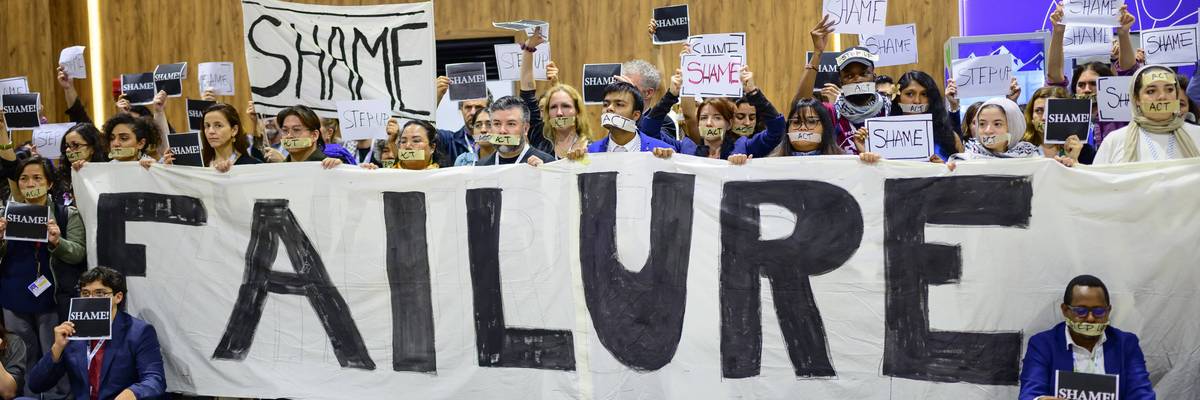
Activists unsatisfied with the second draft text at COP31 hold a silent protest outside the plenary hall, where delegates meet during the United Nations Climate Change Conference (COP31) at the Antalya Expo Centre, in Antalya, Türkiye on November 20, 2026.
What this dismal COP31 tells us is that we must return to our countries and build the political and governance changes necessary to ensure that those who come to multilateral conferences carry the mandates of their people, not corporate polluters.
Sometimes when I close my eyes at night, I still see that massive wall of water and mud swallowing people in Nepal a few months ago—with people running for their very lives.
Too often, those who contributed least to this crisis are paying the highest price. Tragically, this is not an accident. It is the consequence of an economic system that treats nature as a commodity, the atmosphere as a dumping ground, and human suffering as an acceptable cost of profit. Climate injustice is not a side effect of the system. It is one of the ways the system works.
COP31 was meant to be an implementation COP, a moment for governments to move beyond promises and deliver the urgent climate action that science and communities demand. Instead, we witnessed a betrayal of commitments already made. At a time when we must confront the reality of 1.5°C overshoot, accelerate a just transition away from fossil fuels, and deliver the climate finance urgently needed by frontline communities, governments are failing to translate existing commitments under the Paris Agreement, COP28, and COP30 into meaningful action. The failure to include explicit language on transitioning away from fossil fuels in the final cover text is an outrage, but it is also the main reason no agreement was made on the text, as some governments are finally taking a stand against petrostates.
The future of climate negotiations must be shaped by the people most affected by the climate crisis, not by those who profit from its continuation.
Fossil fuels are the principal driver of the climate crisis. The extraction, production, and burning of coal, oil, and gas continue to push global temperatures higher, intensify extreme weather, and devastate ecosystems and livelihoods. The failure to secure even a reference to transitioning away from fossil fuels at COP31 exposes the deep political and economic interests standing in the way of climate action. We cannot solve the climate crisis while continuing to expand the very industry driving it. We need a rapid, equitable, and legally binding transition away from fossil fuels, grounded in historical responsibility, climate justice, and the right of every community to a safe and sustainable future.
Implementing climate justice means transforming how we produce, distribute, and use energy. Renewable energy and electrification are essential, but they must accelerate the phaseout of fossil fuels, not provide cover for their continued expansion. Consequently, we must critically challenge the way electrification has been advanced on the COP31 agenda. While electrification is essential to the energy transition, it cannot become a vehicle for false solutions or a backdoor for expanding Carbon Capture, Utilization, and Storage (CCUS) and prolonging fossil fuel dependence. We do not want renewable energy systems driven by fossil fuel interests; greenwashed through corporate agendas; or imposed at the expense of communities, Indigenous peoples, and ecosystems. Electrification must be powered by genuinely renewable energy, with public accountability, community ownership, and democratic control at their center. Nor can the renewable energy transition justify mineral extraction without a rights-based framework that protects communities, Indigenous peoples, their territories and ecosystems.
Equally unacceptable is the continued failure of wealthy countries and major polluters to deliver adequate and accessible climate finance. The argument that there are insufficient resources simply does not hold. Governments provided approximately $725 billion in direct fossil fuel subsidies in 2024 alone, and global military expenditure reached approximately $2.9 trillion in 2025. This demonstrates the enormous financial resources governments can mobilize when they choose to prioritize them. The question is not simply whether the money exists, but whose priorities governments choose to fund. These priorities must shift toward climate action, adaptation, loss and damage, and the communities bearing the greatest consequences of a crisis they did the least to create.
In Antalya, governments also fell short on meaningful implementation of the Belém Gender Action Plan and Just Transition Mechanism, both adopted at COP30, with concrete commitments, adequate resources, and accountability to advance justice in climate action. The operationalization of the Just Transition Mechanism was pushed to next year, while discussions on the Gender Action Plan continued to see attempts to roll back already agreed gender language. In both negotiating tracks, hard-fought language on human and Indigenous peoples' rights continued to be contested by governments. The recognition, protection, and fulfillment of human rights, including Indigenous peoples' rights, land and territorial rights, self-determination, and the right of Indigenous peoples to free, prior, and informed consent, cannot be sacrificed. Climate action cannot be considered just if it reproduces the same inequalities, dispossession, and violations of rights that have contributed to the crisis in the first place.
What this dismal COP31 tells us is that we must return to our countries and build the political and governance changes necessary to ensure that those who come to multilateral conferences carry the mandates of their people, not those of fossil fuel lobbyists or corporate polluters. We need a different vision for these multilateral spaces, rooted in climate justice and genuine accountability. Civil society, Indigenous peoples, frontline communities, women, and social movements must lead the way in demanding that governments move from rhetoric to real action. The future of climate negotiations must be shaped by the people most affected by the climate crisis, not by those who profit from its continuation.
But we, the climate movement, are undeterred. We know community-led solutions are already working, and we are advancing bold strategies that center justice, equity, and community resilience. From accelerating a fossil fuel phaseout and democratizing renewable energy to advancing a Just Transition that includes care workers, Indigenous peoples, frontline communities, and ecosystems, we will continue building the future many governments have failed to deliver. This also means recognizing the Rights of Nature and protecting ecosystems not as commodities to be exploited, but as the foundation of all life. We are ready, we are rising, and we are moving forward with this work despite government inaction.
The outcome of COP31 makes it clear that we cannot rely on a single multilateral process to deliver the transformation this moment requires. While the COP remains one of the few international arenas where Small Island Developing States, Least Developed Countries, Indigenous peoples, frontline communities, and civil society can bring their experiences and demands directly into global decision-making, we need complementary spaces to further a much needed robust agenda. This is why the call for a Fossil Fuel Treaty is more urgent than ever. We need an international framework that closes the gap left by existing climate agreements, one that stops new fossil fuel expansion, ensures a fair and equitable phaseout of existing production, and provides the international cooperation and finance needed for a Just Transition.
The Paris Agreement sets climate goals, but it does not establish a comprehensive, legally binding framework to end fossil fuel production. Importantly, COP31 saw growing momentum for this treaty, with the coalition of countries developing the proposed international legal instrument reaching 30 nations, including new countries from Africa, Latin America, and the Caribbean. Kenya also advanced a new partnership to strengthen cooperation on the treaty and an equitable phaseout. This growing leadership demonstrates that, even when consensus fails inside the United Nations negotiations, countries are willing to move forward together. The treaty is about confronting the root cause of the crisis rather than simply attempting to manage its consequences.
Looking ahead, the failures of COP31 make the next Conference on the Transition Away From Fossil Fuels (TAFF), co-hosted by Tuvalu and Ireland in 2027, even more important. The first Santa Marta Conference, held in Colombia in April 2026, brought together 57 countries to advance international cooperation on moving away from fossil fuel production and dependence. It created an important space beyond the consensus-based UN Framework Convention on Climate Change negotiations for countries willing to move from rhetoric to action. The next conference in Tuvalu must build on this momentum, turning dialogue into concrete cooperation on finance, economic diversification, and a Just Transition, while advancing the political foundations for a Fossil Fuel Treaty. We cannot allow the inability of some governments to agree to become an excuse for inaction by those ready to lead.
The tide of climate justice is rising, powered by the courage of communities, the determination of movements, and the leadership of those on the frontlines—no government, no fossil fuel lobby, and no failed negotiation can hold back a movement whose time has come.
This country and this world are at a monumental crossroads. US voters have an opportunity to beat back the forces of fascism and confront the billionaires who are rigging the economy, our media system, and our democracy, making it increasingly impossible for ordinary people to get by. We’re not just talking about the election. We’re talking about what must be done once these fascist elements are vanquished from power. We need a bolder set of solutions than what either major party has so far been willing to offer and a working-class movement ready to fight like hell for it. Trump didn't emerge from nowhere. The conditions that fueled MAGA authoritarianism were created by decades of radical neoliberal economic policies and a corrupt political system dominated by corporate interests. They slashed taxes on the super-rich, promising that the benefits would trickle down. They said giveaways to the corporate titans would make life more affordable for the rest of us. It was all bullshit. And when a bitter, betrayed populace searches for someone to blame, right-wing demagogues have little trouble finding scapegoats. People know when they're being lied to, but you won't hear any of this from the corporate media. Only independent journalism—powered and funded by people who believe in building a better world—can deliver truly trustworthy daily news. If you share our vision, please contribute whatever you can to sustain our work. |
Sometimes when I close my eyes at night, I still see that massive wall of water and mud swallowing people in Nepal a few months ago—with people running for their very lives.
Too often, those who contributed least to this crisis are paying the highest price. Tragically, this is not an accident. It is the consequence of an economic system that treats nature as a commodity, the atmosphere as a dumping ground, and human suffering as an acceptable cost of profit. Climate injustice is not a side effect of the system. It is one of the ways the system works.
COP31 was meant to be an implementation COP, a moment for governments to move beyond promises and deliver the urgent climate action that science and communities demand. Instead, we witnessed a betrayal of commitments already made. At a time when we must confront the reality of 1.5°C overshoot, accelerate a just transition away from fossil fuels, and deliver the climate finance urgently needed by frontline communities, governments are failing to translate existing commitments under the Paris Agreement, COP28, and COP30 into meaningful action. The failure to include explicit language on transitioning away from fossil fuels in the final cover text is an outrage, but it is also the main reason no agreement was made on the text, as some governments are finally taking a stand against petrostates.
The future of climate negotiations must be shaped by the people most affected by the climate crisis, not by those who profit from its continuation.
Fossil fuels are the principal driver of the climate crisis. The extraction, production, and burning of coal, oil, and gas continue to push global temperatures higher, intensify extreme weather, and devastate ecosystems and livelihoods. The failure to secure even a reference to transitioning away from fossil fuels at COP31 exposes the deep political and economic interests standing in the way of climate action. We cannot solve the climate crisis while continuing to expand the very industry driving it. We need a rapid, equitable, and legally binding transition away from fossil fuels, grounded in historical responsibility, climate justice, and the right of every community to a safe and sustainable future.
Implementing climate justice means transforming how we produce, distribute, and use energy. Renewable energy and electrification are essential, but they must accelerate the phaseout of fossil fuels, not provide cover for their continued expansion. Consequently, we must critically challenge the way electrification has been advanced on the COP31 agenda. While electrification is essential to the energy transition, it cannot become a vehicle for false solutions or a backdoor for expanding Carbon Capture, Utilization, and Storage (CCUS) and prolonging fossil fuel dependence. We do not want renewable energy systems driven by fossil fuel interests; greenwashed through corporate agendas; or imposed at the expense of communities, Indigenous peoples, and ecosystems. Electrification must be powered by genuinely renewable energy, with public accountability, community ownership, and democratic control at their center. Nor can the renewable energy transition justify mineral extraction without a rights-based framework that protects communities, Indigenous peoples, their territories and ecosystems.
Equally unacceptable is the continued failure of wealthy countries and major polluters to deliver adequate and accessible climate finance. The argument that there are insufficient resources simply does not hold. Governments provided approximately $725 billion in direct fossil fuel subsidies in 2024 alone, and global military expenditure reached approximately $2.9 trillion in 2025. This demonstrates the enormous financial resources governments can mobilize when they choose to prioritize them. The question is not simply whether the money exists, but whose priorities governments choose to fund. These priorities must shift toward climate action, adaptation, loss and damage, and the communities bearing the greatest consequences of a crisis they did the least to create.
In Antalya, governments also fell short on meaningful implementation of the Belém Gender Action Plan and Just Transition Mechanism, both adopted at COP30, with concrete commitments, adequate resources, and accountability to advance justice in climate action. The operationalization of the Just Transition Mechanism was pushed to next year, while discussions on the Gender Action Plan continued to see attempts to roll back already agreed gender language. In both negotiating tracks, hard-fought language on human and Indigenous peoples' rights continued to be contested by governments. The recognition, protection, and fulfillment of human rights, including Indigenous peoples' rights, land and territorial rights, self-determination, and the right of Indigenous peoples to free, prior, and informed consent, cannot be sacrificed. Climate action cannot be considered just if it reproduces the same inequalities, dispossession, and violations of rights that have contributed to the crisis in the first place.
What this dismal COP31 tells us is that we must return to our countries and build the political and governance changes necessary to ensure that those who come to multilateral conferences carry the mandates of their people, not those of fossil fuel lobbyists or corporate polluters. We need a different vision for these multilateral spaces, rooted in climate justice and genuine accountability. Civil society, Indigenous peoples, frontline communities, women, and social movements must lead the way in demanding that governments move from rhetoric to real action. The future of climate negotiations must be shaped by the people most affected by the climate crisis, not by those who profit from its continuation.
But we, the climate movement, are undeterred. We know community-led solutions are already working, and we are advancing bold strategies that center justice, equity, and community resilience. From accelerating a fossil fuel phaseout and democratizing renewable energy to advancing a Just Transition that includes care workers, Indigenous peoples, frontline communities, and ecosystems, we will continue building the future many governments have failed to deliver. This also means recognizing the Rights of Nature and protecting ecosystems not as commodities to be exploited, but as the foundation of all life. We are ready, we are rising, and we are moving forward with this work despite government inaction.
The outcome of COP31 makes it clear that we cannot rely on a single multilateral process to deliver the transformation this moment requires. While the COP remains one of the few international arenas where Small Island Developing States, Least Developed Countries, Indigenous peoples, frontline communities, and civil society can bring their experiences and demands directly into global decision-making, we need complementary spaces to further a much needed robust agenda. This is why the call for a Fossil Fuel Treaty is more urgent than ever. We need an international framework that closes the gap left by existing climate agreements, one that stops new fossil fuel expansion, ensures a fair and equitable phaseout of existing production, and provides the international cooperation and finance needed for a Just Transition.
The Paris Agreement sets climate goals, but it does not establish a comprehensive, legally binding framework to end fossil fuel production. Importantly, COP31 saw growing momentum for this treaty, with the coalition of countries developing the proposed international legal instrument reaching 30 nations, including new countries from Africa, Latin America, and the Caribbean. Kenya also advanced a new partnership to strengthen cooperation on the treaty and an equitable phaseout. This growing leadership demonstrates that, even when consensus fails inside the United Nations negotiations, countries are willing to move forward together. The treaty is about confronting the root cause of the crisis rather than simply attempting to manage its consequences.
Looking ahead, the failures of COP31 make the next Conference on the Transition Away From Fossil Fuels (TAFF), co-hosted by Tuvalu and Ireland in 2027, even more important. The first Santa Marta Conference, held in Colombia in April 2026, brought together 57 countries to advance international cooperation on moving away from fossil fuel production and dependence. It created an important space beyond the consensus-based UN Framework Convention on Climate Change negotiations for countries willing to move from rhetoric to action. The next conference in Tuvalu must build on this momentum, turning dialogue into concrete cooperation on finance, economic diversification, and a Just Transition, while advancing the political foundations for a Fossil Fuel Treaty. We cannot allow the inability of some governments to agree to become an excuse for inaction by those ready to lead.
The tide of climate justice is rising, powered by the courage of communities, the determination of movements, and the leadership of those on the frontlines—no government, no fossil fuel lobby, and no failed negotiation can hold back a movement whose time has come.