5
#000000
#FFFFFF
To donate by check, phone, or other method, see our More Ways to Give page.
Daily news & progressive opinion—funded by the people, not the corporations—delivered straight to your inbox.
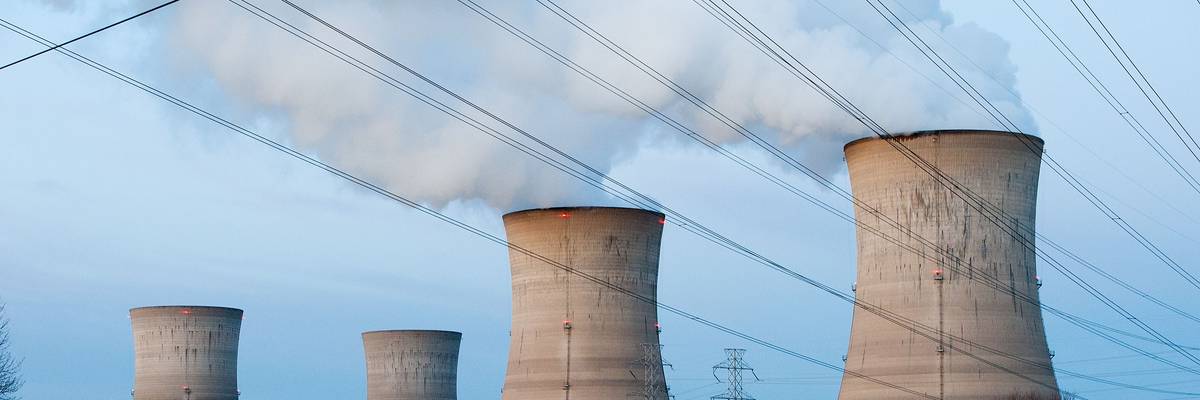
The Three Mile Island Nuclear Plant is seen in the early morning hours March 28, 2011 in Middletown, Pennsylvania.
To pave the way for AI data centers, New England governors are aligning with Trump’s plans for nuclear. But why?
As you may have noticed, nuclear power is back. Many establishment Democrats have now not only abandoned bread-and-butter working-class issues, they’re also busy jettisoning some of the hard-won core principles of the environmental movement hammered out painstakingly over decades. Apparently, someone has waved a magic wand when we weren’t looking and nuclear power is now a “green” source of energy. Is that because if you become irradiated you start to turn green?
How did this happen? We can start by taking a look at what’s been happening in New England, especially Massachusetts, which offers a good case study. In that bluest of blue states, Gov. Maura Healey is eager to bring nuclear power back despite a 1982 voter referendum—now law—that prohibits it. She’s not alone. In March 2026, a group of New England Governors—mostly Democrats—directed their state energy agencies to explore advanced nuclear energy technologies while also continuing to support the region’s existing nuclear resources.
The press release from Gov. Healey’s office described nuclear power as a “pillar of New England’s electric system.” The statement also eagerly encouraged the development of public-private partnerships. Unfortunately, this widely endorsed bipartisan concept has now become the working model for corporate exploitation of public resources and is a key latter-day building block of continuing deregulation. The press release gushed with enthusiasm for nuclear power, noting that “by ensuring both the continued operation of our existing nuclear fleet and setting our region on a path to explore next generation resources, including advanced nuclear energy technologies, the New England states will continue our leadership in grid modernization and energy innovation as we jointly work to meet the region’s current and future energy needs.”
It seems important to explore the convoluted corporate and political forces behind this troubling step backward in our nation’s environmental progress. It’s a bit startling to realize how well the New England governors' position aligns with President Donald Trump’s AI and energy policy. It also reveals a certain political and cultural amnesia about the very real risks of nuclear power. In trying to untangle this Gordian knot, we (surprise!) bump up against the usual suspect: Big Tech's aggressive and often hidden technocratic agenda and power grab across all levels of government.
In the long-form version (which I’ll just briefly touch upon here), the background traces back to the deal with the devil made by President Bill Clinton when he sold out the Democratic Party to neoliberal interests. That was the structural beginning of what some now call the uniparty—an unholy and often unspoken alliance between establishment Republicans and Democrats on key issues, operating as an inchoate blob of distinctions without a difference. It signifies core agreement between the two parties concerning three of the most important drivers of our current political morass: hyper-militarization; excessive deregulation leading to the current privatization spree that’s green-lit corporate greed and overreach; and letting the Big Tech genie out of the bottle to replace democracy with technocratic governance.
What’s happening with nuclear power in New England represents a good case study in how formerly staunch political values have been eroded through back-door workarounds (such as non-disclosure agreements) operating in the shadows of democracy. So, why then are Gov. Healey and other New England governors so comfortable with nuclear 2.0? Are they simply responding to pressures and influences from the Trump administration while also kowtowing to Big-Tech special interests and (needless to say) just following the money?
Nuclear energy is as dangerous as it always was—even more so now that Trump is peeling away traditional regulatory safeguards.
It’s no secret that Trump is solidly—one might even be tempted to say mindlessly—supporting the Big Tech power brokers racing to force-feed the American public AI data centers regardless of their well-known negative impacts on environmental integrity, water supplies, energy costs, and overall quality of life. But the hastily planned deployment of nuclear reactors to provide energy for AI data centers is an important key to Big Tech’s strategy. This is evident from Microsoft’s plan to use the Three-Mile Island nuclear facility for AI power generation.
In the March 2026 announcement, the New England governors were signaling their intent to fall into line with the Trump administration’s massive $17.5 billion fund to help utilities speed the nationwide construction of nuclear reactors to support AI data centers. They also signaled their intent to explore new approaches such as the emerging but unproven technology of SMRs or small modular reactors and nuclear fusion. Trump is, of course, doing this while actively discouraging viable green energy solutions such as wind farms, solar, and renewables. Projects already well underway have been abruptly cancelled, and he announced he would pay $765 million to Invenergy simply to not develop four wind farms in a number of states including Maine and New York.
Nuclear proponents are now using the “zero carbon” tagline to bamboozle the public into thinking that nuclear energy is now safe and “green.” With this clever inversion, they’re betting on large doses of cultural amnesia about disasters such as Fukushima (still ongoing), Chernobyl (still ongoing), and Three-Mile Island. They’re also conveniently sidestepping the fact that the nuclear waste problem persistently shows no easy resolution, although some in the industry are now claiming it can be recycled and repurposed.
Nuclear energy is as dangerous as it always was—even more so now that Trump is peeling away traditional regulatory safeguards. Environmental organizations such as the Sierra Club and Greenpeace oppose it vigorously. The Sierra Club website advises that it “opposes the licensing, construction, and operation of new nuclear reactors utilizing the fission process, pending resolution of the significant safety problems inherent in reactor operation, disposal of spent fuels, and possible diversion of nuclear materials capable of use in weapons manufacture.”
The fact that Gov. Healey and other New England governors have more or less fallen into line with both Trump and Big Tech’s AI plans is obviously troubling. As mentioned, equally troubling is how Healey attempted to subvert a 1982 voter referendum that flat out prohibited nuclear power in the state and is now on the books as law. Fortunately, the Massachusetts state senate stepped up to oppose Healey’s attempt to undemocratically bypass the referendum. And while to her credit, she did recently champion proactive legislation to curb the excesses of AI data center buildouts, reading the fine print reveals that the initiative subtly paves the way for many more nuclear facilities to be developed to support those data centers.
If there’s any good news in this grim scenario, it’s that citizens groups are pushing back not only on AI data centers but also on nuclear 2.0. These efforts include organizations such as The Commonwealth Coalition for Democracy and Safe Energy (CCDSE), a collaborative effort of more than 15 groups, including Mass. Power Forward, Sierra Club, Clamshell Alliance, Massachusetts Peace Action, Cape Downwinders, Save Our Bay Massachusetts, and Citizens Awareness Network. All of these organizations were united in opposition to nuclear and successfully lobbied in support of the Massachusetts Senate’s wise decision to favor democracy and safe energy over Big Tech cronyism.
Dear Common Dreams reader, It’s been nearly 30 years since I co-founded Common Dreams with my late wife, Lina Newhouser. We had the radical notion that journalism should serve the public good, not corporate profits. It was clear to us from the outset what it would take to build such a project. No paid advertisements. No corporate sponsors. No millionaire publisher telling us what to think or do. Many people said we wouldn't last a year, but we proved those doubters wrong. Together with a tremendous team of journalists and dedicated staff, we built an independent media outlet free from the constraints of profits and corporate control. Our mission has always been simple: To inform. To inspire. To ignite change for the common good. Building Common Dreams was not easy. Our survival was never guaranteed. When you take on the most powerful forces—Wall Street greed, fossil fuel industry destruction, Big Tech lobbyists, and uber-rich oligarchs who have spent billions upon billions rigging the economy and democracy in their favor—the only bulwark you have is supporters who believe in your work. But here’s the urgent message from me today. It's never been this bad out there. And it's never been this hard to keep us going. At the very moment Common Dreams is most needed, the threats we face are intensifying. We need your support now more than ever. We don't accept corporate advertising and never will. We don't have a paywall because we don't think people should be blocked from critical news based on their ability to pay. Everything we do is funded by the donations of readers like you. When everyone does the little they can afford, we are strong. But if that support retreats or dries up, so do we. Will you donate now to make sure Common Dreams not only survives but thrives? —Craig Brown, Co-founder |
As you may have noticed, nuclear power is back. Many establishment Democrats have now not only abandoned bread-and-butter working-class issues, they’re also busy jettisoning some of the hard-won core principles of the environmental movement hammered out painstakingly over decades. Apparently, someone has waved a magic wand when we weren’t looking and nuclear power is now a “green” source of energy. Is that because if you become irradiated you start to turn green?
How did this happen? We can start by taking a look at what’s been happening in New England, especially Massachusetts, which offers a good case study. In that bluest of blue states, Gov. Maura Healey is eager to bring nuclear power back despite a 1982 voter referendum—now law—that prohibits it. She’s not alone. In March 2026, a group of New England Governors—mostly Democrats—directed their state energy agencies to explore advanced nuclear energy technologies while also continuing to support the region’s existing nuclear resources.
The press release from Gov. Healey’s office described nuclear power as a “pillar of New England’s electric system.” The statement also eagerly encouraged the development of public-private partnerships. Unfortunately, this widely endorsed bipartisan concept has now become the working model for corporate exploitation of public resources and is a key latter-day building block of continuing deregulation. The press release gushed with enthusiasm for nuclear power, noting that “by ensuring both the continued operation of our existing nuclear fleet and setting our region on a path to explore next generation resources, including advanced nuclear energy technologies, the New England states will continue our leadership in grid modernization and energy innovation as we jointly work to meet the region’s current and future energy needs.”
It seems important to explore the convoluted corporate and political forces behind this troubling step backward in our nation’s environmental progress. It’s a bit startling to realize how well the New England governors' position aligns with President Donald Trump’s AI and energy policy. It also reveals a certain political and cultural amnesia about the very real risks of nuclear power. In trying to untangle this Gordian knot, we (surprise!) bump up against the usual suspect: Big Tech's aggressive and often hidden technocratic agenda and power grab across all levels of government.
In the long-form version (which I’ll just briefly touch upon here), the background traces back to the deal with the devil made by President Bill Clinton when he sold out the Democratic Party to neoliberal interests. That was the structural beginning of what some now call the uniparty—an unholy and often unspoken alliance between establishment Republicans and Democrats on key issues, operating as an inchoate blob of distinctions without a difference. It signifies core agreement between the two parties concerning three of the most important drivers of our current political morass: hyper-militarization; excessive deregulation leading to the current privatization spree that’s green-lit corporate greed and overreach; and letting the Big Tech genie out of the bottle to replace democracy with technocratic governance.
What’s happening with nuclear power in New England represents a good case study in how formerly staunch political values have been eroded through back-door workarounds (such as non-disclosure agreements) operating in the shadows of democracy. So, why then are Gov. Healey and other New England governors so comfortable with nuclear 2.0? Are they simply responding to pressures and influences from the Trump administration while also kowtowing to Big-Tech special interests and (needless to say) just following the money?
Nuclear energy is as dangerous as it always was—even more so now that Trump is peeling away traditional regulatory safeguards.
It’s no secret that Trump is solidly—one might even be tempted to say mindlessly—supporting the Big Tech power brokers racing to force-feed the American public AI data centers regardless of their well-known negative impacts on environmental integrity, water supplies, energy costs, and overall quality of life. But the hastily planned deployment of nuclear reactors to provide energy for AI data centers is an important key to Big Tech’s strategy. This is evident from Microsoft’s plan to use the Three-Mile Island nuclear facility for AI power generation.
In the March 2026 announcement, the New England governors were signaling their intent to fall into line with the Trump administration’s massive $17.5 billion fund to help utilities speed the nationwide construction of nuclear reactors to support AI data centers. They also signaled their intent to explore new approaches such as the emerging but unproven technology of SMRs or small modular reactors and nuclear fusion. Trump is, of course, doing this while actively discouraging viable green energy solutions such as wind farms, solar, and renewables. Projects already well underway have been abruptly cancelled, and he announced he would pay $765 million to Invenergy simply to not develop four wind farms in a number of states including Maine and New York.
Nuclear proponents are now using the “zero carbon” tagline to bamboozle the public into thinking that nuclear energy is now safe and “green.” With this clever inversion, they’re betting on large doses of cultural amnesia about disasters such as Fukushima (still ongoing), Chernobyl (still ongoing), and Three-Mile Island. They’re also conveniently sidestepping the fact that the nuclear waste problem persistently shows no easy resolution, although some in the industry are now claiming it can be recycled and repurposed.
Nuclear energy is as dangerous as it always was—even more so now that Trump is peeling away traditional regulatory safeguards. Environmental organizations such as the Sierra Club and Greenpeace oppose it vigorously. The Sierra Club website advises that it “opposes the licensing, construction, and operation of new nuclear reactors utilizing the fission process, pending resolution of the significant safety problems inherent in reactor operation, disposal of spent fuels, and possible diversion of nuclear materials capable of use in weapons manufacture.”
The fact that Gov. Healey and other New England governors have more or less fallen into line with both Trump and Big Tech’s AI plans is obviously troubling. As mentioned, equally troubling is how Healey attempted to subvert a 1982 voter referendum that flat out prohibited nuclear power in the state and is now on the books as law. Fortunately, the Massachusetts state senate stepped up to oppose Healey’s attempt to undemocratically bypass the referendum. And while to her credit, she did recently champion proactive legislation to curb the excesses of AI data center buildouts, reading the fine print reveals that the initiative subtly paves the way for many more nuclear facilities to be developed to support those data centers.
If there’s any good news in this grim scenario, it’s that citizens groups are pushing back not only on AI data centers but also on nuclear 2.0. These efforts include organizations such as The Commonwealth Coalition for Democracy and Safe Energy (CCDSE), a collaborative effort of more than 15 groups, including Mass. Power Forward, Sierra Club, Clamshell Alliance, Massachusetts Peace Action, Cape Downwinders, Save Our Bay Massachusetts, and Citizens Awareness Network. All of these organizations were united in opposition to nuclear and successfully lobbied in support of the Massachusetts Senate’s wise decision to favor democracy and safe energy over Big Tech cronyism.
As you may have noticed, nuclear power is back. Many establishment Democrats have now not only abandoned bread-and-butter working-class issues, they’re also busy jettisoning some of the hard-won core principles of the environmental movement hammered out painstakingly over decades. Apparently, someone has waved a magic wand when we weren’t looking and nuclear power is now a “green” source of energy. Is that because if you become irradiated you start to turn green?
How did this happen? We can start by taking a look at what’s been happening in New England, especially Massachusetts, which offers a good case study. In that bluest of blue states, Gov. Maura Healey is eager to bring nuclear power back despite a 1982 voter referendum—now law—that prohibits it. She’s not alone. In March 2026, a group of New England Governors—mostly Democrats—directed their state energy agencies to explore advanced nuclear energy technologies while also continuing to support the region’s existing nuclear resources.
The press release from Gov. Healey’s office described nuclear power as a “pillar of New England’s electric system.” The statement also eagerly encouraged the development of public-private partnerships. Unfortunately, this widely endorsed bipartisan concept has now become the working model for corporate exploitation of public resources and is a key latter-day building block of continuing deregulation. The press release gushed with enthusiasm for nuclear power, noting that “by ensuring both the continued operation of our existing nuclear fleet and setting our region on a path to explore next generation resources, including advanced nuclear energy technologies, the New England states will continue our leadership in grid modernization and energy innovation as we jointly work to meet the region’s current and future energy needs.”
It seems important to explore the convoluted corporate and political forces behind this troubling step backward in our nation’s environmental progress. It’s a bit startling to realize how well the New England governors' position aligns with President Donald Trump’s AI and energy policy. It also reveals a certain political and cultural amnesia about the very real risks of nuclear power. In trying to untangle this Gordian knot, we (surprise!) bump up against the usual suspect: Big Tech's aggressive and often hidden technocratic agenda and power grab across all levels of government.
In the long-form version (which I’ll just briefly touch upon here), the background traces back to the deal with the devil made by President Bill Clinton when he sold out the Democratic Party to neoliberal interests. That was the structural beginning of what some now call the uniparty—an unholy and often unspoken alliance between establishment Republicans and Democrats on key issues, operating as an inchoate blob of distinctions without a difference. It signifies core agreement between the two parties concerning three of the most important drivers of our current political morass: hyper-militarization; excessive deregulation leading to the current privatization spree that’s green-lit corporate greed and overreach; and letting the Big Tech genie out of the bottle to replace democracy with technocratic governance.
What’s happening with nuclear power in New England represents a good case study in how formerly staunch political values have been eroded through back-door workarounds (such as non-disclosure agreements) operating in the shadows of democracy. So, why then are Gov. Healey and other New England governors so comfortable with nuclear 2.0? Are they simply responding to pressures and influences from the Trump administration while also kowtowing to Big-Tech special interests and (needless to say) just following the money?
Nuclear energy is as dangerous as it always was—even more so now that Trump is peeling away traditional regulatory safeguards.
It’s no secret that Trump is solidly—one might even be tempted to say mindlessly—supporting the Big Tech power brokers racing to force-feed the American public AI data centers regardless of their well-known negative impacts on environmental integrity, water supplies, energy costs, and overall quality of life. But the hastily planned deployment of nuclear reactors to provide energy for AI data centers is an important key to Big Tech’s strategy. This is evident from Microsoft’s plan to use the Three-Mile Island nuclear facility for AI power generation.
In the March 2026 announcement, the New England governors were signaling their intent to fall into line with the Trump administration’s massive $17.5 billion fund to help utilities speed the nationwide construction of nuclear reactors to support AI data centers. They also signaled their intent to explore new approaches such as the emerging but unproven technology of SMRs or small modular reactors and nuclear fusion. Trump is, of course, doing this while actively discouraging viable green energy solutions such as wind farms, solar, and renewables. Projects already well underway have been abruptly cancelled, and he announced he would pay $765 million to Invenergy simply to not develop four wind farms in a number of states including Maine and New York.
Nuclear proponents are now using the “zero carbon” tagline to bamboozle the public into thinking that nuclear energy is now safe and “green.” With this clever inversion, they’re betting on large doses of cultural amnesia about disasters such as Fukushima (still ongoing), Chernobyl (still ongoing), and Three-Mile Island. They’re also conveniently sidestepping the fact that the nuclear waste problem persistently shows no easy resolution, although some in the industry are now claiming it can be recycled and repurposed.
Nuclear energy is as dangerous as it always was—even more so now that Trump is peeling away traditional regulatory safeguards. Environmental organizations such as the Sierra Club and Greenpeace oppose it vigorously. The Sierra Club website advises that it “opposes the licensing, construction, and operation of new nuclear reactors utilizing the fission process, pending resolution of the significant safety problems inherent in reactor operation, disposal of spent fuels, and possible diversion of nuclear materials capable of use in weapons manufacture.”
The fact that Gov. Healey and other New England governors have more or less fallen into line with both Trump and Big Tech’s AI plans is obviously troubling. As mentioned, equally troubling is how Healey attempted to subvert a 1982 voter referendum that flat out prohibited nuclear power in the state and is now on the books as law. Fortunately, the Massachusetts state senate stepped up to oppose Healey’s attempt to undemocratically bypass the referendum. And while to her credit, she did recently champion proactive legislation to curb the excesses of AI data center buildouts, reading the fine print reveals that the initiative subtly paves the way for many more nuclear facilities to be developed to support those data centers.
If there’s any good news in this grim scenario, it’s that citizens groups are pushing back not only on AI data centers but also on nuclear 2.0. These efforts include organizations such as The Commonwealth Coalition for Democracy and Safe Energy (CCDSE), a collaborative effort of more than 15 groups, including Mass. Power Forward, Sierra Club, Clamshell Alliance, Massachusetts Peace Action, Cape Downwinders, Save Our Bay Massachusetts, and Citizens Awareness Network. All of these organizations were united in opposition to nuclear and successfully lobbied in support of the Massachusetts Senate’s wise decision to favor democracy and safe energy over Big Tech cronyism.