SUBSCRIBE TO OUR FREE NEWSLETTER
Daily news & progressive opinion—funded by the people, not the corporations—delivered straight to your inbox.
5
#000000
#FFFFFF
To donate by check, phone, or other method, see our More Ways to Give page.
The Gwich'in Steering Committee was formed in 1988 in response to proposals to drill for oil in the Sacred Place Where Life Begins, the coastal plain of the Arctic National Wildlife Refuge.

Ovadia, a father of five children, has lived in New York's Rockland County since coming to the United States on a religious worker visa in 2022. He is a member of the Satmar Hasidic sect, an ultra-Orthodox movement that opposes Zionism on religious grounds, holding that Jews should not establish a sovereign state in the land of Israel before the coming of the Messiah.
Some members of Satmar have vocally protested against US support for Israel's genocidal military assault in Gaza since it began in 2023.
“We demonstrated for Gaza, for the liberation of Gaza, for the rights of the Palestinians and to show to the world that the Jews, real Judaism, want to have peace,” Ovadia told the Times from detention.
As the death toll in Gaza has mounted, Ovadia has continued to attend anti-Israel marches across New York and New Jersey. Earlier this year, the government revoked his legal status after he appeared at one of these protests.
In November 2023, Ovadia joined a group of anti-Zionist Hasidic Jews to protest the display of a large Israeli flag at the Ramapo Town Hall. Some attendees were recorded cutting the flag down with scissors. Ovadia and another man were charged with hate crimes over the incident—charges that were later dropped.
Ovadia later pleaded guilty to a misdemeanor offense of disorderly conduct, for which he paid a $200 fine plus an additional $125 charge. He says he was not one of the men who took down the flag and that he did not know about the other attendees' plans to do so.
The formal reason for Ovadia's deportation, according to the Department of Homeland Security (DHS), was that he “overstayed his welcome and refused to depart” the US after losing his status. But the reason he lost that status is more revealing.
Though it acknowledged that Ovadia was eligible to maintain his religious worker status, the US Citizenship and Immigration Services (USCIS) ultimately revoked it “as a matter of discretion." It cited what it said were “adverse factors” stemming from the 2023 Israeli flag protest.
DHS stated even more explicitly that the content of Ovadia's speech was the real issue.
"The Trump administration acted well within its statutory and constitutional authority, as it does with any alien who advocates for violence, glorifies and supports terrorists, harasses Jews, and steals property," DHS said.
At the beginning of his second term, President Donald Trump issued an executive order directing DHS to target noncitizens who have participated in pro-Palestinian protests, which it has deemed antisemitic.
The order has led to nonviolent political organizers, like the Columbia University graduate student Mahmoud Khalil and many others, having their legal immigration statuses abruptly revoked and being whisked into ICE detention without warning. Federal courts have struck down this policy on First Amendment grounds.
Ovadia's attorneys have filed a lawsuit in federal court alleging that DHS had unlawfully retaliated against Ovadia for his protected speech. They argue that by targeting Ovadia over activism that stems from his religious beliefs, the government has taken “an official position” favoring “one religious position within Judaism” while penalizing "an adherent of another.”
Many Jewish protesters have been arrested during demonstrations in solidarity with Palestinians, including dozens who were arrested at a Jewish Voice for Peace event last week to protest Israeli Prime Minister Benjamin Netanyahu's speech at the United Nations General Assembly. But Ovadia's attorneys believe he may be the first Jewish protester to have his immigration status stripped.
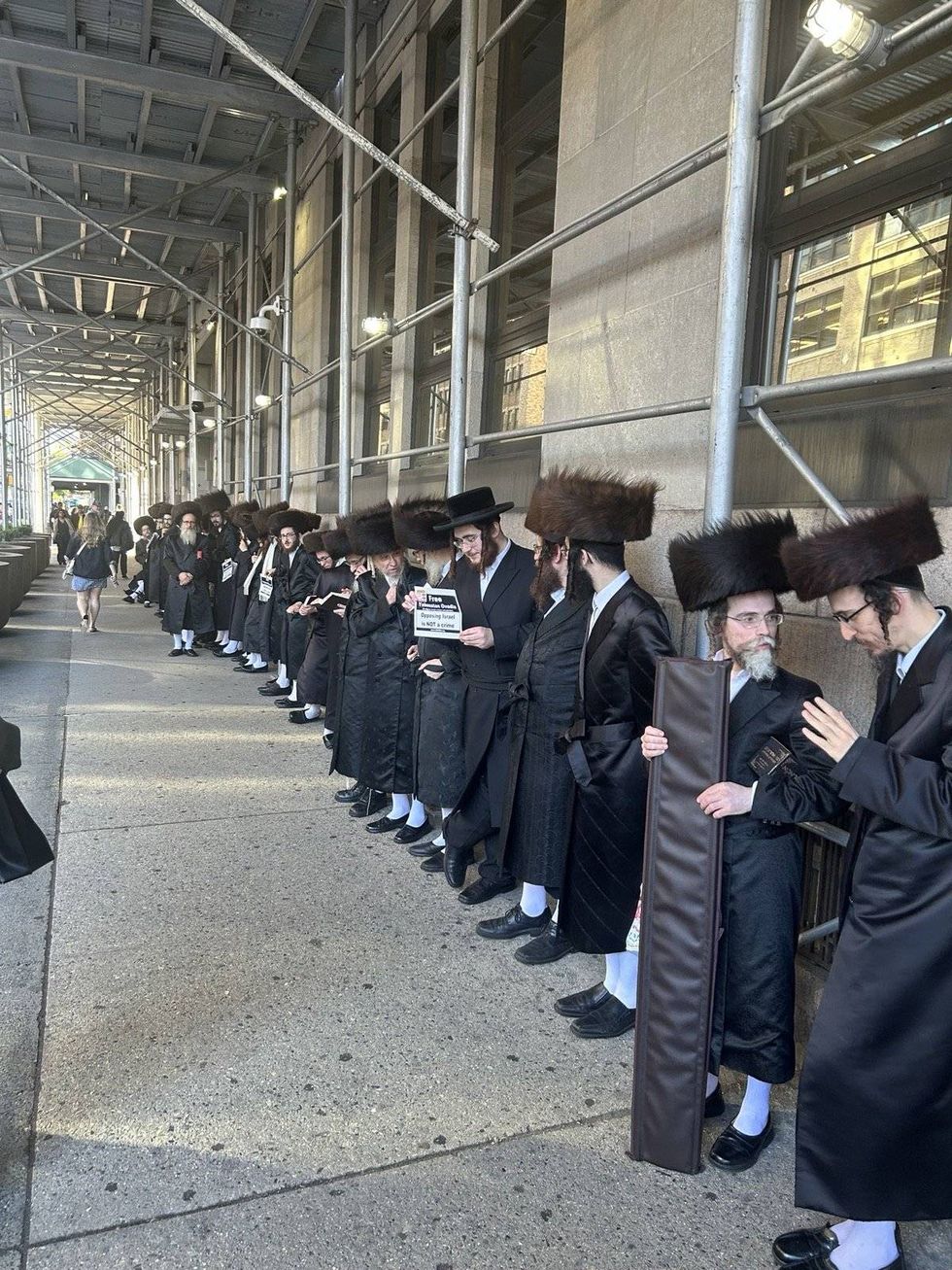 Supporters of Yehonatan Ovadia gather outside his immigration court hearing in Manhattan on September 30, 2026. (Photo from Eric Lee/X)
Eric Lee, one of Ovadia's attorneys, has emphasized the case as an example of why "equating anti-Zionism with antisemitism produces absurd results."
"Trump's DHS says ICE detention of Yehonatan Ovadia is justified because he was 'harassing Jews,'" Lee wrote in a post on social media. "A rabbi detained for participating in a Hasidic demonstration against Israel three years ago was harassing... himself? What a joke!"
Ovadia, whom a judge has denied bond, appeared in immigration court on Wednesday, while dozens of supporters, many in traditional Hasidic dress, assembled outside.
And from detention, the man DHS has accused of "harassing Jews" continued to describe his activism not as hostility toward his own people, but as an expression of Jewish solidarity with Palestinians.
"From the Jewish people to our Palestinian brothers and sisters in Gaza and the West Bank and all over occupied Palestine: We didn't forget you!" Ovadia said in a statement shared by Lee. "We are following you, and we know that you are facing genocide! Please be strong and continue to believe! Because your struggle is our struggle and your liberation is our liberation!"
"We will SHOUT and DEMONSTRATE for you," he continued, "from New York, Washington, Canada, London, and from every place that we can in the free world."
"Your liberation is near," Ovadia concluded, "and it will bring peace and liberation to all of us."


Over the last seven months, Trump has on numerous occasions threatened apocalyptic destruction of Iran, most infamously in April when he said that if it did not submit to a peace agreement he found favorable, its "whole civilization" would "die."
Trump's threat to annihilate a nation of 90 million people drew worldwide condemnation from human rights groups, lawmakers, and other nations, some of whom described the rhetoric as "genocidal."
Time senior political correspondent Eric Cortellessa and editor-in-chief Sam Jacobs asked Trump about these threats and how they comported with his self-description as a peacemaker.
"You've made versions of that threat before. You've also called yourself the president of peace," they said. "How can the president of peace be calling for the annihilation of an entire people?"
Trump replied: "Because by annihilating Iran, we've created peace in the world. With Iran, I don't think you could ever have peace."
The reporters asked Trump to clarify: "Are you talking specifically about the government, the Islamic Republic regime? What about the innocent people?"
He did not give a clear answer, instead accusing the Iranian government of having "killed 75,000 people in the last number of months," referring to its crackdown on anti-government demonstrations.
Iran has claimed that 3,117 people were killed during the protest wave. But while independent investigations have suggested this is an undercount, the figures they have confirmed are far lower than what Trump suggests.
The US-based Human Rights Activists News Agency (HRANA), for instance, documented a total of 7,007 confirmed deaths, mostly of protesters, between December 2025 and February 2026, and says another 11,744 possible deaths remain under review. Other unverified reports suggest that perhaps as many as 30,000 people were killed.
While seeking to justify continued war with Iran—now into its seventh month—Trump has continued to inflate the number of people supposedly killed well beyond even the highest reported figures. In July, he claimed 52,000 people had been killed, but provided no evidence. He again provided no evidence for the 75,000 figure other than to say it was "documented."
After launching the war at the end of February, Trump initially claimed it would last about six to eight weeks. The reporters asked why the war was now entering its seventh month.
"Only because I wanted to go further," Trump acknowledged.
"I took them out," he said, possibly referring to Iranian nuclear sites, or to Iran's senior leadership, including Supreme Leader Ali Khamenei, who was killed during the initial wave of US-Israeli attacks. "I could have stopped then, but I wanted to go further."
Trump went on to portray Iran as essentially destroyed, claiming its economy, navy, and air force were “gone” and putting inflation at “300%”—assertions that substantially overstated the damage inflicted on the country.
Iran has suffered enormous military and economic damage, but it has continued to launch ballistic missile attacks and threaten further retaliation. Meanwhile, official Iranian data puts September inflation at roughly 90% year over year, a far cry from 300%.
“When I said I was going to be there for a short period of time, I was, and then I decided I wanted to go further than that because I didn’t want to have them come back in some different form," the president said.
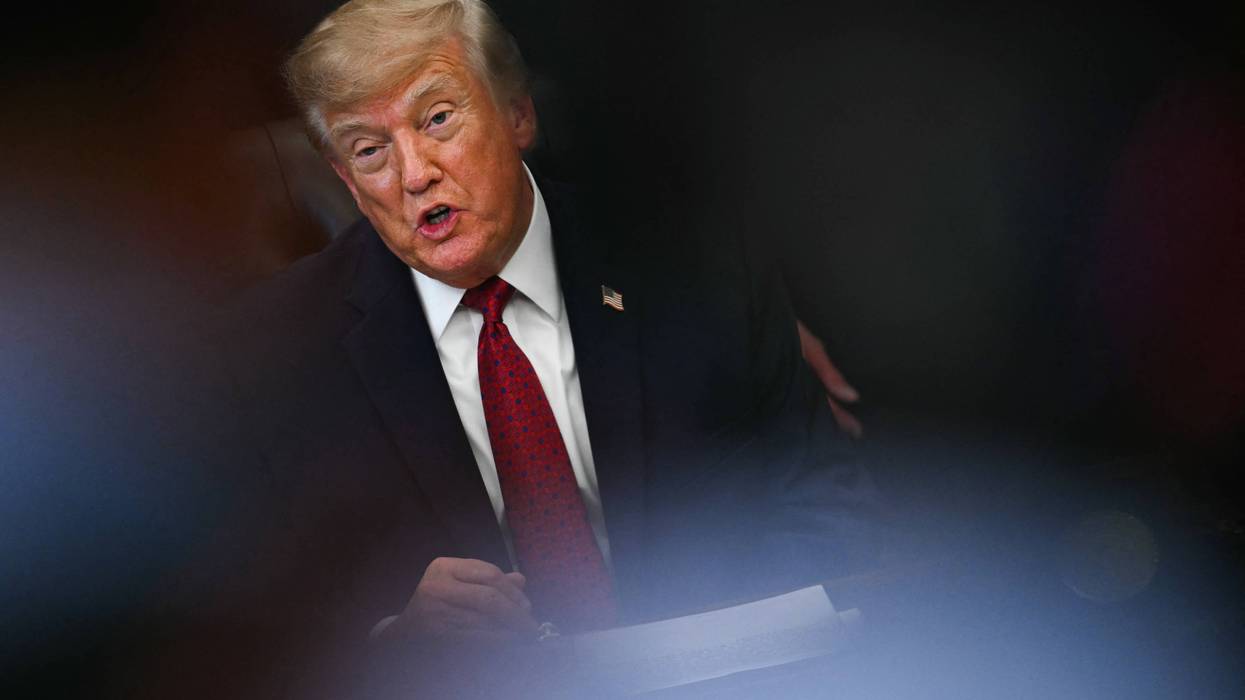
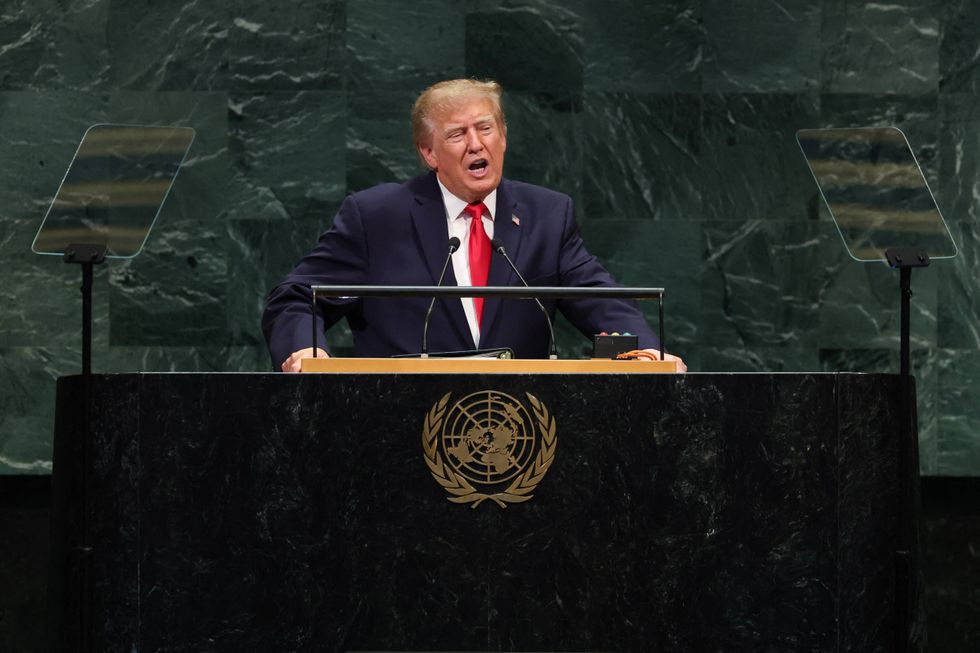 US President Donald Trump addresses the 81st United Nations General Assembly at UN Headquarters in New York on September 22, 2026. (Photo by Timothy A. Clary/AFP via Getty Images)
Trump's threats also come as the US midterm elections loom just over a month away. High gas prices and inflation caused by the war have fueled backlash among American voters, leading to Trump's lowest-ever approval ratings and predictions of an electoral bloodbath for Republicans down the ballot in November.
Last week, Trump rejected a Qatari-mediated ceasefire proposal from Iran that would have involved the US ending its military blockade of Iran in exchange for Iran lifting its restrictions on travel through the Strait of Hormuz. It would also have meant returning to nuclear negotiations for the first time since Trump backed out of the memorandum of understanding agreed upon in June.
With the war deeply unpopular among the American public, Trump has scaled back the tempo of his attacks on Iran in recent months. Reporters asked Trump whether he planned to ramp up the bombing once the elections were over.
He said it was “possible,” adding, “I can’t tell you that because look, you know, you’re asking, 'Where are you going to bomb?'”