SUBSCRIBE TO OUR FREE NEWSLETTER
Daily news & progressive opinion—funded by the people, not the corporations—delivered straight to your inbox.
5
#000000
#FFFFFF
To donate by check, phone, or other method, see our More Ways to Give page.
Daily news & progressive opinion—funded by the people, not the corporations—delivered straight to your inbox.
Congressman Dennis Kucinich (D-OH) today released the following statement responding the Office of Legal Counsel's opinion regarding the President's authority to use military force in Libya:
In the legal memo provided by the President's Office of Legal Counsel, the Administration argues that the President had the authority to attack Libya absent Congressional authorization because he determined it was in the national interest and because the U.S. is engaged in limited military operations that do not constitute a war.
The war in Libya is not in our national interest. The claim that the U.S. had to act in Libya in order to maintain stability in the region - "a vital U.S. interest" - runs contrary to the history of U.S. military intervention in the region. As evidenced by U.S. intervention in Afghanistan, Iraq and drone bombing campaigns in Pakistan, rather than maintain stability, U.S. military action in the region has unfortunately served to further instability. Occupations fuel insurgencies and close a circle of never-ending violence. Additionally, the doctrine that the U.S. has a responsibility to act militarily, without prior authorization from Congress, in the event of a threat to any of our friends in the world puts us on a path to permanent war and has no legal basis in the Constitution or the War Powers Act.
The Obama Administration has prosecuted a war that is "not a war." The assertion that U.S. military actions in Libya do not constitute war belies the significant use of military force in Libya. The Administration's own Secretary of Defense, while testifying before Congress last month, admitted that enforcing a no-fly zone in Libya was an act of war: "A no-fly zone begins with an attack on Libya to destroy the air defenses."[1] The United States, thus far, has spent well over $550 million on the war in Libya, using at least 112 long-range Tomahawk cruise missiles, estimated to cost up to $1.5 million each, in the first day alone. The U.S. also used Joint Direct Attack Munitions - 2,000 pound bombs - to bomb Libya. The characterization of the use of force in Libya solely as a humanitarian intervention cannot hide the reality of what war is. The attempt to assert that this is not a war does violence to cognition and violence to the English language. It is positively Orwellian.
The Administration also claims that authority to use U.S. military force abroad was provided by United Nations Security Council Resolution (UNSCR) 1973, which authorized member states to "take all necessary measures" to protect Libyan civilians and to enforce a no-fly zone. The Constitution does not provide an exception for the President to unilaterally decide to use military force abroad if an international body, such as the United Nations, provides him with one. It is unequivocally clear, in Article 1, Section 8, that the power to authorize the use of military force or to declare war lies solely with Congress.
The law provides the President with the authority to use military force absent prior Congressional authorization only to repel sudden or imminent attack. There was no threat of sudden or imminent attack to the United States from Libya. President Obama himself recognized the constitutional limitations imposed on any U.S. President when, in an October 2008 interview, he stated that "The President does not have power under the Constitution to unilaterally authorize a military attack in a situation that does not involve stopping an actual or imminent threat to the nation."[2]
In the sophistry of the Office of Legal Counsel's memo, the Obama administration fails to justify what cannot be justified. While the President has argued that the credibility of the United Nations (U.N.) was at stake if members of the Security Council did not act, it is actually the credibility of his administration and of our own democracy that is at stake. Preserving the credibility of the U.N. has never been a reason to go to war. A plain reading of the U.S. Constitution explicitly places war powers in the hands of Congress.
In this flimsy attempt to justify military action in Libya, it appears as though the administration is taking scissors and scotch tape to the Constitution, cutting out sections they do not like, and replacing them with legal theory that is reminiscent of the now discredited theories (of a former administration) which were used to justify torture.
Dennis Kucinich is an American politician. A U.S. Representative from Ohio from 1997 to 2013, he was also a candidate for the Democratic nomination for president of the United States in 2004 and 2008.
"Trump’s problem is that whatever the claims he might make about the damage to Iran’s nuclear and military capacity, which is substantial, the regime survives, the international economy has been severely disrupted, and the bills keep on coming in."
President Donald Trump is reportedly preparing to launch some kind of ground assault on Iran in the coming weeks, but one prominent military strategy expert believes he's heading straight for defeat.
The Washington Post on Saturday reported that the Pentagon is preparing for "weeks" of ground operations in Iran, which for the last month has disrupted global energy markets by shutting down the Strait of Hormuz in response to aerial assaults by the US and Israel.
The Post's sources revealed that "any potential ground operation would fall short of a full-scale invasion and could instead involve raids by a mixture of Special Operations forces and conventional infantry troops" that could be used to seize Kharg Island, a key Iranian oil export hub, or to search out and destroy weapons systems that could be used by the Iranians to target ships along the strait.
Michael Eisenstadt, director of the Military and Security Studies Program at the Washington Institute for Near East Policy, told the Post that taking over Kharg Island would be a highly risky operation for American troops, even if initially successful.
“I just wouldn’t want to be in that small place with Iran’s ability to rain down drones and maybe artillery,” said Eisenstadt.
Eisenstadt's analysis was echoed by Ret. Gen. Joseph Votel, former head of US Central Command, who told ABC News that seizing and occupying Kharg Island would put US troops in a state of constant danger, warning they could be "very, very vulnerable" to drones and missiles launched from the shore.
Lawrence Freedman, professor emeritus of war studies at King's College London, believes that the president has already checkmated himself regardless of what shape any ground operation takes.
In an analysis published Sunday, Freedman declared Trump had run "out of options" for victory, as there have been no signs of the Iranian regime crumbling due to US-Israeli attacks.
Freedman wrote that Trump now "appears to inhabit an alternative reality," noting that "his utterances have become increasingly incoherent, with contradictory statements following quickly one after the other, and frankly delusional claims."
Trump's loan real option at this point, Freedman continued, would to simply declare that he had achieved an unprecedented victory and just walk away. But even in that case, wrote Freedman, "this would mean leaving behind a mess in the Gulf" with no guarantee that Iran would re-open the Strait of Hormuz.
"Success in war is judged not by damage caused but by political objectives realized," Freedman wrote in his conclusion. "Here the objective was regime change, or at least the emergence of a new compliant leader... Trump’s problem is that whatever the claims he might make about the damage to Iran’s nuclear and military capacity, which is substantial, the regime survives, the international economy has been severely disrupted, and the bills keep on coming in."
"The NY Times saves its harshest skepticism for progressives," said one critic.
The New York Times is drawing criticism for publishing articles that downplayed the significance of Saturday's No Kings protests, which initial estimates suggest was the largest protest event in US history.
In a Times article that drew particular ire, reporter Jeremy Peters questioned whether nationwide events that drew an estimated 8 million people to the streets "would be enough to influence the course of the nation’s politics."
"Can the protests harness that energy and turn it into victories in the November midterm elections?" Peters asked rhetorically. "How can they avoid a primal scream that fades into a whimper?"
Journalist and author Mark Harris called Peters' take on the protests "predictable" and said it was framed so that the protests would appear insignificant no matter how many people turned out.
"There's a long, bad journalistic tradition," noted Harris. "All conservative grass-roots political movements are fascinating heartland phenomena, all progressive grass-roots political movements are ineffectual bleating. This one is written off as powered by white female college grads—the wine-moms slur, basically."
Media critic Dan Froomkin was event blunter in his criticism of the Peters piece.
"Putting anti-woke hack Jeremy Peters on this story is an act of war by the NYT against No Kings," he wrote.
Mark Jacob, former metro editor at the Chicago Tribune, also took a hatchet to Peters' analysis.
"The NY Times saves its harshest skepticism for progressives," he wrote. "Instead of being impressed by 3,000-plus coordinated protests, NYT dismisses the value of 'hitting a number' and asks if No Kings will be 'a primal scream that fades into a whimper.' F off, NY Times. We'll defeat fascism without you."
The Media and Democracy Project slammed the Times for putting Peters' analysis of the protests on its front page while burying straight news coverage of the events on page A18.
"NYT editors CHOSE that Jeremy Peters's opinions would frame the No Kings demonstrations and pro-democracy movement to millions of NYT readers," the group commented.
Joe Adalian, west coast editor for New York Mag's Vulture, criticized a Times report on the No Kings demonstrations that quoted a "skeptic" of the protests without noting that said skeptic was the chairman of the Ole Miss College Republicans.
"Of course, the Times doesn’t ID him as such," remarked Adalian. "He's just a Concerned Youth."
Jeff Jarvis, professor emeritus at the CUNY Graduate School of Journalism, took issue with a Times piece that offered five "takeaways" from the No Kings events that somehow managed to miss their broader significance.
"I despise the five-takeaways journalistic trope the Broken Times loves so," Jarvis wrote. "It is reductionist, hubristic in its claim to summarize any complex event. This one leaves out much, like the defense of democracy against fascism."
Journalist Miranda Spencer took stock of the Times' entire coverage of the No Kings demonstrations and declared it "clueless," while noting that USA Today did a far better job of communicating their significance to readers.
Harper's Magazine contributing editor Scott Horton similarly argued that international news organizations were giving the No Kings events more substantive coverage than the Times.
"In Le Monde and dozens of serious newspapers around the world, prominent coverage of No Kings 3, which brought millions of Americans on to the streets to protest Trump," Horton observed. "In NYT, an illiterate rant from Jeremy W Peters and no meaningful coverage of the protests. Something very strange going on here."
In San Francisco, thousands of anti-Trump activists gathered on a local beach to form a human sign that read, "Trump must go now! No ICE, no wars, no lies, no kings."
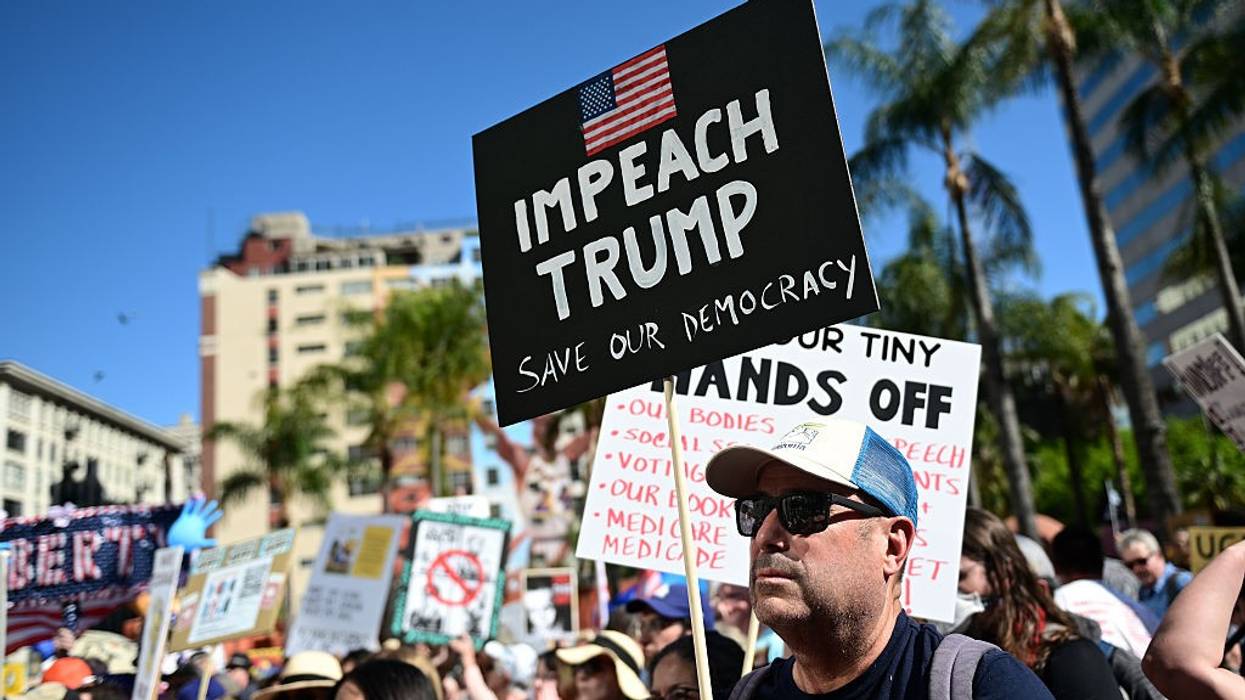
Millions of American across all 50 states on Saturday rallied against President Donald Trump and his authoritarian agenda during nationwide No Kings protests.
The flagship No Kings rally in Minneapolis, which organizers Indivisible estimated drew over 200,000 demonstrators, featured speeches from Minnesota Gov. Tim Walz and US Sen. Bernie Sanders (I-Vt.), Rep. Ilhan Omar (D-Minn.), and actress Jane Fonda, as well as a special performance from rock icon Bruce Springsteen, who performed "Streets of Minneapolis," a song he wrote in tribute of slain protesters Renee Good and Alex Pretti.
Organizers called it "the largest single-day nationwide demonstrations in US history," with an estimate 8 million people coming out for events in communities and cities nationwide.
From major cities to rural towns that have never seen mobilizations like this before, protesters made clear that in America, we don’t do kings," the No Kings coalition said in a statement.
"This is what it looks like when a movement grows—not just in size, but in reach, in courage, and in more people who see themselves as part of this movement," the organizers said. "The American people are fed up with this administration’s power grabs, an illegal war that Congress and the public haven’t approved, and the continued attempts to stifle our freedoms. We’re not waiting for change; we’re making it."
The rally in Minneapolis was one of more than 3,300 No Kings events across the US and internationally, and aerial video footage showed massive crowds gathered for demonstrations in cities including Washington, DC, New York City, Boston, Philadelphia, Chicago, and San Diego.
Congratulations to all Americans who dared to take to the streets today and publicly expressed their stance and disagreement with the actions and policies of their president. #WeSayNoKings 👍👍👍 pic.twitter.com/f3UDpmsj3m
— Dominik Hasek (@hasek_dominik) March 28, 2026
In San Francisco, thousands of anti-Trump activists gathered on a local beach to form a human sign that read, "Trump must go now! No ICE, no wars, no lies, no kings."
WOW! Protesters in San Francisco, CA formed a MASSIVE human sign on Ocean Beach reading “Trump Must Go Now!” for No Kings Day (Video: Ryan Curry / S.F. Chronicle) pic.twitter.com/ItF7c7gvke
— Marco Foster (@MarcoFoster_) March 28, 2026
However, No Kings rallies weren't just held in major US cities. In a series of social media posts, Indivisible co-founder Leah Greenberg collected photos and videos of No Kings events in communities including Arvada, Colorado, Madison, New Jersey, and St. Augustine, Florida, as well as international No Kings events held in London and Madrid.
Attendance estimates for Saturday's No Kings protests were not available as of this writing. Polling analyst G. Elliott Morris estimated that the previous No Kings event, held in October, drew at least 5 million people nationwide, making it likely “the largest single-day political protest ever.”