

SUBSCRIBE TO OUR FREE NEWSLETTER
Daily news & progressive opinion—funded by the people, not the corporations—delivered straight to your inbox.
5
#000000
#FFFFFF
To donate by check, phone, or other method, see our More Ways to Give page.
Daily news & progressive opinion—funded by the people, not the corporations—delivered straight to your inbox.
Meredith Turner, Farm Sanctuary, 646-369-6212, mturner@farmsanctuary.org
On behalf of Farm Sanctuary, the nation's leading
farm animal protection organization, the Lewis and Clark Animal Law
Clinic has
submitted comments to the United
States
Department of Agriculture (USDA) and the Department of Health and Human Services (HHS)
regarding a
newly issued report on the dietary guidelines for Americans. The report,
produced by an advisory committee to the USDA and HHS, urges Americans
to
modify their diets to become more plant-based, but still condones
moderate
consumption of lean meats, poultry, and eggs as well as fat-free and
low-fat
milk products.
The report was borne of a meeting in October
2009 when the
Dietary Guidelines Advisory Committee, a group of thirteen independent
experts
in the fields of nutrition and health, concluded that nutrition and
dietary science
had changed substantially since 2005, when the last set of dietary
guidelines
for Americans was published. The committee completed a study of new
science
and, based on that work, issued the Report of Dietary Guidelines Committee on the
Dietary Guidelines
for Americans, 2010. The report was then opened to public
comment, which Farm Sanctuary acted upon.
"Our comments attempt to augment the
committee's
suggestion of a shift toward a plant-based diet," said Dr. Allan
Kornberg, executive director of Farm
Sanctuary. "Americans should be supplied with a list of healthy
alternatives to animal-based foods. As a practicing pediatrician for
many
years, I know the transition to a plant-based diet would become more
conceivable and easily accomplished for the majority of Americans if our
Dietary Guidelines reflected healthy options and alternatives to meat,
dairy
and eggs."
Paradigm
Shift
Within the submitted comments, Farm
Sanctuary applauds the
Dietary Guidelines Committee for advising that Americans move towards a
more
plant-based diet, but believes that the final draft of the Dietary
Guidelines
should include ways to facilitate the recommended shift in dietary
habits by
suggesting specific plant-based alternatives for Americans to eat. Not
only
would a list of specific alternatives assist many Americans in making
the
suggested dietary modifications, but it would also make the guidelines
applicable to those for whom meat, dairy, eggs, and poultry are
objectionable
for a variety of reasons.
Answer
to the Age-Old Question "Where do
you get your protein?"
Specific suggestions Farm Sanctuary would
like to see taken
into consideration for the final draft of the dietary guidelines include
an
emphasis on plant-based sources of protein, such as lentils, nuts and
tofu, as
well as non-dairy options for calcium. The group would also like to see a
listing of specific "solid fats" to be avoided, most of which are
or contain animal products, and a related listing of accepted
substitutions for
those fats, including unsalted nuts, soy products and vegetable-based
oils.
Evidence-Based
Review
The final suggestion that Farm Sanctuary
makes to the
Dietary Guidelines Committee is that it would be valuable to undertake
an
Evidence-Based Review addressing the benefits of a low-fat vegetarian or
vegan
diet in the treatment and prevention of chronic diseases. Already, many
influential groups, such as the American
Dietetic
Association (A.D.A.) and the Mayo Clinic have noted the benefits of vegetarian and
vegan
diets and it would be extraordinarily worthwhile to do an empirical
study
addressing the role plant-based diets play in disease prevention and
control.
"Many vegetarians and vegans already know
the health
benefits of their diet but by requesting an Evidence-Based Review of the
impact
of plant-based diets in preventing and treating chronic illness, we will
further prove that plant-based diets are best not only for the animals,
but for
the people's health as well," continued Kornberg. "Past
studies have already linked vegetarian and vegan diets to the prevention
of Type
2 Diabetes, heart disease, cancer, and obesity. We hope the Dietary
Guidelines
Committee will consider the suggestions we have made when writing the
final
draft of the 2010 Dietary Guidelines."
More
information on the benefits of a
plant-based diet can be found through Farm Sanctuary's Veg for Life Campaign at www.vegforlife.org.
If you
would like to speak with Farm
Sanctuary Executive Director Dr. Allan Kornberg,
please contact Meredith Turner at 646-369-6212 or mturner@farmsanctuary.org.
Farm Sanctuary fights the disastrous effects of animal agriculture on animals, the environment, social justice, and public health through rescue, education, and advocacy.
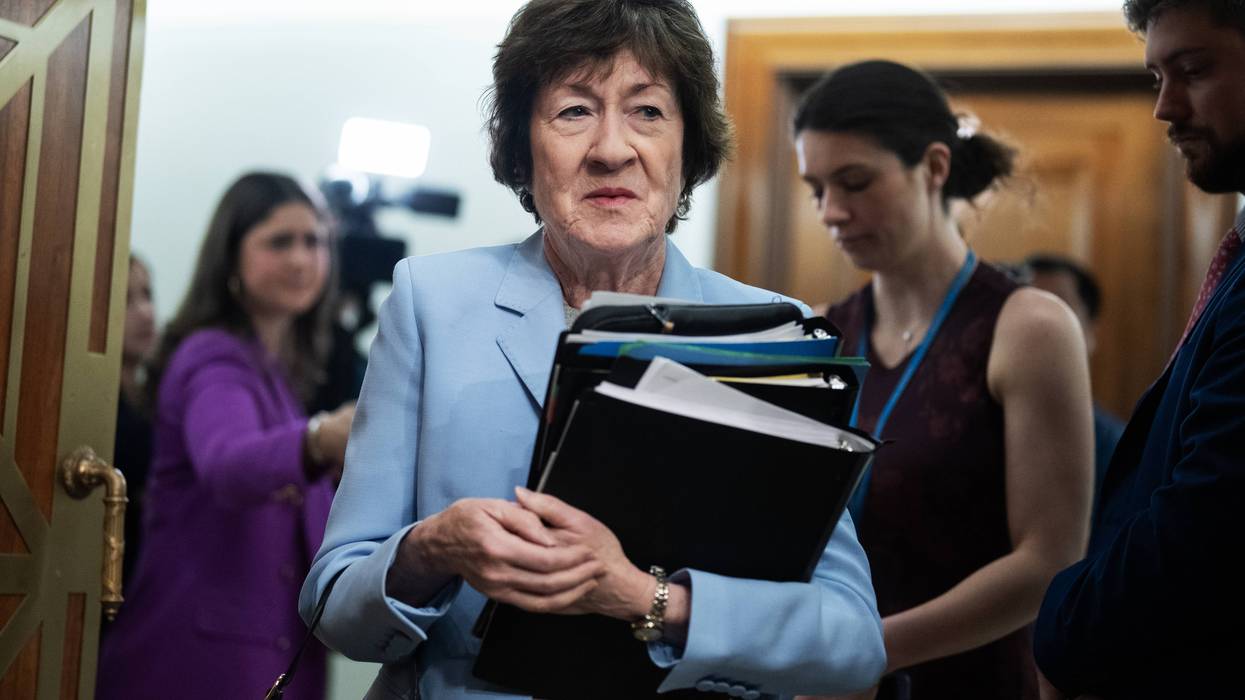
The campaign highlighted findings that the lobbying firm run by Collins’ husband brought in $76 million in federal contracts while she pushed K Street-friendly legislation in the Senate.
Democratic Senate nominee Graham Platner's campaign is taking aim at Sen. Susan Collins and her lobbyist husband, calling her long history of supporting policies that helped his firm "the biggest political scandal in Maine" in an ad released Wednesday.
It follows a report out the previous day from Zeteo revealing that Collins' husband, Tom Daffron, worked as recently as last year for a firm owned by Scott Reed, the lobbyist who leads Pine Tree Results, a billionaire-funded super political action committee (PAC) that is spending millions to support Collins' (R-Maine) campaign for reelection.
While not necessarily a violation of the law, which prohibits super PACs from coordinating with the campaigns they support, the Platner campaign described Daffron's lobbying work as “only the latest example of the blurred lines between Collins, her husband, and the Washington insider network that has surrounded her political career for decades.”
Daffron’s activity as a Washington lobbyist stretches back more than two decades, before his marriage to Collins in 2012. In 2006, Daffron became the chief operating officer of the lobbying and consulting firm Jefferson Consulting Group.
A veteran of national Republican campaigns, he also served as a consultant on Collins’ 1996, 2002, and 2008 Senate bids, and ran her leadership PAC from 2003 until 2012. As far back as 2001, the Portland Press Herald described Daffron as "a close friend [of Collins] and one of the top advisers in her ‘kitchen cabinet.'"
Platner’s ad accuses Collins of having overseen "over $76 million in taxpayer dollars to his company,” which the campaign has argued was due in part to contracting reform legislation she wrote, and which passed in 2008. That law was said to “improve the federal acquisition workforce,” an area in which Jefferson Consulting specialized.
The Platner campaign cited a 2020 article by Salon, which found that:
Between 2006 and 2016, Daffron’s firm landed more than $76 million spread across dozens of federal contracts related to acquisition and procurement, according to searches on USAspending.gov.
In 2010, Jefferson Consulting reported providing acquisitions services and support to nearly two dozen federal agencies. Certain specific provisions included with Collins’ 2007 contract reforms appear to have benefited Daffron’s firm directly, by adding new requirements for acquisition services that Jefferson specialized in.
The ad also highlights Collins' role in voting against several ethics and transparency efforts that could have impacted firms like the one run by Daffron.
One amendment she voted against in 2006 would have required members of Congress to disclose when they or their staff were discussing a possible future private-sector role while serving in government. It would also have restricted lobbyists from giving gifts to lawmakers, such as free lunch or paying for travel or tickets to events.
In 2012, Collins helped to defeat another amendment that would have targeted the so-called “political intelligence” industry that profits from acquiring insider information and passing it on to investors, corporations, and other clients.
Platner: Susan Collins has gotten 21 times wealthier just in the last 15 years. Has anybody else gotten 21 times wealthier since Susan Collins was elected to office? Does Maine have 21 times the schools and hospitals? No, we have less. Susan Collins is getting rich while we're… pic.twitter.com/ZsB2v9JyVu
— Acyn (@Acyn) June 10, 2026
Platner has attacked Collins over her husband's work in recent days, thundering before a crowd on the night of his primary victory last week that “Susan Collins has used her privilege to funnel... federal contracts to her lobbyist husband. If that’s not corruption, I don’t know what is.”
Collins has denied the accusation, saying "It’s just not true, and it’s obvious that Mr. Platner has a problem with the truth.”
Platner has also highlighted Collins' own personal net worth, which had grown from just over $205,000 in 2011 to at least $4.3 million today, when including the estimated value of her stock holdings.
"Has anybody else gotten 21 times wealthier since Susan Collins was elected to office?" Platner asked last week. "Does Maine have 21 times the schools and hospitals? No, we have less."
The ad continues to hammer on this theme of self-dealing, calling out that "Collins voted for new forever wars that gave billions to companies they invested in."
"They made millions," the ad states. "They get rich. Maine pays the price."

This is now the second time Trump has derailed renewal of FISA’s Section 702, which US intelligence agencies have widely abused to spy on Americans without a warrant.
President Donald Trump threw a wrench into bipartisan efforts to renew the federal government's widely abused warrantless spying powers on Wednesday by demanding it be paired with the passage of Republicans' voter suppression legislation.
In a Truth Social post, Trump announced that he would not approve the renewal of Section 702 of the Foreign Intelligence Surveillance Act (FISA) "without THE SAVE AMERICA ACT going along with it," a reference to Republican-backed legislation that would create nationwide voter ID and proof-of-citizenship requirements.
Passing the SAVE America Act, which critics have warned could be used to disenfranchise millions of eligible voters, would require scrapping the filibuster in the US Senate, and Senate Majority Leader John Thune (R-SD) has said that there are not enough votes in his caucus to make this happen.
This is now the second time Trump has derailed renewal of FISA's Section 702, which allows for warrantless spying on noncitizens located outside the US. Intelligence agencies have routinely used the authority, which lapsed over the weekend, to collect Americans’ data without a warrant.
Earlier this month, Trump appointed Federal Housing Finance Agency Director Bill Pulte to be his acting director of national intelligence (DNI). Many critics expressed horror at Pulte's appointment, given that he has no experience working in intelligence and has been instrumental in pushing the US Department of Justice to prosecute the president's political enemies.
This led many Senate Democrats, including Senate Intelligence Committee vice-chairperson Mark Warner (D-Va.), to withdraw their support for a FISA extension until the president nominated a more acceptable permanent replacement for outgoing DNI Tulsi Gabbard.
FISA renewal appeared to be back on track last week after Trump nominated Jay Clayton, former chairman of the Securities and Exchange Commission, to be DNI.
However, in the same Truth Social post where Trump announced his intent to veto a FISA extension without the SAVE America Act, the president said that he was "canceling" Clayton's scheduled Wednesday Senate hearing.
Senate Intelligence Committee Chair Tom Cotton (R-Ark.) announced shortly after Trump's post that the hearing for Clayton would still take place unless the president formally pulled the nominee.
"Jay Clayton is a pending nominee before the Intelligence Committee," Cotton wrote in a social media post. "We will proceed with his hearing as scheduled unless the president directs him not to appear or withdraws his nomination."
According to The New York Times, the latest chaos and drama caused by Trump "all but guarantee that Mr. Pulte... would take the job at the end of this week as the acting director of national intelligence."

The Defense Department's chief AI officer said the US military used a Grok model to help "deploy over 2,000 munitions to 2,000 distinct targets" in Iran "within 96 hours."
A Pentagon official revealed in a court filing earlier this week that the US military used a version of trillionaire Elon Musk's artificial intelligence tool, Grok, to help carry out attacks on Iran.
Cameron Stanley, the Pentagon's chief digital and AI officer, wrote in a sworn statement to a federal court in Mississippi that the US military "relies on derivatives of [Musk-run xAI's] commercial offerings known as the Grok Gov Model." The model, which is used within the Pentagon's Maven Smart System, "enabled US forces to deploy over 2,000 munitions to 2,000 distinct targets within 96 hours during Operation Epic Fury," the Trump administration's name for the illegal war the president launched against Iran in late February.
Stanley's statement came as part of a lawsuit that the NAACP brought against xAI earlier year, accusing Musk's company of illegally operating dozens of polluting gas turbines for its Colossus 2 data center, which powers Grok.
Defending xAI, Stanley claimed in his statement that if Grok "cannot be deployed, refined, and upgraded" across the Pentagon "due to either limitations in energy supply or limited reserve compute capability, such as those requested by plaintiffs in this matter, the many tools deployed by military and civilian personnel alike which rely on Grok Gov Models would be severely impacted."
The Defense Department acknowledged shortly after launching its assault on Iran that the US military was "leveraging a variety of advanced AI tools" to help "sift through vast amounts of data in seconds so our leaders can cut through the noise and make smarter decisions faster than the enemy can react."
In a March 12 letter to Pentagon Secretary Pete Hegseth, a group of more than 120 House Democrats demanded details on "the role of artificial intelligence... in selecting targets, assessing intelligence, and making legal determinations during Operation Epic Fury."
The lawmakers specifically asked whether AI tools were used to identify an Iranian elementary school as a target. On the first day of the Iran war, the US military bombed a girls' school in southern Iran, killing more than 150 people—mostly young children.
Stanley's statement did not identify any of the "2,000 distinct targets" he said were attacked with the help of the Grok Gov Model.