SUBSCRIBE TO OUR FREE NEWSLETTER
Daily news & progressive opinion—funded by the people, not the corporations—delivered straight to your inbox.
5
#000000
#FFFFFF
To donate by check, phone, or other method, see our More Ways to Give page.
Daily news & progressive opinion—funded by the people, not the corporations—delivered straight to your inbox.
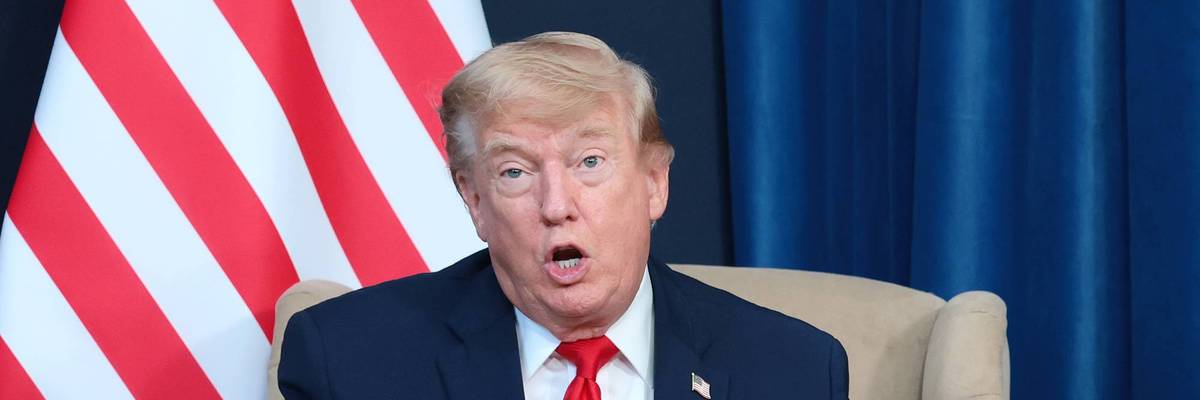
US President Donald Trump speaks during a bilateral meeting with the emir of Qatar, Sheikh Tamim bin Hamad Al Thani, on the sidelines of the G7 summit, on June 16, 2026 in Evian-les-Bains, France.
Trump's comments served as an admission, said one observer, that "the uranium was a false justification for war."
President Donald Trump and his top advisers have spent months insisting that extracting and confiscating highly enriched uranium from Iran was the top objective of the unprovoked war he and Israeli Prime Minister Benjamin Netanyahu began in February—but on Tuesday at the Group of Seven summit in France, he shrugged off the need to rapidly obtain the nuclear reactor component.
There is "no rush" to retrieve uranium from nuclear sites the US bombed in June 2025, Trump said, adding that taking the highly enriched uranium is something the US wants "psychologically," but not enough to prioritize extracting it right away.
One could make the argument, he said, that it wasn't worth the effort to take the material at all.
"Frankly, to go get it—we're going to go get it—but to go get it is a big deal, because they say only China and us have the equipment," said the president. "You could make the case, 'Why do you even bother?' because it's not very valuable, you know. It's probably half a million dollars worth, it's not very valuable stuff."
Trump is backing away from getting Iran's enriched material: "You could make the case, why even bother? It's not very valuable stuff." pic.twitter.com/CgNgnZCaMQ
— Aaron Rupar (@atrupar) June 16, 2026
Trump's comments came a day after he and the Iranian government announced they had reached a memorandum of understanding (MOU) to end the war. The president told The New York Times that the agreement includes a requirement that Iran will be limited to enriching uranium only to levels that "could never be used by the military."
White House officials, though, told The Washington Post that details of Iran's nuclear program will be subject to negotiations over the next two months. The question of whether talks on the nuclear program could be held separately, after a deal to end the war was reached, had been a major sticking point for the US leading up to the MOU.
Trump brushed off suggestions that the deal to end the war, in which Iran demonstrated its economic might by effectively closing the Strait of Hormuz and sending energy prices skyrocketing—obtained no guarantees on Iran's nuclear program that hadn't already been secured in 2015 in the Joint Comprehensive Plan of Action, which was brokered by the Obama administration and which limited Iran's nuclear program in exchange for sanctions relief. Trump exited the JCPOA during his first term.
Iran will only be able to enrich uranium “for nonmilitary purposes. Forever," said Trump on Monday.
On Fox News on Monday, former National Security Council chief of staff Alex Gray insisted the president had secured a deal that, for the first time, would stop Iran from developing a nuclear weapon. Before the US and Israel began attacking Iran in February, the Middle Eastern country maintained that its nuclear power program was not for military purposes.
While Trump's supporters insisted the war and the MOU had made clear Trump had drawn a hard line on Iran's nuclear capacity, his comments on Tuesday were taken by foreign policy analyst Logan McMillen as an admission that "the uranium was a false justification for war."
"The real purpose was to punish Iran for the crime of being an independent economic power that refused to participate in America’s petro economy," said McMillen.
At CNN, Aaron Blake noted that Trump has spent weeks sending inconsistent messages about his demand that Iran end its nuclear program.
Late last month, the president said on social media that Iran's uranium "will be unearthed by the United States... in close coordination and conjunction with the Islamic Republic of Iran, plus the International Atomic Energy Agency, and DESTROYED.”
But in April, Trump told Reuters that US strikes last year had left Iran's uranium "so far underground, I don’t care about that."
Two weeks later, he again said that the US had "to take that nuclear dust," before telling Fox News last month that destroying the uranium was not "necessary except from a public relations standpoint."
Dear Common Dreams reader, It’s been nearly 30 years since I co-founded Common Dreams with my late wife, Lina Newhouser. We had the radical notion that journalism should serve the public good, not corporate profits. It was clear to us from the outset what it would take to build such a project. No paid advertisements. No corporate sponsors. No millionaire publisher telling us what to think or do. Many people said we wouldn't last a year, but we proved those doubters wrong. Together with a tremendous team of journalists and dedicated staff, we built an independent media outlet free from the constraints of profits and corporate control. Our mission has always been simple: To inform. To inspire. To ignite change for the common good. Building Common Dreams was not easy. Our survival was never guaranteed. When you take on the most powerful forces—Wall Street greed, fossil fuel industry destruction, Big Tech lobbyists, and uber-rich oligarchs who have spent billions upon billions rigging the economy and democracy in their favor—the only bulwark you have is supporters who believe in your work. But here’s the urgent message from me today. It's never been this bad out there. And it's never been this hard to keep us going. At the very moment Common Dreams is most needed, the threats we face are intensifying. We need your support now more than ever. We don't accept corporate advertising and never will. We don't have a paywall because we don't think people should be blocked from critical news based on their ability to pay. Everything we do is funded by the donations of readers like you. When everyone does the little they can afford, we are strong. But if that support retreats or dries up, so do we. Will you donate now to make sure Common Dreams not only survives but thrives? —Craig Brown, Co-founder |
President Donald Trump and his top advisers have spent months insisting that extracting and confiscating highly enriched uranium from Iran was the top objective of the unprovoked war he and Israeli Prime Minister Benjamin Netanyahu began in February—but on Tuesday at the Group of Seven summit in France, he shrugged off the need to rapidly obtain the nuclear reactor component.
There is "no rush" to retrieve uranium from nuclear sites the US bombed in June 2025, Trump said, adding that taking the highly enriched uranium is something the US wants "psychologically," but not enough to prioritize extracting it right away.
One could make the argument, he said, that it wasn't worth the effort to take the material at all.
"Frankly, to go get it—we're going to go get it—but to go get it is a big deal, because they say only China and us have the equipment," said the president. "You could make the case, 'Why do you even bother?' because it's not very valuable, you know. It's probably half a million dollars worth, it's not very valuable stuff."
Trump is backing away from getting Iran's enriched material: "You could make the case, why even bother? It's not very valuable stuff." pic.twitter.com/CgNgnZCaMQ
— Aaron Rupar (@atrupar) June 16, 2026
Trump's comments came a day after he and the Iranian government announced they had reached a memorandum of understanding (MOU) to end the war. The president told The New York Times that the agreement includes a requirement that Iran will be limited to enriching uranium only to levels that "could never be used by the military."
White House officials, though, told The Washington Post that details of Iran's nuclear program will be subject to negotiations over the next two months. The question of whether talks on the nuclear program could be held separately, after a deal to end the war was reached, had been a major sticking point for the US leading up to the MOU.
Trump brushed off suggestions that the deal to end the war, in which Iran demonstrated its economic might by effectively closing the Strait of Hormuz and sending energy prices skyrocketing—obtained no guarantees on Iran's nuclear program that hadn't already been secured in 2015 in the Joint Comprehensive Plan of Action, which was brokered by the Obama administration and which limited Iran's nuclear program in exchange for sanctions relief. Trump exited the JCPOA during his first term.
Iran will only be able to enrich uranium “for nonmilitary purposes. Forever," said Trump on Monday.
On Fox News on Monday, former National Security Council chief of staff Alex Gray insisted the president had secured a deal that, for the first time, would stop Iran from developing a nuclear weapon. Before the US and Israel began attacking Iran in February, the Middle Eastern country maintained that its nuclear power program was not for military purposes.
While Trump's supporters insisted the war and the MOU had made clear Trump had drawn a hard line on Iran's nuclear capacity, his comments on Tuesday were taken by foreign policy analyst Logan McMillen as an admission that "the uranium was a false justification for war."
"The real purpose was to punish Iran for the crime of being an independent economic power that refused to participate in America’s petro economy," said McMillen.
At CNN, Aaron Blake noted that Trump has spent weeks sending inconsistent messages about his demand that Iran end its nuclear program.
Late last month, the president said on social media that Iran's uranium "will be unearthed by the United States... in close coordination and conjunction with the Islamic Republic of Iran, plus the International Atomic Energy Agency, and DESTROYED.”
But in April, Trump told Reuters that US strikes last year had left Iran's uranium "so far underground, I don’t care about that."
Two weeks later, he again said that the US had "to take that nuclear dust," before telling Fox News last month that destroying the uranium was not "necessary except from a public relations standpoint."
President Donald Trump and his top advisers have spent months insisting that extracting and confiscating highly enriched uranium from Iran was the top objective of the unprovoked war he and Israeli Prime Minister Benjamin Netanyahu began in February—but on Tuesday at the Group of Seven summit in France, he shrugged off the need to rapidly obtain the nuclear reactor component.
There is "no rush" to retrieve uranium from nuclear sites the US bombed in June 2025, Trump said, adding that taking the highly enriched uranium is something the US wants "psychologically," but not enough to prioritize extracting it right away.
One could make the argument, he said, that it wasn't worth the effort to take the material at all.
"Frankly, to go get it—we're going to go get it—but to go get it is a big deal, because they say only China and us have the equipment," said the president. "You could make the case, 'Why do you even bother?' because it's not very valuable, you know. It's probably half a million dollars worth, it's not very valuable stuff."
Trump is backing away from getting Iran's enriched material: "You could make the case, why even bother? It's not very valuable stuff." pic.twitter.com/CgNgnZCaMQ
— Aaron Rupar (@atrupar) June 16, 2026
Trump's comments came a day after he and the Iranian government announced they had reached a memorandum of understanding (MOU) to end the war. The president told The New York Times that the agreement includes a requirement that Iran will be limited to enriching uranium only to levels that "could never be used by the military."
White House officials, though, told The Washington Post that details of Iran's nuclear program will be subject to negotiations over the next two months. The question of whether talks on the nuclear program could be held separately, after a deal to end the war was reached, had been a major sticking point for the US leading up to the MOU.
Trump brushed off suggestions that the deal to end the war, in which Iran demonstrated its economic might by effectively closing the Strait of Hormuz and sending energy prices skyrocketing—obtained no guarantees on Iran's nuclear program that hadn't already been secured in 2015 in the Joint Comprehensive Plan of Action, which was brokered by the Obama administration and which limited Iran's nuclear program in exchange for sanctions relief. Trump exited the JCPOA during his first term.
Iran will only be able to enrich uranium “for nonmilitary purposes. Forever," said Trump on Monday.
On Fox News on Monday, former National Security Council chief of staff Alex Gray insisted the president had secured a deal that, for the first time, would stop Iran from developing a nuclear weapon. Before the US and Israel began attacking Iran in February, the Middle Eastern country maintained that its nuclear power program was not for military purposes.
While Trump's supporters insisted the war and the MOU had made clear Trump had drawn a hard line on Iran's nuclear capacity, his comments on Tuesday were taken by foreign policy analyst Logan McMillen as an admission that "the uranium was a false justification for war."
"The real purpose was to punish Iran for the crime of being an independent economic power that refused to participate in America’s petro economy," said McMillen.
At CNN, Aaron Blake noted that Trump has spent weeks sending inconsistent messages about his demand that Iran end its nuclear program.
Late last month, the president said on social media that Iran's uranium "will be unearthed by the United States... in close coordination and conjunction with the Islamic Republic of Iran, plus the International Atomic Energy Agency, and DESTROYED.”
But in April, Trump told Reuters that US strikes last year had left Iran's uranium "so far underground, I don’t care about that."
Two weeks later, he again said that the US had "to take that nuclear dust," before telling Fox News last month that destroying the uranium was not "necessary except from a public relations standpoint."