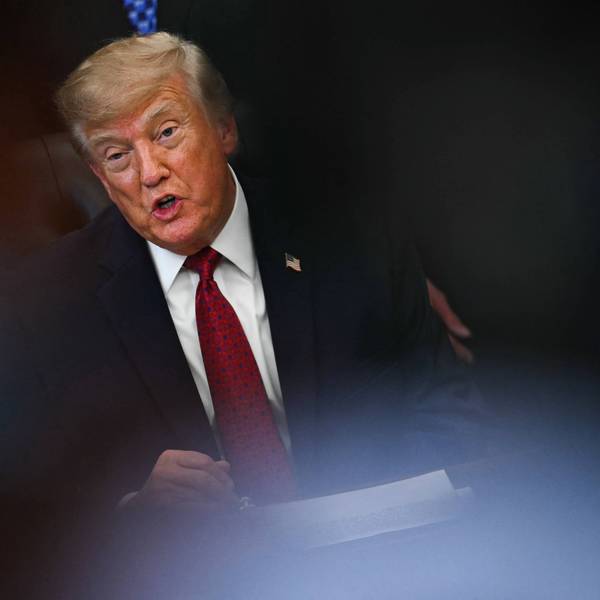

US President Donald Trump speaks during a Cabinet meeting on March 26, 2026.
'Sounds a Lot Like a Nuclear Threat': Trump Floats 'Ultimate Alternative' If Iran Talks Collapse
Trump claimed on social media that a diplomatic agreement would be signed on Sunday, but Iran's Foreign Ministry pushed back on that timeline.
President Donald Trump claimed Saturday that the US and Iran are on track to sign a diplomatic agreement this weekend, but added that "we have the ultimate alternative" if the process doesn't "work out."
"The 'ultimate alternative' sounds a lot like a nuclear threat," Sina Toossi, a senior fellow at the Center for International Policy, wrote in response to the president's Truth Social post. "Not the first time Trump has hinted at it."
The agreement Trump referenced is believed to be "memorandum of understanding" that's expected be fleshed out in "technical talks" that could begin next week, according to Pakistani Prime Minister Shehbaz Sharif, who is mediating the negotiations.
"We are closer to a peace deal than ever before," Sharif wrote on social media, echoing Iranian Foreign Minister Abbas Araghchi, who said on Friday that "the Islamabad Memorandum of Understanding has never been closer."
"Pending its finalization, the media should refrain from entering speculation about its content," Araghchi added. "In line with our responsible and transparent approach, all details will be shared with the public in due course."
On Saturday, a spokesperson for the Iranian Foreign Ministry cast doubt on the timeline put forth by Trump and Sharif.
"We will have to wait and see about the exact date of the signing of the memorandum of understanding, although it will not be tomorrow,” said Esmaeil Baqaei, as reported by Iranian state media. “The possibility of this happening in the coming days cannot be ruled out. However, due to the hesitation of the other side, we must be cautious in making any comments about this process.”
In his Truth Social post on Saturday, Trump declared that the Strait of Hormuz will be "OPEN TO ALL" immediately after the deal is signed—a condition that Iran has not confirmed.
"We look forward to working with Iran, and the entire Middle East, long into the future," Trump added. "Hopefully, this process will all work out quickly, easily, and smoothly. If it doesn’t, we have the ultimate alternative, hopefully never to be used again!"
Trump has repeatedly issued genocidal threats against Iran since launching the illegal war in late February, openly declaring his intention to target Iran's civilian infrastructure and wipe out its "whole civilization." Experts say such threats, even if they aren't acted on, constitute war crimes under international law.
We are at a crossroads
This country and this world are at a monumental crossroads. In a few short weeks, US voters will have an opportunity to beat back the forces of fascism and confront the billionaires who are rigging the economy, our media system, and our democracy, making it increasingly impossible for ordinary people to get by. We’re not just talking about the election. We’re talking about what must be done once these fascist elements are vanquished from power. We need a bolder set of solutions than what either major party has so far been willing to offer and a working-class movement ready to fight like hell for it. Trump didn't emerge from nowhere. The conditions that fueled MAGA authoritarianism were created by decades of radical neoliberal economic policies and a corrupt political system dominated by corporate interests. They slashed taxes on the super-rich, promising that the benefits would trickle down. They said giveaways to the corporate titans would make life more affordable for the rest of us. It was all bullshit. And when a bitter, betrayed populace searches for someone to blame, right-wing demagogues have little trouble finding scapegoats. People know when they're being lied to, but you won't hear any of this from the corporate media. Only independent journalism—powered and funded by people who believe in building a better world—can deliver truly trustworthy daily news. Our Fall Campaign is underway, and we need your help. To power our newsroom through the rest of the year, we need to raise $125,000 by midnight on October 31. So if you share our vision, please contribute whatever you can to sustain our work. |
President Donald Trump claimed Saturday that the US and Iran are on track to sign a diplomatic agreement this weekend, but added that "we have the ultimate alternative" if the process doesn't "work out."
"The 'ultimate alternative' sounds a lot like a nuclear threat," Sina Toossi, a senior fellow at the Center for International Policy, wrote in response to the president's Truth Social post. "Not the first time Trump has hinted at it."
The agreement Trump referenced is believed to be "memorandum of understanding" that's expected be fleshed out in "technical talks" that could begin next week, according to Pakistani Prime Minister Shehbaz Sharif, who is mediating the negotiations.
"We are closer to a peace deal than ever before," Sharif wrote on social media, echoing Iranian Foreign Minister Abbas Araghchi, who said on Friday that "the Islamabad Memorandum of Understanding has never been closer."
"Pending its finalization, the media should refrain from entering speculation about its content," Araghchi added. "In line with our responsible and transparent approach, all details will be shared with the public in due course."
On Saturday, a spokesperson for the Iranian Foreign Ministry cast doubt on the timeline put forth by Trump and Sharif.
"We will have to wait and see about the exact date of the signing of the memorandum of understanding, although it will not be tomorrow,” said Esmaeil Baqaei, as reported by Iranian state media. “The possibility of this happening in the coming days cannot be ruled out. However, due to the hesitation of the other side, we must be cautious in making any comments about this process.”
In his Truth Social post on Saturday, Trump declared that the Strait of Hormuz will be "OPEN TO ALL" immediately after the deal is signed—a condition that Iran has not confirmed.
"We look forward to working with Iran, and the entire Middle East, long into the future," Trump added. "Hopefully, this process will all work out quickly, easily, and smoothly. If it doesn’t, we have the ultimate alternative, hopefully never to be used again!"
Trump has repeatedly issued genocidal threats against Iran since launching the illegal war in late February, openly declaring his intention to target Iran's civilian infrastructure and wipe out its "whole civilization." Experts say such threats, even if they aren't acted on, constitute war crimes under international law.
President Donald Trump claimed Saturday that the US and Iran are on track to sign a diplomatic agreement this weekend, but added that "we have the ultimate alternative" if the process doesn't "work out."
"The 'ultimate alternative' sounds a lot like a nuclear threat," Sina Toossi, a senior fellow at the Center for International Policy, wrote in response to the president's Truth Social post. "Not the first time Trump has hinted at it."
The agreement Trump referenced is believed to be "memorandum of understanding" that's expected be fleshed out in "technical talks" that could begin next week, according to Pakistani Prime Minister Shehbaz Sharif, who is mediating the negotiations.
"We are closer to a peace deal than ever before," Sharif wrote on social media, echoing Iranian Foreign Minister Abbas Araghchi, who said on Friday that "the Islamabad Memorandum of Understanding has never been closer."
"Pending its finalization, the media should refrain from entering speculation about its content," Araghchi added. "In line with our responsible and transparent approach, all details will be shared with the public in due course."
On Saturday, a spokesperson for the Iranian Foreign Ministry cast doubt on the timeline put forth by Trump and Sharif.
"We will have to wait and see about the exact date of the signing of the memorandum of understanding, although it will not be tomorrow,” said Esmaeil Baqaei, as reported by Iranian state media. “The possibility of this happening in the coming days cannot be ruled out. However, due to the hesitation of the other side, we must be cautious in making any comments about this process.”
In his Truth Social post on Saturday, Trump declared that the Strait of Hormuz will be "OPEN TO ALL" immediately after the deal is signed—a condition that Iran has not confirmed.
"We look forward to working with Iran, and the entire Middle East, long into the future," Trump added. "Hopefully, this process will all work out quickly, easily, and smoothly. If it doesn’t, we have the ultimate alternative, hopefully never to be used again!"
Trump has repeatedly issued genocidal threats against Iran since launching the illegal war in late February, openly declaring his intention to target Iran's civilian infrastructure and wipe out its "whole civilization." Experts say such threats, even if they aren't acted on, constitute war crimes under international law.