

SUBSCRIBE TO OUR FREE NEWSLETTER
Daily news & progressive opinion—funded by the people, not the corporations—delivered straight to your inbox.
5
#000000
#FFFFFF
To donate by check, phone, or other method, see our More Ways to Give page.
Daily news & progressive opinion—funded by the people, not the corporations—delivered straight to your inbox.

When I was growing up, eating turkey on Thanksgiving was just... "normal." I didn't give it a second thought, except maybe when my Grandma took the insides of the turkey out so she could put the stuffing in.
That all changed on my 30th birthday, which happened to fall on Thanksgiving. I had read Alicia Silverstone's The Kind Diet, and I had learned so much about how animals suffer: chickens locked in tiny cages, pigs mutilated without pain relief, and fish suffocated on commercial fishing vessels. So I went vegan.
This Thanksgiving, 45 million turkeys will be killed across the country. Now that I've taken the time to actually meet turkeys and learn about them, that statistic breaks my heart.
I remember one rescued turkey in particular. I met him at Farm Sanctuary, a shelter for abused and neglected farm animals. His name was Turpentine, and he loved to be held and petted--just like a dog. As turkeys like Turpentine ate from my hand, I saw how these social, loving animals truly do have personalities all of their own.
"This Thanksgiving, 45 million turkeys will be killed across the country. Now that I've taken the time to actually meet turkeys and learn about them, that statistic breaks my heart."
In nature, turkeys happily spend their days tending to their young, dustbathing, and hanging out in the same trees they sleep in at night. Every morning before descending from their branches, wild turkeys utter a sequence of soft yelps just to make sure their flock mates are OK. Mother turkeys are so protective that they will readily die defending their young from predators. This is partly why baby turkeys stay with their mothers for the first five months of their lives.
But virtually all turkeys raised for food are factory farmed and slaughtered at around five months old. In fact, the turkeys we eat are bred to grow so unnaturally large in such a short time that many suffer hip joint lesions and heart problems. And the nightmare doesn't stop there. Deeply empathic animals who often mourn the deaths of flock mates, turkeys sometimes have heart attacks when they witness the violent deaths of fellow birds. Those who live long enough to be slaughtered are often scalded alive; production lines move so fast that workers frequently can't kill the birds before they're dropped, completely conscious, into feather-removal tanks.
Unfortunately, this horrific suffering is considered standard and acceptable by the animal agriculture industry. But the cruelty goes even further. I know this because my employer is Mercy For Animals, an animal protection charity working to expose and stop animal abuse at factory farms and slaughterhouses.
MFA's undercover investigations into Butterball resulted in the first-ever felony conviction for cruelty to factory-farmed birds after we documented workers punching, kicking, and throwing turkeys. These tragic investigations revealed toes and beaks cut or burned off of unsedated turkeys, baby birds ground up alive in giant macerators, and wounded animals left to die slow, painful deaths. But when it comes to factory farming in America, Butterball is the rule, not the exception.
So this holiday, I must ask: Why take part in animal abuse when you don't have to, especially when eating meat increases risk of high cholesterol, antibiotic resistance, heart disease, colon cancer, diabetes, hormonal imbalance, and premature death?
Thankfully, Thanksgiving might be the perfect day to start eating cruelty-free; your traditional sides, like mashed potatoes, string bean casserole, and stuffing are just as delicious and easy to prepare vegan. Replace turkey with whichever cruelty-free centerpiece you prefer--stuffed squash, vegan wellington, and a plant-based roast are all great options. (My top recommendations are Field Roast's Celebration Roast and Gardein's Holiday Roast.) Options abound at your local Safeway or Whole Foods and at my favorite Denver vegan shop, NOOCH.
I'm proud to say that about 80 percent of the family I join for Thanksgiving is now also vegan. We learned the truth about factory farming as a family, and once we did, choosing compassion brought us closer together. Now we celebrate life on Thanksgiving.
North Carolina's controversial ag-gag law is facing a court challenge by a coalition of watchdog groups who charge that it violates a citizen's First Amendment rights and places the safety of animals, families, and food supply at great risk.
Anna Myers, executive director and CEO of whistleblower protection and advocacy organization Government Accountability Project (GAP), who announced the legal action on Wednesday, said the law "is one of the most appalling overt attempts to silence whistleblowers" in the organization's 38-year history.
The law, which took effect on January 1, "aim[s] to criminalize food industry whistleblowing" by "punish[ing] those who conduct undercover investigations of any private entity in North Carolina," Myers continued.
Among other things, the law prohibits the recording of video at industrial agriculture facilities without written consent of the owner. However, as Myers points out, the law "is written so broadly that it could target truth-tellers across all corporate sectors," such as those who wish to expose improper activity at nursing homes or daycare centers.
In addition to GAP, the plaintiffs in the suit include People for the Ethical Treatment of Animals (PETA), the Center for Food Safety, Animal Legal Defense Fund, Farm Sanctuary, and Food & Water Watch.
Their joint statement reads: "This law blatantly violates citizens' rights to free speech, a free press, and to petition their government, and violates the Equal Protection Clause. It places the safety of our families, our food supply, and animals at risk, and it attempts to bully and threaten those working for transparency, free speech and the public good. Our lawsuit is being brought for the sake of the health and safety of all citizens of North Carolina. We are confident the law will be found unconstitutional and that a victory in North Carolina will deter other state legislatures from repeating North Carolina's mistake."
Similar bills have already been introduced in more than half of all state legislatures and have become law in numerous states, including Idaho, Iowa, Kansas, Missouri, Montana, North Dakota, Utah, Wyoming--and now North Carolina.
Animal rights groups attribute the success of these measures to an aggressive factory farm lobby.
Last week, a North Carolina Perdue employee was found guilty of criminal animal cruelty after an undercover expose by animals rights group Mercy for Animals revealed him kicking, stomping, and throwing chickens.
As Charlotte Observer columnist Eric Frazier recently pointed out, had the abuse occurred after the new law took effect, the employee may have gotten away with it.
The law, Frazier wrote last week, "would have allowed the supplier to quietly dismiss [the employee] without criminal prosecution, then go to civil court to sue the undercover animal activist who videotaped the crimes. Net effect: no animal rights expose, no messy public relations problem for the poultry industry."
"According to those running our General Assembly, this is progress," Frazier continued. "Whistle blowers can now be sued for secretly taking pictures in the workplace or exposing trade secrets. Be they fed-up longtime employees or social activists who hire on temporarily to sniff out abuses, all are now legally at risk if they try to get wrongdoing on tape."
Offering a boost to the animal rights movement and farm animals everywhere, former Daily Show host Jon Stewart and his wife, advocate and former veterinary technician Tracey, announced this weekend that their property in Middletown, New Jersey, will be the fourth outpost of the nation's largest and most effective farm rescue and protection organization.
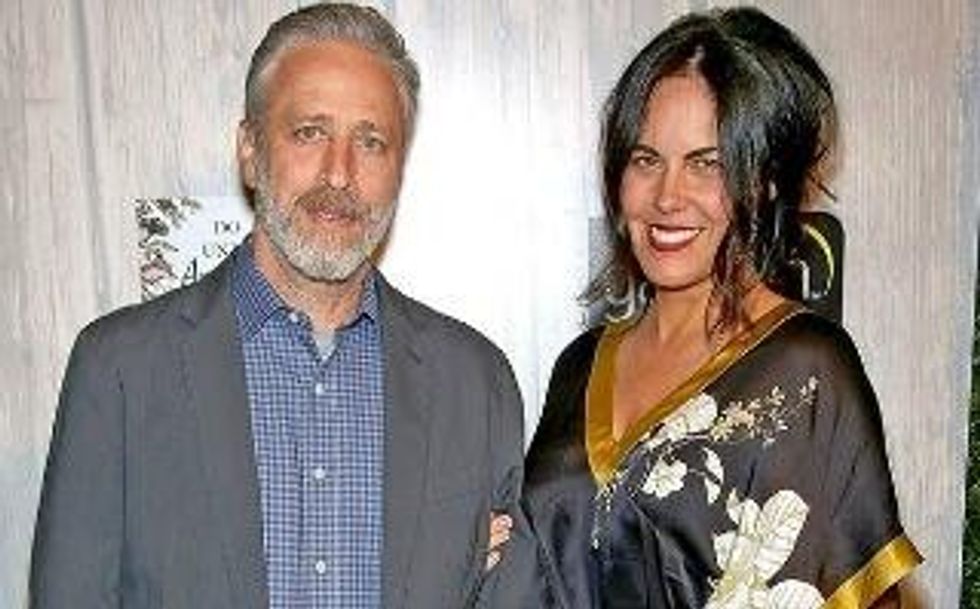
"We bought a farm in New Jersey to start a farm sanctuary of our own with an educational center," Tracey Stewart told attendees of the Farm Sanctuary's 100%-vegan gala on Saturday evening, "but what I'm announcing tonight is that our farm is actually going to be the New Jersey branch of Farm Sanctuary. We will build new advocates, curious learners, and leaders for this very important movement."
The organization currently operates three shelters--a 175-acre sanctuary in upstate New York, a 300-acre sanctuary in Northern California, and a 26-acre sanctuary in Southern California--where they rescue, rehabilitate, and provide lifelong care for hundreds of animals who have been saved from stockyards, factory farms, and slaughterhouses. In addition, the nonprofit promotes "compassionate vegan living" through rescue, education, and advocacy efforts.
In August, Jon Stewart ended a 16-year run on Comedy Central's The Daily Show. "I'm a little uncomfortable," he announced at Farm Sanctuary's annual gala. "I've spent the last 20 years immersed in the world of Washington politics and the media landscape, so I don't know how to deal necessarily with people who have empathy."
As Farm Sanctuary pointed out in a press statement, "viewers of The Daily Show have undoubtedly noticed Stewart's increasingly frequent rants and barbs aimed at politicians who ignore the suffering of animals to further their agendas, including an 8-minute segment dedicated to New Jersey Governor Chris Christie's refusal to sign a bill that would end the lifelong confinement of pigs in crates so small they can't even turn around."
Farm Sanctuary president and co-founder Gene Baur appeared on the show to discuss his new book, Living the Farm Sanctuary Life: The Ultimate Guide to Eating Mindfully, Living Longer and Feeling Better Every Day (Rodale Books), earlier this year:
Animal welfare advocates on Wednesday are saying the McDonald's Corporation's recently announced plan to have a cage-free supply chain for its eggs within ten years is a "watershed moment" for the U.S. and Canadian food systems and a victory for those who have campaigned tirelessly against the fast-food behemoth whose business model historically rests on the industrial-scale abuse of chickens, cows, and other animals.
In a statement on its corporate website, McDonald's said it "will fully transition to cage-free eggs for its nearly 16,000 restaurants in the U.S. and Canada over the next 10 years" as a way to meet the changing expectations and preferences of its many millions of annual customers.
Acknowledging what animal rights campaigners and food system reform advocates have long believed, McDonald's USA President Mike Andres said that once consumers are given a better understanding of where their food comes from--including the cruelty animals experience within the nation's food system--they can become key drivers of changing farming and production practices. "Our customers are increasingly interested in knowing more about their food and where it comes from," Andres said. The decision, he added, is an attempt to "meet and exceed our customers' expectations."
According to the company, McDonald's is one of the largest single purchasers in North America with its U.S. restaurants buying approximately two billion eggs each year and those located in Canada purchasing an additional 120 million eggs.
Paul Shapiro, vice president of farm animal protection at the Humane Society, made it clear that "cage-free" in no way means "cruelty-free" when it comes to the egg-laying hens that will continue to supply McDonald's in the years to come--but said the development is a definitely an improvement. "The birds can walk, spread their wings, perch, lay their eggs in nest, and engage in other natural behaviors," Shapiro told Buzzfeed.
As the animal welfare group Farm Sanctuary explains, just because a package of eggs reads "cage-free" does not not mean the hens are experiencing a humane existence:
Despite those realities, Wayne Pacelle, president and CEO of the Human Society U.S., said the announcement of McDonald's transition "is a watershed moment in a decades-long effort to eliminate the cruelest confinement from our food supply." The move, added, "makes clear that egg productions' future is cage-free."
As Buzzfeed notes:
Roughly 3.2% of hens in the U.S., or about 9.6 million hens, were cage-free as of March, according to United Egg Producers, and an additional 3.2% were organic, which also has cage-free requirements.
In addition to "cage-free," there are other animal welfare standards for hens. According to the Humane Society, "free-range," "pasture raised," and "organic" labels on eggs mean the hens are granted outdoor access -- unlike their "cage-free" counterparts -- although their beaks may also be trimmed.
McDonald's joins a growing list of companies that are switching to cage-free eggs. In 2012, Burger King committed to using 100% cage-free eggs and pork by 2017; Hellmann's Mayonnaise maker Unilever set a goal for 2020; and the large food service companies Aramark, Sodexo, and Compass Group made cage-free commitments by 2019 or 2020 as well. This summer, General Mills also said it would stop buying eggs from caged hens in the U.S., although it did not provide a timeline.
Earlier this year, McDonald's announced it would use only antibiotic-free chicken by 2017 and serve hormone-free milk.
Leah Garces, who directs the U.S. chapter of Compassion in World Farming, said her group "wholeheartedly" commends McDonald's for its announcement.
"This will positively affect the lives of over 7 million hens annually in the U.S. and Canada and the importance cannot be overstated," said Garces. "Nobody wants to see a hen locked up in a cage and McDonald's has recognized that today. We have no doubt their announcement will create a ripple effect in the entire market. This signals the end of the cage age for laying hens in the U.S."
In a victory for animal rights advocates--and the animals on factory farms they seek to protect--a federal judge on Monday ruled Idaho's controversial "ag-gag" law unconstitutional in a decision that said criminalizing the undercover documentation of livestock abuse violates both free speech and the equal protection clause.
"The facts show the state's purpose in enacting the statute was to protect industrial animal agriculture by silencing its critics." --U.S. District Judge B. Lynn Winmill
"The effect of the statute will be to suppress speech by undercover investigators and whistleblowers concerning topics of great public importance: the safety of the public food supply, the safety of agricultural workers, the treatment and health of farm animals, and the impact of business activities on the environment," U.S. District Judge B. Lynn Winmill stated in his 28-page ruling.
Under the law, people filming agricultural operations without permission in Idaho face up to a year in jail and a $5,000 fine. By comparison, a jail sentence for an animal cruelty conviction is capped at six months and a maximum fine of $5,000.
However, as Winmill's ruling continued, the legal arguments in favor of banning undercover investigations--long a tactic of animal rights groups with no other way to prove or expose such abuse--did not stand up to scrutiny. "Audio and visual evidence is a uniquely persuasive means of conveying a message," he wrote, "and it can vindicate an undercover investigator or whistleblower who is otherwise disbelieved or ignored. Prohibiting undercover investigators or whistleblowers from recording an agricultural facility's operations inevitably suppresses a key type of speech because it limits the information that might later be published or broadcast."
In the end, the judge concluded, "the facts show the state's purpose in enacting the statute was to protect industrial animal agriculture by silencing its critics."
Though other states have passed similar laws in recent years, the decision by Winmill marks the first time a federal court has struck down such legislation. And though the Idaho ruling could be appealed to a higher federal court, it is also likely to spur additional challenges in those other states.
Instigated by an undercover operation by the animal rights group Mercy for Animals, Idaho's law was signed into law in 2014 by the state's Republican Gov. Butch Otter, but was challenged in court by a coalition of welfare advocates, led by attorneys with the Animal Legal Defense Fund.
ALDF called Winmill's ruling a "landmark victory" for all those represented by the suit, which in addition to the tens of thousands nameless animals, included a broad-based public interest coalition of national nonprofits, including the People for the Ethical Treatment of Animals (PETA), the American Civil Liberties Union (ACLU) of Idaho, journalists Will Potter and Blair Koch, Farm Sanctuary, and the Center for Food Safety (CFS). In a joint statement, the coalition said:
Undercover video and photography has exposed numerous shocking practices that are "industry standards." These pervasive, systematic procedures include routine mutilation, including debeaking birds with electrically heated blades and castrating male animals by slicing open their scrotum and ripping their testicles out without pain relief or anesthesia and intensive confinement--where animals are literally unable to turn around for months on end. Exposes have also detailed the sickening farming conditions resulting in contaminated meat products--posing serious health risks to the public--and life threatening conditions for farm workers.
These investigations, and the subsequent media coverage, have led to food safety recalls, citations for environmental and labor violations, evidence of health code violations, plant closures, criminal convictions, and civil litigation. The Idaho statute unconstitutionally and unwisely prohibits efforts to bring violations of state and federal laws relating to food safety, environmental protection, and animal handling to the attention of the public and law enforcement.
Ag-Gag laws are notoriously unsupported by the public. Nationwide thirty-two similar Ag-Gag measures have failed. Currently, seven states have Ag-Gag laws on the books. This Idaho decision is just the first step in defeating similar Ag-Gag laws across the country.
Mercy for Animals also hailed the ruling, saying it is now looking forward to continuing its work and producing more undercover videos in Idaho.
"Idaho's lawmakers should be ashamed of wasting precious time and valuable resources enacting unconstitutional laws that threaten animal welfare, food safety, workers' rights and the environment," said Nathan Runkle, president of Mercy for Animals, in response to the ruling. "We hope they will now focus their efforts on improving animal welfare and rewarding the brave whistleblowers who uncover criminal activity in Idaho's agricultural operation."
WATKINS GLEN, N.Y.--There are mornings when Susie Coston, walking up to the gate of this bucolic farm in her rubber boots, finds crates of pigs, sheep, chickens, goats, geese or turkeys on the dirt road. Sometimes there are notes with the crates letting her know that the animals are sick or injured. The animals, often barely able to stand when taken from the crates, have been rescued from huge industrial or factory farms by activists.
WATKINS GLEN, N.Y.--There are mornings when Susie Coston, walking up to the gate of this bucolic farm in her rubber boots, finds crates of pigs, sheep, chickens, goats, geese or turkeys on the dirt road. Sometimes there are notes with the crates letting her know that the animals are sick or injured. The animals, often barely able to stand when taken from the crates, have been rescued from huge industrial or factory farms by activists.
The crates are delivered anonymously under the cover of darkness. This is because those who liberate animals from factory farms are considered terrorists under U.S. law. If caught, they can get a 10-year prison term and a $250,000 fine under the Animal Enterprise Terrorism Act. That is the punishment faced by two activists who were arrested in Oakland, Calif., last month and charged with freeing more than 5,700 minks in 2013, destroying breeding records and vandalizing other property of the fur industry.
Only in the insanity of corporate America can nonviolent animal rights activists be charged as terrorists while a white supremacist who gunned down African-Americans in a South Carolina church is charged on criminal counts. Only in the insanity of America can Wall Street financers implode the global economy through massive acts of fraud, causing widespread suffering, and be rewarded with trillions of dollars in government bailouts. Only in the insanity of America can government leaders wage wars that are defined as criminal acts of aggression under international law and then remain, unchallenged, in positions of power and influence. All this makes no sense in an open society. But it makes perfect sense in our species of corporate totalitarianism, in which life, especially the life of the vulnerable, is expendable and corporate profit alone is protected and sanctified as the highest good.
The animal agriculture industry causes suffering, death and environmental degradation--to humans as well as animals--on a scale equaled only by the arms industry and the fossil fuel industry. And by eating meat and dairy products we aid and abet a system that is perhaps the primary cause of global warming and is pumping toxins and poisons into our bodies and the rest of the ecosystem.
Animal agriculture sends more greenhouse gas emissions into the atmosphere than worldwide transportation. The waste and flatulence from livestock are responsible for creating at least 32,000 million tons of carbon dioxide per year, or 51 percent of all worldwide greenhouse gas emissions. Livestock causes 65 percent of all emissions of anthropogenic nitrous oxide, a greenhouse gas 296 times more destructive than carbon dioxide. Crops raised to feed livestock consume 56 percent of the water used in the United States. Seventy percent of the crops we grow in the U.S. are fed to animals. Eighty percent of the world's soy crop is fed to animals. It is a flagrant waste of precious and diminishing resources. It takes 1,000 gallons of water to produce one gallon of milk.
Farm Sanctuary in Watkins Glen--which the government briefly listed as an "extremist" animal rights group in the early 1990s--is probably the world's most lavish retirement home for farm animals. Gene Baur and Lorri Houston founded it. They raised money to create Farm Sanctuary, and to pass out literature about the abuse of animals at the hands of factory farm operators, by selling vegan hot dogs from a Volkswagen van at Grateful Dead concerts. In all, they drove their van to the parking lots outside nearly 100 concerts across the country. The first animal they rescued was a sheep, later named Hilda, found lying in a pile of dead animals behind a stockyard.
"Farm Sanctuary begins with the idea that there's this horrible system and most people are unwittingly supporting it by buying animal-based foods," Baur said when I reached him by phone at his home in Arlington, Va.
"We can only rescue a small handful compared to the billions who deserve to be rescued," he said. "So we try to model and encourage a new kind of relationship with animals. Rescuing individuals also helped us cope with the horrors of factory farming. Going into these places we would see atrocious abuse. We would witness thousands of animals confined in horrible conditions, held in crates where they couldn't even turn around. This takes a toll on you emotionally. Being able to rescue a few individuals out of that system helped heal us. Farm Sanctuary is a place of hope. It is a place of transformation. Animals who had been terribly mistreated, and seen only as production units, as commodities, have their lives transformed. They become our friends, instead of our food. You can't rescue them all, but you do what you can. Farm animal rescue is an immediate concrete response to an untenable chronic problem."
Farm Sanctuary, which operates through donations, has a budget of $10 million a year and runs two farms in California besides the one in New York state.
There are 1,000 animals at the organization's three farms--cows, sheep, goats, turkeys, pigs, geese, donkeys, chickens and ducks. The animals, which receive state-of-the-art medical care and are fed vegan food, roam the pastures unmolested. Cows are not impregnated in order to keep them producing milk. Eggs are not taken from chickens for human use. And all the creatures live out their natural lives liberated from the animal holocaust that defines the animal agriculture industry.
"It is very easy to love dogs and cats," Coston, the sanctuary's shelter director, said as we stood amid a flock of turkeys one rainy morning. "They are everywhere. They are in our world. But it is not easy to love turkeys because very few people get to meet turkeys. But look, they just followed us in," she said as we stepped into a barn. "They love being around people. They love attention. They are no different from pets. They also like to be petted."
"Every animal [at the farm] has a different personality, every animal has a name, all have health records," she went on as we walked to a barn that held rescued pigs. "We are saying they are as important as any other individual."
The relationships between the animals, including two blind cows that are inseparable, and between the animals and the men and women who work at the sanctuary were evident, and often moving. Pigs, chickens, turkeys and cows often responded to those working in the barns the way pets respond to their human companions. The animals gathered around barn workers to be scratched or stroked. Coston often suspended our conversation to address a pig or a cow by name and explain the intricacies of their histories and personalities--some shy, some gregarious, some rebellious, some jealous of others in the herd or flock, some moody and some attached to a particular worker at the farm.
Coston said the farm keeps the numbers small to maintain the relationships. "I won't overcrowd," she said. "I could go out now and save 5,000 spent layers [chickens]. But I would not see them, and many of them would die. They would no longer be individuals."
Farm Sanctuary has been behind ballot initiatives to end the worst abuses in factory farming and has rescued pigs trapped by flooding in Iowa and more than 700 chickens at a Mississippi broiler factory struck by a tornado. Coston said that after storms hit factory farms--some of which can house more than a million chickens--the animals often are bulldozed alive into pits.
Yet the sanctuary movement is not without its critics within the animal rights community.
"Farm Sanctuary is a strong supporter of what I call 'happy exploitation,' or the idea that we can exploit nonhuman animals in a 'compassionate' way through welfare reforms that supposedly make animal exploitation more 'humane,' " said the animal rights philosopher and author Gary Francione, whom I spoke with in New York City. "This sort of approach sends a most problematic normative signal and encourages people to be comfortable about their continued participation in the institutionalized exploitation of animals. For example--one of many--Farm Sanctuary joined with Peter Singer and others in publicly expressing 'appreciation and support' for the supposedly 'pioneering' effort of Whole Foods that has evolved into the Animal Welfare Rating program, which gives Whole Foods customers a choice of what level of animal torture they will purchase--and all with the stamp of approval of 'animal advocates' such as Farm Sanctuary. To the extent that Farm Sanctuary promotes veganism, it does so as a means to reduce suffering, along with 'enriched' caged eggs, crate-free pork and other supposedly more 'humane' foods, and not as a moral imperative required by fundamental justice. Indeed, Farm Sanctuary denigrates principled, consistent veganism as a moral imperative, characterizing it [instead] as involving 'personal purity.' "
Farm Sanctuary's Baur said he is more willing than strict abolitionists such as Francione to "meet people where they are." He sees his organization's farms as educational tools, a way for visitors to begin to recognize that food-stock animals are worthy of life.
"We are a vegan organization. We encourage people to eat plants, instead of animals, but we also understand that sometimes change happens incrementally," Baur said.
"Proposition 2 in California was an initiative that was on the ballot in 2008 to ban the use of veal crates, gestation crates and battery cages in the state of California," Baur said. "It was approved by voters. Gary sees this as a 'welfare reform' that only enables and further codifies this notion that animals are consumables and commodities. My belief is that it gets people thinking and talking about farm animals as living creatures who suffer. It begins a process and a discussion. If these are living, feeling creatures, don't they deserve to be treated with compassion and respect? When you start thinking through those issues, the logical conclusion is that you don't eat animals."
Baur, like Francione, dismisses what he calls industry "marketing tools" that present cattle or chicken as free-range, grass-fed or naturally raised. "[These animals] basically still live on a factory farm," Baur said. "And at the end of the day, there's the fundamental question of whether or not we should be killing and eating animals. If we can live well without killing and causing unnecessary harm, why wouldn't we? The words 'humane' and 'slaughter' don't fit well together."
"Our food system is a mess," Baur said. "The vegan movement and the animal rights movement have focused largely on what happens to the nonhuman animals who are exploited. But the human beings in the system are also treated very badly," he said in speaking of workers in the slaughterhouses and factory farms. "They too are treated as expendable commodities. To me, being vegan is about trying to live as kindly as possible. That includes how we relate to nonhuman animals, as well as to human animals, as well as to the planet. It's about creating mutually beneficial relationships, instead of abusive and exploitive relationships."
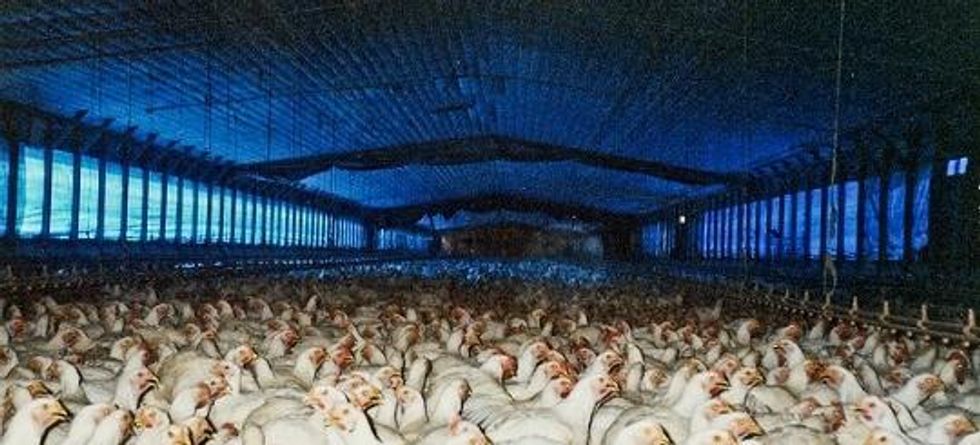
The report, Industrial Food Animal Production in America: Examining the Impact of the Pew Commission's Priority Recommendations, is a follow-up five years after a Pew Commission issued a series of recommendations to address the detrimental impact of industrial food animal production (IFAP) on public, animal, and environmental health.
"There has been an appalling lack of progress," said Robert S. Lawrence, MD, director of CLF. "The failure to act by the USDA and FDA, the lack of action or concern by the Congress, and continued intransigence of the animal agriculture industry have made all of our problems worse."
Half of the 24 recommendations made by the April 2008 panel fell under the umbrella of public health concerns with five of those dealing with antimicrobial use in livestock, which has gross consequences for the efficacy of antibiotics in humans. The FDA estimates that 80 percent of the antibiotics sold in this country are fed to food animals.
According to the report, Congress has killed every effort to legislate a ban on feeding farm animals antibiotics that are important in human medicine. As Reuters explains:
While the U.S. Food and Drug Administration has altered its guidelines to say antibiotics should be used only under the guidance of a veterinarian for prevention, control or treatment of disease, the Johns Hopkins report said there was a loophole. Drugs can be approved for disease prevention on the proviso that they are not being used as part of livestock production.
"This means that while antimicrobial approvals may change... antimicrobial use may not," notes the report.
The authors note that "despite the sizable body of literature supportive of a decision to eliminate antimicrobial use outside the context of veterinarian-diagnosed disease," since the initial recommendations to restrict their usage "little progress has been made to change the patterns of use."
Further, the report notes that under the Obama administration there has been scant improvement in the food animal production industry as a whole.
"In fact," they write, "regulatory agencies in the administration have acted regressively in their decision-making and policy-setting procedures."
The report singles out the House of Representatives for stepping up the "intensity of its attacks on avenues for reform and stricter enforcement of existing regulations, paving the way for industry avoidance of scrutiny and even deregulation, masked as protection of the inappropriately termed 'family farmer.'"
Further, the report notes that regulation tactics have shifted to "the implementation of policies such as 'ag-gag,' agricultural certainty and right-to-farm laws, all of which are designed to further shield unsavory industry practices from the eye of the public and the intervention of regulators."
"In 2008, the recommendations were heralded by many in the agriculture community, the agencies and Congress as the catalyst they needed to make vital changes to a food supply that has been criticized as unsustainable and in some cases unsafe," said Bob Martin with the Pew Commission on Industrial Farm Animal Production (PCIFAP) which released the initial report. "Inaction was inexcusable five years ago, now it is unconscionable."
_____________________
If you're one of the 91 percent of Americans who opposes genetically engineered (GE) meat, you may have limited time to act: The Food and Drug Administration (FDA) has proposed approval of the first-ever GE animal, called "AquAdvantage Salmon." If this first approval proceeds, the process is likely to become top secret in the future: we won't find out about new GE animals until after they're approved for human consumption, and they won't be labeled.
If you're one of the 91 percent of Americans who opposes genetically engineered (GE) meat, you may have limited time to act: The Food and Drug Administration (FDA) has proposed approval of the first-ever GE animal, called "AquAdvantage Salmon." If this first approval proceeds, the process is likely to become top secret in the future: we won't find out about new GE animals until after they're approved for human consumption, and they won't be labeled. Welcome to the new world of genetically engineered meat -- unless we act now.
The Process
The problems begin with FDA's bizarre decision to consider GE meat using its "New Animal Drug Approval" (NADA) process, a process designed for evaluation of new animal drugs (hence the name), not genetically engineered animals. The GE salmon themselves are, according to this analysis, the animal drug. As food blogger Ari LeVaux explains on Civil Eats, "the drug per se is AquaBounty's patented genetic construct... Inserted at the animal's one-cell stage, the gene sequence exists in every cell of the adult fish's body."
Of course, NADA was not designed to analyze the human health or environmental consequences of new animal drugs, and because the animals are the drugs in this process, their welfare is also ignored. In all three areas, there is ample reason for concern.
Human Health
Since they aren't consumed by humans, new animal drugs are not evaluated for their human health impact, so perhaps it's unsurprising that FDA's analysis in this area has been almost nonexistent. Health and consumer rights advocates have raised alarms, noting among other concerns, that: 1) these animals will require massive doses of antibiotics to keep them alive in dirty, crowded aquaculture conditions, and we don't know these antibiotics' effect on human health; 2) the limited testing that has been conducted was carried out by or for AquaBounty and included shockingly small sample sizes; and 3) what studies have been done indicated increased allergic potential and increased levels of the hormone IGF-1, which is linked to various cancers -- an outcome ignored in FDA's approval according to the Consumers Union, Food & Water Watch, and the Center for Food Safety.
Our Environment
The process of examining new drugs' environmental impact is also lax, so it's also not surprising that FDA bungled this analysis as well. As just one glaring example, the agency looked only at how one small pilot project in Canada and Panama will affect U.S. waters, ignoring its legal obligations to consider the likelihood of salmon escaping as the pilot program expands--an expansion the company has already announced. Similarly, FDA suggests that the GE salmon's lack of fear and rapacious appetite means that they could not survive escape. Another possibility, ignored by FDA and feared by environmental groups including Friends of the Earth, is that escapees would "wreak havoc on the ecosystem." The Center for Food Safety (CFS) points out that every year "millions of farmed salmon escape, outcompeting wild populations for resources and straining ecosystems." Regarding GE salmon, CFS continues: "Research published in the Proceedings of the National Academy of Sciences notes that a release of just sixty GE salmon into a wild population of 60,000 would lead to the extinction of the wild population in less than 40 fish generations." FDA totally ignores this scenario and its vast implications for our aquatic ecosystems.
Animal Welfare
Animal welfare is the one area where we might expect NADA to do a passable job because the process is supposed to guarantee drug safety in the target animal. Sadly, FDA ignored animal welfare in its decision to recommend approval of GE meat, perhaps because it considers the GE animals to be drugs, not animals. In 2010, the American Anti-Vivisection Society and Farm Sanctuary detailed more than a dozen concerns with the AquAdvantage salmon, any one of which should have precluded approval. Yet, in its proposal, FDA ignored animal welfare concerns entirely.
Here are just a few of our concerns, none of which were addressed in FDA's proposal:
Brave New World
The scariest thing about approving GE animals through NADA is that once a type of technological drug advance is approved (here, genetic animal engineering), future approvals become much easier and much less transparent: the process that protects corporate drug development secrets will protect the GE process, resulting in reduced scrutiny and no transparency at all for future approvals. The American public will probably not even find out about future GE animals until after they're approved for sale. As Friends of the Earth notes, FDA's approval "will open the floodgates for other genetically engineered animals, including pigs and cows, to enter the food supply."
Conclusion
FDA's process for approving genetically engineered meat is rotten to the core, and the effects of such a bad process on human health, our environment, and animals cannot be overstated. In the 2010 process, FDA received more than 400,000 comments and letters from more than 300 health, consumer advocacy, environmental, animal protection, and other organizations. All were ignored. We have one more chance before litigation becomes necessary. Click here to take action.
More and more people are realizing that our food chain is in crisis. Agribusiness has made profits more important than your health -- more important than the environment -- and more important than your right to know how your food is produced.
The United States now spends nearly 20 percent of GDP on health care, but levels of obesity, diabetes and chronic illness are higher than ever.
Perhaps because so many people are suffering, beneath the surface, a revolution has been building.
From rural farms to urban dinner plates, from grocery store shelves to state ballot boxes, ever more people are finding their voices and taking action. If you believe in taking responsibility for your health, if you believe there is an important link between the quality of the food you eat and the quality of your life, you are part of this movement.
In the seven years after my dad and colleague, John Robbins, released the first edition of his landmark bestseller Diet for a New America in 1987, beef consumption in the United States dropped by 19 percent. The National Cattlemen's Association, not pleased, pointedly blamed Diet For A New America. Since then, beef consumption has continued to slowly drop, while organic food sales have increased over 26-fold, to now exceed four percent of market share.
This month marks the release of the 25th anniversary edition of Diet For A New America, and it couldn't come at a more opportune time. People are taking an increasing interest in the way that the animals raised for food are treated. In fact, a poll conducted by Lake Research partners found that 94 percent of Americans agree that animals raised for food on farms deserve to be free from cruelty. Nine U.S. states have now joined the entire European Union in banning gestational crates for pigs, and Australia's two largest supermarket chains now sell only cage-free eggs in their house brands.
The demand is growing for food that is organic, sustainable, fair trade, GMO-free, humane, and healthy. In cities around the world, we're seeing more and more farmer's markets (a nearly three-fold increase in the last decade), and more young people getting back into farming. Grocery stores (even big national chains) are displaying local, natural and organic foods with pride. The movements for healthy food are growing fast, and starting to become a political force.
Earlier this year, California voters put an initiative on the ballot that called would have mandated the labeling of food containing GMOs. Monsanto and their buddies in the pesticide and junk food business were forced to spend $46 million burying California's voters under an avalanche of deception in order to narrowly defeat California's Proposition 37 in the November election. Although they won the battle, more than six million California voters had come out in favor of the "right to know." It was clear that the natural foods movement was becoming a political force to be reckoned with.
Now organizers in 30 other states have begun building GMO labeling campaigns, and efforts to improve treatment of animals, to make factory farms pay for the pollution they produce, and to reform the food offered in school lunches are all gaining strength.
What You Can Do
Go to the movies. Eric Schlosser's Food, Inc., Drs. Caldwell Esslestyn and T. Colin Campbell's Forks Over Knives, and Jeffrey Smith's Genetic Roulette are some of the most popular and insightful films currently on the market.
Boycott the bad guys. Many people are choosing to boycott companies that oppose labeling of GMOs, that treat farm animals cruelly, or that profit from the sale of junk food. Other consumers are choosing to buy from the good guys. For example, the non-profit Non-GMO Project, which offers a third party certification program, has now verified 764 products, and had a record-shattering 189 new enrollment inquiries in October. You can also check out the farmer's market nearest you.
Sign petitions for GMO labeling. Want to work for policy change? A team of organizations, led by Care2 and the Food Revolution Network, have launched a petition demanding that Congress label GMOs, and it has already generated more than 65,000 signatures. And last year's JustLabelIt petition to the FDA, which generated more than 1.3 million signatures, is being revived in hopes that the FDA might eventually dig itself out of Monsanto's back pocket.
Get politically engaged. For the passionate activist, there's always more you can do, like lobbying your member of Congress, your mayor, your governor, your local media outlets, or your relatives. You can also join the Humane Society's campaign for farm animal protection, or Farm Sanctuary's work for animal welfare legislation.
Get engaged and informed. For a directory of organizations working for healthy, sustainable and humane food, as well as free access to dozens of cutting edge articles and tools to help you make a difference, you can join the Food Revolution Network. Or check out the newly released 25th anniversary edition of Diet for a New America, the book that helped to launch the modern food movement.
Big agribusiness would probably like us all to sit alone in the dark, munching on highly processed, genetically engineered, chemical-laden, pesticide-contaminated pseudo-foods. But the tide of history is turning, and regardless of how much they spend attempting to maintain their hold on our food systems, more and more people are saying No to foods that lead to illness, and YES to foods that help us heal.
In one of history's most stunning victories for humane farming, Australia's largest supermarket chain, Coles, will as of January 1 stop selling company branded pork and eggs from animals kept in factory farms. As an immediate result, 34,000 mother pigs will no longer be kept in stalls for long periods of their lives, and 350,000 hens will be freed from cages.
Not to be outdone, the nation's other dominant supermarket chain, Woolworths, has already begun phasing out factory farmed animal products. In fact all of Woolworth's house brand eggs are now cage-free, and by mid-2013 all of their pork will come from farmers who operate stall-free farms.
Coles and Woolworths together account for a dominant 80 percent of all supermarket sales in Australia.
The move to open up the cages was fueled by "consumer sentiment," and it has been synchronous with a major campaign against factory farming of animals led by Animals Australia. The campaign features a TV ad, titled "When Pigs Fly," in which an adorable piglet tells the story of animals sentenced to life in cramped cages, and then flies to freedom.
Meanwhile, in the United States, egg factory farms cram more than 90 percent of the country's 280 million egg-laying hens into barren cages so small the birds can't even spread their wings. Each bird spends her entire life given less space than a sheet of paper. And in a reality that does not please fans of Wilber or Babe, between 60 to 70 percent of the more than five million breeding pigs in the United States are kept in crates too small for them to so much as turn around.
There are laws against cruelty to animals in the United States, but most states specifically exempt animals destined for human consumption. The result is that the animal agriculture industry routinely does things to animals that, if you did them to a dog or a cat, would get you put in jail.
Gene Baur, president of Farm Sanctuary, explains: "Most of the anti-cruelty laws exempt farm animals as long as the practices are considered to be normal by the agriculture industry. What has happened is that bad has become normal, and no matter how cruel it is, normal is legal."
But here, too, change is coming. Undercover investigations have led to a $497 million judgment against the now defunct Hallmark Meat Packing company, and to the recent temporary shutdown of Central Valley Meat Company over what federal investigators termed "egregious, inhumane handling and treatment of livestock." California and Michigan have passed laws that will phase in a ban on battery cages for hens, and nine U.S. states have joined the entire European Union in heading towards a ban on confining pigs in gestation crates.
Worried that consumers are starting to find out the truth about treatment of modern farm animals and will demand further changes, industry leaders are pushing for "ag gag" laws that would hide factory farming and slaughterhouse abuses from public scrutiny. Recently passed laws in Iowa and Utah threaten jail time for anyone working undercover and taking pictures or video of animals in factory farms without permission.
What don't they want us to know? What are they trying to hide? What would happen if the veil was lifted and we saw the level of cruelty that has become the norm in U.S. industrial meat production?
A poll conducted by Lake Research partners found that 94 percent of Americans agree that animals raised for food on farms deserve to be free from abuse and cruelty, and that 71 percent of Americans support undercover investigative efforts by animal welfare organizations to expose animal abuse on industrial farms.
Most farmers don't try to be cruel to animals, but they do worry about how to cut costs. And so long as consumers are kept in the dark about the real source of their food, farm owners have no economic incentive to do more than the minimum necessary to appease regulatory authorities.
Want to take action? Join the Food Revolution Network, an online community dedicated to healthy, sustainable, humane and delicious food for all.
Or join the Humane Society's campaign for farm animal protection, or Farm Sanctuary's work for animal welfare legislation. Or if you want to save 100 animals per year, you can sign up for PETA's free veg starter kit.