5
#000000
#FFFFFF
To donate by check, phone, or other method, see our More Ways to Give page.
Daily news & progressive opinion—funded by the people, not the corporations—delivered straight to your inbox.

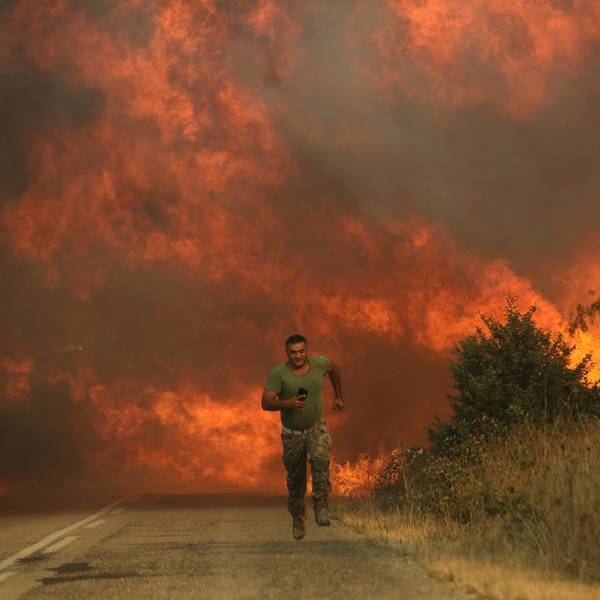
Flames and thick smoke rise from a forest fire in Adana, Türkiye, as firefighting efforts continue on September 8, 2026.
"The climate crisis is here, and the frequency and severity of extreme weather events are increasing day by day," said 350.org's Türkiye manager.
Scientists have long warned that the fossil fuel-driven climate crisis means more frequent and destructive wildfires, and blazes raging in Türkiye this week have sparked a fresh call to rapidly phase out planet-heating coal, gas, and oil.
As firefighters battled blazes in three southern Turkish provinces, Efe Baysal, Türkiye manager at the global advocacy group 350.org, pointed out that the country is set to host the next United Nations Climate Change Conference, COP31.
"In November, the world will gather in Antalya for COP31 to discuss the steps that must be taken against the climate crisis," Baysal said in a Wednesday statement. "Today, however, that same city is battling an uncontrollable wildfire that began in Aksu district of Antalya and spread throughout the region. Reports of fires are also coming in from Adana and Mersin."
"Our prayers are with those fighting the blazes on the ground to defend life," he continued. "The wildfires occurring primarily in Antalya demonstrate this truth once again: Rising temperatures create the conditions for fires to start more easily, spread faster, and become more destructive. The climate crisis is here, and the frequency and severity of extreme weather events are increasing day by day."
Baysal said that "assuming the COP31 presidency, Türkiye's responsibility is even more crucial. At COP31, Türkiye should aim to produce concrete outcomes to advance the transition away from fossil fuels. To make this leadership credible, Türkiye should announce a timeline for a phaseout of coal without delay."
"It should initiate a just transition to renewable energy that will reduce our dependence on coal, oil, and gas," he added. "It is not enough merely to respond to the consequences of the climate crisis. We must eliminate the causes that exacerbate it. COP31 is an opportunity for Türkiye to demonstrate true leadership in this direction."
Previous UN summits on the planetary crisis have ended in deep disappointment, with critics calling the "empty deal" that came out of COP30 in Brazil last year "a stark reminder that the answers to the climate crisis do not lie inside the climate talks," and, a year earlier, blasting COP29 in Azerbaijan as "a dumpster fire" and "a big F U to climate justice, to the poorest communities who are on the frontlines of climate breakdown."
Since those summits, there has been a constant stream of events that have fueled fears of a hotter world—and United Nations scientists are now warning that preventing at least a temporary temperature rise above 1.5°C, relative to preindustrial levels, is not possible, but humanity can still limit the damage by dramatically lowering emissions.
"This summer's scorching heat, raging wildfires, and deadly floods are a warning of what lies ahead," UN Secretary-General António Guterres said last week. "We must make the overshoot above 1.5 degrees as small and short as possible."
The fires in Türkiye have already proven deadly. The Aksu district mayor, Isa Yildirim, said on social media that one person died after suffering a heart attack during the fire there.
That blaze has also caused injuries. Citing the Turkish Anadolu Agency, The Associated Press reported that "two people were hospitalized with injuries to their legs while six others affected by smoke were treated on site."
As Deutsche Presse-Agentur detailed Wednesday:
Forest fires are common in Turkey in the summer months, fueled by long periods of drought and strong winds.
Cihan Erdönmez, an expert at Istanbul University, said triggers for the fires were often poorly maintained power lines running through forests.
Forestry Minister İbrahim Yumaklı said there had been more than 5,000 forest fires in Turkey in 2025 and 96% of them were directly or indirectly caused by humans.
Meanwhile, 350.org called the current blazes "a reminder that a hotter, drier climate will continue to exact its toll on ordinary people unless leaders act urgently to phase out fossil fuels."
Dear Common Dreams reader, It’s been nearly 30 years since I co-founded Common Dreams with my late wife, Lina Newhouser. We had the radical notion that journalism should serve the public good, not corporate profits. It was clear to us from the outset what it would take to build such a project. No paid advertisements. No corporate sponsors. No millionaire publisher telling us what to think or do. Many people said we wouldn't last a year, but we proved those doubters wrong. Together with a tremendous team of journalists and dedicated staff, we built an independent media outlet free from the constraints of profits and corporate control. Our mission has always been simple: To inform. To inspire. To ignite change for the common good. Building Common Dreams was not easy. Our survival was never guaranteed. When you take on the most powerful forces—Wall Street greed, fossil fuel industry destruction, Big Tech lobbyists, and uber-rich oligarchs who have spent billions upon billions rigging the economy and democracy in their favor—the only bulwark you have is supporters who believe in your work. But here’s the urgent message from me today. It's never been this bad out there. And it's never been this hard to keep us going. At the very moment Common Dreams is most needed, the threats we face are intensifying. We need your support now more than ever. We don't accept corporate advertising and never will. We don't have a paywall because we don't think people should be blocked from critical news based on their ability to pay. Everything we do is funded by the donations of readers like you. When everyone does the little they can afford, we are strong. But if that support retreats or dries up, so do we. Will you donate now to make sure Common Dreams not only survives but thrives? —Craig Brown, Co-founder |
Scientists have long warned that the fossil fuel-driven climate crisis means more frequent and destructive wildfires, and blazes raging in Türkiye this week have sparked a fresh call to rapidly phase out planet-heating coal, gas, and oil.
As firefighters battled blazes in three southern Turkish provinces, Efe Baysal, Türkiye manager at the global advocacy group 350.org, pointed out that the country is set to host the next United Nations Climate Change Conference, COP31.
"In November, the world will gather in Antalya for COP31 to discuss the steps that must be taken against the climate crisis," Baysal said in a Wednesday statement. "Today, however, that same city is battling an uncontrollable wildfire that began in Aksu district of Antalya and spread throughout the region. Reports of fires are also coming in from Adana and Mersin."
"Our prayers are with those fighting the blazes on the ground to defend life," he continued. "The wildfires occurring primarily in Antalya demonstrate this truth once again: Rising temperatures create the conditions for fires to start more easily, spread faster, and become more destructive. The climate crisis is here, and the frequency and severity of extreme weather events are increasing day by day."
Baysal said that "assuming the COP31 presidency, Türkiye's responsibility is even more crucial. At COP31, Türkiye should aim to produce concrete outcomes to advance the transition away from fossil fuels. To make this leadership credible, Türkiye should announce a timeline for a phaseout of coal without delay."
"It should initiate a just transition to renewable energy that will reduce our dependence on coal, oil, and gas," he added. "It is not enough merely to respond to the consequences of the climate crisis. We must eliminate the causes that exacerbate it. COP31 is an opportunity for Türkiye to demonstrate true leadership in this direction."
Previous UN summits on the planetary crisis have ended in deep disappointment, with critics calling the "empty deal" that came out of COP30 in Brazil last year "a stark reminder that the answers to the climate crisis do not lie inside the climate talks," and, a year earlier, blasting COP29 in Azerbaijan as "a dumpster fire" and "a big F U to climate justice, to the poorest communities who are on the frontlines of climate breakdown."
Since those summits, there has been a constant stream of events that have fueled fears of a hotter world—and United Nations scientists are now warning that preventing at least a temporary temperature rise above 1.5°C, relative to preindustrial levels, is not possible, but humanity can still limit the damage by dramatically lowering emissions.
"This summer's scorching heat, raging wildfires, and deadly floods are a warning of what lies ahead," UN Secretary-General António Guterres said last week. "We must make the overshoot above 1.5 degrees as small and short as possible."
The fires in Türkiye have already proven deadly. The Aksu district mayor, Isa Yildirim, said on social media that one person died after suffering a heart attack during the fire there.
That blaze has also caused injuries. Citing the Turkish Anadolu Agency, The Associated Press reported that "two people were hospitalized with injuries to their legs while six others affected by smoke were treated on site."
As Deutsche Presse-Agentur detailed Wednesday:
Forest fires are common in Turkey in the summer months, fueled by long periods of drought and strong winds.
Cihan Erdönmez, an expert at Istanbul University, said triggers for the fires were often poorly maintained power lines running through forests.
Forestry Minister İbrahim Yumaklı said there had been more than 5,000 forest fires in Turkey in 2025 and 96% of them were directly or indirectly caused by humans.
Meanwhile, 350.org called the current blazes "a reminder that a hotter, drier climate will continue to exact its toll on ordinary people unless leaders act urgently to phase out fossil fuels."
Scientists have long warned that the fossil fuel-driven climate crisis means more frequent and destructive wildfires, and blazes raging in Türkiye this week have sparked a fresh call to rapidly phase out planet-heating coal, gas, and oil.
As firefighters battled blazes in three southern Turkish provinces, Efe Baysal, Türkiye manager at the global advocacy group 350.org, pointed out that the country is set to host the next United Nations Climate Change Conference, COP31.
"In November, the world will gather in Antalya for COP31 to discuss the steps that must be taken against the climate crisis," Baysal said in a Wednesday statement. "Today, however, that same city is battling an uncontrollable wildfire that began in Aksu district of Antalya and spread throughout the region. Reports of fires are also coming in from Adana and Mersin."
"Our prayers are with those fighting the blazes on the ground to defend life," he continued. "The wildfires occurring primarily in Antalya demonstrate this truth once again: Rising temperatures create the conditions for fires to start more easily, spread faster, and become more destructive. The climate crisis is here, and the frequency and severity of extreme weather events are increasing day by day."
Baysal said that "assuming the COP31 presidency, Türkiye's responsibility is even more crucial. At COP31, Türkiye should aim to produce concrete outcomes to advance the transition away from fossil fuels. To make this leadership credible, Türkiye should announce a timeline for a phaseout of coal without delay."
"It should initiate a just transition to renewable energy that will reduce our dependence on coal, oil, and gas," he added. "It is not enough merely to respond to the consequences of the climate crisis. We must eliminate the causes that exacerbate it. COP31 is an opportunity for Türkiye to demonstrate true leadership in this direction."
Previous UN summits on the planetary crisis have ended in deep disappointment, with critics calling the "empty deal" that came out of COP30 in Brazil last year "a stark reminder that the answers to the climate crisis do not lie inside the climate talks," and, a year earlier, blasting COP29 in Azerbaijan as "a dumpster fire" and "a big F U to climate justice, to the poorest communities who are on the frontlines of climate breakdown."
Since those summits, there has been a constant stream of events that have fueled fears of a hotter world—and United Nations scientists are now warning that preventing at least a temporary temperature rise above 1.5°C, relative to preindustrial levels, is not possible, but humanity can still limit the damage by dramatically lowering emissions.
"This summer's scorching heat, raging wildfires, and deadly floods are a warning of what lies ahead," UN Secretary-General António Guterres said last week. "We must make the overshoot above 1.5 degrees as small and short as possible."
The fires in Türkiye have already proven deadly. The Aksu district mayor, Isa Yildirim, said on social media that one person died after suffering a heart attack during the fire there.
That blaze has also caused injuries. Citing the Turkish Anadolu Agency, The Associated Press reported that "two people were hospitalized with injuries to their legs while six others affected by smoke were treated on site."
As Deutsche Presse-Agentur detailed Wednesday:
Forest fires are common in Turkey in the summer months, fueled by long periods of drought and strong winds.
Cihan Erdönmez, an expert at Istanbul University, said triggers for the fires were often poorly maintained power lines running through forests.
Forestry Minister İbrahim Yumaklı said there had been more than 5,000 forest fires in Turkey in 2025 and 96% of them were directly or indirectly caused by humans.
Meanwhile, 350.org called the current blazes "a reminder that a hotter, drier climate will continue to exact its toll on ordinary people unless leaders act urgently to phase out fossil fuels."