SUBSCRIBE TO OUR FREE NEWSLETTER
Daily news & progressive opinion—funded by the people, not the corporations—delivered straight to your inbox.
5
#000000
#FFFFFF
To donate by check, phone, or other method, see our More Ways to Give page.
Daily news & progressive opinion—funded by the people, not the corporations—delivered straight to your inbox.
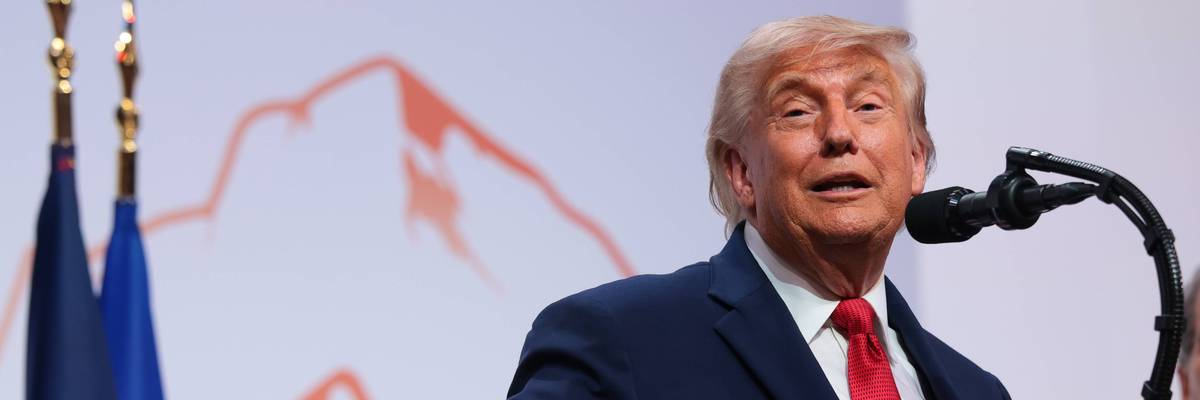
US President Donald Trump speaks at a press conference during the G7 Leaders' Summit on June 17, 2026 in Evian-les-Bains, France.
"Trump appears to return to the non-zero enrichment position," said one foreign policy analyst. "He should never have abandoned it."
Foreign policy analysts and peace advocates expressed relief Wednesday that the end of the unprovoked US-Israeli war on Iran could be in sight, as the US government released the text of the memorandum of understanding reached this week by the Trump administration and Iranian negotiators.
But observers noted that the text of the agreement and President Donald Trump's remarks at the Group of Seven meeting in France appeared to acknowledge how needless the war was—after 3,400 Iranians and thousands more people across the Middle East were killed by US and Israeli troops.
The memorandum of understanding (MOU) declares the "immediate and permanent termination of military operations on all fronts, including in Lebanon," where Israeli forces have killed more than 3,600 people since early March, allows a 60-day window to negotiate the final terms of the deal, and holds that Iran will "maintain the current status quo of its nuclear program," which Iranian officials have consistently said is not for military purposes.
"The United States of America will not impose any new sanctions and will not deploy additional forces in the region," says the MOU.
At the National Iranian American Council, policy director Ryan Costello rejected the commentary of some Trump opponents in Washington, DC who portrayed the deal as a surrender by the US, with some Democratic lawmakers scoffing at the deal's inclusion of a $300 billion reconstruction fund for Iran—where US and Israeli attacks have destroyed or damaged "100,000 housing units along with schools, hospitals, bridges, and other vital infrastructure."
"The core terms of the agreement are either mutually beneficial or have significant upside, even the ones being decried, denounced, and misportrayed," wrote Costello. "Time will tell if this memorandum can survive the caustic politics in Washington and Tehran that have accompanied any lessening of tensions between the US and Iran, and ultimately deliver relief that is sorely needed... Yet, what has been started is not a threat to American security, it is a threat to the Washington mindset that any US-Iran outcome is ultimately zero-sum and that Iran’s gain is an American loss. The US will benefit if our nation moves off the path of war with Iran. That will be accomplished by the memorandum and the steps that it entails."
In remarks to the press at the G7 summit, Trump addressed questions about how the MOU will stop Iran from developing a nuclear weapon—the key objective of the war, White House officials have repeatedly said. He issued a threat to "bomb them" if Iran does not refrain from developing a nuclear weapon, before indicating he had arrived at a viewpoint long pushed by opponents of the war and foreign policy experts.
"It is a little hard though, when you say that somebody wants it, other people have it, other adjoining states have it, and you're not letting them have it for purposes of electricity and things like that," the president said, referring to Iran's nuclear program.
Trump added that neighboring countries also have ballistic missiles, which Iran has long maintained it should be permitted to have as part of its national security arsenal.
"Today in things it would’ve been great to figure out before you started a war over them," said Matt Duss, executive vice president at the Center for International Policy.
Danny Citrinowicz, a Middle East policy expert, said: "It may have taken a long, costly, and complicated conflict, but the United States appears to have arrived at a conclusion that should have been evident from the start: Iran's missile program is not negotiable because it sits at the very core of the regime's security doctrine."
"Reasonable people can ask whether such a prolonged conflict was necessary to reach this conclusion," he said. "Yet it is better to recognize strategic realities late than never at all. Before events spiraled completely out of control, the US administration stepped back from maximalist objectives and returned to a more measured and realistic approach."
The president suggested that the planned official signing of the deal, scheduled for Friday, could still potentially fall through, and threatened to resume bombing if Iranian officials did not "behave."
He added that he will take credit for the agreement if it holds, and will blame Vice President JD Vance "if it doesn't."
Below is the text of the MOU:
The United States of America and the Islamic Republic of Iran have jointly agreed in good faith on [ __ date] on the following:
1 — The United States of America and the Islamic Republic of Iran and their allies in the current war are signing this MOU to declare the immediate and permanent termination of military operations on all fronts, including in Lebanon, and undertake from now on not to initiate any war or any military operation against each other, and to refrain from the threat or use of force against each other, and ensuring the territorial integrity and sovereignty of Lebanon. The final deal will confirm the permanent termination of the war on all fronts, including in Lebanon and other provisions of this paragraph.
2 — The United States of America and the Islamic Republic of Iran undertake to respect each other’s sovereignty and territorial integrity and to refrain from interfering in each other’s internal affairs.
3 — The United States of America and the Islamic Republic of Iran commit to negotiating and achieving the final deal in maximum 60 days, extendable with mutual consent.
4 — Immediately upon the signing of this MOU, the United States of America will begin the removal of its naval blockade and any disturbances or impediments against the Islamic Republic of Iran, and will fully end the naval blockade within 30 days. During this period, the traffic of vessels will be in proportion to the numbers of pre-war traffic being restored by the Islamic Republic of Iran. The United States of America further undertakes to remove its forces from the proximity of the Islamic Republic of Iran within 30 days after the final deal.
5 — Upon the signing of this MOU, the Islamic Republic of Iran will make arrangements using its best efforts for the safe passage of commercial vessels with no charge, for 60 days only, from the Persian Gulf to the Sea of Oman and vice versa. The traffic of commercial vessels will immediately start, and considering the need for removing the technical and military obstacles, and demining by the Islamic Republic of Iran will be instated within 30 days. The Islamic Republic of Iran will conduct dialog with the Sultanate of Oman to define the future administration and maritime services in the Strait of Hormuz in discussion with other Persian Gulf littoral states in line with the applicable international law and the sovereign rights of coastal states of the Strait of Hormuz.
6 — The United States of America undertakes with regional partners to develop a definitive, mutually agreed plan with at least USD 300 billion for the reconstruction and economic development of the Islamic Republic of Iran. The mechanism for the implementation of this plan will be finalized as part of a final deal within 60 days. All required licenses, waivers and permissions needed for the relevant financial transactions will be granted by the United States of America.
7 — The United States of America undertakes to terminate all types of sanctions against the Islamic Republic of Iran, including the United Nations Security Council resolutions, IAEA Board of Governors resolutions, and all unilateral US sanctions, primary and secondary, in an agreed upon schedule as part of the final deal. The Islamic Republic of Iran and the United States of America acknowledge the critical importance of the sanctions termination issue above mentioned, and expressed their intentions to immediately address these issues in the negotiations in order to achieve mutual agreement on them.
8 — The Islamic Republic of Iran reaffirms that it shall not procure or develop nuclear weapons. The United States of America and the Islamic Republic of Iran have agreed to resolve the disposition of stockpiled enriched material pursuant to a mechanism that will be mutually agreed upon in accordance with the schedule mentioned in paragraph seven, with the minimum methodology to be down blended on site under the supervision of the IAEA. The two parties also agreed to discuss the issue of enrichment and other mutually agreed matters related to the Islamic Republic of Iran’s nuclear needs, based on a satisfactory framework being agreed upon in the final deal. The final deal will confirm the provisions of this paragraph. The United States of America and the Islamic Republic of Iran acknowledge the critical importance of the nuclear issues above mentioned. They express their intention to immediately address these issues in the negotiations in order to achieve mutual agreement on them.
9 — Pending the final deal, the United States of America and the Islamic Republic of Iran agree to maintain the status quo. The Islamic Republic of Iran will maintain the current status quo of its nuclear program, and the United States of America will not impose any new sanctions and will not deploy additional forces in the region.
10 — The United States of America undertakes that immediately upon the signing of this MOU and until the termination of sanctions, US Department of Treasury will issue waivers for the export of Iranian crude oil, petroleum products and derivatives, and all associated services, including banking transactions, insurances, transportation, etc.
11 — The United States of America undertakes to make fully available for use the frozen or restricted funds and assets of the Islamic Republic of Iran upon the implementation of this MOU. The United States of America and the Islamic Republic of Iran will mutually agree on the procedures related to the release of these funds during negotiations. Such funds, whether retained in the original account or transferred, shall be made fully usable for payment to any ultimate beneficiary designated by the Central Bank of the Islamic Republic of Iran. The United States of America undertakes to issue all necessary licenses and authorizations accordingly.
12 — The United States of America and the Islamic Republic of Iran agree that an executive mechanism will be established to monitor the successful implementation of this MOU and the future compliance of the final deal.
13 — After signing this MOU, and subject to the beginning of the implementation of paragraphs 1, 4, 5, 10 and 11 of this MOU, and the continuing implementation of these measures, the United States of America and the Islamic Republic of Iran will start negotiations regarding the final deal exclusively on the other paragraphs.
14 — The final deal will be endorsed by a binding UNSC resolution.
Dear Common Dreams reader, It’s been nearly 30 years since I co-founded Common Dreams with my late wife, Lina Newhouser. We had the radical notion that journalism should serve the public good, not corporate profits. It was clear to us from the outset what it would take to build such a project. No paid advertisements. No corporate sponsors. No millionaire publisher telling us what to think or do. Many people said we wouldn't last a year, but we proved those doubters wrong. Together with a tremendous team of journalists and dedicated staff, we built an independent media outlet free from the constraints of profits and corporate control. Our mission has always been simple: To inform. To inspire. To ignite change for the common good. Building Common Dreams was not easy. Our survival was never guaranteed. When you take on the most powerful forces—Wall Street greed, fossil fuel industry destruction, Big Tech lobbyists, and uber-rich oligarchs who have spent billions upon billions rigging the economy and democracy in their favor—the only bulwark you have is supporters who believe in your work. But here’s the urgent message from me today. It's never been this bad out there. And it's never been this hard to keep us going. At the very moment Common Dreams is most needed, the threats we face are intensifying. We need your support now more than ever. We don't accept corporate advertising and never will. We don't have a paywall because we don't think people should be blocked from critical news based on their ability to pay. Everything we do is funded by the donations of readers like you. When everyone does the little they can afford, we are strong. But if that support retreats or dries up, so do we. Will you donate now to make sure Common Dreams not only survives but thrives? —Craig Brown, Co-founder |
Foreign policy analysts and peace advocates expressed relief Wednesday that the end of the unprovoked US-Israeli war on Iran could be in sight, as the US government released the text of the memorandum of understanding reached this week by the Trump administration and Iranian negotiators.
But observers noted that the text of the agreement and President Donald Trump's remarks at the Group of Seven meeting in France appeared to acknowledge how needless the war was—after 3,400 Iranians and thousands more people across the Middle East were killed by US and Israeli troops.
The memorandum of understanding (MOU) declares the "immediate and permanent termination of military operations on all fronts, including in Lebanon," where Israeli forces have killed more than 3,600 people since early March, allows a 60-day window to negotiate the final terms of the deal, and holds that Iran will "maintain the current status quo of its nuclear program," which Iranian officials have consistently said is not for military purposes.
"The United States of America will not impose any new sanctions and will not deploy additional forces in the region," says the MOU.
At the National Iranian American Council, policy director Ryan Costello rejected the commentary of some Trump opponents in Washington, DC who portrayed the deal as a surrender by the US, with some Democratic lawmakers scoffing at the deal's inclusion of a $300 billion reconstruction fund for Iran—where US and Israeli attacks have destroyed or damaged "100,000 housing units along with schools, hospitals, bridges, and other vital infrastructure."
"The core terms of the agreement are either mutually beneficial or have significant upside, even the ones being decried, denounced, and misportrayed," wrote Costello. "Time will tell if this memorandum can survive the caustic politics in Washington and Tehran that have accompanied any lessening of tensions between the US and Iran, and ultimately deliver relief that is sorely needed... Yet, what has been started is not a threat to American security, it is a threat to the Washington mindset that any US-Iran outcome is ultimately zero-sum and that Iran’s gain is an American loss. The US will benefit if our nation moves off the path of war with Iran. That will be accomplished by the memorandum and the steps that it entails."
In remarks to the press at the G7 summit, Trump addressed questions about how the MOU will stop Iran from developing a nuclear weapon—the key objective of the war, White House officials have repeatedly said. He issued a threat to "bomb them" if Iran does not refrain from developing a nuclear weapon, before indicating he had arrived at a viewpoint long pushed by opponents of the war and foreign policy experts.
"It is a little hard though, when you say that somebody wants it, other people have it, other adjoining states have it, and you're not letting them have it for purposes of electricity and things like that," the president said, referring to Iran's nuclear program.
Trump added that neighboring countries also have ballistic missiles, which Iran has long maintained it should be permitted to have as part of its national security arsenal.
"Today in things it would’ve been great to figure out before you started a war over them," said Matt Duss, executive vice president at the Center for International Policy.
Danny Citrinowicz, a Middle East policy expert, said: "It may have taken a long, costly, and complicated conflict, but the United States appears to have arrived at a conclusion that should have been evident from the start: Iran's missile program is not negotiable because it sits at the very core of the regime's security doctrine."
"Reasonable people can ask whether such a prolonged conflict was necessary to reach this conclusion," he said. "Yet it is better to recognize strategic realities late than never at all. Before events spiraled completely out of control, the US administration stepped back from maximalist objectives and returned to a more measured and realistic approach."
The president suggested that the planned official signing of the deal, scheduled for Friday, could still potentially fall through, and threatened to resume bombing if Iranian officials did not "behave."
He added that he will take credit for the agreement if it holds, and will blame Vice President JD Vance "if it doesn't."
Below is the text of the MOU:
The United States of America and the Islamic Republic of Iran have jointly agreed in good faith on [ __ date] on the following:
1 — The United States of America and the Islamic Republic of Iran and their allies in the current war are signing this MOU to declare the immediate and permanent termination of military operations on all fronts, including in Lebanon, and undertake from now on not to initiate any war or any military operation against each other, and to refrain from the threat or use of force against each other, and ensuring the territorial integrity and sovereignty of Lebanon. The final deal will confirm the permanent termination of the war on all fronts, including in Lebanon and other provisions of this paragraph.
2 — The United States of America and the Islamic Republic of Iran undertake to respect each other’s sovereignty and territorial integrity and to refrain from interfering in each other’s internal affairs.
3 — The United States of America and the Islamic Republic of Iran commit to negotiating and achieving the final deal in maximum 60 days, extendable with mutual consent.
4 — Immediately upon the signing of this MOU, the United States of America will begin the removal of its naval blockade and any disturbances or impediments against the Islamic Republic of Iran, and will fully end the naval blockade within 30 days. During this period, the traffic of vessels will be in proportion to the numbers of pre-war traffic being restored by the Islamic Republic of Iran. The United States of America further undertakes to remove its forces from the proximity of the Islamic Republic of Iran within 30 days after the final deal.
5 — Upon the signing of this MOU, the Islamic Republic of Iran will make arrangements using its best efforts for the safe passage of commercial vessels with no charge, for 60 days only, from the Persian Gulf to the Sea of Oman and vice versa. The traffic of commercial vessels will immediately start, and considering the need for removing the technical and military obstacles, and demining by the Islamic Republic of Iran will be instated within 30 days. The Islamic Republic of Iran will conduct dialog with the Sultanate of Oman to define the future administration and maritime services in the Strait of Hormuz in discussion with other Persian Gulf littoral states in line with the applicable international law and the sovereign rights of coastal states of the Strait of Hormuz.
6 — The United States of America undertakes with regional partners to develop a definitive, mutually agreed plan with at least USD 300 billion for the reconstruction and economic development of the Islamic Republic of Iran. The mechanism for the implementation of this plan will be finalized as part of a final deal within 60 days. All required licenses, waivers and permissions needed for the relevant financial transactions will be granted by the United States of America.
7 — The United States of America undertakes to terminate all types of sanctions against the Islamic Republic of Iran, including the United Nations Security Council resolutions, IAEA Board of Governors resolutions, and all unilateral US sanctions, primary and secondary, in an agreed upon schedule as part of the final deal. The Islamic Republic of Iran and the United States of America acknowledge the critical importance of the sanctions termination issue above mentioned, and expressed their intentions to immediately address these issues in the negotiations in order to achieve mutual agreement on them.
8 — The Islamic Republic of Iran reaffirms that it shall not procure or develop nuclear weapons. The United States of America and the Islamic Republic of Iran have agreed to resolve the disposition of stockpiled enriched material pursuant to a mechanism that will be mutually agreed upon in accordance with the schedule mentioned in paragraph seven, with the minimum methodology to be down blended on site under the supervision of the IAEA. The two parties also agreed to discuss the issue of enrichment and other mutually agreed matters related to the Islamic Republic of Iran’s nuclear needs, based on a satisfactory framework being agreed upon in the final deal. The final deal will confirm the provisions of this paragraph. The United States of America and the Islamic Republic of Iran acknowledge the critical importance of the nuclear issues above mentioned. They express their intention to immediately address these issues in the negotiations in order to achieve mutual agreement on them.
9 — Pending the final deal, the United States of America and the Islamic Republic of Iran agree to maintain the status quo. The Islamic Republic of Iran will maintain the current status quo of its nuclear program, and the United States of America will not impose any new sanctions and will not deploy additional forces in the region.
10 — The United States of America undertakes that immediately upon the signing of this MOU and until the termination of sanctions, US Department of Treasury will issue waivers for the export of Iranian crude oil, petroleum products and derivatives, and all associated services, including banking transactions, insurances, transportation, etc.
11 — The United States of America undertakes to make fully available for use the frozen or restricted funds and assets of the Islamic Republic of Iran upon the implementation of this MOU. The United States of America and the Islamic Republic of Iran will mutually agree on the procedures related to the release of these funds during negotiations. Such funds, whether retained in the original account or transferred, shall be made fully usable for payment to any ultimate beneficiary designated by the Central Bank of the Islamic Republic of Iran. The United States of America undertakes to issue all necessary licenses and authorizations accordingly.
12 — The United States of America and the Islamic Republic of Iran agree that an executive mechanism will be established to monitor the successful implementation of this MOU and the future compliance of the final deal.
13 — After signing this MOU, and subject to the beginning of the implementation of paragraphs 1, 4, 5, 10 and 11 of this MOU, and the continuing implementation of these measures, the United States of America and the Islamic Republic of Iran will start negotiations regarding the final deal exclusively on the other paragraphs.
14 — The final deal will be endorsed by a binding UNSC resolution.
Foreign policy analysts and peace advocates expressed relief Wednesday that the end of the unprovoked US-Israeli war on Iran could be in sight, as the US government released the text of the memorandum of understanding reached this week by the Trump administration and Iranian negotiators.
But observers noted that the text of the agreement and President Donald Trump's remarks at the Group of Seven meeting in France appeared to acknowledge how needless the war was—after 3,400 Iranians and thousands more people across the Middle East were killed by US and Israeli troops.
The memorandum of understanding (MOU) declares the "immediate and permanent termination of military operations on all fronts, including in Lebanon," where Israeli forces have killed more than 3,600 people since early March, allows a 60-day window to negotiate the final terms of the deal, and holds that Iran will "maintain the current status quo of its nuclear program," which Iranian officials have consistently said is not for military purposes.
"The United States of America will not impose any new sanctions and will not deploy additional forces in the region," says the MOU.
At the National Iranian American Council, policy director Ryan Costello rejected the commentary of some Trump opponents in Washington, DC who portrayed the deal as a surrender by the US, with some Democratic lawmakers scoffing at the deal's inclusion of a $300 billion reconstruction fund for Iran—where US and Israeli attacks have destroyed or damaged "100,000 housing units along with schools, hospitals, bridges, and other vital infrastructure."
"The core terms of the agreement are either mutually beneficial or have significant upside, even the ones being decried, denounced, and misportrayed," wrote Costello. "Time will tell if this memorandum can survive the caustic politics in Washington and Tehran that have accompanied any lessening of tensions between the US and Iran, and ultimately deliver relief that is sorely needed... Yet, what has been started is not a threat to American security, it is a threat to the Washington mindset that any US-Iran outcome is ultimately zero-sum and that Iran’s gain is an American loss. The US will benefit if our nation moves off the path of war with Iran. That will be accomplished by the memorandum and the steps that it entails."
In remarks to the press at the G7 summit, Trump addressed questions about how the MOU will stop Iran from developing a nuclear weapon—the key objective of the war, White House officials have repeatedly said. He issued a threat to "bomb them" if Iran does not refrain from developing a nuclear weapon, before indicating he had arrived at a viewpoint long pushed by opponents of the war and foreign policy experts.
"It is a little hard though, when you say that somebody wants it, other people have it, other adjoining states have it, and you're not letting them have it for purposes of electricity and things like that," the president said, referring to Iran's nuclear program.
Trump added that neighboring countries also have ballistic missiles, which Iran has long maintained it should be permitted to have as part of its national security arsenal.
"Today in things it would’ve been great to figure out before you started a war over them," said Matt Duss, executive vice president at the Center for International Policy.
Danny Citrinowicz, a Middle East policy expert, said: "It may have taken a long, costly, and complicated conflict, but the United States appears to have arrived at a conclusion that should have been evident from the start: Iran's missile program is not negotiable because it sits at the very core of the regime's security doctrine."
"Reasonable people can ask whether such a prolonged conflict was necessary to reach this conclusion," he said. "Yet it is better to recognize strategic realities late than never at all. Before events spiraled completely out of control, the US administration stepped back from maximalist objectives and returned to a more measured and realistic approach."
The president suggested that the planned official signing of the deal, scheduled for Friday, could still potentially fall through, and threatened to resume bombing if Iranian officials did not "behave."
He added that he will take credit for the agreement if it holds, and will blame Vice President JD Vance "if it doesn't."
Below is the text of the MOU:
The United States of America and the Islamic Republic of Iran have jointly agreed in good faith on [ __ date] on the following:
1 — The United States of America and the Islamic Republic of Iran and their allies in the current war are signing this MOU to declare the immediate and permanent termination of military operations on all fronts, including in Lebanon, and undertake from now on not to initiate any war or any military operation against each other, and to refrain from the threat or use of force against each other, and ensuring the territorial integrity and sovereignty of Lebanon. The final deal will confirm the permanent termination of the war on all fronts, including in Lebanon and other provisions of this paragraph.
2 — The United States of America and the Islamic Republic of Iran undertake to respect each other’s sovereignty and territorial integrity and to refrain from interfering in each other’s internal affairs.
3 — The United States of America and the Islamic Republic of Iran commit to negotiating and achieving the final deal in maximum 60 days, extendable with mutual consent.
4 — Immediately upon the signing of this MOU, the United States of America will begin the removal of its naval blockade and any disturbances or impediments against the Islamic Republic of Iran, and will fully end the naval blockade within 30 days. During this period, the traffic of vessels will be in proportion to the numbers of pre-war traffic being restored by the Islamic Republic of Iran. The United States of America further undertakes to remove its forces from the proximity of the Islamic Republic of Iran within 30 days after the final deal.
5 — Upon the signing of this MOU, the Islamic Republic of Iran will make arrangements using its best efforts for the safe passage of commercial vessels with no charge, for 60 days only, from the Persian Gulf to the Sea of Oman and vice versa. The traffic of commercial vessels will immediately start, and considering the need for removing the technical and military obstacles, and demining by the Islamic Republic of Iran will be instated within 30 days. The Islamic Republic of Iran will conduct dialog with the Sultanate of Oman to define the future administration and maritime services in the Strait of Hormuz in discussion with other Persian Gulf littoral states in line with the applicable international law and the sovereign rights of coastal states of the Strait of Hormuz.
6 — The United States of America undertakes with regional partners to develop a definitive, mutually agreed plan with at least USD 300 billion for the reconstruction and economic development of the Islamic Republic of Iran. The mechanism for the implementation of this plan will be finalized as part of a final deal within 60 days. All required licenses, waivers and permissions needed for the relevant financial transactions will be granted by the United States of America.
7 — The United States of America undertakes to terminate all types of sanctions against the Islamic Republic of Iran, including the United Nations Security Council resolutions, IAEA Board of Governors resolutions, and all unilateral US sanctions, primary and secondary, in an agreed upon schedule as part of the final deal. The Islamic Republic of Iran and the United States of America acknowledge the critical importance of the sanctions termination issue above mentioned, and expressed their intentions to immediately address these issues in the negotiations in order to achieve mutual agreement on them.
8 — The Islamic Republic of Iran reaffirms that it shall not procure or develop nuclear weapons. The United States of America and the Islamic Republic of Iran have agreed to resolve the disposition of stockpiled enriched material pursuant to a mechanism that will be mutually agreed upon in accordance with the schedule mentioned in paragraph seven, with the minimum methodology to be down blended on site under the supervision of the IAEA. The two parties also agreed to discuss the issue of enrichment and other mutually agreed matters related to the Islamic Republic of Iran’s nuclear needs, based on a satisfactory framework being agreed upon in the final deal. The final deal will confirm the provisions of this paragraph. The United States of America and the Islamic Republic of Iran acknowledge the critical importance of the nuclear issues above mentioned. They express their intention to immediately address these issues in the negotiations in order to achieve mutual agreement on them.
9 — Pending the final deal, the United States of America and the Islamic Republic of Iran agree to maintain the status quo. The Islamic Republic of Iran will maintain the current status quo of its nuclear program, and the United States of America will not impose any new sanctions and will not deploy additional forces in the region.
10 — The United States of America undertakes that immediately upon the signing of this MOU and until the termination of sanctions, US Department of Treasury will issue waivers for the export of Iranian crude oil, petroleum products and derivatives, and all associated services, including banking transactions, insurances, transportation, etc.
11 — The United States of America undertakes to make fully available for use the frozen or restricted funds and assets of the Islamic Republic of Iran upon the implementation of this MOU. The United States of America and the Islamic Republic of Iran will mutually agree on the procedures related to the release of these funds during negotiations. Such funds, whether retained in the original account or transferred, shall be made fully usable for payment to any ultimate beneficiary designated by the Central Bank of the Islamic Republic of Iran. The United States of America undertakes to issue all necessary licenses and authorizations accordingly.
12 — The United States of America and the Islamic Republic of Iran agree that an executive mechanism will be established to monitor the successful implementation of this MOU and the future compliance of the final deal.
13 — After signing this MOU, and subject to the beginning of the implementation of paragraphs 1, 4, 5, 10 and 11 of this MOU, and the continuing implementation of these measures, the United States of America and the Islamic Republic of Iran will start negotiations regarding the final deal exclusively on the other paragraphs.
14 — The final deal will be endorsed by a binding UNSC resolution.